If Xi Jinping moves to wind down the war in Ukraine, it won’t be out of concern for Ukrainian lives or the international order. It will be because a failing Russia is a liability he cannot afford heading into the most consequential Communist Party Congress of his tenure.
In yesterday’s World Briefing Plus, we made the case that the endgame in Ukraine may now run through Beijing rather than Washington or Moscow. A striking new analysis in Asia Times by veteran China-watcher Francesco Sisci supplies the missing piece: the calendar.
The Party Congress scheduled for autumn 2027 could be one of the most delicate in CPC history. Xi - who has purged the military’s political power to a degree no predecessor, including Mao, ever achieved - will use it to install a generation of younger cadres who owe him everything. What he cannot control is what happens on the battlefields between now and then.
Here’s the rub, in Sisci’s telling: the wars in Ukraine and the Middle East have so far served Beijing by keeping Washington distracted. But there is a real possibility that over the next year Russia or Iran - or both - will cave, becoming failed states or American allies. (we are not so sure that will happen). If it does, China becomes more isolated, and that reflects badly on Xi on the eve of the congress. Hence the conclusion: Beijing now has a self-interested reason to help pull the plug on both wars - and to claim the peacemaking credit if it does.
From where we sit in Odesa under skies darkened by drones and missiles, this is worth taking seriously - not because Beijing has suddenly discovered a conscience, but because self-interest is the only currency that has ever moved Chinese foreign policy. A ceasefire brokered, or merely blessed, by Beijing would hand Xi a diplomatic triumph, repair some of the damage his pro-Moscow tilt did to relations with Europe, and arrive gift-wrapped before his coronation congress.
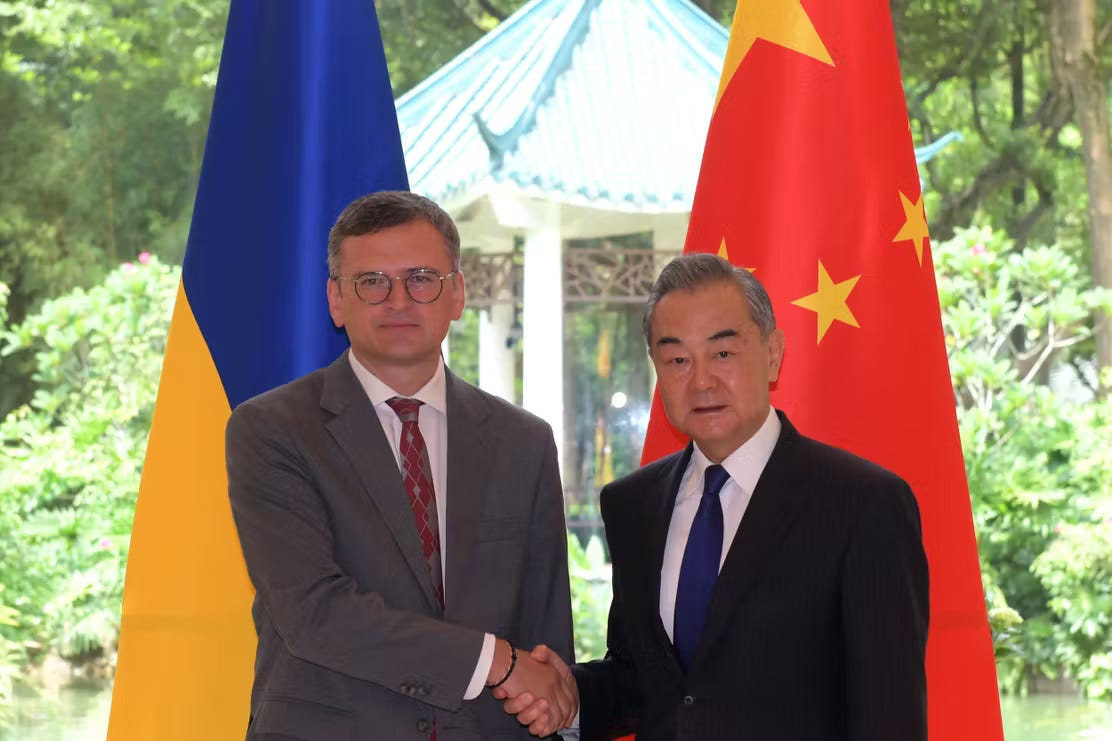
There's just one wrinkle in the peacemaker script: Xi has never once met the man whose war he'd be settling. In the nearly seven years since Zelensky took office - more than four of them under full-scale invasion - the two leaders have managed exactly one phone call, in April 2023. By then Xi had already spoken with Putin five times, twice in person. The channel hasn't been entirely dead below the top - our favourite former Ukrainian foreign minister Dmytro Kuleba made it to Guangzhou in July 2024 to see Wang Yi, only to be sacked by Zelensky weeks later - but ministers meeting is not leaders meeting. And that lone call came just days after China's ambassador in Paris caused an uproar across Europe by suggesting former Soviet republics - Ukraine included - have no status under international law, an unsubtle echo of Putin's view that Ukraine isn't a real country at all. A mediator who has embraced one belligerent, never shaken hands with the other, and let his diplomats question whether the second party legally exists isn't a broker. He's a second at the duel.
And make no mistake: a Chinese-brokered peace would come with a price tag. Expect Beijing to elbow its way into Ukraine’s rare earth and critical mineral deposits - among the largest untapped reserves in Europe - and to position its state firms at the front of the queue for a reconstruction effort that will run into the hundreds of billions. Peacemaker and prospector, in one visit.
But before anyone in Washington reaches for the smelling salts: is that really so different from what Trump and his circle pursued - and pursued openly? The minerals deal the White House extracted from Kyiv was transactional diplomacy stripped of all pretense: security assistance in exchange for a stake in Ukraine’s subsoil. If the price of peace is paid in titanium and lithium, Beijing would merely be reading from a playbook Washington wrote, published, and bragged about. Ukrainians noticed. So did the Global South.
Kyiv, of all capitals, knows - or should know - how Beijing plays when it holds the leverage. In June 2021, with Ukraine desperate for COVID vaccines after a late and fumbling procurement effort, it signed a Canada-led joint statement at the UN Human Rights Council - alongside more than 40 countries - calling for independent observers to be allowed into Xinjiang. Within 48 hours, Kyiv's signature was gone. The reason, as diplomats told the AP and Ukrainian lawmakers later confirmed to RFE/RL: Beijing had frozen the export paperwork on more than half a million Sinovac doses Ukraine had already paid for, and unfroze it the moment the signature came off. China denied any conditions were attached. The paperwork said otherwise. That is the negotiating culture Ukraine would be inviting to its peace table - and to its mineral deposits.
Which brings us back to accountability. Earlier this week we reported how Manila - armed with the pen, the anniversary of its arbitral victory, and the legal high ground - still couldn’t get China’s South China Sea conduct into ASEAN’s communiqué, and how Myanmar’s junta walked away from the same summit unscathed after rejecting the bloc’s peace plan outright. When Beijing polls better than Washington across much of the Global South, accountability has no constituency. A China that ends the Ukraine war on its own terms won't be a China converted to the rules-based order. It will be a China that has learned it can rewrite the rules - and be thanked for it. And the next classroom where that lesson gets applied has a name: Taiwan. If Ukraine's borders prove negotiable, many analysts warn, Taipei should assume its own are next - which is precisely why Beijing's selective devotion to "territorial integrity" deserves scrutiny before anyone hands it the gavel.
Sisci notes one more thing worth remembering: for all its dominance, China has no allies or friends among its neighbors - an atmosphere of isolation, fear, and suspicion surrounds it. Feared, not followed. That is the power now positioning itself to hold the keys to Europe’s largest war since 1945.
Watch this space.
A homemade bomb carried by a woman killed at least three people and injured 21 near an upscale restaurant in central Moscow on Saturday evening, authorities said, amid unconfirmed speculation on social media that the attack may have been linked to the war in Ukraine. The explosion occurred just before 8:00 p.m. close to an Italian restaurant located in one of Moscow’s seven Stalin-era skyscrapers at Kudrinskaya Ploshchad, the police said. Russia’s National Anti-Terrorism Committee (NAK) said an unidentified woman carrying an improvised explosive device had tried to get into the restaurant but had been stopped by a security guard. NAK said the woman, the guard and a customer at the Balzi Rossi Italian restaurant had been killed instantly in the blast that followed. REN TV cited a source on Sunday as saying that two people who had been taken to the hospital had later died of their wounds, bringing the death toll to five, though there was no official confirmation. REN TV said six people remained in a serious condition. Moscow Mayor Sergei Sobyanin on Sunday offered his condolences to the families of those killed and said those responsible would be punished. “A brutal terrorist attack was carried out in Moscow yesterday,” he said in a statement. The authorities did not name those killed or injured or any suspects. Unverified social media reports suggested that a top Russian military commander had been the intended target but had been unharmed. The restaurant’s website said the venue had been closed on Saturday for a private event - Moscow Times
US President Donald Trump’s decision to step back from his earlier pledge to allow Ukraine to manufacture Patriot missile interceptors has prompted renewed debate in Washington over the future direction of US military support for Kyiv. Congressman Don Bacon of Nebraska offered one of the strongest Republican criticisms of the move. Speaking to RFE/RL on July 31, Bacon, a senior Republican on the House Armed Services Committee, accused the White House of sending contradictory signals at a time when Ukraine faces an escalating Russian missile campaign and an acute shortage of Patriot interceptors. “While 70 percent of Americans support Ukraine, the policies of the White House make them appear to be in the 30 percent. Enabling the Ukrainians to build the Patriot would have helped relieve the shortage of interceptors we face today,” Bacon said. “I wish the president was more of a Reagan or Churchill when it comes to Russia,” he added. Bacon’s criticism came as Russia continued intensive strikes on Kyiv, increasing pressure on Ukraine’s already strained air-defense network. The comments also underscore a broader debate within Trump’s own political camp over how far Washington should go in supporting Ukraine against Russia. The dispute centers on Trump’s apparent reversal over Patriot production. During his recent meeting with Ukrainian President Volodymyr Zelenskyy, Trump had indicated that the United States would allow Ukraine to manufacture Patriot interceptors under license. Days later, however, speaking during a Cabinet meeting at Camp David, he said no agreement had been reached. “We have not agreed to that,” Trump said, describing such technology as “a hard thing to give away” and warning that recipients of advanced military technology could someday “turn on you.” The reversal is particularly significant because Patriot interceptors have become one of Ukraine’s most urgent military requirements as Russia increasingly relies on ballistic missile attacks. Shortages have been compounded by heavy US expenditure of interceptors in other conflicts, with analysts suggesting the Pentagon has already used roughly two-thirds of its Patriot inventory - RFE/RL

Upgrade via this link— and lock in 30% off an annual subscription to World Briefing Plus.
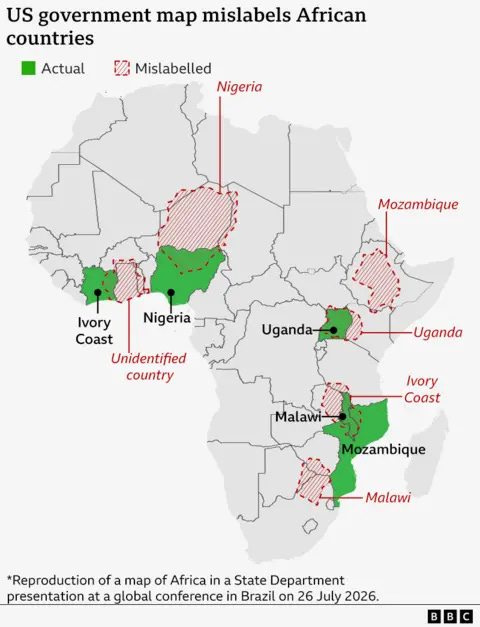
AI-Botched Africa Map Exposes Deeper Rot at State Department
A US State Department map of Africa that mislabeled every single country on the continent - reportedly AI-generated and presented at a global conference in Brazil — went viral this week among Africa policy specialists, drawing ridicule, embarrassment, and a formal apology from Foggy Bottom. But as Yinka Adegoke writes in Semafor Africa, the blunder matters less for what it was than for what it revealed. After 18 months of restructuring under the Trump administration, the department has shed an estimated one-fifth to one-third of its staff, and senior diplomatic representation across Africa has been hollowed out - including 37 vacant ambassadorships. “You can draw a straight line between the lack of 37 ambassadors and the map screw-up,” veteran US-Africa policy hand Witney Schneidman told Semafor, calling it evidence of understaffed vetting. The timing is awkward: Washington says it wants deeper African partnerships on critical minerals, security, and trade - while gutting the diplomatic infrastructure that makes those ambitions credible. Every vacancy and avoidable blunder, Adegoke argues, hands Beijing another opening to cast itself as the more consistent, attentive partner - and deepens doubts in African capitals that the continent is being taken as seriously as US rhetoric claims.
US President Donald Trump has lashed out after longtime ally Jeanine Pirro moved to drop charges against a former Olympian who had been accused of vandalising the Lincoln Memorial Reflecting Pool in Washington, DC. David Hearn, a former US Olympics Team canoeist, had been charged with vandalising the pool after a tear in the lining was discovered. He denied the charges, saying he had only stopped to touch the water. Pirro, the US Attorney for the District of Columbia, on Saturday moved in court for the charges to be dropped in a prosecutorial retreat after a government report found the apparent damage to the pool was likely due to botched installation work. “I disagree 100% with Jeanine Pirro, the US Attorney for the District of Columbia, on the Reflecting Pool. I don’t know what she was thinking?” Trump posted on Truth Social overnight. “To me, it was a pure case of VANDALISM, that included the grass, which had a big 86 47 emblazoned in giant letters on it, and other elements of the surrounding area. “There may have been some contractor difficulty, but the major damage was caused by VANDALS!” The report also found the hurried deadlines for the installation were a factor. “Damage to the Lincoln Memorial Reflecting Pool in June 2026 was the result of flawed installation by the contractor, Atlantic Industrial Coating,” Pirro, a Trump appointee and longtime loyalist, said in her motion, which asked a judge to formally dismiss the case. The pool, now currently drained, became a centrepiece of Trump’s second-term ambition to “beautify” Washington DC’s public monuments - Nine News
The journals…