Accountability requires a constituency, and China no longer has one in Southeast Asia. When Beijing polls better than Washington across most of the world - a recent Pew Research survey found that China is now seen more positively than the U.S. in most of 36 countries - the question is no longer whether ASEAN can hold China to account - it’s why any member would want to.
On paper, the Philippines came into its 2026 ASEAN chairmanship with everything a claimant state could ask for. It held the pen on the communiqué, had built new domestic legal infrastructure, secured bilateral partner commitments - and the foreign ministers’ meeting fell in the very week of the arbitral ruling's tenth anniversary - the landmark 2016 decision in the South China Sea Arbitration, final and binding under international law, that demolished Beijing's expansive maritime claims.
And yet, as a sharp new Asia Times analysis by risk analyst Lam Duc Vu lays out, the communiqué Manila produced is, on the South China Sea, functionally identical to the one Malaysia wrote the year before. A full decade on, the arbitral ruling remains absent from ASEAN’s consensus language.
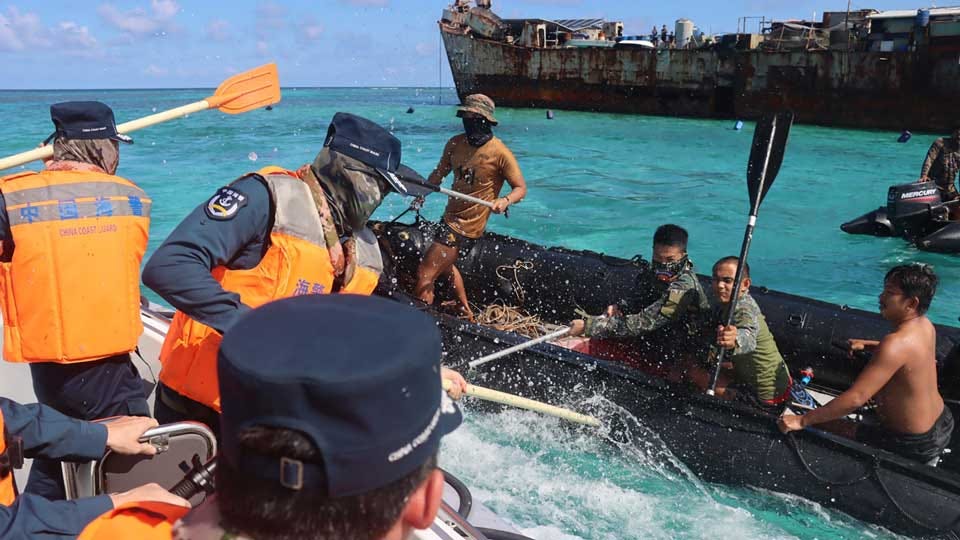
The timing could hardly have been crueler. On July 20 - the day before the meeting opened - Philippine and Chinese sailors clashed at Second Thomas Shoal. External partners condemned it. Not a single ASEAN member stood with the Philippines. Fourteen countries - Japan, Australia, the United States, a clutch of European states - reaffirmed the ruling as final and legally binding on its anniversary. No ASEAN member signed except the Philippines itself.
The conventional read is that ASEAN’s consensus machinery simply can’t process sovereignty disputes - and there’s truth in that. When the ruling was first issued in 2016 under Laos’s chairmanship, every proposed reference to it was blocked from the communiqué. A decade later, with the claimant state itself holding the pen, the result was the same.
This is not a new playbook. At the 2018 APEC leaders' summit in Port Moresby, Chinese diplomats are said to have stormed into the office of Papua New Guinea's foreign minister demanding changes to the summit's draft wording - an extraordinary breach that ended with police being called, and a summit that collapsed without a communiqué at all, a first in APEC's history. Beijing denied it, of course. But having spent time in PNG myself, I understand the leverage at work: the country receives enormous sums in Chinese money and infrastructure, and Beijing expected the language to reflect it. What played out crudely in Port Moresby in 2018 now operates smoothly across Southeast Asia - no stormed offices required. The dependencies do the talking.
But the machinery explanation misses the deeper shift. Consensus mechanisms don’t operate in a vacuum; they reflect where members believe their interests lie. And here the ground has moved decisively - as per the Pew Research findings.
Donald Trump, swinging his tariff baton once again, seems determined to prove the skeptics right. New Section 301 tariffs took effect on July 24 - the summit's closing day - slapping additional duties of 10 to 12.5 percent on seven ASEAN economies, including the Philippines. Punishing your ally with tariffs on the final day of the summit it's hosting is not statecraft; it's self-sabotage.
The doubt runs deeper than trade. I've covered the Philippines since my days as a South China Morning Post correspondent, and I've lost count of the ASEAN summits and ministerials I've reported from - enough to know when the ritual language is masking real movement. So when I was in Manila this spring and put a blunt question to top Philippine generals - do you now see being a treaty ally of the United States as a liability? - their inability or unwillingness to give me a straight answer registered.
This is the accountability trap in full view: holding a great power to account requires members willing to absorb Beijing’s displeasure, and a credible alternative partner to absorb it for. Right now, ASEAN has neither.
And we’ve seen this movie before - at this very summit. As World Briefing reported last week, ASEAN foreign ministers in Manila solemnly reaffirmed their Five-Point Consensus on Myanmar just after Naypyidaw’s junta-controlled parliament rejected the peace plan outright. Five years of “consensus,” publicly repudiated by its intended subject, and the bloc’s response was to restate it. Myanmar got away with it for the same reason China does: ASEAN’s unanimity rules mean the price of impunity is zero, and nobody in the room has an incentive to raise it.
The Philippines, to its credit, has read the room and built around it - a dedicated maritime law unit at the justice department, the ASEAN Maritime Centre, an expanded Coast Guard Forum, Australian drone support, Canadian maritime security support. But note where all of that lives: outside ASEAN consensus. Manila is constructing the legal and operational scaffolding to defend its claims regardless of whether its own regional bloc ever follows. That’s prudent. It’s also an indictment.
The bottom line: The 2016 ruling was supposed to be the moment international law caught up with Beijing in the South China Sea. Ten years later, the law is intact, the coalition endorsing it has never been larger - and the region it was written for won’t touch it. China hasn’t beaten the ruling in court. It’s beaten it in the court of regional opinion, with an assist from an America that keeps tariffing its friends. Accountability doesn’t die by veto. It dies by favorability rating.
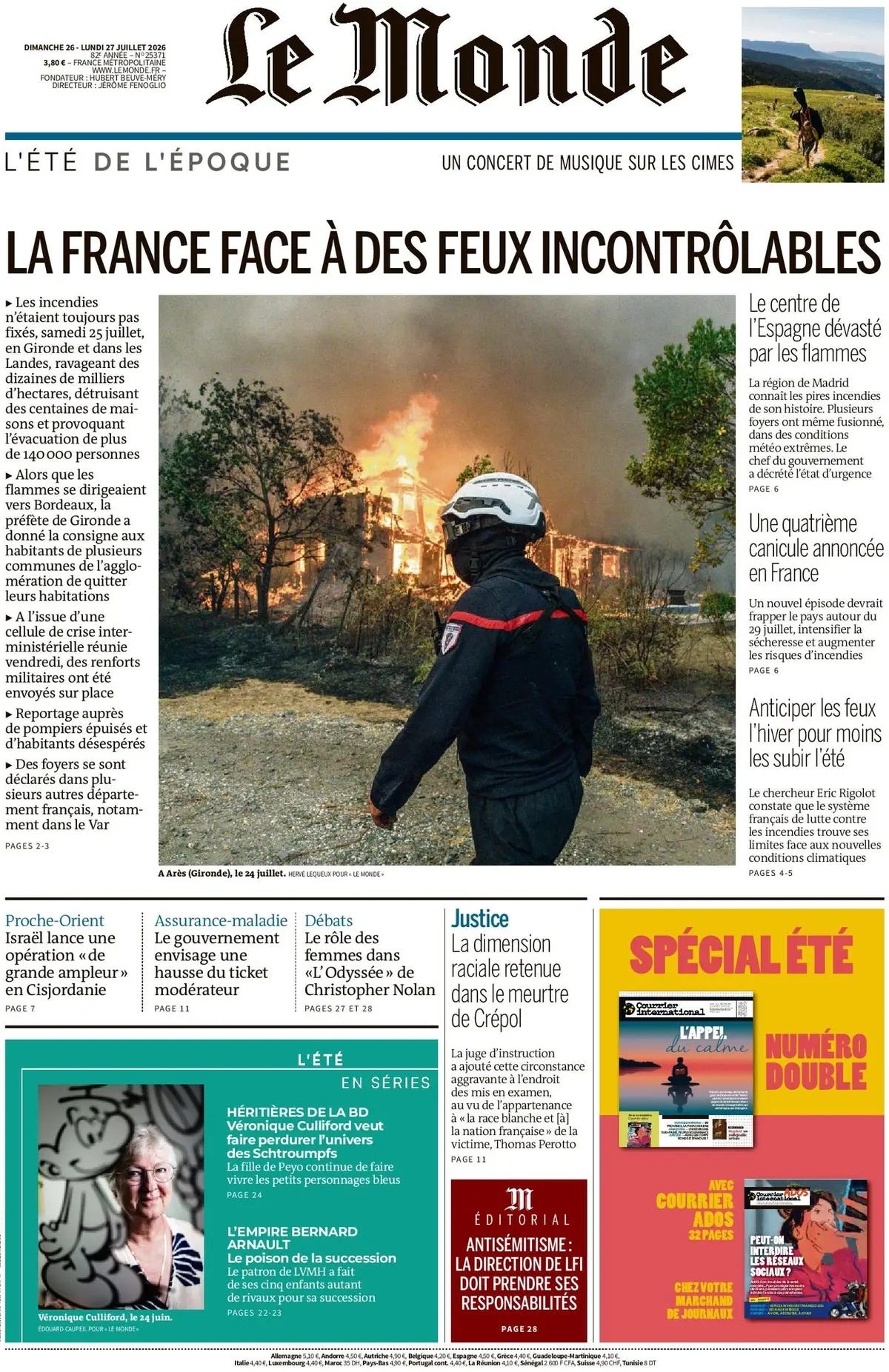
France’s interior minister has conceded what the smoke over Bordeaux already made plain: the Gironde wildfire has “a life of its own,” and firefighters are confronting what he called an “unprecedented situation,” the BBC reports. President Emmanuel Macron has arrived in the region to meet response teams — the obligatory presidential pilgrimage to the fire line — as the blaze burns roughly 15 kilometres from the outskirts of Bordeaux. Residents of France’s wine capital are, in the words of one, “anxious and fearful.” The mayor of Cestas, a town directly in the fire’s path south of the city, was blunter still, telling the BBC this “will be the fire of the century” and describing the scenes as “catastrophic.” The BBC’s correspondent on the ground reports flames leaping several feet into the air as crews struggle to hold containment lines; a British tourist in Gironde described acrid air and ash falling from the sky. The scale is continental. More than 300,000 people have now been evacuated across France and Spain, with satellite data showing fires spreading near both Bordeaux and Madrid. And the driver is no mystery: record-breaking heat is exacerbating the blazes, while climate change is making the hotter, drier conditions that let fires spread faster and burn more fiercely increasingly likely — a point the BBC’s climate desk underscores.
Russian Forces Systematically Used Sexual Torture Against Ukrainian POWs, Testimony Shows
Russian guards subjected Ukrainian prisoners of war to systematic sexualized torture over more than four years of full-scale war, according to survivor testimony reported by the Wall Street Journal and corroborated by United Nations investigators and Ukrainian prosecutors.
Serhii Boychuk, a 33-year-old Ukrainian soldier captured in 2022, told the Journal he was raped with bottles and sticks and threatened with genital mutilation during more than two years in Russian captivity. He still struggles to walk. Other former detainees described similar abuse, and their accounts align with findings from extensive interviews conducted by Ukrainian prosecutors, intelligence services and UN investigators.
The UN has gathered testimony in about 310 cases of alleged sexual violence by Russian forces, including rape, gang rape, genital mutilation, electric shocks and beatings to the genitals. Of the identified victims, 280 were men — a marked departure from most conflicts, where female civilians are the primary targets. Pramila Patten, the UN Secretary-General’s Special Representative on sexual violence in conflict, documented the abuse of Ukrainian men in Russian detention in her April report; freed prisoners undergo medical reviews and give recorded testimony upon exchange.
“I have listened to verbal and read direct testimony,” said Irena Yarosevych, a member of the UN representation team of the World Federation of Ukrainian Women’s Organizations, which has spent four years raising the issue at the UN Commission on the Status of Women and in briefings for US and foreign officials. “The sadism is totally, totally mind-blowing.”
The pattern is not new. Poorly documented incidents of sexual violence date to the occupied territories after 2014, and Russian troops committed widespread assaults against civilians — women and men — as they advanced into towns including Bucha and Irpin in 2022. As the war became attritional, captured male soldiers emerged as the most frequent known victims. The growing body of evidence suggests the abuse has been condoned, even encouraged, by senior Russian officials, according to the Journal’s reporting.
Ukraine’s prosecutor general’s office is overseeing roughly 400 cases of alleged sexual violence against civilians, with charges brought in absentia, while Ukrainian teams working with international experts are assembling evidence for a future war crimes tribunal. “Sexual abuse is the cheapest method of waging war,” prosecutor Anna Sosonska told the Journal.
Investigators caution the full scale remains unknown. Russia denies UN access to occupied areas, and stigma keeps many survivors silent - often for years. One woman described to us was repeatedly sexually assaulted in captivity, who could not join support groups offered after her release through a Western-funded health initiative: each time she tried to speak about what happened, she would vomit.
I sat down with Times Radio’s Frontline today for an extended conversation that ranged across just about every live wire in the war right now. We covered Zelensky’s back-to-back visits to the UK and the US - and the political crisis waiting for him at home. I also gave my read from the ground here in Odesa, where the situation continues to deteriorate. We dug into Ukraine’s deep strikes inside Russia - including the hits on Wildberries, which brought the war to the doorstep of Russia’s e-commerce economy - and the moment few saw coming: Kazakhstan’s president publicly telling Putin, to his face, that it’s time to freeze this war. That’s not a throwaway line; it’s a crack in the post-Soviet deference Moscow has long taken for granted. And we went beyond Ukraine: the Iran war, and the remarkable development of Ukraine striking an Iranian vessel in the Caspian Sea - the clearest sign yet that Kyiv views Moscow and Tehran as co-belligerents, and is prepared to act on it.
Watch the full conversation below 👇
Tatiana Navka, the wife of Russian President Vladimir Putin’s spokesman Dmitry Peskov, has launched a legal challenge aimed at overturning European Union sanctions imposed on her over the war in Ukraine, according to details published on an EU website. Navka, a former Olympic ice-skating champion, was put on a sanctions list by the EU in June 2022 that targeted people over Moscow’s invasion of Ukraine. Peskov’s daughter Elizaveta and son Nikolai were included on the same list. Brussels said at the time that the sanctions, which included a travel ban to the EU and financial restrictions, were imposed “in respect of actions undermining or threatening the territorial integrity, sovereignty and independence of Ukraine.” Details published on the EU’s EUR-Lex website showed that Navka, who was born in Soviet Ukraine but is a Russian citizen, is now seeking to overturn the sanctions on her through the European Court of Justice. The legal filing said she was arguing that the reason for the restrictions on her had not been properly set out, that errors of law and factual assessment had been made and that the EU had failed to prove a sufficient link between her and the stated aim of its sanctions. Navka is seeking damages from the Council of the European Union for material damage and for damage to her reputation and other non-material damage totaling just over 2 million euros ($2.3 million), the same document showed. Another official EU database shows that Yekaterina Ignatova, wife of Sergei Chemezov, head of the state-owned Rostec defense and industrial corporation, is seeking to overturn EU sanctions on her through the same legal route - Reuters
The journals…