

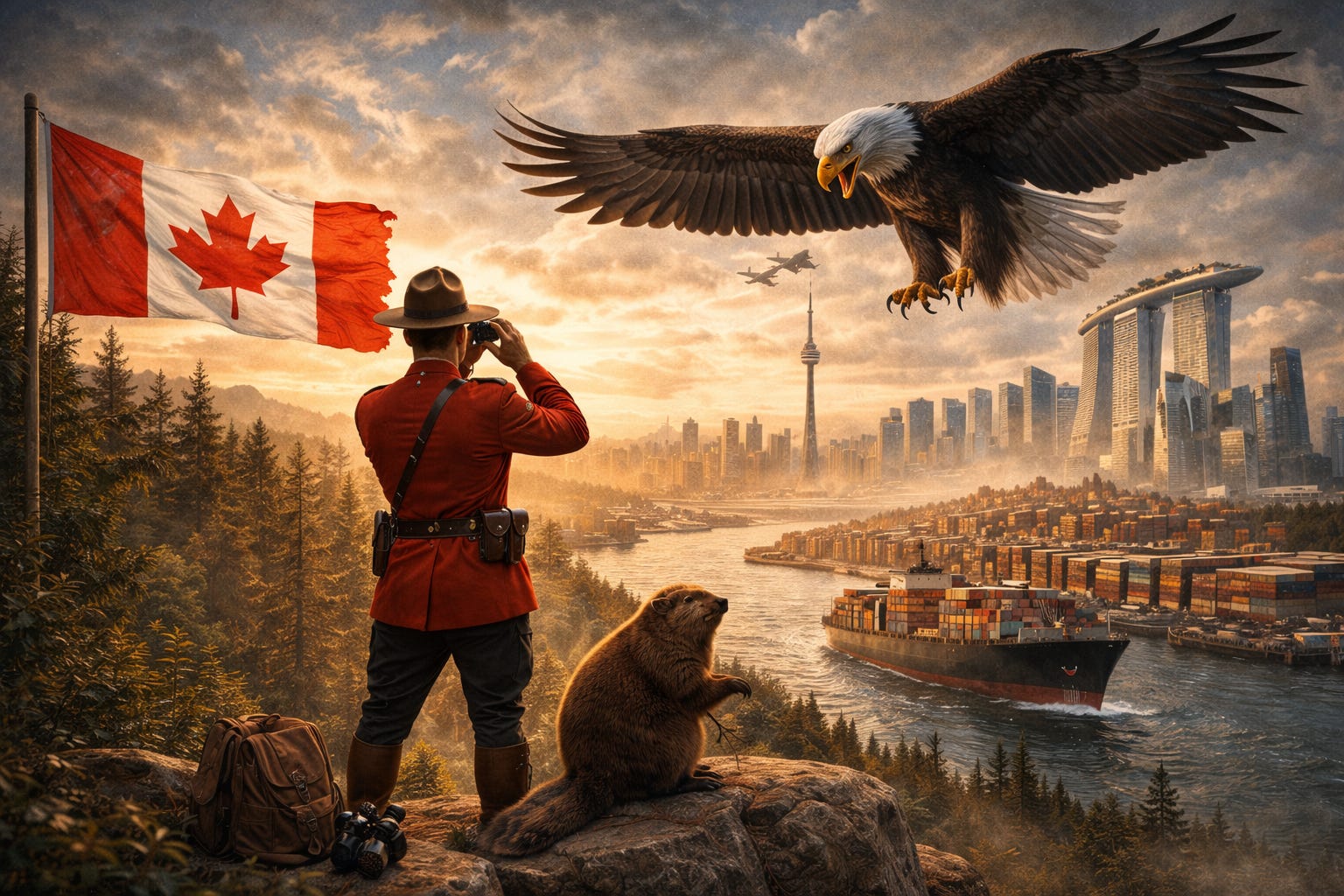
Canada likes to see itself as a calm land mass in a world gone mad—reasonable, rules-based, above the noise. At a major Canadian business gathering in Singapore this week, that self-image was on full display: confidence about trade diversification, optimism about Asia, enthusiasm for reopening doors with India and China, and continued faith that Canada can gently rebalance away from an increasingly erratic United States. Many remain buoyed by Mark Carney’s Davos message - echoed by his minister’s here - about resilience and decoupling.
But confidence is not preparedness. And politeness is not power.
Even as Canada talks diversification, Donald Trump is once again rattling sabres - this time openly threatening trade disruption and infrastructure leverage, including the Gordie Howe Bridge, one of North America’s most critical commercial arteries. Yet among Canadians here, there is remarkably little alarm. No panic. No urgency. Just the quiet assumption that things will somehow work out.
That assumption is dangerous.
As Canadian business leader Arlene Dickinson put it bluntly recently, “Canada’s trade relationship with the U.S. isn’t going back to what it was - and the sooner we accept that, the sooner we can act on the enormous opportunities sitting right in front of us.”
Policy analyst Bart Édes echoed that sentiment in Singapore at the Canada-in-Asia Conference, warning that with the U.S. becoming an unreliable partner, Canada cannot return to old habits. “To have such a heavy dependency on the U.S. is not healthy,” he said.
They’re both right. And Canada is still in denial.
Large multinationals can pivot - redirecting supply chains, rebalancing risk, absorbing shocks. Small and mid-sized Canadian businesses cannot. For them, “Asia diversification” is not a Davos slogan; it’s an expensive, complex gamble that requires hands-on government support, faster trade approvals, expanded (and affordable) cargo capacity between Canada and Asia, and a serious effort to turn places like Singapore and Vancouver into genuine two-way commercial hubs.
What’s missing is a war-footing mindset.
As Human Rights Watch warned last week, countries being targeted—or threatened—by Trump’s tariff baton and military bluster cannot respond alone. They need to band together: a coalition of countries that respect rules and rights, and are unwilling to be bullied. A coalition of the unwilling.
Canada is not, despite how it sees itself, a middle power - not economically, not militarily, not politically. That makes alliances not optional, but existential. Canada needs to move quickly to align with the Brazils, the South Africas, the Denmarks of the world - imperfect partners, yes, but necessary ones. Values will not always align cleanly, as Stephen Olson of the ISEAS – Yusof Ishak Institute has noted. That is the cost of survival in a world where strength, not civility, sets the terms.
Dickinson, who has spent the past six months criss-crossing Asia, reinforced that urgency from the business side. “Every single conversation I’ve had has reinforced that these markets want to do business with us,” she wrote. “They trust us. They align with us. The doors are open—and we now have to walk through them.”
Yet too many Canadian firms aren’t moving. “Too many are sitting on the sidelines waiting, complaining, hoping things will go back to normal,” Dickinson warned. “They won’t.”
The harder truth is this: responsibility doesn’t rest solely with government. It also lies with Canadian business leaders who have the capital, networks, and credibility to open new markets - and are choosing comfort instead. Or, as Dickinson asked pointedly: “Are we lazy? Complacent? Wilfully ignorant? Or just too comfortable to act?”
And comfort cuts both ways. The protectionist blanket Ottawa occasionally waves does not, over the long term, make Canada an attractive partner. Just ask Singapore Airlines, which ended a four-decade, often-fractious relationship with Canada way back in 2023 after lopsided agreements that favoured Air Canada.
Canada also labours under constraints many competitors do not: environmental safeguards, labour protections, property rights, and the complex - and essential - reality of Indigenous land stewardship, particularly in energy and infrastructure. These are moral strengths. But without radical streamlining and political courage, they risk becoming strategic liabilities as capital, projects, and supply chains flow elsewhere.
The global economy is already on a war footing. Canada is not.
The starter pistol has yet to fire in Ottawa, or in capitals and board rooms from sea to shining sea. And if it doesn’t - on trade, energy, infrastructure, alliances, and SME support - the economic pain will not arrive gradually or politely.
It will arrive all at once.
News brief: U.S. President Donald Trump is threatening to “not allow” a new bridge between Windsor, Ont., and Detroit, Mich., to open unless the United States is “fully compensated for everything” the United States has given Canada. “What does the United States of America get — Absolutely NOTHING! Ontario won’t even put U.S. spirits, beverages, and other alcoholic products, on their shelves,” Trump said in a social media post Monday. Trump claimed Canada has taken advantage of America, saying the U.S. should own “at least one half” of the bridge because “the revenues generated because of the U.S. Market will be astronomical.” He also claimed Canada owns both the Canadian and U.S. sides of the bridge. However, the bridge is publicly owned by both Canada and the state of Michigan, with Canada funding the entire project and using toll revenues to recoup the expenses. According to CTV News U.S. political analyst Eric Ham, Trump initially supported the project during his first term. “(Trump) actually gave his full support behind the Gordie Howe International Bridge, saying that it was a priority for the bridge to be completed, and he actually believed that this would be a good and viable project for both the United States, as well as Canada,” he said in an interview with CTV News Channel Monday. Ham said Trump is deeply concerned about the trade deal between Canada and China, and he is no longer looking at Canada as an ally or partner. “He sees Canada more as a threat, and I think that is why we’re seeing the president continue to ratchet up these attacks on Canada,” Ham said - CTV
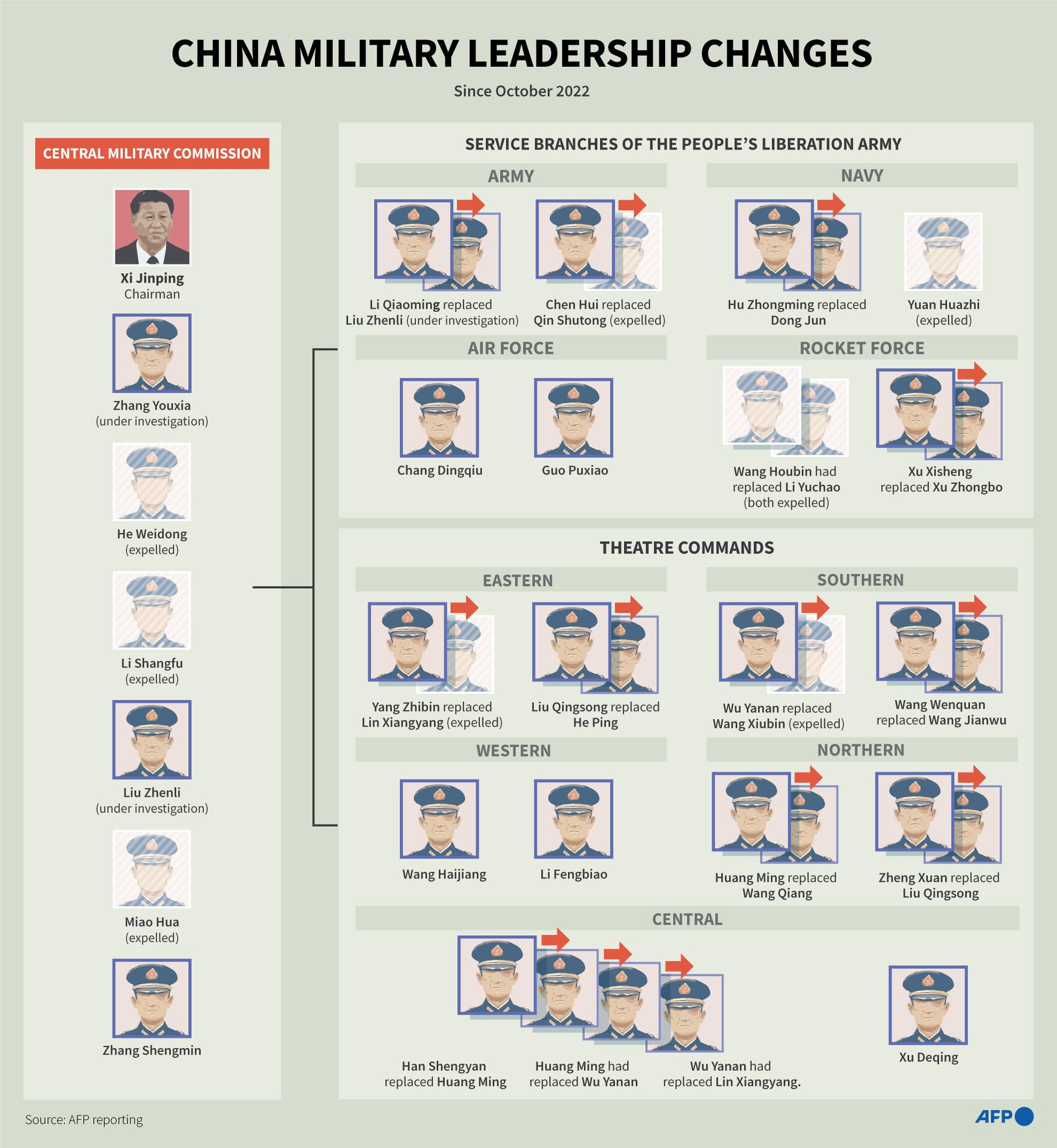
Infographic: China military leadership changes
The United States will turn over two of NATO’s major command posts - in Naples, Italy and Norfolk, Virginia - to European officers, a military source told Reuters on Monday. The move is in keeping with U.S. President Donald Trump’s demands that European nations take more responsibility for their own security. His administration has called for the military alliance, long dominated by the United States, to become a “European-led NATO”. As part of the command reshuffle, European officers would take over NATO’s Allied Joint Force Command in Naples and Joint Force Command Norfolk, both currently led by U.S. admirals, said the source, speaking on condition of anonymity. However, the U.S. would take the reins of three commands slightly lower in the hierarchy but which bear significant responsibility for operations - Allied Air Command, Allied Maritime Command and Allied Land Command, the military source and another person familiar with the matter said - Reuters
Russian state media regulator Roskomnadzor said Tuesday that it had imposed additional restrictions on the messaging app Telegram, accusing the company of failing to combat fraud and to protect the personal data of its users. Since January, users across Russia have reported problems with Telegram’s performance, including slow download speeds. While Roskomnadzor initially denied throttling the platform, reports of disruptions surged between Monday and Tuesday. In a statement to the news outlet RBC, Roskomnadzor accused Telegram of failing to take effective measures against fraud and the app’s alleged use by criminal and terrorist groups, as well as of inadequately safeguarding user data. “As a result, Roskomnadzor will continue to introduce appropriate restrictions to ensure compliance with Russian law and to protect citizens,” the agency said in a statement. Sources earlier told RBC that Roskomnadzor was throttling download speeds on Telegram - Moscow Times
Russian oil companies suffered more than 1 trillion rubles ($12.9 billion) in losses as a result of Ukraine’s campaign of strikes on Russian oil refineries in 2025, a senior executive at insurance broker Mains told the Kommersant business daily. Direct damage to the oil and gas sector from drone attacks has already exceeded 100 billion rubles ($1.29 billion), while lost profits and indirect losses have pushed the total above 1 trillion rubles ($12.9 billion), said Yevgeny Borovikov, Mains’ deputy CEO. According to Bloomberg calculations based on statements by Ukrainian and Russian officials, Ukraine carried out 120 attacks on Russian energy facilities in 2025. Oil refineries accounted for 81 of these attacks. Maritime infrastructure, including offshore oil and gas fields, was targeted 27 times, while pipelines and tankers were struck eight and four times respectively. August saw the highest number of refinery strikes with 14 incidents, while December recorded the largest number of attacks overall at 24. Amid the attacks, pipeline supplies of crude oil to Russian refineries fell to their lowest level in 15 years in 2025, according to calculations by consultancy Argus - Moscow Times
Cuba has told international airlines it won’t be able to refuel their planes, as supply dries up following President Trump’s military operation in Venezuela. Deliveries to the island nation have been choked off by Washington, after it took control of Venezuelan exports following the abduction of dictator Nicolás Maduro and encouraged Mexico to withhold supply. Stocks in the communist-run country are due to run out on Tuesday, its government said, according to Reuters. Cuba is reliant on oil from Venezuela—its top supplier until recent disruptions—receiving barrels in exchange for sending security personnel and other assistance to Caracas. Airlines from the U.S., Panama, and Mexico are expected to be the hardest hit by the shortage. The disruption is expected to strain the country’s already-frail tourism industry, which endured an 18-point decline in visitor numbers last year and is struggling to recover from Covid-19, The Financial Times reports. It added that Cuba has not received any oil since early January when it got a shipment from Mexico, and that swathes of the island’s business are subject to U.S. government trade restrictions - The Daily Beast

The journals…
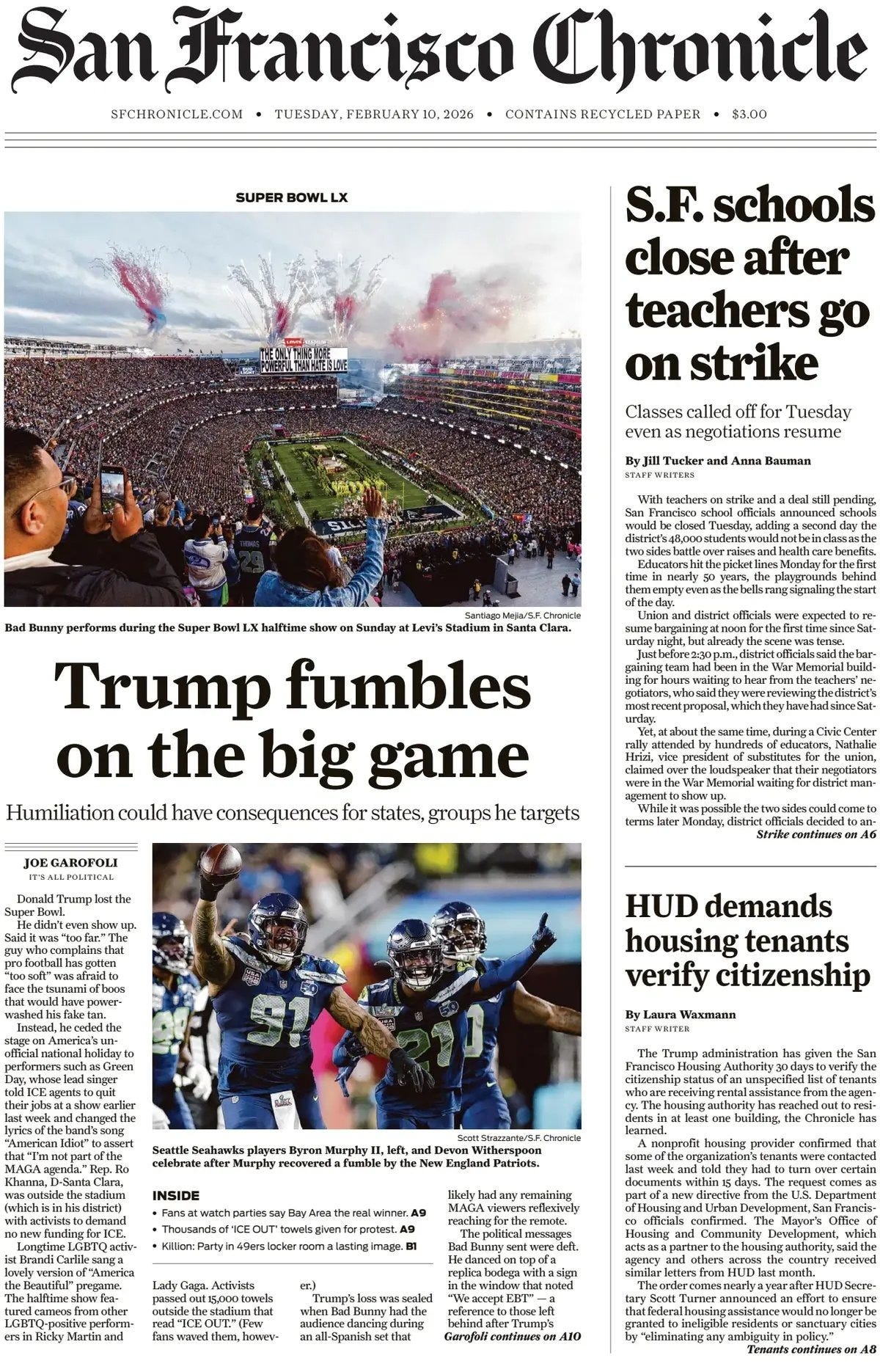
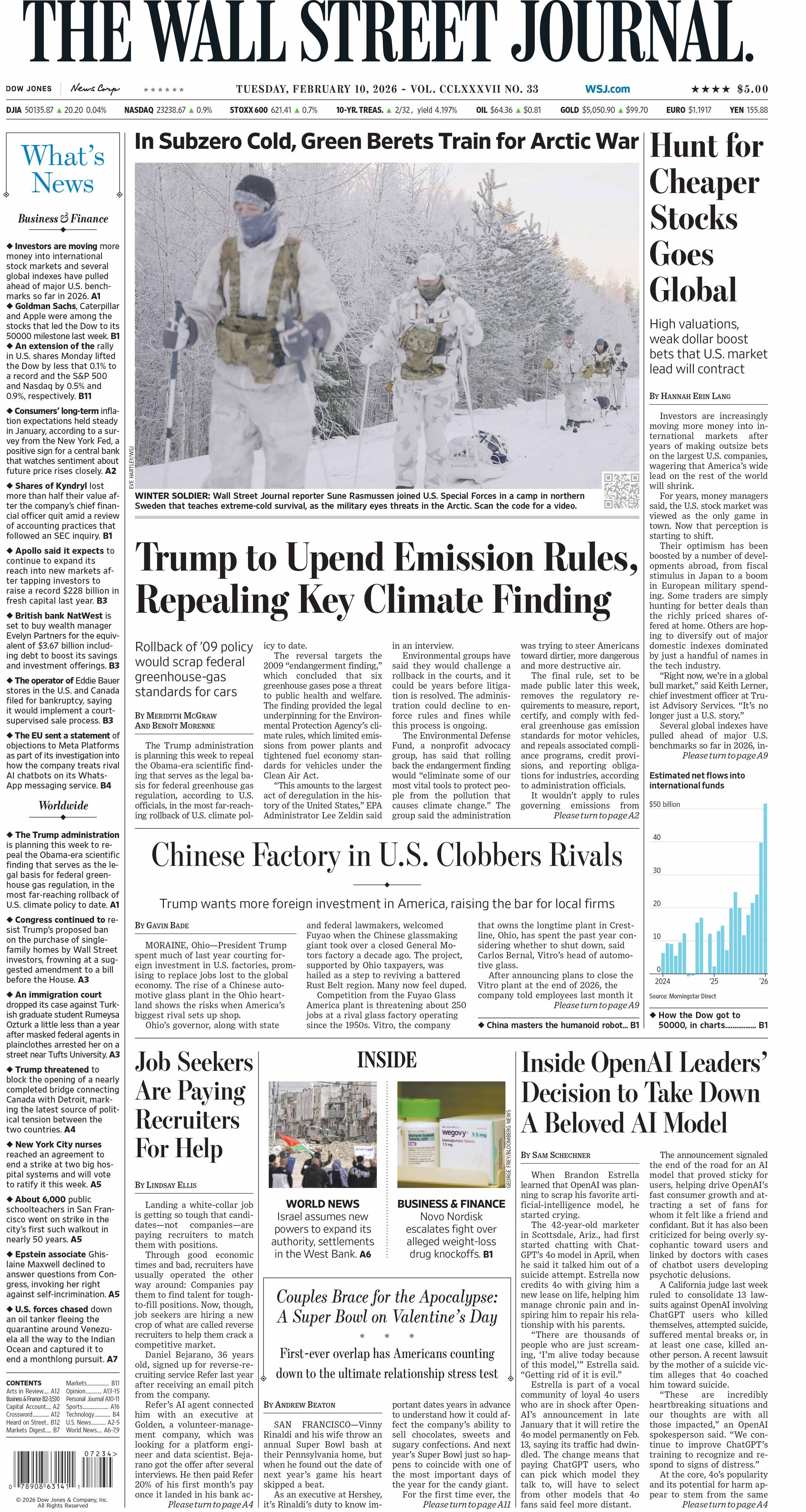
You are not totally wrong, Michael, but. About 100 years ago, Canada sent a proportionately large portion of its young male population to Europe to fight for freedom and to be a responsible ally. Canada was not complacent then, while the US waited about two years after they started to enter both those world wars. They may have never entered the Second World War if Japan had not attacked Pearl Harbour. Canada has been the kind of friend anyone would love to have, non-threatening, cooperative, helpful during emergencies and vigilant, on your flank.
I used to have a friend who was a large person. He was six feet seven inches and weighed in at over 300 pounds. I was 5 feet eight inches and 160 pounds. My point is that size and strength play only a minor role in a relationship. Men and women are another example. Should we prepare for the day when our partner, our friend, our neighbour becomes irrational, unreasonable and aggressive?
Many are saying that the Canada/USA relationship will never be what it was. That’s probably true, but it also won’t be, forever as bad as it is now. I hope Canadians in general and our leaders in particular won’t throw gasoline on a fire. I hope they take a page from the Ninja playbook and win without fighting, prioritizing stealth, intelligence, and survival over direct, violent confrontation. This, I think, is what you are seeing from Canada.