

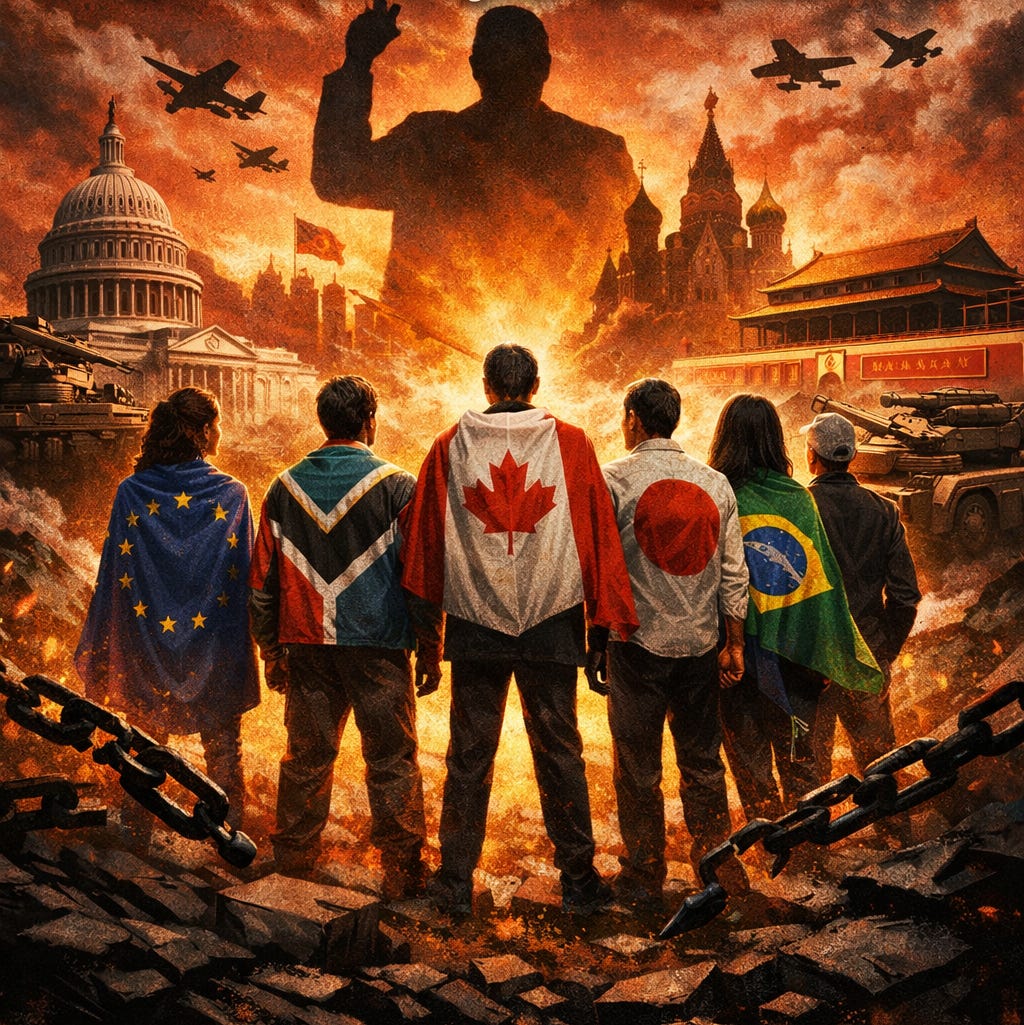
🔥 World Briefing Hot Take
For years, the world assumed the greatest threat to the rules-based order came from Beijing or Moscow. Human Rights Watch now puts into print what many capitals have been whispering: the United States itself has become a destabilizing force. Under Donald Trump, tariffs are wielded like truncheons, alliances are treated like protection rackets, and human rights are dismissed as optional rather than foundational.
Democracy is now back to 1985 levels according to Human Rights Watch, with 72 percent of the world’s population now living under autocracy. Russia and China are less free today than 20 years ago. And so is the United States. “If the philosopher Hannah Arendt was right that history is an ongoing struggle between freedom and tyranny, the latter looked confident in 2025,” HRW Executive Director Philippe Bolopion said in an essay accompany his organization’s annual World Report.
The implication is stark: this is no longer a story of democratic backsliding “elsewhere,” but of systemic decay at the very center of the postwar order.
What I have called a coalition of the unwilling - countries such as South Africa, Canada, and Brazil refusing to be bullied or coerced - HRW describes more formally as an “alliance of rights-respecting democracies.” The labels differ, but the logic is the same: acting alone leaves countries exposed; acting together creates leverage. Fear of retaliation - whether trade punishment, diplomatic tantrums, or security threats - has paralysed too many capitals for too long.
This new rights-based alliance would also be a powerful voting bloc at the United Nations, says HRW. “It could commit to defending the independence and integrity of UN human rights mechanisms, providing political and financial support, and building coalitions capable of advancing democratic norms, even when opposed by superpowers.”
The uncomfortable truth is this: the future of human rights will not be decided in Washington. As Human Rights Watch Asia director Elaine Pearson put it yesterday in Bangkok, the Trump administration’s newly announced “Board of Peace” looks less like a peace initiative than “a club of rights abusers rather than a board of peace.”
Instead, the future will be shaped by whether middle and smaller powers—from Canada to South Africa, from Japan to Costa Rica—are willing to stop waiting for permission and start coordinating resistance. In today’s world disorder, neutrality is no longer prudence. It is complicity.
News Brief
Human Rights Watch warned Wednesday, February 4 that President Donald Trump was turning the United States into an authoritarian state as democracy declines globally to its lowest ebb in four decades. Trump’s return to the White House has intensified a “downward spiral” on human rights that was already under pressure from Russia and China, the New York-based advocacy and research group said in its annual report. “The rules-based international order is being crushed,” HRW said. In the US, the group said, Trump has shown “blatant disregard for human rights and egregious violations.” In descriptions that would have been unthinkable in the US section of its previous annual reports, the group pointed to the deployment of masked, armed agents – the Immigration and Customs Enforcement (ICE) agency – which has carried out "hundreds of unnecessarily violent and abusive raids." “The administration’s racial and ethnic scapegoating, domestic deployment of National Guard forces in pretextual power grabs, repeated acts of retaliation against perceived political enemies and former officials now critical of him, as well as attempts to expand the coercive powers of the executive and neuter democratic checks and balances, underpin a decided shift toward authoritarianism in the US,” the report said. Human Rights Watch repeated its finding that the US engaged in enforced disappearances – a crime under international law – by sending 252 Venezuelan migrants to a maximum-security prison in El Salvador. In a recent report, HRW documented allegations by the men, who eventually were allowed into Venezuela, of being tortured including beatings and sexual violence. Philippe Bolopion, the group's executive director, called on countries to form alliances based on respect for human rights and to stand together – including against the tariff-wielding Trump. "Some countries may be tempted to forge ad hoc alliances on specific issues – one day with China, another with Turkey, another with South Africa," Bolopion told AFP. You can share an article by clicking on the share icons at the top right of it. “From our perspective, for such an alliance to be strong and lasting, it must be built on principles and values – democracy, international law, human rights,” he said. “It can carry weight and provide a degree of security to its members,” he added. The 529-page report stands in contrast to the latest human rights report issued by the US State Department, which toned down sections on countries friendly to Trump. The State Department report said El Salvador in 2024 saw “no credible reports of significant human rights abuses” and that President Nayib Bukele’s crackdown on gangs has brought crime to a “historic low.” The Human Rights Watch report also said that gang violence had “markedly declined” but that in 2025, authorities carried out “widespread abuses, including mass arbitrary detention, enforced disappearance, torture and ill-treatment of detainees and due process violations.” - Le Monde
“If the philosopher Hannah Arendt was right that history is an ongoing struggle between freedom and tyranny, the latter looked confident in 2025,” HRW Executive Director Philippe Bolopion
US President Donald Trump and Chinese leader Xi Jinping held a wide-ranging call on Wednesday that both leaders welcomed as a sign of warming ties. The call touched on Taiwan, Ukraine, Iran, and trade, suggesting that lingering disagreements on fraught geopolitical issues haven’t derailed the superpowers’ months-old trade truce. Trump has shifted Washington’s approach to Beijing away from a great-power struggle and toward a more transactional relationship centered around trade and tech competition, a Brookings scholar wrote. But, he noted, “there likely will not be a firm floor under the US-China relationship,” which “rarely travels along a straight line for long.” Xi said he hoped he and Trump could steer “the giant ship” of US-China relations “through winds and storms.” - Semafor
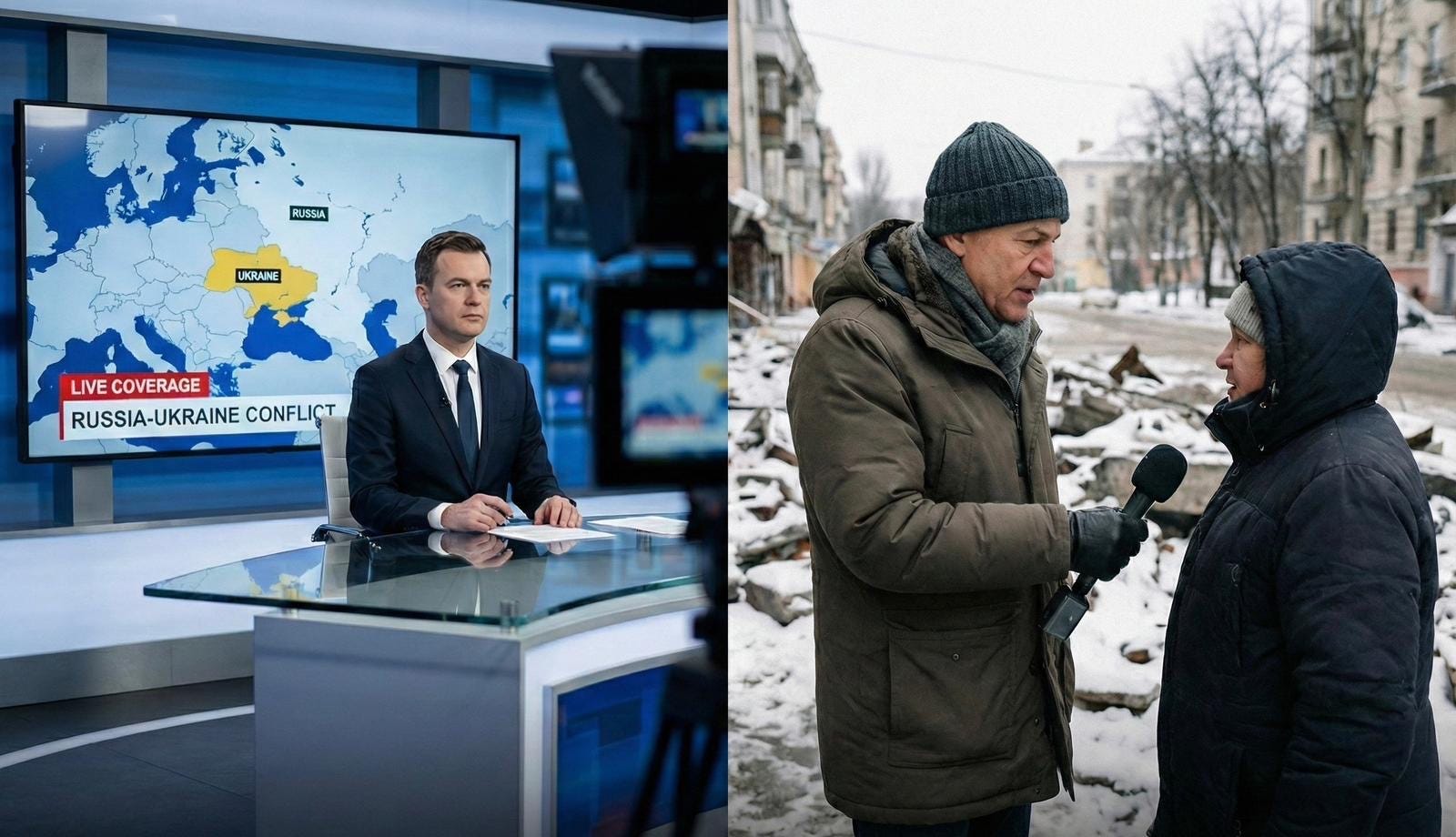
We’re outside for a reason. The best reporting doesn’t come from distant studios - it happens in the messy, uncertain places where decisions collide with real lives. If you believe independent journalism and sharp commentary are worth backing, please upgrade to a paid subscription to support World Briefing. Your contribution helps fund reporting, travel, verification, and the work that turns chaos into clarity. You can also support World Briefing through Patreon or PayPal.
Finland has urged U.S. officials not to describe future security pledges to a postwar Ukraine as “Article 5-like,” implying that doing so could undercut the mutual defense clause at the heart of the NATO military alliance, according to a State Department cable obtained by POLITICO. The Jan. 20 cable hints at worries in some corners over the labels used during peace talks between Kyiv and Moscow. They show how sensitive some phrases can be in the national security realm, even when officials are merely trying to offer an analogy to various audiences. According to the cable, sent from the U.S. Embassy in Helsinki to Washington, Finnish Foreign Minister Elina Valtonen discussed the issue on Jan. 19 with U.S. Reps. Jack Bergman (R-Mich.) and Sarah Elfreth (D-Md.), both of whom are members of the House Armed Services Committee. Valtonen underscored Finland’s view that Russia is a “long-term strategic threat” and cautioned against a “weak” peace deal for Ukraine that would hinder its ability to defend itself against future Russian aggression, the cable states. But Valtonen cautioned against any suggestions of “Article 5-like” security guarantees in a postwar Ukraine, the cable adds. She warned that it risked conflating NATO’s Article 5 guarantees with whatever bilateral promises are made to Ukraine. It also quotes her as saying there should be a “firewall” between NATO and future security guarantees to Ukraine. Finland’s defense minister made similar points in a later meeting, according to the cable. Article 5 is a critical clause in the NATO pact that means an armed attack on one member of the 32-member alliance will be treated as an attack on all members. NATO has invoked the article only once: after Islamist terrorists attacked the U.S. on Sept. 11, 2001 - Politico
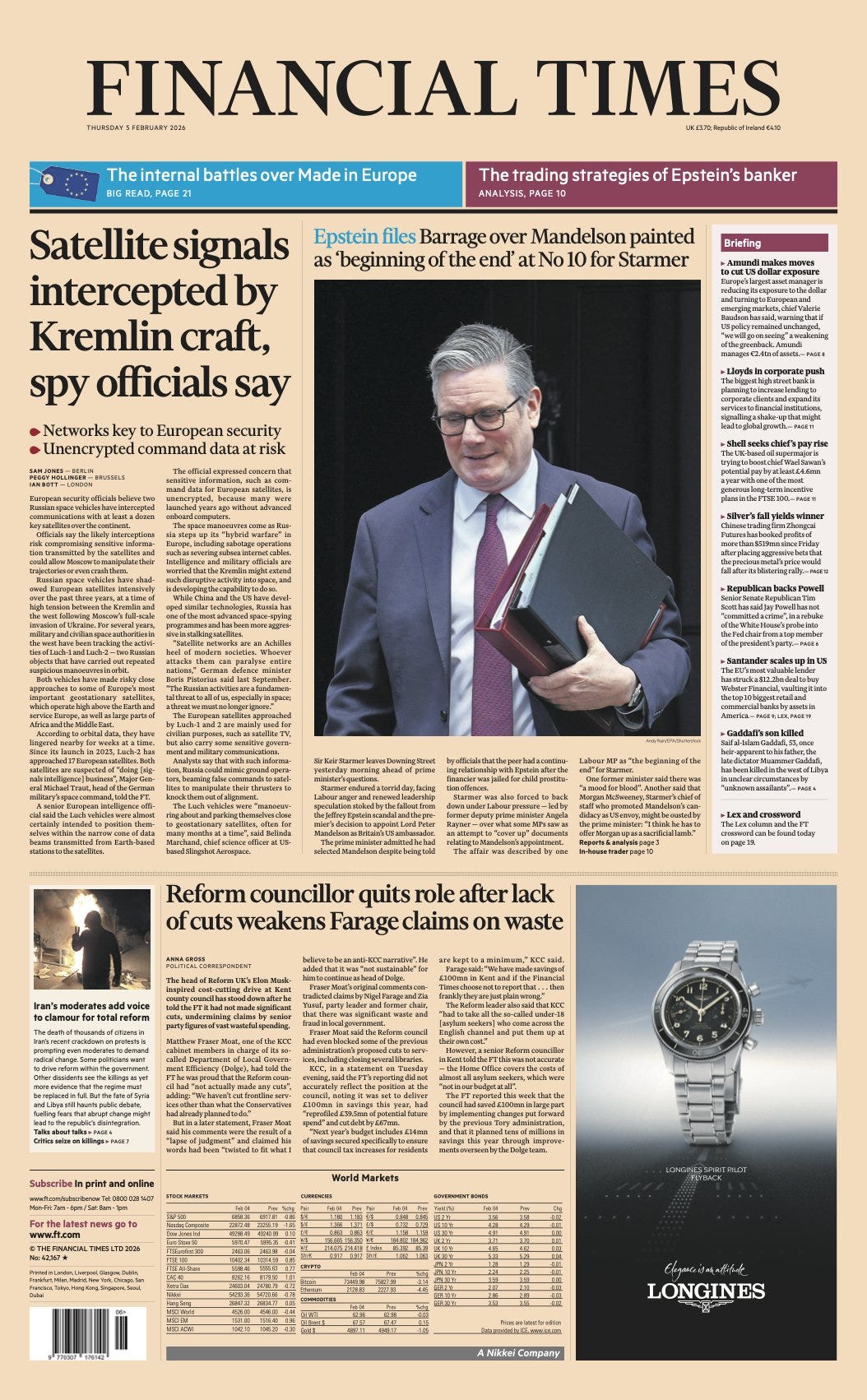
The last remaining nuclear arms pact between Russia and the United States expires Thursday, removing any caps on the two largest atomic arsenals for the first time in more than a half-century. The termination of the New START Treaty could set the stage for what many fear could be an unconstrained nuclear arms race. Russian President Vladimir Putin last year declared readiness to stick to the treaty’s limits for another year if Washington follows suit, but U.S. President Donald Trump has been noncommittal about extending it. He has indicated that he wants China to be a part of it — a push Beijing has rebuffed. Putin discussed the pact’s expiration with Chinese leader Xi Jinping on Wednesday, Kremlin adviser Yuri Ushakov said, noting Washington hasn’t responded to his proposed extension. Kremlin spokesman Dmitry Peskov said Thursday that Moscow views the expiration of the treaty “negatively” and regrets its - AP
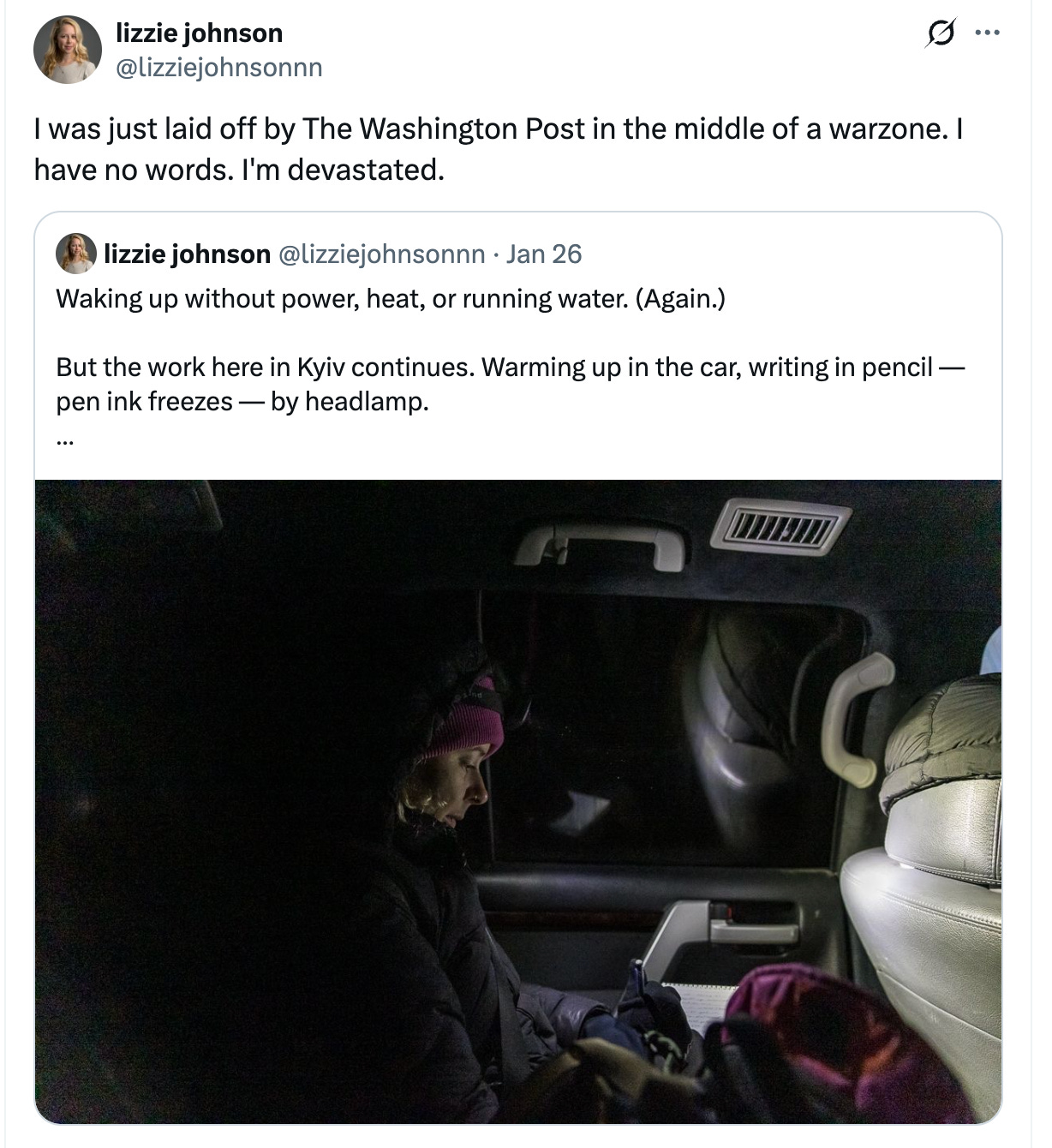
The Washington Post carried out a widespread round of layoffs on Wednesday that decimated the organization’s sports, local news and international coverage. The company laid off about 30 percent of all its employees, according to two people with knowledge of the decision. That includes people on the business side and more than 300 of the roughly 800 journalists in the newsroom, the people said. The cuts are a sign that Jeff Bezos, who became one of the world’s richest people by selling things on the internet, has not yet figured out how to build and maintain a profitable publication on the internet. The paper expanded during the first eight years of his ownership, but the company has sputtered more recently. Matt Murray, The Post’s executive editor, said on a call Wednesday morning with newsroom employees that the company had lost too much money for too long and had not been meeting readers’ needs. He said that all sections would be affected in some way, and that the result would be a publication focused even more on national news and politics, as well as business and health, and far less on other areas. The Post’s sports section will close, though some of its reporters will stay on and move to the features department to cover the culture of sports. The Post’s metro section will shrink, and the books section will close, as will the “Post Reports” daily news podcast. Mr. Murray told the staff that while The Post’s international coverage also would be reduced, reporters would remain in nearly a dozen locations. Reporters and editors in the Middle East were laid off, as well as in India and Australia. In the interview, Mr. Murray took responsibility for the cuts, saying they were part of a plan he put together with his team. Some of the departures shocked the newsroom, including that of a Ukraine correspondent who was laid off while working in a war zone, and the cutting of all staff photographers. A sports reporter in Italy for the Winter Olympics said that he would keep filing articles despite being laid off - NYT
One half of the infamous couple caught cozying up on the Jumbotron last year at a Coldplay concert is turning her pain into profit. Kristin Cabot and her former boss, Astronomer CEO Andy Byron, gained notoriety overnight after the pair frantically darted out of the frame of a kiss cam in July—a viral moment that has racked up more than 3 billion views and exposed their extramarital affair to the world. Now, Cabot, a human resources executive, is set to debut as a keynote speaker at PR Week’s Crisis Comms Conference in Washington, D.C., on April 16. Tickets to the keynote event are priced at a hefty $875 per person. Titled “Kristin Cabot: Taking Back The Narrative,” Cabot’s talk will position her as an “anti-bullying advocate,” detailing her work combating “public shaming, working to better understand and repair a cultural phenomenon that unhesitatingly and relentlessly tears others down in lieu of choosing kindness,” according to the event’s website. The event’s description also states that Cabot was “traumatized” by the incident and “unable to leave her home.” - The Daily Beast
The journals….
Yesterday it was certain, a minute was sixty seconds. Today, I’m not so sure. Today a metaphorical earthquake is rattling those kinds of beliefs. Yesterday we were hobbits, today we are Gollum searching for our “precious”. There is a crack in the cosmic egg. Our safe, self-contained shell is crumbling away. It feels like the age of dis-enlightenment. A dystopian world of irrationality is no longer futuristic. I’m too old to fight, I’m too frail to be stoic. A hundred years ago it was the youth that fought in the trenches for what was right. Does that have to happen again? Is there anyone to find the trim tab on the ship of state? “I need a hero, I’m holding out for a hero” (Bonnie Tyler, Jim Steinman and Dean Pitchford)