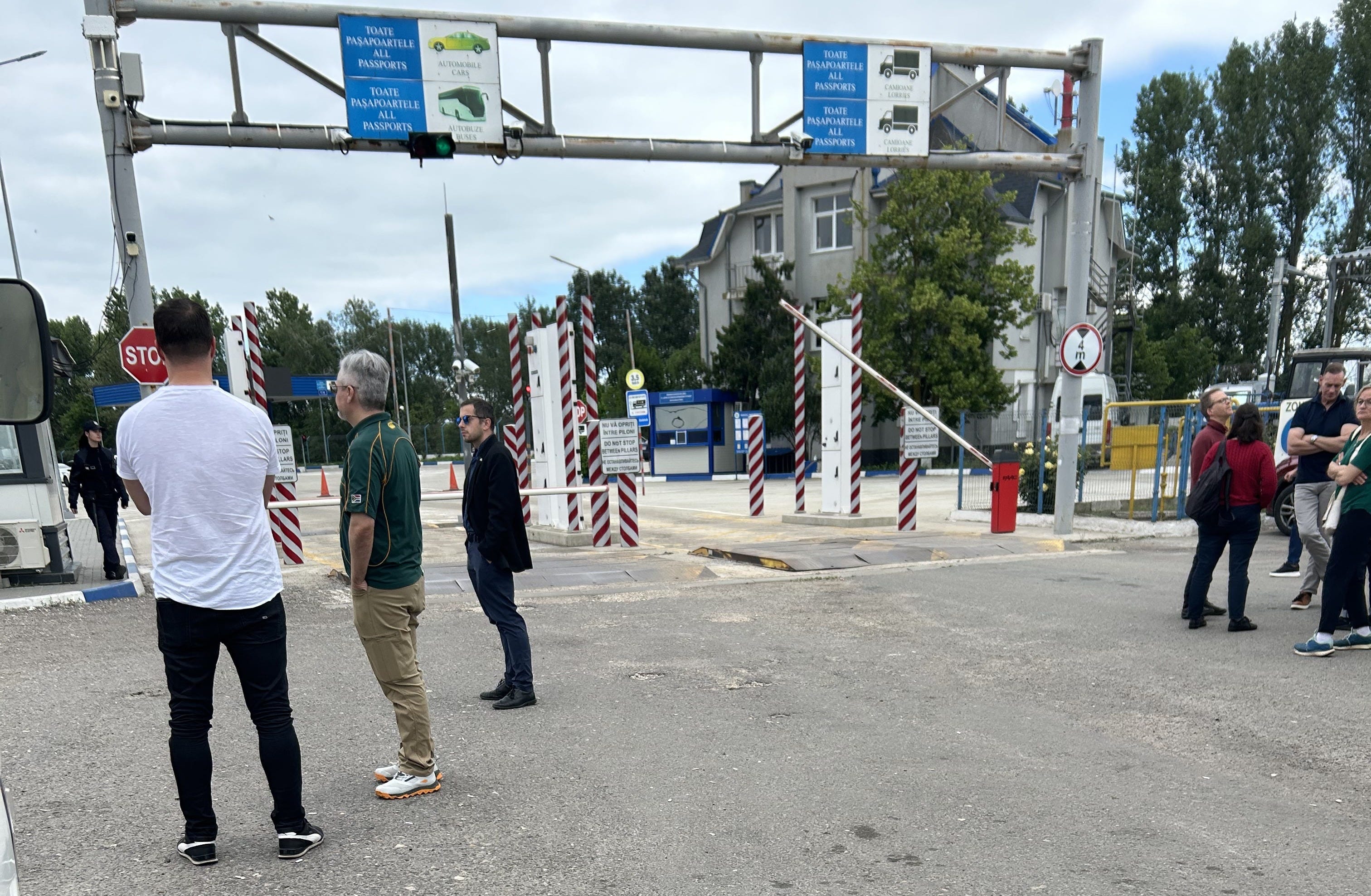
PALANCA, Moldova–Ukraine border — On Friday afternoon I stood in the queue at the joint crossing here and did what anyone can do in ten minutes: counted trucks. Dozens, in both directions, on a two-lane road never built for it. I wanted a coffee from the cafe on the far side and decided against crossing the highway to get it. The traffic never broke.
Two days later, Russian missiles hit the bridge at Mayaki on the highway that feeds this crossing. It was the second bridge struck in nine days. On August 1, a span of the Zatoka crossing over the Dniester estuary was hit hard.
Those are the two crossings serving the southwest corner of Odesa oblast - the corner where Ukraine’s Danube ports sit.
Whether either bridge is open on any given morning is now a question with a different answer every day. Damage is assessed, traffic is halted, repairs are rushed, crossings reopen, power fails somewhere and they close again. That churn is not the story. The story is that a region of Ukraine, and the ports that carry a large share of its trade, now depend on infrastructure with no redundancy behind it - and that Russia has worked out it does not need to destroy any of it. It only needs to make it unreliable.
This is not only my reading of the map. In its August 9 assessment, the Institute for the Study of War judged that Russian forces have likely shifted their targeting away from port infrastructure toward the overland routes Ukraine relies on for agricultural exports, and named the Mayaki strike specifically. Moscow, ISW assessed, is probably moving its emphasis from the sea corridor to the land corridor - to obstruct grain exports and weaken Ukraine’s economy.
Read that alongside the campaign that pushed Ukrainian trade off the Black Sea in the first place, and the shape is clear enough. Close the sea. Then close the roads that were the answer to closing the sea.
Which is where it stops being only about Ukraine.
Ukraine still has open borders to the west - with Poland, Slovakia, Hungary and Romania. What it no longer reliably has is a road of its own into its own southwest. The dependable route from Odesa to the Danube ports crosses into Moldova at Palanca and comes back out again. A piece of Ukraine, and the ports that move its grain, are now most reliably reached by leaving the country.
In Odesa, where the recent mass strike is read locally as a preview rather than an aberration, people who stayed through February 2022 are making contingency plans. Not the ones you would expect. The ones who swore they never would.
There is a second meaning to these roads that does not show up in freight statistics. For anyone living in Odesa, the crossings into Moldova are the escape route. Forty-five minutes in a fast car and you are at the border. Through more than four years of war, that proximity has functioned as a kind of psychological insurance - whatever comes, there is a way out, and it is close.
In the days after the strikes, traffic snarled for kilometres, and Moldova temporarily limited movement back into Ukraine to a single crossing. The direction out of Odesa stayed open. Even so, the corridor jammed - and that was infrastructure damage alone, with no crowd trying to leave.
Now imagine the strikes intensify and a great many people need to go at once.
They are watching the same map.
This is about to become Europe’s problem — again.
News Briefs
At least 13 people were killed and dozens of others injured in an overnight Ukrainian drone attack in the republic of Tatarstan, regional officials said Monday morning, with media reports suggesting that a petrochemical plant was struck. Radmir Belyayev, the mayor of the industrial city of Nizhnekamsk, said drones targeted both civilian and industrial sites during the attack. Besides the more than a dozen fatalities, regional authorities said more than 70 people sought medical attention. Unverified reports said the Nizhnekamskneftekhim petrochemical plant, which produces synthetic rubber and plastics, was hit during the overnight attack. Tatarstan declared a period of mourning after the deadly strikes on Nizhnekamsk. The city was previously attacked in June, when Ukrainian drones targeted Tatneft’s Taneco oil refinery. Ukraine later on Monday claimed it struck the Taneco refinery in its attack on Nizhnekamsk. Russia’s Defense Ministry said it intercepted 456 Ukrainian drones in Russia and annexed Crimea between Sunday night and Monday morning. Ukraine began ramping up its attacks against Russian oil refineries and supply lines this spring in a bid to deprive the Kremlin of windfalls from surging oil prices. Drone strikes have halted or scaled back production at facilities that account for large shares of Russia’s gasoline output - Moscow Times
Tedros Adhanom Ghebreyesus, director-general of the World Health Organization, said on Sunday that a WHO warehouse in Dnipro in Ukraine was destroyed by a strike on Friday. The warehouse held humanitarian supplies for frontline health facilities. No casualties were reported, as a WHO staff member and drivers managed to evacuate 130 of approximately 300 pallets and left the area before the attack. “I cannot say loudly enough: attacks on health care MUST STOP. Otherwise, people are deprived of lifesaving healthcare,” Tedros said - Politico
This segment opens with senior BBC Monitoring analyst Vitaly Shevchenko on the significance of Ukraine's long-range strikes into Russia, hundreds of miles east of Moscow. My hit follows, starting with the context - why Kyiv is reaching that deep, and how it has become able to. Then the harder question of what comes back the other way, and what a winter of retaliation means for Odesa and for Europe.
Royal Navy spy drones used by Britain’s elite special forces secretly sent data to China. The cameras on the K3 Scout surveillance drones had components made in China which were transmitting information to a device in the country. The Royal Marines have been using the £12m fleet since March and the Ministry of Defence (MoD) was forced to remove all internet connectivity from the cameras after discovering the breach. The revelation raises fears that Beijing has been attempting to spy on Britain’s military after years of security warnings about the threat from the country. The drones were supplied by a major British defence contractor, Kraken Technology Group, which sourced the cameras from a third party who had given assurances about their security. An investigation into the drones revealed that the cameras were transmitting “heartbeat communications” – data to confirm they were online and functioning normally – to an IP address in China. The MoD insisted that there was no evidence that any sensitive data or systems had been sent abroad. The discovery triggered national security fears that security-cleared staff at the Special Boat Service (SBS) headquarters in Poole, Dorset could have been exposed. The unmanned vessels were supplied by Kraken Technology Group, a major British defence contractor A defence source familiar with the matter told The Telegraph that the K3 drones made up part of a future defence package offered by the UK to secure the freedom of navigation in the Strait of Hormuz. The source said that preparations for Britain’s plans in the Gulf had been conducted on the drones, adding: “This is major failure to check origins of components and we have lost confidence in the platform.” There are also concerns that the surveillance drones have been near highly sensitive meetings between senior special forces staff, and that cameras remained active even when the drones were switched off. The MoD said that the department took “security of our equipment, networks and data extremely seriously” and insisted that no MoD data had been compromised. However the Tories called upon the Government to “urgently audit” its equipment for hidden Chinese footprints. The revelation comes amid a growing threat from China, despite efforts by the Labour Government to thaw relations with the ruling Chinese Communist Party - The Telegraph
Regions home to around 900 million people experienced their hottest July on record in 2026, including in the Sahel, Central America, France and Spain, according to AFP analysis of Copernicus data. Some 33 countries recorded their hottest July since records began, according to a detailed analysis of billions of data points from Copernicus’s ERA5 climate model. Western Europe experienced its hottest June-July on record as climate change fuels an historic summer of heat, drought and wildfires across the region, the EU’s global warming monitor said Monday. Nearly 120 million Europeans live in regions where July 2026 was the hottest ever recorded. The records were concentrated in southern Britain, western France, and northern and eastern Spain. In France, average temperatures were 3.8C above the 1991-2020 normal — a reference period already significantly warmer than the pre-industrial climate of 1850-1900. France and Spain also registered record levels of drought, which fuelled devastating wildfires. A megafire burned nearly 42,000 hectares and forced the evacuation of more than 220,000 people in France’s Gironde department in late July. At the same time, Spain’s largest wildfire in recent history scorched almost 44,000 hectares in Avila province, near Madrid. Europe is the world’s fastest-warming continent and the first two months of summer have been marked by successive heatwaves, scorching temperatures and bone-dry conditions - Euronews
The Mecca Pact's Third Front: An Asia Times analysis reads the pact as Turkey's route into South Asia — and Pakistan's route into a war that isn't its own
Most of the Mecca Joint Defence Agreement analysis has looked west — at Iran, at the Houthis, at what the pact means for a Gulf still recovering from the Hormuz closure. Asia Times has published a piece looking east instead, and it’s the more uncomfortable read.
Writing for Asia Times, analyst Imran Khurshid argues the trilateral does something the old Saudi-Pakistan bilateral never did: it gives Turkey a conduit into South Asia. Ankara’s “Asia Anew Initiative,” its defence-industrial relationship with Islamabad, its courtship of Bangladesh — Khurshid reads these as a single strategic footprint, one that New Delhi has been slow to treat as anything other than a bilateral irritant.
His sharper point concerns Pakistan itself. Islamabad thinks it has bought leverage. Khurshid’s verdict is entrapment: a country that has already deployed 8,000 troops, a fighter squadron and a Chinese-supplied air defence battery to Saudi Arabia during the Iran war — Reuters reported in May that the confidential pact allows for up to 80,000 — while sharing a 900km border with Iran and fighting an insurgency in Balochistan. Tehran has already dismissed the new agreement, warning it won’t make Riyadh any safer.
Worth noting Asia Times has run a competing assessment calling the pact more a strategic hedge than a mutual-defence revolution. Both can’t be right. Our own read is in Saturday’s World Briefing Plus video.
Philippine lawmakers are pushing to restrict or ban social media use for minors, as officials link a recent surge in school violence to young people’s exposure to harmful online content. Last month, Philippine Education Secretary Juan Edgardo Angara said harmful online influences were a possible factor behind the violence. “Experts say this is partly due to exposure of young people to damaging social media sites, negative influences, groomers, and terrorist groups online actively recruiting (children),” he said. The government is looking at ways to reduce such exposure. A Bill in the House of Representatives seeks to ban social media use for children under 13, while a separate Senate proposal extends the restriction to those under 16. The proposed measures would require online platforms to introduce age and identity verification systems and proactively deactivate accounts belonging to users who do not meet age requirements. Repeated failures to comply could result in penalties of up to 50 million Philippine pesos (US$820,000). The platforms could also be permanently banned in the country - CNA
The journals…