A note from the road: I’m on my way to Turkey - one of the three signatories - and will record this week’s exclusive video briefing for paid subscribers from there. I’ll go deeper on what Ankara has actually signed up to, plus my VFS Global visa investigation and the latest on Black Sea security. Annual subscriptions are discounted right now. There has rarely been a better week to upgrade.
Three countries that spent decades outsourcing their security to the United States have decided to insure themselves. That is the story, and no amount of diplomatic throat-clearing about “not being aimed at any particular country” changes it.
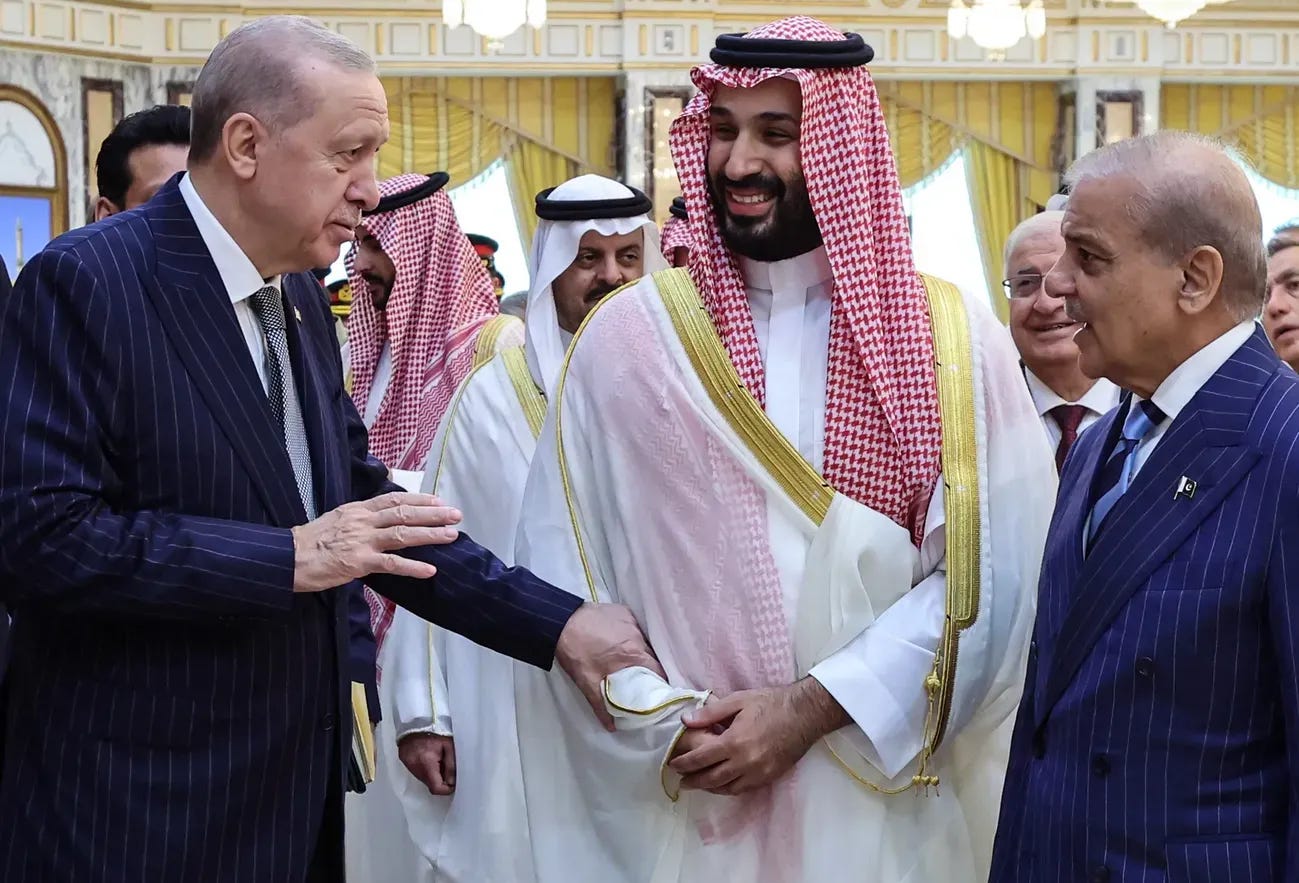
Saudi Arabia, Pakistan and Turkey signed the Mecca Joint Defence Agreement on Friday, pledging that an armed attack on one is an attack on all. It links the Arab world’s only G20 economy, the Muslim world’s only nuclear-armed state, and NATO’s second-largest army. Nearly a year in the making, sealed in Islam’s holiest city for maximum symbolic weight.
Look at the timing. This week Washington was consumed not by the pact but by leaks about its own magazine. CSIS analysts Mark Cancian and Chris Park, tracking the air campaign of Operation Epic Fury, put remaining Patriot interceptors at under 1,000 and THAAD at roughly 250 - down from about 2,330 and 452 before the war. There are no good substitutes; Navy ships carrying Standard Missiles are generally too far from the fight. Their warning is the one Riyadh will have underlined: shrinking stockpiles may force Washington and its partners to take more risks with interceptions. Not fewer missiles, but harder choices about whose skies - including Ukraine’s - get defended.
The President’s response was to insist the US has massive amounts of munitions and promise long jail terms for the “treasonous” leakers - while his administration asks Congress for $95 billion in munitions for next year’s budget and another $21 billion in a war supplemental. You do not request $116 billion to fill a magazine that is full.
Riyadh can read a spreadsheet. When your guarantor is hunting reporters’ sources rather than explaining the arithmetic, you buy a second policy. Ukrainians will recognise the scene: Patriot interceptors have already been pulled from Ukrainian cities and sent to the Middle East. One finite pile of hardware, promised to everyone at once, and the queue now visible to all.
Now the question nobody is asking. Pakistan is the Chinese-armed member of this trio: J-10s, JF-17s, HQ-9 batteries. India flies French Rafales and Russian S-400s. So what happens the next time Delhi and Islamabad exchange fire? Are Saudi jets scrambling for Pakistan? Are Turkish ones?
Follow the money and the answer is no. Indians are Saudi Arabia’s largest expatriate workforce, and their remittances underwrite entire Indian states. Bilateral trade ran to some $27 billion in the year to November, most of it crude flowing east. The irony is exquisite: Washington’s own pressure on Delhi to drop Russian oil pushed Saudi exports to India up to 924,000 barrels a day by January, from a low of 539,000 the previous April. MBS is not going to bomb his best customer’s ally on Islamabad’s behalf. Turkey will do what it did in 2025 - supply drones, issue statements, absorb an Indian consumer boycott.
Osama Al Sharif, the veteran Jordanian commentator, puts the Saudi calculation more sharply than any Western analyst I’ve read this week. The pact, he told me, is Riyadh responding to a region redrawn by the US-Israeli war on Iran and by Tehran’s retaliation against Gulf Cooperation Council (GCC) states - but also to Benjamin Netanyahu’s greater-Israel agenda, and to a GCC fraying from within. The UAE now runs a foreign policy openly at odds with Saudi Arabia’s on Yemen, Somalia, Sudan, Syria and Israel.
Consider how far that has gone. In 2015 Riyadh and Abu Dhabi launched the Yemen war side by side; in 2017 they blockaded Qatar together. Last December, Saudi aircraft bombed the Yemeni port of Mukalla to destroy what Riyadh said was an Emirati weapons shipment to southern separatists, then gave Abu Dhabi 24 hours to withdraw its forces. The UAE pulled out, and in the spring announced it was leaving OPEC after nearly sixty years. Some in Amman and Doha are calling it a divorce. Read Mecca in that light and the pact was as much a message to Abu Dhabi as to Tehran.
Al Sharif’s verdict on the substance is the one to carry: for now this is messaging, and it will only be tested when a member is actually attacked. Which is why the language was left so conveniently vague. The joint statement offered no specifics on what anyone committed to. A Turkish official was careful to add that it alters no other alliance commitments. Deterrence for Tehran and Tel Aviv; a blank cheque for nobody.
And on Washington he is blunt. All three signatories remain close American allies, and the US remains a strategic partner - but the Iran war tested America’s commitment to protect those allies, and America failed the test. The pact is an attempt to fill the vacuum before anyone finds out how large it is.
Two things to watch. A Saudi deputy minister volunteered that the pact has nothing to do with “any nuclear ambitions or arms race.” Nobody issues that denial unprompted. And expect imitators - if the American guarantee is now a queue rather than a promise, Kyiv, Warsaw, Vilnius and Chisinau have been doing this arithmetic far longer than Riyadh has.
News Briefs
Saudi Arabia, Pakistan and Turkey signed a mutual defence agreement in Saudi Arabia on Friday, binding the three Sunni-majority states to a NATO-style commitment. Pakistan’s foreign ministry said the agreement is intended to strengthen collective deterrence against aggression and stipulates that any armed attack against any one of the three states will be regarded as an attack against them all. Saudi broadcaster Al Arabiya has dubbed it the “Mecca Joint Defence Agreement.” The signing was done at leader level. Pakistani Prime Minister Shehbaz Sharif arrived in Saudi Arabia the previous day accompanied by army chief Asim Munir and performed the Umrah pilgrimage in Mecca; Turkish President Recep Tayyip Erdogan travelled on Friday to meet Crown Prince Mohammed bin Salman. Ankara moved quickly to define the limits. A Turkish official said the pact is purely defensive, pledges mutual support only for defence, is not directed at any specific actor, and remains open to other regional states. It does not abrogate or replace existing bilateral or multilateral agreements, the official added. Context: the pact lands against the Iran war. Saudi Arabia has been struck repeatedly by Iran, as well as by Tehran’s Houthi allies in Yemen and Shia armed groups in Iraq, since the US and Israel attacked Iran on 28 February — a conflict that has imperilled Saudi oil exports and development plans and raised questions about the reliability of the longstanding US security umbrella. Turkey and Pakistan have avoided significant direct attacks but are anxious to contain conflicts threatening their security and economies. It builds on existing architecture rather than starting fresh: Riyadh and Islamabad signed a bilateral Strategic Mutual Defence Agreement in September 2025 with near-identical attack-on-one language. Source: France 24 live blog, 7 August 2026.
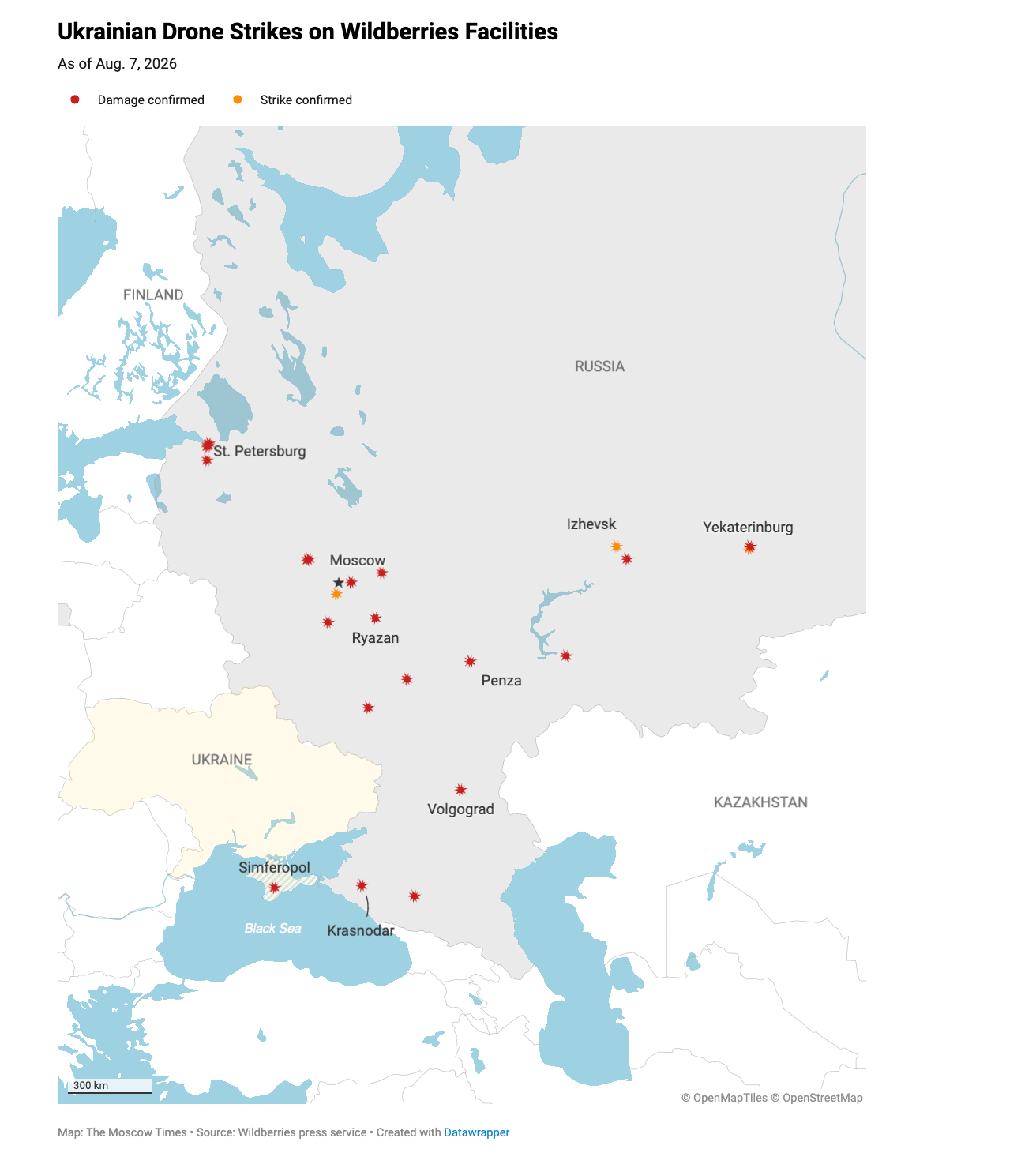
A Ukrainian drone attack set fire to a logistics center belonging to online retailer Wildberries in the Urals city of Yekaterinburg, regional officials and the company said Friday morning. Acting Sverdlovsk region Governor Denis Pasler said air defense forces shot down eight drones over the region, three of which crashed onto the roof of the facility. Wildberries confirmed that a fire broke out at the logistics center, located nearly 2,000 kilometers (1,200 miles) from the Ukrainian border, but said that firefighters have since contained the blaze. President Vladimir Putin’s envoy to the Urals Federal District, Artyom Zhoga, said 800 people had been evacuated from the facility. No injuries were reported. Wildberries said most of the inventory at the Yekaterinburg logistics center remained undamaged. Inbound shipments were temporarily rerouted to other logistics hubs, the company added. Videos shared on social media showed employees evacuating the facility as drones struck the roof, with gunfire audible in the background as local defense forces tried to shoot down the incoming aircraft. Russia’s Defense Ministry said it intercepted 203 Ukrainian drones across Russia and annexed Crimea between Thursday evening and Friday morning - Moscow Times
Vladimir Putin is plotting a desperate ploy, according to Lithuanian intelligence.
Security forces in the Baltic nation say that the Kremlin is cooking up a plan to use captured Ukrainian drones to stage provocative incidents across several European nations. Several mysterious incidents have occurred in countries supporting Ukraine in its defense against Russia since the war began in 2022, including one on Wednesday when a drone reported to be carrying explosives was found at an airport in Leipzig, Germany. "We are talking about a false flag operation, using a false Ukrainian drone... One of the goals is for NATO to waver and decrease support to Ukraine. I can assure this will not happen," said Lithuanian Defense Minister Robertas Kaunas.“Lithuanian intelligence is working. We are collecting information and seeing it,” he told reporters in Vilnius, the Lithuanian capital. Officials from all three Baltic states—Estonia, Latvia, and Lithuania—and Poland have said that Putin is planning to carry out sabotage attacks against their countries in the hope that doing so will reduce support for Ukraine and draw attention away from the conflict, Reuters reports. All four countries are staunch supporters of Ukraine and are NATO members, and would enjoy the protection of Article 5, which is the commitment to shared defense. - The Daily Beast
Russia is not trying to stop Ukraine’s cargo. It is trying to make Ukrainian ports uninsurable. Live on BBC News from Odesa Thursday, as Russian strikes hit two more vessels in the Greater Odesa port area - one of them believed to be a ship already immobilised by an earlier attack. I reported from the city on what is now a sustained campaign against Ukraine’s maritime lifeline. Re-striking vessels that are already damaged and sitting idle at berth points to a deliberate strategy: not to interdict cargo, but to terrify the crews and shipowners who still call here, and to price the risk out of reach. Indiscriminate strikes on loaded vessels could also trigger an ecological disaster. And Odesa now defends itself with fewer interceptors than it had in the spring - for the reasons set out in the lead item above. Watch the video above, which includes a scene-setter report by BBC diplomatic correspondent Paul Adams, also on the ground in Odesa.
Spain will impose border controls on travellers from Italy as a row between the two EU countries intensifies. The measures - coming into force at midnight (22:00 GMT) - come a week after Italy introduced similar measures following an influx of about 78,000 migrants from neighbouring Morocco into the Spanish exclave of Ceuta. The disagreement intensified on Friday after Spain demanded Italy reverse its restrictions by Sunday - prompting Rome to say it will not accept “ultimatums”. Instead, in its response, Italy said it planned to keep border checks in place until at least 15 August - when, according to it, Spain “expects a new wave of migration” to hit Ceuta. Spain has not announced an anticipated second wave of crossings. Reports have been fuelled by social media activity by Moroccan users planning another attempt, El Pais reports. The Spanish prime minister’s office told the newspaper they were monitoring the situation but did not expect a repeat of scenes from last week. Last week's crossings marked a new low in relations between Spain's socialist leader Pedro Sanchez and Italy's conservative leader Giorgia Meloni - who has long called for stricter migration rules in the EU - BBC
Record-low water on the Danube has exposed a slice of 1945 in the middle of Budapest. On 2 August, a Second World War motorbike was pulled from the riverbed off Batthyány Square, on the Buda side opposite parliament — identified by the Institute and Museum of Military History as a DKW NZ 350-1, prized in its day for durability. The bike was not alone. The German War Graves Commission (Volksbund) says two Wehrmacht soldiers were exhumed from the mud nearby, along with a military decoration, a petrol can and a quantity of Tellermine 35 anti-tank mines. A Volksbund reburial specialist worked the site with Hungarian counterparts. The preservation is down to an accident of chemistry: harbour silt laced with gas oil kept both remains and metal intact. The soldiers’ identity discs are still fully legible — and, tellingly, both halves are still together. One half should have been forwarded to the Wehrmacht information office in Berlin to notify next of kin. It never was. The men are due for burial at the Budaörs war cemetery outside Budapest. The Volksbund expects more. If the water stays this low, shipwrecks are likely to surface, and with them further war dead. Hungary would take the lead; Berlin gets a call if German remains are indicated. Source: Euronews (Franziska Müller), 7 August 2026.
The journals…