

A World Briefing Special Investigation
Dear subscribers: no news briefs or front pages today - they return tomorrow. VFS Global is the private company that stands between millions of people and a visa. Today we’re running a single piece on it, and on the governments that no longer seem able to hold it to account: original field reporting from Manila, a parliamentary recommendation Ottawa quietly abandoned, and two federal departments that would not answer basic questions.
A follow-up video taking this story further lands imminently for World Briefing Plus subscribers. If you’ve been meaning to upgrade, this is the moment.
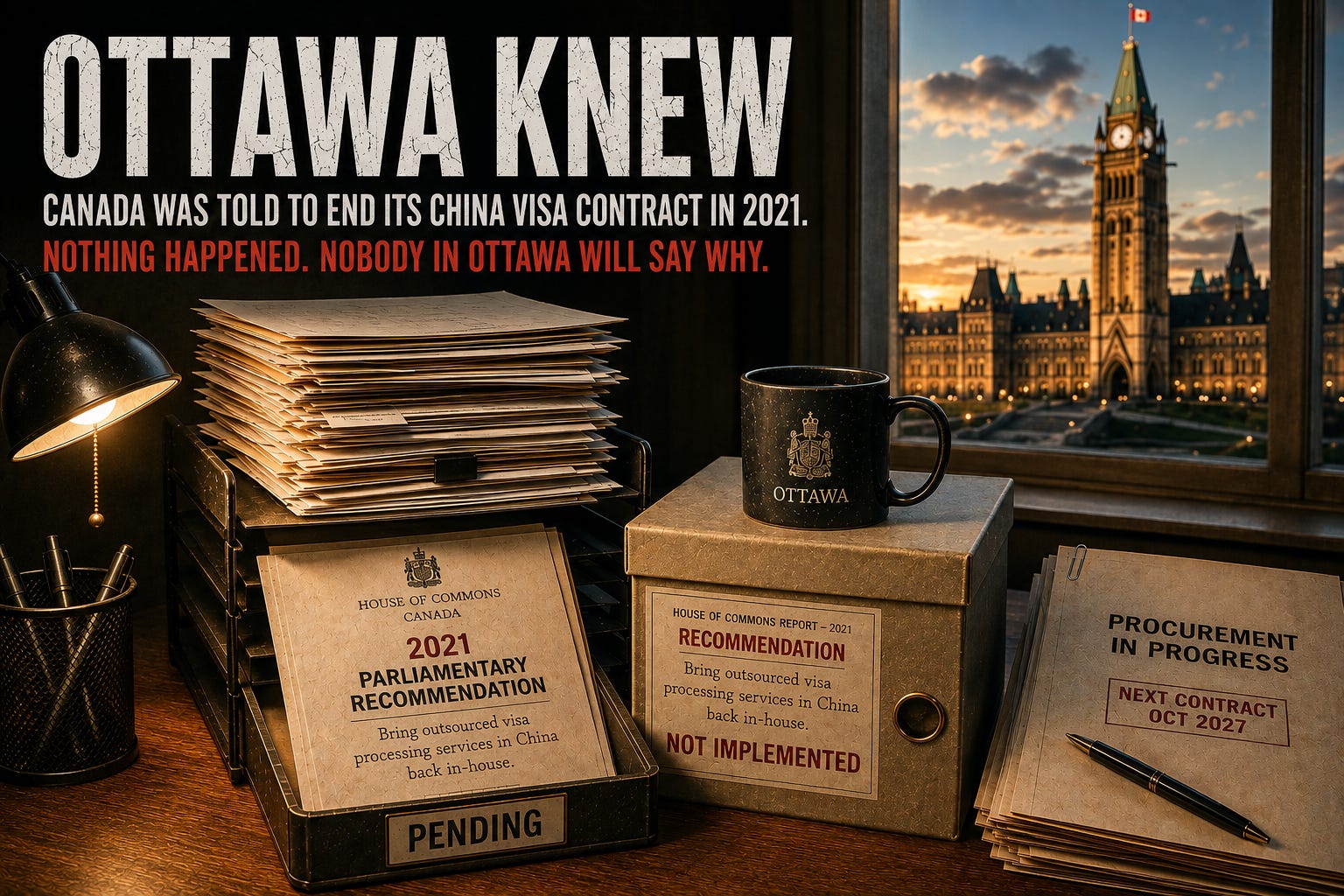
Ten weeks ago, a year-long investigation by Lighthouse Reports, Politico, and 13 media partners - alongside a parallel CBC probe - exposed systematic overcharging, coercion, and regulatory failures at VFS Global, the Dubai-headquartered firm that holds a near-monopoly on outsourced visa processing for most of Europe and Canada: GDPR violations documented by 22 Schengen governments, a sales culture built on bonuses for pushing unnecessary add-ons, and an applicant base with no recourse.
What’s happened since is the more revealing story: nothing has moved. No EU state has suspended a VFS contract. No fine has landed. The Commission’s promised “comprehensive study” has produced no public output.
Canada's immigration department, Immigration, Refugees and Citizenship Canada (IRCC), still repeats the same posture it gave investigators in May - that it is “aware,” “vigilant,” and continuously “strengthening oversight” - while its $725-million-plus contract runs toward an October 2027 expiry, procurement for the next round already underway, unforced by scandal.
The one real disruption to VFS’s operations since had nothing to do with any of this. On July 1, VFS suspended all Indian consular and visa services across its Australian centres - not over coercion, but on instructions from the High Commission of India in Canberra amid a separate tender dispute now in Delhi High Court litigation. A reminder of how the model works: VFS’s leverage runs entirely through its government clients. When one pulls the lever, services stop overnight. When the lever needs to run toward accountability for applicants, nothing moves.
What VFS actually does. VFS Global has run this business since 2001, when founder Zubin Karkaria - then a Kuoni travel executive, and, as one admiring profile puts it, a devout Parsi priest from a middle-class Mumbai family - convinced the U.S. embassy in Mumbai to let him pilot an outsourced visa-processing model. That same profile, published last year in India’s World, crowns him the “Architect of Seamless Global Mobility,” a title that reads differently against the queue in Manila. It has since become the largest player of its kind, contracted by more than 70 governments across 167 countries, including Canada. VFS doesn’t decide who gets a visa - that stays with government officers. Its mandate is the front end: running appointment systems, collecting biometrics and documents, and preparing applications for IRCC officers to actually adjudicate. For that core service, governments pay VFS directly; the controversy this investigation has documented is what VFS charges applicants on top of it. VFS was re-domiciled from Mauritius - named by Oxfam and the EU among the world’s worst tax havens - to Dubai in 2019, according to Global News. It now lists headquarters in both Zurich and Dubai, and claims 3,469 application centres across 153 countries, having processed more than 297 million applications since 2001. Dubai is where regulatory oversight and tax exposure are both considerably lighter than in most of the countries whose visa systems it now administers.
World Briefing Probe: Manila, May 2026
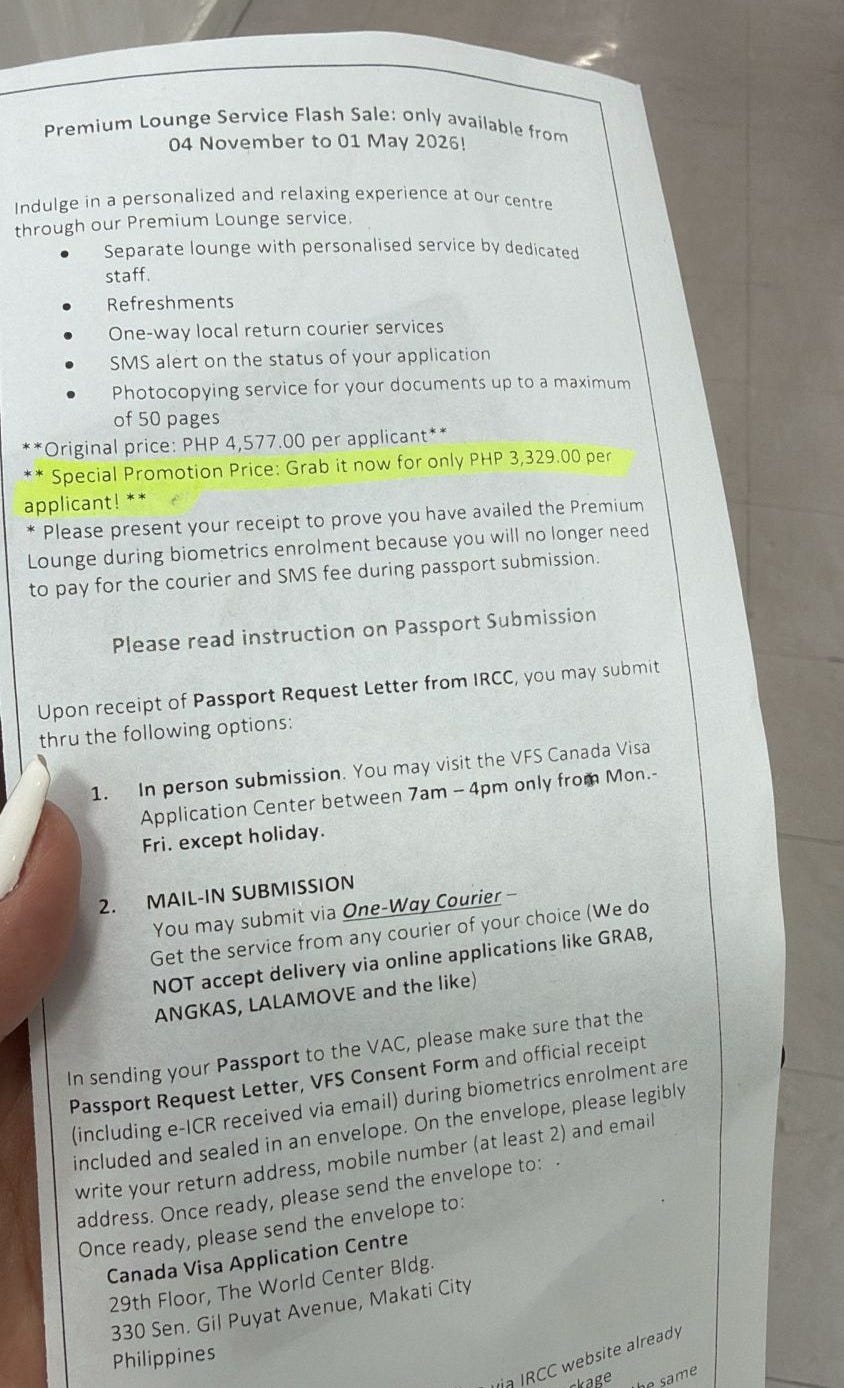
World Briefing has identified one Philippine national who visited VFS’s Manila office earlier this year to submit biometrics for a Canadian visitor visa and was pressed to pay close to C$75 for supplemental services in a coercive, near-mandatory pitch. A handout advertising a “Premium Lounge Service Flash Sale” doubled as the official IRCC passport-submission instructions - blurring commercial upsell with government process in a way legal experts say is deliberate. On a later visit, staff tried to charge an extra fee for a second submission the applicant had already paid IRCC C$100 to cover.
A separate simulation - a routine Turkish visa enquiry - drew an unprompted pitch for add-ons before any application existed. VFS Philippines lists nine such add-ons, and stacking them goes well beyond a single lounge fee: the modest ones alone add roughly C$170 to a C$180 base fee, nearly doubling the cost before an officer has decided anything.
The Upselling Machine
The Lighthouse Reports/Politico investigation laid out the mechanics. Between 2017 and 2024, VFS more than quadrupled its operating profit, from 36 million to 161 million Swiss francs, while application volumes rose just 15 percent. Analysing more than 2,000 Swedish receipts across 16 countries, reporters found value-added services accounted for an average 30 percent of VFS revenue per application. Former employees in Nigeria, Kenya, India and East Africa told the investigation that low base pay was tied to sales bonuses, with training built around exploiting applicants' unfamiliarity with the process - a dynamic they said intensified after Blackstone took a 75 percent stake in 2021, putting the company's lowest-paid contractors, earning little more than €125 a month in Nigeria, at the sharp end of a business that generated €172 million in operating profit in 2024. VFS denies the claims, saying it maintains "zero tolerance" for coercion and that add-ons are always optional.
The Money Behind the Queue
The financial arc explains the incentive. Blackstone bought 75 percent of VFS in 2021 from Swedish private equity firm EQT AB for $1.8 billion. Three years later, Singapore’s state investment company Temasek bought 17–18 percent for $950 million, a deal valuing VFS at $5 billion in equity and $7 billion in enterprise value — against roughly $2.5 billion when Blackstone took over. Lighthouse calculated Blackstone banked about $475 million in profit on the partial sale alone. The company nearly tripled in value in three years while the number of people applying for visas grew 15 percent. The gap between those two figures is the story.
Nor is Canada the only government to have looked at VFS and found something worth investigating. In 2024, Sri Lanka’s government ordered a forensic audit of VFS Global and two Indian firms, GBS Technology and IVS Global FZCO, over a multimillion-dollar visa-processing contract, after the country’s Supreme Court suspended the scheme entirely amid corruption allegations reported to total more than a billion dollars, ordering the previous online visa system restored. Unlike Canada’s parliamentary recommendation, Sri Lanka’s court actually stopped the arrangement.
Regulators Documented It. Consequences Remain Theoretical
Internal monitoring reports from 22 Schengen-zone countries, obtained by the investigation, describe a consistent pattern: biometric data on unencrypted discs in Luxembourg, missed deletion deadlines in Norway, optional services not presented as optional in Sweden. Czech authorities found “excessive pressure” to promote add-ons that led applicants to believe purchases would improve their chances — a breach of EU Visa Code obligations. Ten weeks on, none of it has produced a single EU contract suspension.
The Canadian Dimension
CBC’s parallel investigation, built on IRCC documents obtained after a two-year access-to-information wait, found the same dynamics inside Canada’s network: overcharging, a 2024 malware attack on Russian visa centres, and appointment scalping in Bangladesh, where resellers block-booked slots for up to $250 Canadian each. “We could write a novel about all the fraud we are seeing,” one official wrote internally. Immigration lawyer Karina Juma told CBC: “There are probably thousands more stories… it’s not just one centre — it’s multiple centres in multiple countries.” A former senior Canadian official told World Briefing the dynamic was predictable - “that’s what happens when dealing with a truly profit-oriented enterprise” - while noting add-ons must be government-approved and required to be optional, which puts some responsibility on IRCC itself.
World Briefing put three direct questions to IRCC this week: has oversight of VFS changed in the two months since the CBC investigation; is the department aware of applicants in the Philippines being pressured into add-on purchases, matching what this publication documented in Manila; and does the current procurement process for VFS’s 2027 contract renewal account for any of these findings. IRCC’s written reply ran several paragraphs and answered none of them directly. The department said it is “aware of reported incidents” and takes “all allegations of misconduct seriously,” describing an ongoing posture of “enhanced monitoring,” “reinforced compliance measures” and reviews of “existing privacy and security protocols” — the language of a permanent state of vigilance, not a response to a specific finding. Asked whether anything concrete has changed since May, IRCC did not say. Asked about the Manila pattern specifically, IRCC did not address it, pivoting instead to a general policy statement that optional VFS services - premium lounges, courier options - are supposed to be clearly disclosed and don’t affect processing. Asked about the 2027 contract renewal, IRCC referred the question to Public Services and Procurement Canada, declining to answer at all. PSPC, in turn, told World Briefing it "cannot provide information about a procurement process while it is underway," and said a fuller answer to World Briefing's remaining question would follow but could not be provided by publication time. Neither department would say whether documented fraud, overcharging and data-handling failures are being weighed as Canada prepares to award the next contract. IRCC did note that VFS is contractually subject to “corrective measures,” administrative or financial, “when Service Standards are not met” - a mechanism that, notably, IRCC did not say has ever actually been used against VFS.
This Is Not a New Concern
Parliament flagged the deeper structural risk years ago, and nothing has changed. The House of Commons Standing Committee on Citizenship and Immigration examined VFS’s China operations directly in 2021 and found something more specific than a vague security worry: VFS’s own facility-management subcontractor in China, Beijing Shuangxiong Foreign Service Company, is owned by the Beijing Municipal Public Security Bureau - a Chinese police authority. At least some of the staff at the Beijing centre are Chinese Communist Party members, recruited from a school that trains the next generation of party elite. VFS confirmed the ownership arrangement to the committee and testified that Chinese law requires any state-owned company to embed Communist Party recognition into its governance, with a party organ mandated wherever more than three Party members are on staff. Witnesses were blunt about the implication: Hong Kong activist Nathan Law told the committee that when Beijing wants information from a China-registered company, there is no concept of private data - the Party has blackmail, collusion and financial incentives at its disposal to get what it wants. VFS disputed that its subcontractors have any access to applicant data, and said it had faced no cybersecurity incidents in China since it began operating there in 2004. The committee wasn’t persuaded: a majority of witnesses recommended Ottawa suspend or terminate the VFS contract in China altogether, and the committee’s own Recommendation 15 called for the government to “terminate its contract with VFS Global in China and bring the services back in-house at Canadian diplomatic missions in China.” That recommendation was never acted on. The same arrangement is still in place today.
Ottawa’s position is that it didn’t know. VFS’s own testimony says otherwise: the company told MPs it began working for the Canadian government in China in 2008 with Beijing Shuangxiong as its facility manager and informed Ottawa of that intention, with VFS executives adding that approving the local partner was the Canadian government’s call. Both IRCC and Public Services and Procurement Canada declined to say whether they knew the Beijing centre was run by a police-owned company. New Zealand, which uses the same subcontractor, told the Globe and Mail it had known from the outset - and that VFS partnered with the firm Chinese authorities required. Canada would not say the same.
A senior Canadian immigration lawyer at a major firm - who spoke to World Briefing on condition of anonymity - went further than the committee’s 2021 findings, alleging the China problem isn’t merely structural. “They have known this for years and they do nothing,” he said, adding that VFS passes applicant information to the Chinese government as a matter of course. He said the same dynamic exists in India, and that the problem isn’t confined to Canada or China: France also relies on VFS, and he said Canadian applicants seeking a French visa currently cannot find any available appointments through VFS at all. “It is a worldwide corrupt system,” he said. VFS has previously and strongly denied that any government or subcontractor has access to applicant data. World Briefing put these and the other findings in this piece to VFS Global ahead of publication. The company acknowledged the request and asked for an extension to the deadline, which was granted; it did not respond by the agreed London close of business.
VFS Global responded after the agreed deadline, just as this package was being prepared for publication. A spokesman said the company has been “a trusted partner to governments worldwide” for more than 25 years, operating “under rigorous oversight.” All visa decisions, he said, are made solely by governments; optional value-added services are approved by client governments and “have no bearing on application outcomes.” At the Manila centre, he said, the Premium Lounge is the only optional service available during biometric enrolment, is clearly advertised as such, and applicants who take it acknowledge in writing that it is optional. Applicant information, he said, is transmitted only to client governments through encrypted channels.
On China, VFS's statement marks an apparent shift. The company told World Briefing that the Canada Visa Application Centres there are "managed and operated entirely by VFS Global through its own independent entity, with no third-party organization involved." That is not what VFS told Parliament in 2021. In a written submission to the immigration committee, the company said the visa outsourcing sector in China "required foreign companies to partner with local companies for operations of VACs in accordance with Chinese law," named Beijing Shuangxiong as its sole facility management company since 2005, and said it had recommended the firm to the Canadian Embassy - which, once satisfied, "confirmed this in writing to the Chinese Ministry of Public Security." VFS did not tell World Briefing when that arrangement ended, and neither IRCC nor PSPC has confirmed whether it has. VFS's statement that the Premium Lounge is the only optional service at that stage also sits awkwardly with the company's own handout, which advertises the lounge as covering courier and SMS fees the applicant would otherwise pay later.
The Structural Problem
Underneath both investigations sits the same fact: governments have outsourced a core state function to a company they can no longer meaningfully discipline, because they’ve made themselves dependent on it. As Switzerland’s delegation to India put it in working group minutes obtained by the Lighthouse Reports/Politico investigation: “We have no other option but to see VFS as a partner… because we ourselves will never be able to accept this number of applications.” For the world’s most mobile populations - South Asia, Southeast Asia, Sub-Saharan Africa, the Middle East - VFS remains the unavoidable gateway to consular access. Two months after the world learned how that gateway operates, nothing about it has changed. Parliament called for change four years ago. IRCC’s answer, today, is that it’s watching.
Sources: Lighthouse Reports / Politico joint investigation; CBC News / IRCC internal documents; House of Commons Standing Committee on Citizenship and Immigration, Seventh Report (June 2021); Globe and Mail; World Briefing reporting and original field interviews, Manila and globally.
Illustration: World Briefing (AI-generated).

World Briefing is written from the field. Paid subscribers get Saturday video analysis. Upgrade via this link— and lock in 30% off an annual subscription to World Briefing Plus.