

World Briefing Hot Take
Mykhailo Fedorov’s call would be easy to dismiss as the manoeuvre of a sacked minister with a narrowing window. Except that Dmytro Kuleba, no one’s idea of an opportunist, has made a version of the same diagnosis. Confirming his words to World Briefing, Kuleba added that elections shouldn’t happen without clear public demand, which he says doesn’t yet exist. So the argument in Kyiv isn’t whether the 2019 settlement is exhausted. It’s whether anything can be done about it while the war runs.
And there’s an irony Zelensky’s critics won’t let pass: the man elected in 2019 on a promise to serve a single term is now in his eighth year of a five-year mandate. But wanting a vote and being able to hold one are different problems, and nobody pushing for elections has answered the second. Millions abroad, funnelled through Ukrainian diplomatic posts that cannot process them. Up to a million eligible voters in uniform at the front. Whole populations under occupation. Electoral machinery idle for years. Polling stations that would function as target lists.
Then NABU came for the presidential office. Zelensky isn’t implicated and Iryna Mudra hasn’t been named a suspect — but he dismissed her within hours, which tells you how thin his margin has become. Fedorov, meanwhile, may be in Washington next week, at a moment when Kyiv has no ambassador there.
None of this is a coup. All of it is pressure, arriving at once, on a president who hasn’t faced a real domestic contest since 2019 — and who now has a rival polling ahead of him.
News Briefs
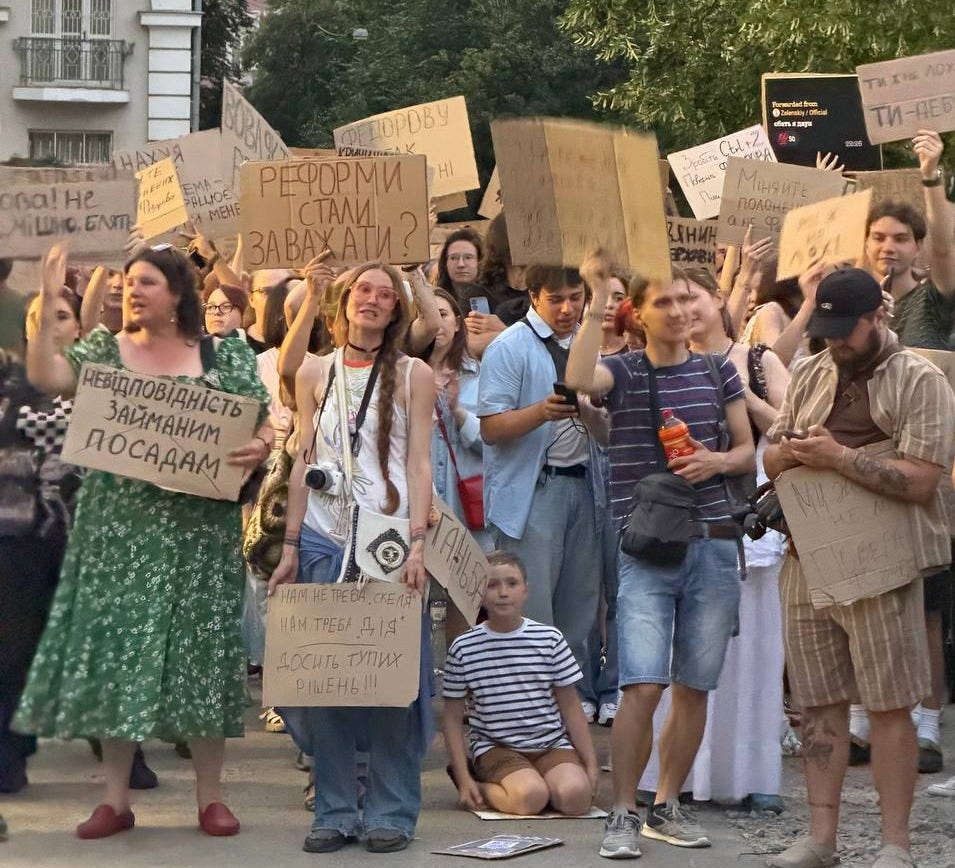
Mykhailo Fedorov has called for elections in Ukraine despite Russia’s ongoing invasion, after his firing as defense minister sparked nationwide protests against President Volodymyr Zelensky. The president has been under increasing pressure at home following the controversial government reshuffle last month in which he pushed out Fedorov, a popular minister credited with inspiring battlefield innovations. “People cannot endlessly live in a state where they do not understand why certain decisions are made,” Fedorov said in a video address Tuesday night, alluding to the reshuffle. “We must not let [Russian President Vladimir] Putin decide when Ukrainians can choose their government,” he said. Ukraine’s constitution does not allow for it to hold elections while it is under martial law, the state of play since Russia’s full-scale invasion began in February 2022 - Politico
Sky News political analyst Michael Clarke characterized the crisis as “Zelensky’s most dangerous day since Russia’s full-scale invasion.” He called it an extraordinary moment and questioned how a safe election could occur with millions of Ukrainians displaced in occupied territories and within Ukraine.
Dmytro Kuleba - a former top ally of Zelensky and a highly-respected foreign minister - has questioned the case for waiting until the war ends, arguing that in Ukraine “elections after war will not be more civilized, than during.” He added: “We don’t know when it will end. What if it lasts for another three years? We will be living under the political model that was formed in 2019, which is already emotionally exhausted. There is a demand among people for new members of parliament,” Kuleba told Interfax Ukraine, referring to the election in which Zelensky upended Kyiv’s politics with a landslide victory. Confirming those words to World Briefing, Kuleba added an important qualifier: elections “should not be held unless there is a clear public demand for them. Right now, that demand does not exist. I think it will emerge over time, but we are not there yet.”
In what the AP described as a stunning development, Zelensky fired one of his most senior officials Wednesday as corruption investigators named a deputy head of the presidential office among the suspects in a money-laundering case. Although Zelensky was not implicated in the graft investigation, it threatened to pull him into another political crisis and provide another test of his resilience.
Investigators gave few details of the probe. It has identified a group of people alleged to have laundered 150 million hryvnias ($3.4 million) to pay bail for a defendant in a major graft case last year, the National Anti-Corruption Bureau said. That case, involving the state-owned nuclear power company, brought the resignations of Ukraine’s justice and energy ministers. The latest suspects include a former lawmaker, the chairperson of a state bank’s board and the head of the bank’s supervisory board, as well as a deputy head of the presidential office, the agency said. Zelensky made no public comment on the investigation but issued a decree dismissing Iryna Mudra as deputy head of the Office of the President. Investigators have not named her as a suspect. Investigators searched Mudra’s office Wednesday, said lawmaker Oleksii Honcharenko - AP
Fedorov is considering a trip to the United States, U.S. and Ukrainian officials familiar with the matter told the Kyiv Independent. The trip could take place as soon as next week, one person said. It remains unclear whom Fedorov plans to meet in the U.S. He has, however, remained in close contact with SpaceX CEO Elon Musk over the potential use of Starlink terminals to counter ballistic missile systems deployed on Russian territory. Currently, Zelensky is without an ambassador in Washington after his envoy resigned due to a separate corruption probe.
President Vladimir Putin ordered the Russian government on Wednesday to launch a program to rebuild commercial warehouses damaged or destroyed in Ukrainian drone attacks. Ukraine has carried out drone strikes against at least two dozen warehouses of Russia‘s top online retailer Wildberries since mid-July, causing explosions and fires that have destroyed a large share of the company’s storage capacity. Putin, without naming Wildberries specifically, said a number of logistic sites needed state support to rebuild. “It is essential to ensure that the restoration of damaged facilities is carried out at a qualitatively new technological level,” he said in televised comments to a conference of ministers and business leaders dedicated to the economy - Reuters
At 5am London time this morning, I joined Sally Bundock on BBC News as the story was still breaking: Ukraine's ousted defence minister, Mykhailo Fedorov, has called for wartime elections - the first such demand from a major Ukrainian figure since February 2022, and the sharpest internal challenge Volodymyr Zelensky has faced in four and a half years of war. My read is that Fedorov's timing is calculated; wait much longer and he risks fading from view. But calculated isn't the same as wise. In this interview I lay out why elections are, for now, practically unworkable - millions of Ukrainians abroad who can't be processed by under-resourced consulates, up to a million eligible voters serving on the front line, whole populations under occupation, electoral machinery that hasn't run in years, and the very real prospect that polling stations become Russian targets. What's beyond doubt is that this crisis isn't going away.
For more insight and analysis, watch my exclusive video for paid subscribers below, beyond the paywall…
The scaling back of South Korea-U.S. joint military drills, following U.S. President Donald Trump’s social media post calling for a reduction, has increased uncertainty in Seoul’s push for an earlier transfer of wartime operational control (OPCON) from Washington, as the reduced exercise will likely limit the opportunity to evaluate Seoul’s readiness to lead the combined forces. The Lee Jae Myung administration has sought to advance verification of the Combined Forces Command’s Full Operational Capability (FOC) under South Korean leadership during the ongoing Ulchi Freedom Shield (UFS) exercise and use the results to discuss a target year the OPCON transfer at the next Security Consultative Meeting (SCM) in October. But the reduced training is expected to complicate that plan, including the government’s efforts to pursue OPCON transfer around 2028. The allies on Wednesday announced that this year’s UFS would end on Friday, six days earlier than its original Aug. 28 end date, while scaling back or adjusting some field training exercises. The move came after Trump asked his defense chief to scale back the drills while repeatedly expressing interest in resuming dialogue with North Korean leader Kim Jong-un. Trump’s sudden move apparently caught Seoul off guard, with Foreign Minister Cho Hyun saying neither the Korean government nor U.S. officials knew about it until Trump posted his comments on social media - Korea Times
Meta rejected claims that its apps were designed to addict young users, as a trial began Tuesday that could reshape the social media giant’s businesses. Brought by 29 US states, the lawsuit argues Facebook and Instagram knowingly contributed to negative health outcomes for minors. The outcome could result in billions of dollars in penalties for Meta and potentially lead to significant changes to the platforms, as countries from Australia to Poland to Vietnam look to curb youth access to social media. The backlash has spurred safety action on other tech fronts, as well: OpenAI said Tuesday it will restrict teenagers to a version of ChatGPT with greater mental health safeguards, as the company faces suits for allegedly failing to prevent self-harm among users - Semafor
U.S. President Donald Trump announced late Tuesday he will pause the implementation of 50 per cent tariffs on a range of Canadian goods for three days, posting the decision less than two hours before the crushing levies were set to take effect. In an initial online post, the president said he delayed the levies “based on the fact that Canada and the U.S.A., subject to the finalization of documents, have a DEAL!” A White House declaration later said the suspension is “in the public interest” because Canadian negotiators “expressed a commitment” to concede on trade grievances the Trump administration had cited as the reason for threatening the tariffs in the first place. In his own statement an hour later, Prime Minister Mark Carney did not speak of a tentative deal and did not say which concessions might have been made. He characterized the administration’s decision as a postponement so trade discussions can continue. “Substantial progress has been made, although there is important work still to be done,” read the statement. “While we continue this work, Canada remains focused on building a stronger, more independent, and more competitive economy at home.” The Trump administration's latest round of tariffs were originally scheduled to take effect at 12:01 a.m. ET on Wednesday. The levies would have applied to hundreds of products worth more than $28 billion, from plywood and cement to wine and hockey sticks - CBC
