When FIFA awarded the 2026 World Cup to the U.S., Mexico, and Canada eight years ago, the pitch was right there in the name: the “United Bid,” a celebration of three economies and three societies stitched together. The tournament opens Thursday with a match between Mexico and South Africa at the iconic Estadio Azteca in Mexico City.
In the end, the tournament has become as a monument to the opposite - a continent whose trade pact is on life support, whose borders have hardened, and whose marquee sporting event is testing just how much division one tournament can absorb.
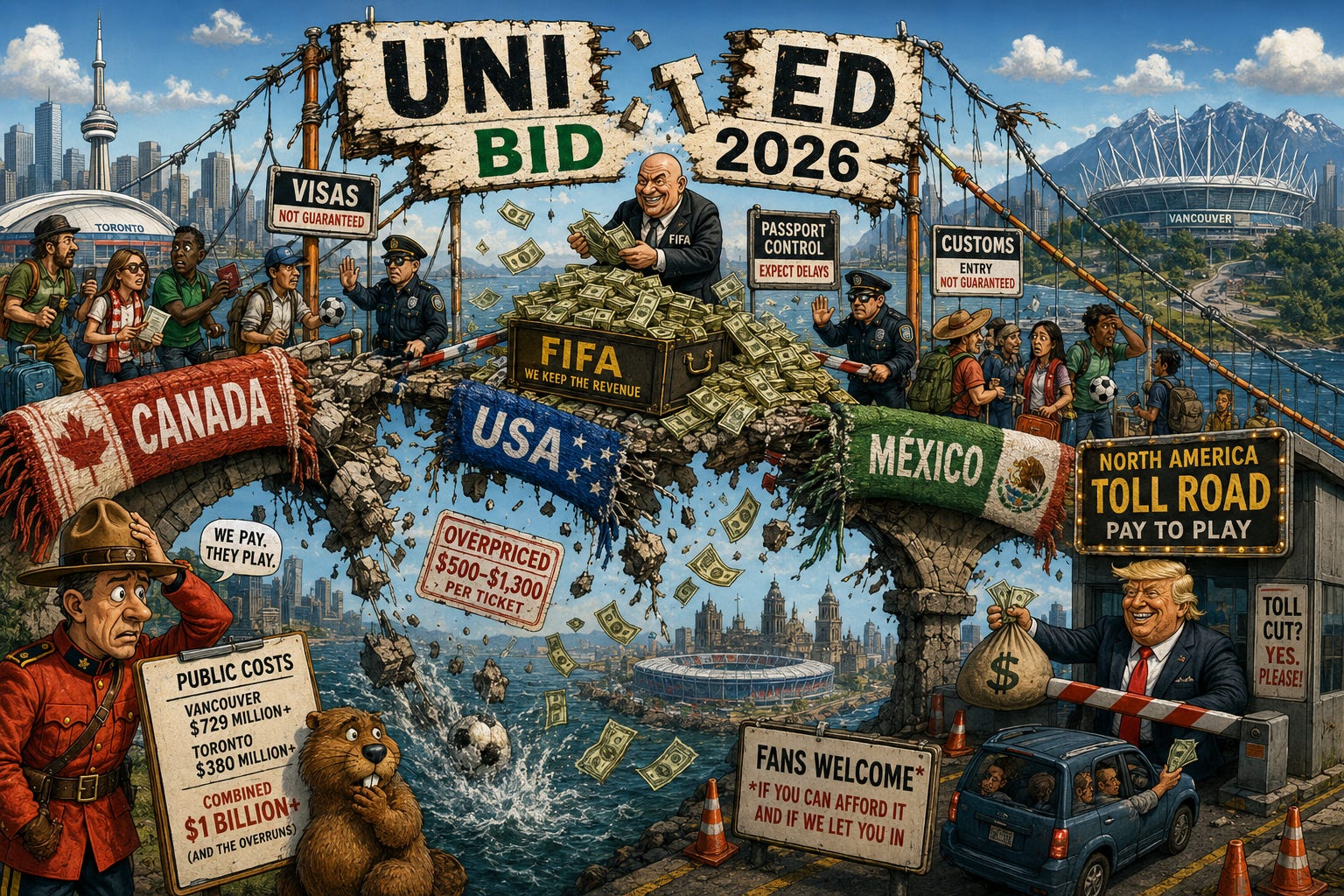
Start with the fans, who were supposed to be the point. The New York Times’ Tariq Panja - covering his fifth World Cup - told CBC’s As It Happens that ticket prices are running three to ten times higher than the last tournament, with seats fluctuating between $500 and $1,300. The predictable result: thousands of unsold tickets and a genuine risk of “swaths” of empty seats at what FIFA branded the biggest World Cup ever. Even Trump reportedly conceded he wouldn’t pay these prices.
Then there’s the question of who’s allowed in. Iraq’s star striker held for seven hours at the border. A Somali FIFA referee denied entry. South Africa’s squad delayed by visa chaos. Iran’s team training in Tijuana because its players can only enter the U.S. one day before each match. A World Cup premised on the free movement of fans is being staged in a country that is, as Panja put it, more closed to the world than it has ever been - while FIFA president Gianni Infantino, who has spent the past year cultivating Trump and even handing him an invented “peace prize,” has converted his Oval Office access into precisely nothing for fans or players.
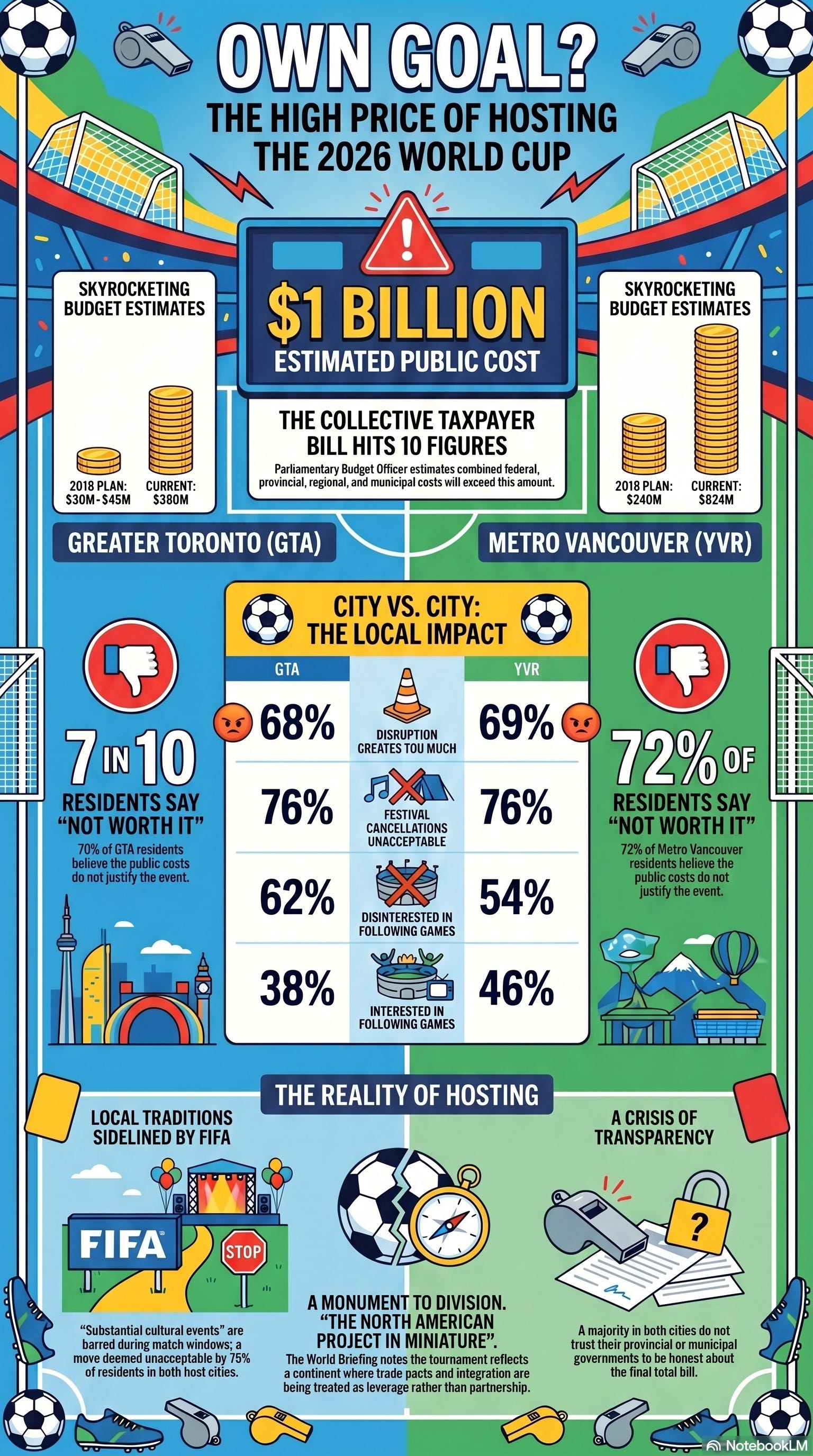
And the hosts? New Angus Reid Institute data shows the wariness isn’t a Vancouver quirk - it’s both Canadian host cities. Seven in ten residents of Greater Toronto (70%) and Metro Vancouver (72%) say the public cost of hosting isn’t worth it, and in both cities more people describe themselves as disinterested in the matches than excited their hometown is staging them - this in only the third World Cup ever to feature a Canadian team. The numbers explain the mood. Toronto’s 2018 hosting plan pegged costs at $30–45 million; it now projects $380 million. Vancouver’s early $240 million estimate has climbed to $624 million., if not more. The Parliamentary Budget Officer puts the combined public bill above $1 billion - before overruns, which taxpayers are contractually on the hook for while FIFA keeps the bulk of the revenue from a tournament it expects will generate at least $11 billion. And residents only know these terms because journalists sued: the host-city agreements stayed hidden until freedom-of-information requests and lawsuits forced their release. Majorities in both cities say they don’t trust their provincial or municipal governments to be straight about the final bill. It’s hard to blame them.
World Briefing Hot Take
This was never just a soccer story. The 2026 World Cup is the North American project in miniature - conceived in an era when integration was the assumption, delivered in an era when everything from a trade pact to a bridge to a match ticket is treated as leverage. And FIFA? The sports body didn't fail to anticipate the political risk - it simply offloaded it, the way it offloads everything. The contracts guarantee FIFA the revenue and the taxpayers the overruns; the borders, the visa chaos, the priced-out fans are someone else's problem. Gianni Infantino spent his political capital manufacturing a "peace prize" for the man whose policies are hollowing out his own tournament, and got nothing for fans or players in return. An organization that answers to no electorate, pays no taxes on the windfall, and hid its host-city terms until journalists sued is not a victim of this moment - it's a beneficiary of it. The tournament may yet produce its moments of grace; sport usually does. But when the USMCA renegotiation lands July 1, mid-tournament, the spectacle in the stadiums will run alongside the quiet dismantling of the very partnership that made the bid possible. The "United Bid" deserved a more honest name. We've given it one.
News Briefs
New York Times global soccer correspondent Tariq Panja warned that a combination of staggering ticket prices and strict travel restrictions are actively draining the magic from the tournament. On CBC’s As It Happens, Panja, who is covering his fifth World Cup and attending his seventh, highlighted that ticket prices for the current tournament are three to ten times more expensive than the last one, with some prices fluctuating from $1300 down to $500. “It is staggering how much these tickets cost,” Panja noted, adding, “I’ve not seen prices at these levels for anything I’ve covered quite frankly”. Because of this barrier to entry, there are currently thousands of unsold seats, and Panja warns of the very real risk of “swaths of empty stadiums” unless organizers manage to pull something “from the fire at the last moment”. Despite this being billed as the “biggest World Cup ever,” the promise of a global gathering is clashing with an environment of travel bans and visa restrictions. Panja pointed out that the United States is currently “more closed to the world than it ever has been,” citing concerning incidents such as an Iraqi fan being questioned for hours and the struggles of a Somali refugee. “These are images I have not seen before,” he remarked, raising questions about whether players themselves will even feel comfortable and welcomed. According to Panja, FIFA absolutely should have anticipated these logistical and diplomatic nightmares, having had since 2018 to prepare. He observed that FIFA President Gianni Infantino has developed a “curiously close relationship” with President Trump - joking that Infantino almost seems to have a “season ticket to the Oval Office”- yet this relationship has failed to produce any positive impact on the ongoing visa and accessibility issues. Ultimately, Panja lamented that the World Cup is a fun game meant to be “full of joy” every four years, but due to these mounting controversies, “the build up though has been fairly joyless”.
As the World Cup gets set to kick off Thursday, residents in both of Canada’s host cities are expressing significant skepticism. Almost three-quarters of Vancouver residents - alongside 70 per cent of residents in Greater Toronto (GTA) - say the public costs of the tournament may not be worth it. According to a new poll by the Angus Reid Institute, 72 per cent of Vancouverites and 70 per cent of Torontonians surveyed said they don’t think the pros outweigh the cons when it comes to the World Cup. Increased security measures, cancelled festivals, street closures, and a lack of transparency from all levels of government are major concerns across the board. Specifically, 69 per cent in Metro Vancouver and 68 per cent in the GTA say the event creates too much disruption for locals, and 76 per cent in both cities find the cancellation of local summer festivals to accommodate FIFA blackout dates to be unacceptable. A staggering 83 per cent of respondents said they thought government being on the hook for any cost overruns was unacceptable. Furthermore, 79 per cent of respondents said they believe FIFA will receive most of the revenue from ticket sales, sponsorship fees, and broadcast rights, leaving governments footing most of the bill. According to the host city agreements, FIFA controls almost 100 per cent of the revenue and expects to raise at least $11 billion from the 2026 World Cup, while taxpayers are contractually on the hook for overruns. Meanwhile, taxpayers in both cities are watching their local estimates soar: Vancouver’s early $240-million estimate has climbed to $624 million, and Toronto’s initial 2018 projection of $30–45 million has ballooned to $380 million. Consequently, a majority of residents in both cities say they do not trust their provincial or municipal governments to be transparent about the final bill, with distrust of the provincial government running especially high in the GTA. Angus Reid Institute president Shachi Kurl says that many people have seen the stories of sluggish hotel bookings and ticket sales. Combined with the reputation FIFA has for corruption, they have concluded that Vancouver and Toronto are not going to see the promised benefits. This wariness is reflected in local enthusiasm; only 46 per cent of Metro Vancouver residents and an even lower 38 per cent of GTA residents say they are actually interested in following the games. “This is a tournament that wasn’t subject to a plebiscite or a referendum as to whether the people of Metro Vancouver or the City of Vancouver wanted this tournament,” said Kurl. “It’s not as though there won’t be interest or fans showing up in fan zones. There will be diehard folks, there will be enthusiastic folks who want to go and be part of this, but in terms of the costs and the payoffs, we have been hearing about how this has not necessarily been the net boon for the Vancouver hotel industry that was predicted.” She also said that, unlike the 2010 Vancouver Olympics, the World Cup doesn’t provide for the same level of engagement because the tickets are more unaffordable, there is only one venue, and many of the seats are being snapped up by wealthy fans from abroad.
(The World Cup) wasn’t subject to a plebiscite or a referendum as to whether the people of Metro Vancouver or the City of Vancouver wanted this tournament - Angus Reid Institute president Shachi Kurl
The US and Iran have exchanged strikes across the Middle East for a second consecutive day, further straining an already shaky ceasefire agreed between the two countries in April. US Central Command (Centcom) said it had completed a wave of “self-defense strikes” targeting military, surveillance and radar sites in southern Iran. The attack came hours after President Donald Trump vowed US forces would hit Iran “hard”, and that Tehran had taken “too long to make a deal” to permanently end the war. In response, Iran launched a round of strikes targeting US military assets in countries across the region. US military bases in Bahrain and Kuwait came under Iranian fire for a second day in a row, while Iran’s Islamic Revolutionary Guard Corps (IRGC) said it fired ballistic missiles at a US command centre in Jordan, according to Iranian state media. Bahrain’s interior ministry said its air raid sirens were activated overnight, as Kuwait’s Army posted on X that its anti-air defence systems intercepted “hostile aerial targets”. Kuwait said it had temporarily closed its airspace due to the Iranian attacks. In the latest flare-up, the IRGC also said it had hit two oil tankers passing through the Strait of Hormuz, Iranian state media reported, although there was no immediate confirmation of the strike - BBC
Help Us Keep Connecting The Dots
For more than three decades, I’ve reported from conflict zones, humanitarian crises, and geopolitical flashpoints - and World Briefing is how I continue that mission independently. No editors second-guessing the story. No algorithms deciding what matters. Just rigorous, on-the-ground analysis delivered straight to your inbox.
If you find this reporting valuable, please consider upgrading to a paid subscription - or support World Briefing at your own level via PayPal or via Zelle (mbociu@gmail.com).
At a time when foreign coverage is shrinking and misinformation is filling the void, your support helps keep independent global journalism alive and in the field.
Thank you for reading, sharing, and being part of this community.
Trump Demands Tolls From a Bridge He Didn’t Pay For and Canada’s Opening Date Wobbles
Donald Trump wants a cut of the toll revenue from a $6.4 billion bridge the United States paid nothing to build - and within 24 hours of Prime Minister Mark Carney announcing a Friday opening, that date is already wobbling. “There’s no big drama,” Carney insisted to reporters on Parliament Hill, a day after committing to a Friday opening for the long-delayed Gordie Howe International Bridge connecting Windsor and Detroit. “If it takes a little longer, it’ll take a little longer.” The White House saw it differently, telling CBC News the timeline “hasn’t been finalized” and that the president’s position “has not changed” - a position, recall, built on Trump’s February eruption that the bridge wouldn’t open “until the United States is fully compensated,” along with bogus claims of “virtually no U.S. content.” The reality: Canada footed the entire $6.4 billion bill, the bridge was built by workers from both countries with steel from both countries, and Canada is set to collect the tolls precisely to recoup costs Washington never shared. The more telling drama played out at Queen’s Park, where Pennsylvania Gov. Josh Shapiro - in town to sign an MOU with Premier Doug Ford — condemned the “reckless and disrespectful rhetoric coming from our president” and declared he “respects Canadian sovereignty. Period.” A sitting U.S. governor publicly breaking with the White House on Canadian soil is the kind of governor-level diplomacy that increasingly bypasses Washington altogether. Ford, for his part, said he expects “some sort of ribbon-cutting” Friday on the Canadian side - though he conceded he doesn’t have “100 per cent of the details.” Neither, it seems, does anyone else.
President Trump on Wednesday threw nascent trade talks with Mexico and Canada into disarray, saying he wasn’t sure he would renew the pact that has shaped the North American economy over the past three decades. Asked about the ongoing process to renew the free-trade deal between the United States, Mexico and Canada, Mr. Trump sounded off on Wednesday: “I don’t know that I’m going to renew it.” He went on to repeat claims that the United States had no need for Canada or Mexico, the country’s two top trading partners. The three-nation agreement underpins $2 trillion in annual trade and has, over the years, knitted several economic sectors across the borders together. But Mr. Trump has been casting the pact, and that close integration, as a burden for the American economy since his re-election.
The journals….