Trust me - there are easier jobs than Secretary-General of the United Nations. I was working with UNICEF USA in 2008 when Madonna, Gucci and UNICEF threw what was supposed to be a spectacular fundraiser on the lawn of UN headquarters. Tom Cruise, Gwyneth Paltrow, Rihanna, Demi Moore, Ashton Kutcher, Drew Barrymore and a heavily-pregnant Jennifer Lopez turned up. Ban Ki-moon did not.
The event - "A Night to Benefit Raising Malawi and UNICEF” - raised $3.7 million (a paltry sum, in the wider context). But by opening night it had become a diplomatic nightmare: questions about Madonna’s Raising Malawi charity, accusations that Gucci, a major UNICEF partner, was using the UN to promote its new Fifth Avenue flagship, and unease inside the organisation over how the whole thing had been approved. Ban had been expected to attend. Instead, hours before the party began, he left New York for meetings in Chicago - which weren’t actually due to start until the following day.
Alicia Barcena Ibarra, Ban's undersecretary general for administration and management, said at the time that her office "should have investigated more fully" before it approved UNICEF’s request to hold the event in the grounds of the UN headquarters.
It was a small lesson in what the job demands. Raise money, but don’t commercialise the UN. Court celebrities, but don’t cheapen the institution. Keep member states happy, protect the brand, dodge controversies by UN agencies that you didn’t create. And, all the while, somehow appear above all of it.
Now imagine doing that with Donald Trump, Vladimir Putin and Xi Jinping holding vetoes over your appointment.
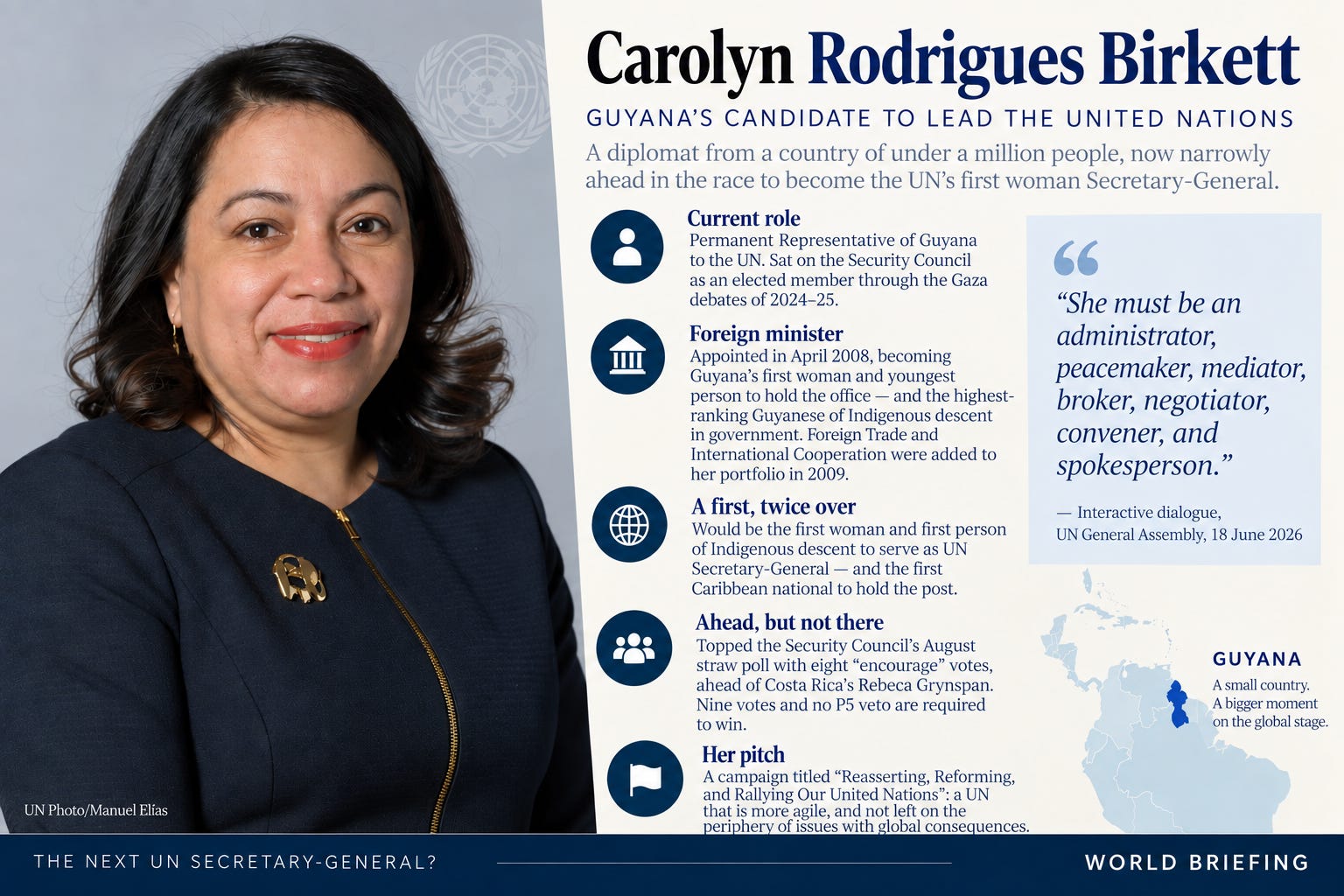
World leaders start landing in New York next week for the high-level UNGA (aka the annual Super Bowl of international diplomacy’. And for the first time in eighty years the United Nations may be about to pick a woman to lead it. Five of the eight candidates to replace António Guterres are women, and women currently occupy the top two spots.
The leader, for now, is Carolyn Rodrigues Birkett. A known name, she is Guyana’s ambassador, and once her country’s first female foreign minister. She edged ahead of Costa Rica’s Rebeca Grynspan in a secret Security Council vote in August. Neither is close to winning. The job requires nine votes and, crucially, no veto from any of the five permanent members.
True to the UN’s reputation, the procedure is strange: the candidates can’t see who’s against them. The ballots are secret and the results aren’t officially published. Grynspan led comfortably in July and slipped a month later - from ten votes encouraging her candidacy to seven. Nobody outside the room knows whether the opposition came from Washington, Moscow, Beijing or somewhere else. That starts to become clearer only in later rounds, when the permanent members vote on differently coloured ballots.
Until then, the real contest hasn’t started.
And whoever wins inherits a wreck - to put it mildly. The United States pulled out of 31 UN entities in January. This week it paid $827 million in dues - $725 million toward the regular budget and another $102 million for peacekeeping. That leaves it still owing more than $1.3 billion on the regular budget alone. Money is increasingly being used not simply as an obligation but as leverage. The Trump administration is said to desire a Secretary-General who shrinks the organisation and puts its focus back on peace and security.
Which invites an uncomfortable thought. The first woman to get this job may get it partly because the job isn’t worth what it was.
Watch the corridors in the weeks ahead, rather than the speeches. There’s talk of a late candidate emerging - and this is exactly the week to build one. We will be on location to share any news and insider info!
World Briefing will be on the ground in New York next week during the UN General Assembly. Watch for our exclusive briefings and posts for paid subscribers!
SIDEBAR: The Job Description
Pay. $238,375-a-year - a figure set by the General Assembly. Less than a mid-tier NGO chief executive, a fraction of what the people the Secretary-General negotiates with earn, but higher what President Trump earns. There is also a post adjustment as of February 2025 of $179,973-per-year.
House. A townhouse on Sutton Place, on Manhattan’s East River. It came to the UN only because Adlai Stevenson turned it down as the US ambassador’s residence in the 1960s, reportedly preferring the Waldorf. Maintenance and security are covered, as is a chauffeured car and a $25,000 annual allowance for official expenses.
Status. “His Excellency” - soon, perhaps, “Her Excellency.” Tax exemption. Immunities under the 1946 Convention on the Privileges and Immunities of the UN.
Term. Five years, renewable once. No formal limit, but no one has ever served three.
Not included. Any power to make anyone do anything.
The Trump administration has denied visas for a high-level Palestinian delegation to attend an annual meeting of world leaders at the United Nations for the second year in a row. The State Department said Wednesday that Palestinian officials, including Palestinian Authority President Mahmoud Abbas, had failed to live up to their commitments under previous agreements to seek peace with Israel. In a statement, the department said the Palestinian Authority had continued to pursue legal action against Israel at the International Court of Justice and the International Criminal Court and kept paying stipends to the families of prisoners convicted of attacks against Israelis. It also mentioned officials tied to the Palestine Liberation Organization, or PLO. Despite the visa denials, the Palestinians will still be represented at next week’s high-level meeting of the U.N. General Assembly by their diplomats who are already accredited to the United Nations. Last year, Abbas appeared by video - AP
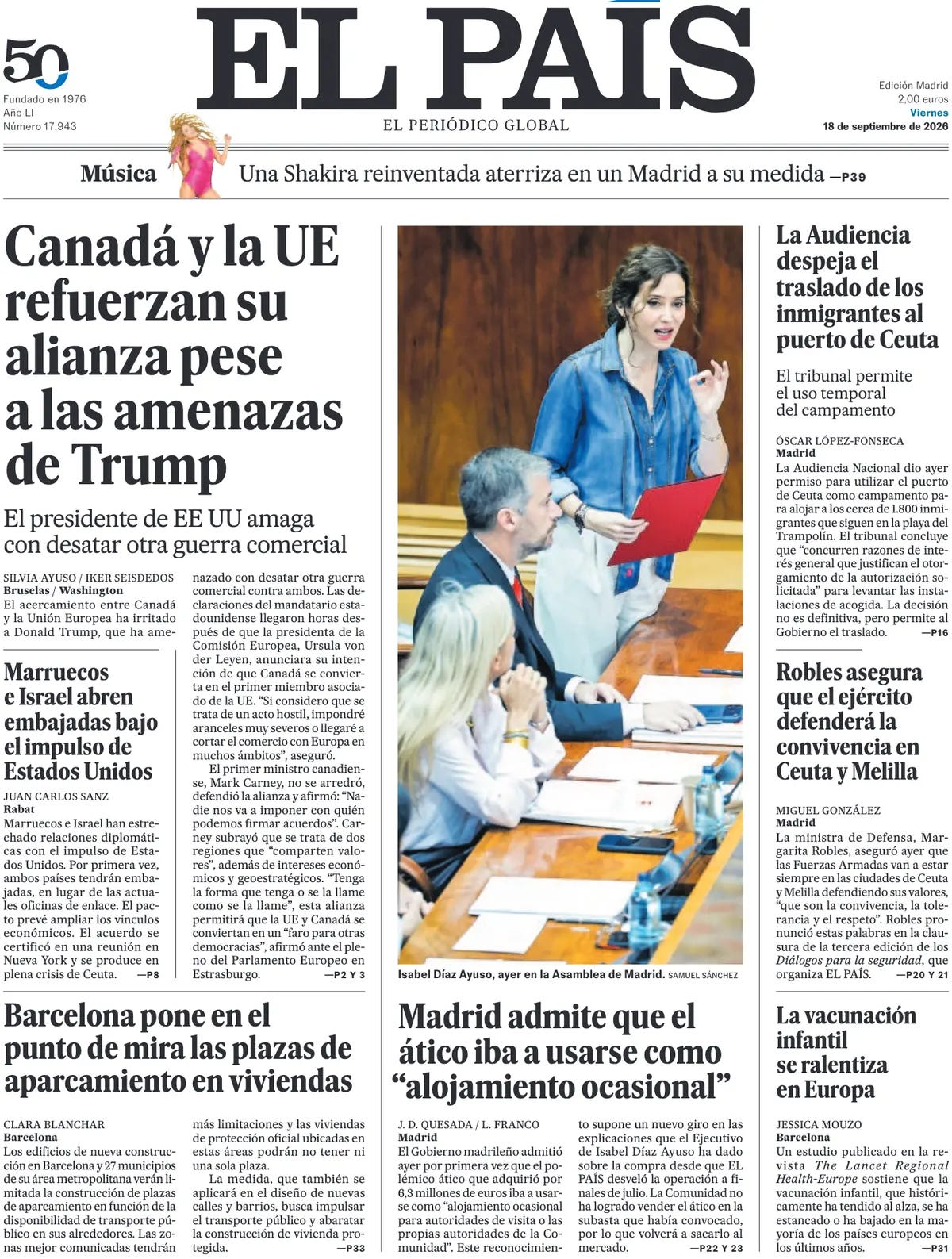
Mark Carney used an address to the European Parliament to sketch out what Ottawa would want from closer ties with the EU but declined to give full-throated approval of Ursula von der Leyen’s surprise “associate member” plan. Speaking a day after the Commission president floated the unique relationship status, the Canadian prime minister acknowledged the offer and instead of accepting it outright, listed potential individual areas of cooperation, including critical minerals, defense, AI, energy security, and space. He also called for more seamless digital trade in non-agricultural goods and services, as well as Canadian participation in Erasmus+, the EU’s student exchange program. “We welcome this ambition,” he said, after name-checking the idea of von der Leyen, who was sitting in the audience. “Polling shows an overwhelming majority of Canadians support much closer ties.” Carney’s list of potential tie-ups was an early attempt to put substance behind what, for now, remains a largely undefined political proposition. The “associate member” idea had caused confusion on Wednesday because the Commission hadn’t run it past European capitals in advance and no such status currently exists. Later on Wednesday, U.S. President Donald Trump said he might respond with “serious tariffs” if Canada were to become closer to the EU. “An alliance for the future is a unique, positive approach that we will define together, building on our common strengths and based on shared values,” Carney said. In a press conference after the speech, Carney was asked if the Canadian people would have a say on associate membership. He said: “Of course. There will be debates, and there will be a vote in the Canadian parliament, but at this point, this is just the beginning of the process.” Carney’s admission that there will be eventual votes in parliament on this “Alliance for the Future” with the EU seemed to suggest Canadian lawmakers will get a say in what the prime minister’s team is cooking. The House of Commons returns from summer break on Monday. - POLITICO
The global response to the Russia sanctions bill the U.S. Congress approved late Wednesday has been swift and defiant, with Moscow warning it would prolong its war on Ukraine, India vowing to protect its interests, and Beijing pushing back against what it called illegal “long-arm jurisdiction.” The bill, which U.S. President Donald Trump must still sign into law, would slap mandatory sanctions on Moscow’s leadership, energy sector, defense industry and “shadow fleet” seaborne delivery system for embargoed Russian fuel. It also empowers Trump to hit the five largest global purchasers of that fuel with 100% sanctions, a cudgel that has U.S. allies worried. China has bought 50% of Russian crude exports since 2022, India 37%, Turkey 5% — and the EU 5%. The bloc has also been the largest buyer of Russian LNG (49%) over that period, as well as the largest buyer of Russian pipeline gas (32%), according to data from the Helsinki-based Centre for Research on Energy and Clean Air non-profit. Trump has not said whether he will sign the Russia sanctions bill, although the Wall Street Journal reported Thursday that he intends to do so, citing the White House. The European Commission has not publicly commented on the legislation - POLITICO
Debris that appeared to be from a Chinese ballistic missile found in Yemen pointed to the growing use of Beijing’s military hardware in conflicts far afield, which may raise worries in the US. No previous sales of the Dongfeng missile, a version of which was discovered in Yemen, have been confirmed in the Middle East. But Saudi Arabia, which secretly acquired an earlier version of such a system, may have used it against the Houthis, according to the South China Morning Post. That may be particularly troubling to Washington, where intelligence officials have already voiced concern that a potential advanced fighter jet sale to Saudi Arabia risks the technology being transferred to China, The New York Times reported.
The mounting political, economic, and military costs of the Iran war for the US came into clearer view - with barely a third of Americans support the conflict. Most say it has failed to achieve its goals, surveys showed, further hurting Republicans’ prospects for retaining control of Congress. In part, that opposition is driven by the war’s impact on government and personal finances: A recent study showed that Americans have spent about $107 billion more on fuel since the war broke out than they otherwise would have. Militarily, the US is draining its stockpiles of missile interceptors, while photos obtained by CBS News showcased the extent of the damage to US Middle East military installations as a result of Iranian attacks - Semafor
Turkey moves to halt a “fund run” in Istanbul
Turkish regulators froze trading in funds run by seven asset managers and ordered some 150 funds into liquidation, moving to contain a speculative bubble that has shaken the Istanbul market and put ordinary savers’ money at risk, the Financial Times reports in its Friday editions.
The panic began when Pusula Portföy, a prominent Istanbul fund manager, said several of its funds could not meet redemption requests on time. Retail investors rushed for the exit. Tera Portföy then reported the same problem with two funds, and Atlas Portföy lengthened the waiting period for withdrawals. The three groups manage roughly $29 billion between them.
The response came on three fronts. The central bank eased lending and collateral rules to keep liquidity flowing and prevent forced selling. The Capital Markets Board suspended trading in funds run by Tera, Pusula, Hedef, Atlas, A1, Pardus and Bulls Portföy, and referred 38 people to prosecutors over suspected manipulation. And the state moved to ring-fence household savings: Emlak Katılım, a state-owned Islamic participation bank, opened talks through a subsidiary to buy two firms that pool customer savings to finance home and car purchases — in effect a Treasury-backed rescue.
After an emergency meeting on Thursday, Turkey’s Financial Stability Committee called the problem contained to one segment of the fund market and temporary, with the priority being to stop contagion. The BIST 100, down a combined 8 per cent on Tuesday and Wednesday, recovered as much as 2.5 per cent before paring gains.
Why it matters: this lands on Mehmet Şimşek, the former Merrill Lynch economist brought in to restore Turkey’s economic credibility as finance minister. A retail savings panic is precisely the kind of event that stabilisation programmes are meant to make impossible.
The journals…