WORLD BRIEFING | POTASH POLITICS
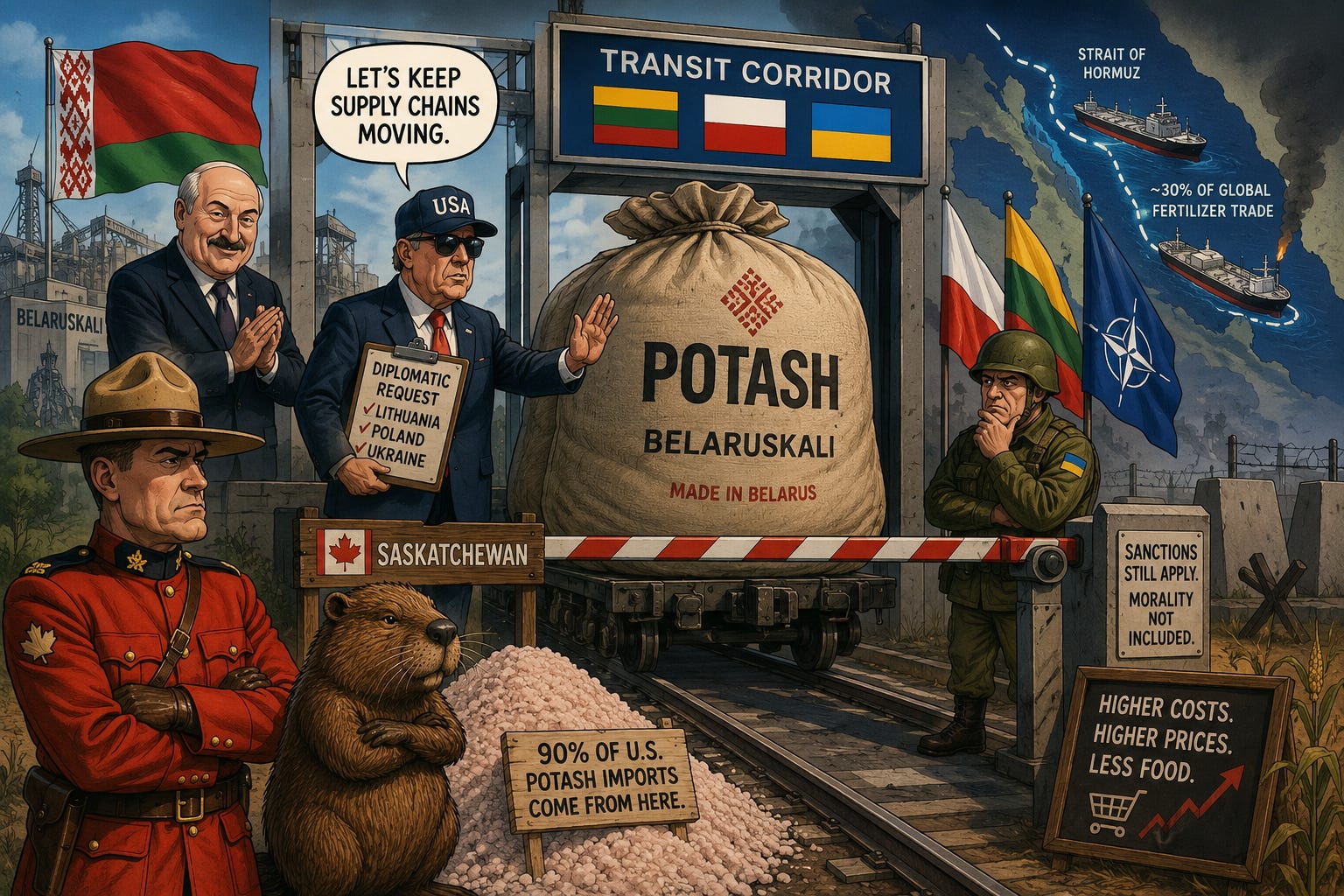
The United States has asked Lithuania, Poland, and Ukraine to allow the transit of Belarusian potash through their territories, according to an unsigned diplomatic document obtained by RFE/RL. The request follows Washington’s decision in March to lift sanctions on Belaruskali - one of the world’s largest potash producers and the single biggest source of revenue for Alexander Lukashenko’s government.
For Kyiv, the request borders on geopolitical absurdity: facilitating export revenues for the very regime that helped launch the war now devastating Ukraine.
Ukraine’s Foreign Ministry confirmed receipt of the document but declined to comment further.
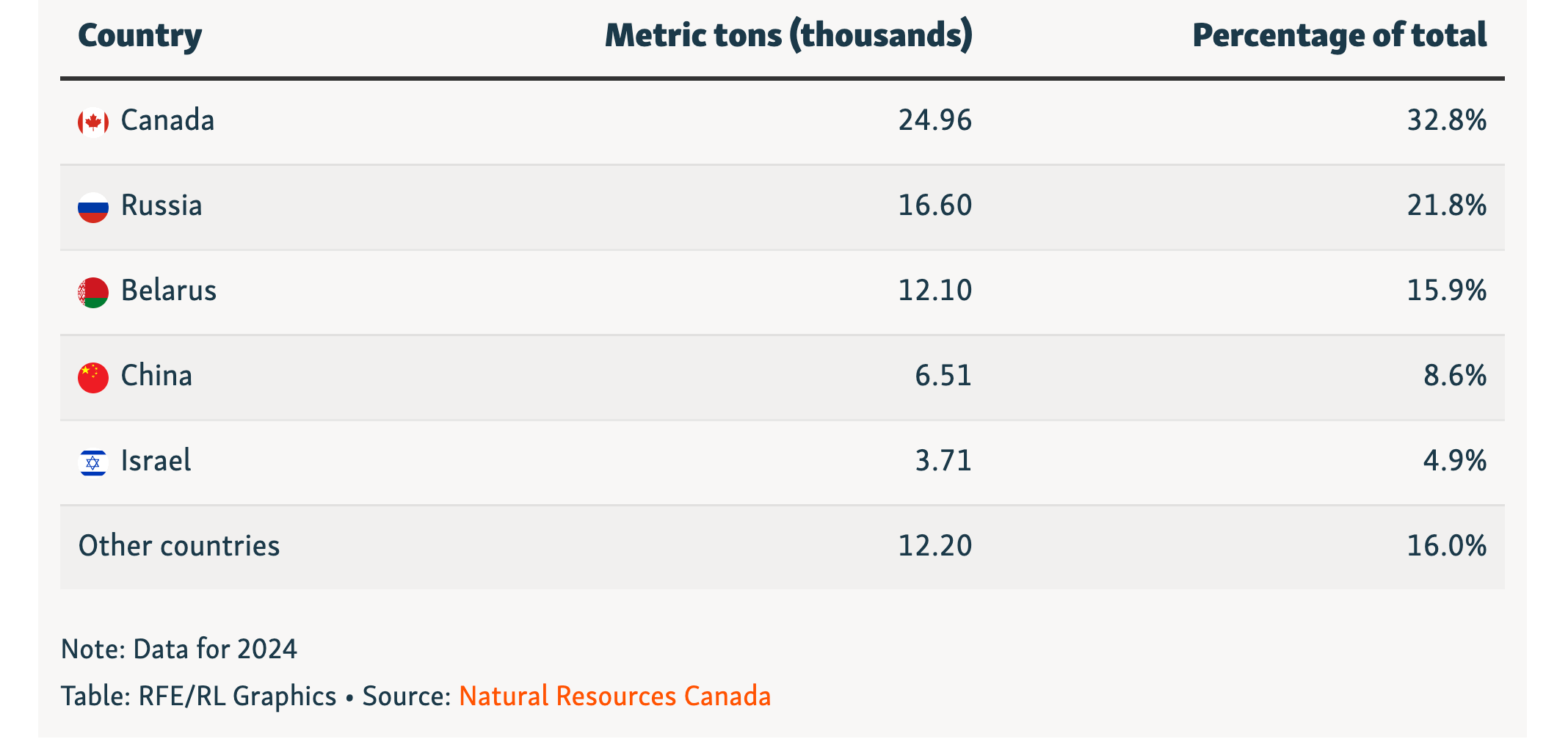
The backdrop is a deepening anxiety in Washington over fertilizer supply. Russia and Belarus together account for more than a third of global potash production, while Canada - specifically Saskatchewan - supplies nearly 90 percent of US imports. With the Canada-US-Mexico Agreement heading into renegotiation this summer and the mood in Washington described as confrontational, the Trump administration appears to be building alternative leverage before any tariff confrontation.
The calculus was made explicit last December, when Washington struck a deal with Minsk: 123 political prisoners released in exchange for sanctions relief on potash exports. Critics note the arrangement handed Lukashenko a significant economic lifeline dressed up as a human rights win.
The pressure intensified dramatically after Iran moved to disrupt traffic through the Strait of Hormuz - a chokepoint tied to roughly 30 percent of global fertilizer trade. The resulting spike in shipping risk and input prices has turned fertilizer security into a strategic concern inside Washington.
But industry analysts caution that Belarusian potash is no easy substitute for Canadian supply. The logistics alone - ocean freight, US port congestion, and long inland hauls - would substantially raise costs for American farmers, who would likely pass them on to consumers. “They will inevitably have to buy Canadian potash or face having substantially less food grown in their country,” said Matt Simpson, CEO of Brazil Potash.
For now, Warsaw, Kyiv and Vilnius have not responded publicly to the US request. Their answer - shaped by both alliance politics and proximity to Belarus - may be the next indicator of how far Washington is willing to push this particular gambit.
Ukraine is being asked to facilitate exports that would directly benefit the regime that permitted Russia to use Belarusian territory to launch its 2022 invasion
US Secretary of State Marco Rubio said there has been “slight progress” in Pakistan-mediated talks to end the Iran war, while warning against what he described as Tehran’s attempt to establish a tolling system in the Strait of Hormuz, which he said no country should accept. Speaking to reporters on May 22 in Helsingborg, Sweden, where he was attending the second day of a NATO foreign ministers’ meeting, Rubio said discussions mediated by Pakistan had shown limited but positive movement. “There has been some slight progress,” he said. “I don’t want to exaggerate it, but there’s been a little bit of movement, and that’s good.” His comments came as Pakistan’s powerful army chief, Asim Munir, traveled to Tehran, according to media reports in Pakistan and Iran. The Iranian state-run IRNA news agency and Pakistan’s Dawn newspaper both reported that Munir was expected to hold talks with senior Iranian officials. Munir’s trip -- his second to Tehran since a cease-fire between the United States and Iran went into effect on April 8 -- has raised hopes that the United States and Iran are close to agreeing a draft peace agreement - RFE/RL
US President Donald Trump said he would deploy 5,000 troops to Poland, reversing a prior decision as European leaders vie to contain a growing transatlantic rift. The continent is nonetheless bracing for a potential wider US troop drawdown expected to be announced as early as today, Politico reported. The straining of ties — the US Secretary of State voiced disappointment with NATO’s lack of support for the US war with Iran — has led analysts to question the alliance’s future viability, with some leaders calling on Europe to reduce its military dependence on the US. Greater defense spending would allow Europe to address the US from a position of increased “diplomatic leverage” Greece’s prime minister told the Financial Times - Semafor
Russia’s agricultural watchdog announced Wednesday a temporary restriction on all flower imports originating from or transiting through Armenia, a move that comes amid fraying relations between the two countries. Rosselkhoznadzor claimed the ban, which takes effect on Thursday, is aimed at protecting domestic plant safety and domestic producers. Out of 96.2 million flowers imported from Armenia, inspectors flagged 135 cases requiring “quarantine” measures, the agency said without providing further details. The restrictions will remain in place until inspections of Armenian greenhouse facilities can be carried out. Armenia supplies around 10% of Russia’s cut tulips, and Armenian roses retail for up to 60% less than competing imports from Ecuador, according to the Kommersant business newspaper. Rosselkhoznadzor’s announcement follows weeks of diplomatic friction ahead of parliamentary elections in Armenia next month. Prime Minister Nikol Pashinyan’s party faces off on June 7 against an array of opposition parties dominated by pro-Russia groups.
New York Times publisher AG Sulzberger slammed President Donald Trump’s incursions on press freedom and chastised the news outlets he accused of caving to White House pressure in a speech Thursday night. The Times has been embroiled in several major lawsuits against Trump and the federal government, both as a defendant and plaintiff, since the president returned to the White House last year. “It serves no one to sidestep the reality that President Trump has used an increasingly broad suite of tools and powers to go after the press far more aggressively than his modern predecessors,” Sulzberger said. He listed off the Pentagon’s loyalty policy for the media; Trump’s lawsuits against the Des Moines Register, The Wall Street Journal and the BBC; and CBS’s altered programming, personnel and policies under its new owner, David Ellison. Sulzberger reprehended publications he said have settled “winnable cases” with the president, refocused their editorial pages away from White House criticism and adopted Trump’s favored language in their reporting, such as swapping out the Gulf of Mexico for the Gulf of America — all to “appease the administration or advance their business interests…Such capitulation, even seemingly small instances of it, serves only to embolden the administration to keep attacking the press,” he said. “A number of news organizations have risen to the occasion by pushing back on the Trump administration’s efforts to attack and punish independent journalism,” he said, shouting out the Journal, Associated Press and NPR. “That’s important because, without brave clients, good lawyers can neither assert nor defend the rights of a free and independent press.” - Politico
The journals….