Michael O’Leary, Ryanair’s combative chief and arguably the king of low-cost flying, has launched another broadside against Brussels. This time, he may have a point.
In a Euronews interview this morning, the argumentative and sometimes foul-mouthed O’Leary called European Commission President Ursula von der Leyen “useless”, accusing her of preaching competitiveness while delivering none. He wants the EU to stop loading costs onto short-haul European flights while US, Asian and Chinese carriers on long-haul routes into Europe largely escape the same levies, even though those flights produce more than half of European aviation’s emissions.
He’s backing words with action. As Ryanair’s winter schedule kicks in, it is cutting a million seats and 20 routes from Belgium over a tax rise to €7 per ticket. That’s still well below the Netherlands (€30.25) or Germany (€13.03). He also warns fares will rise sharply in 2027, when Ryanair’s fuel hedge at around US$67 a barrel expires. Brent crude has just topped US$110.
But this is about more than one airline boss picking a fight.
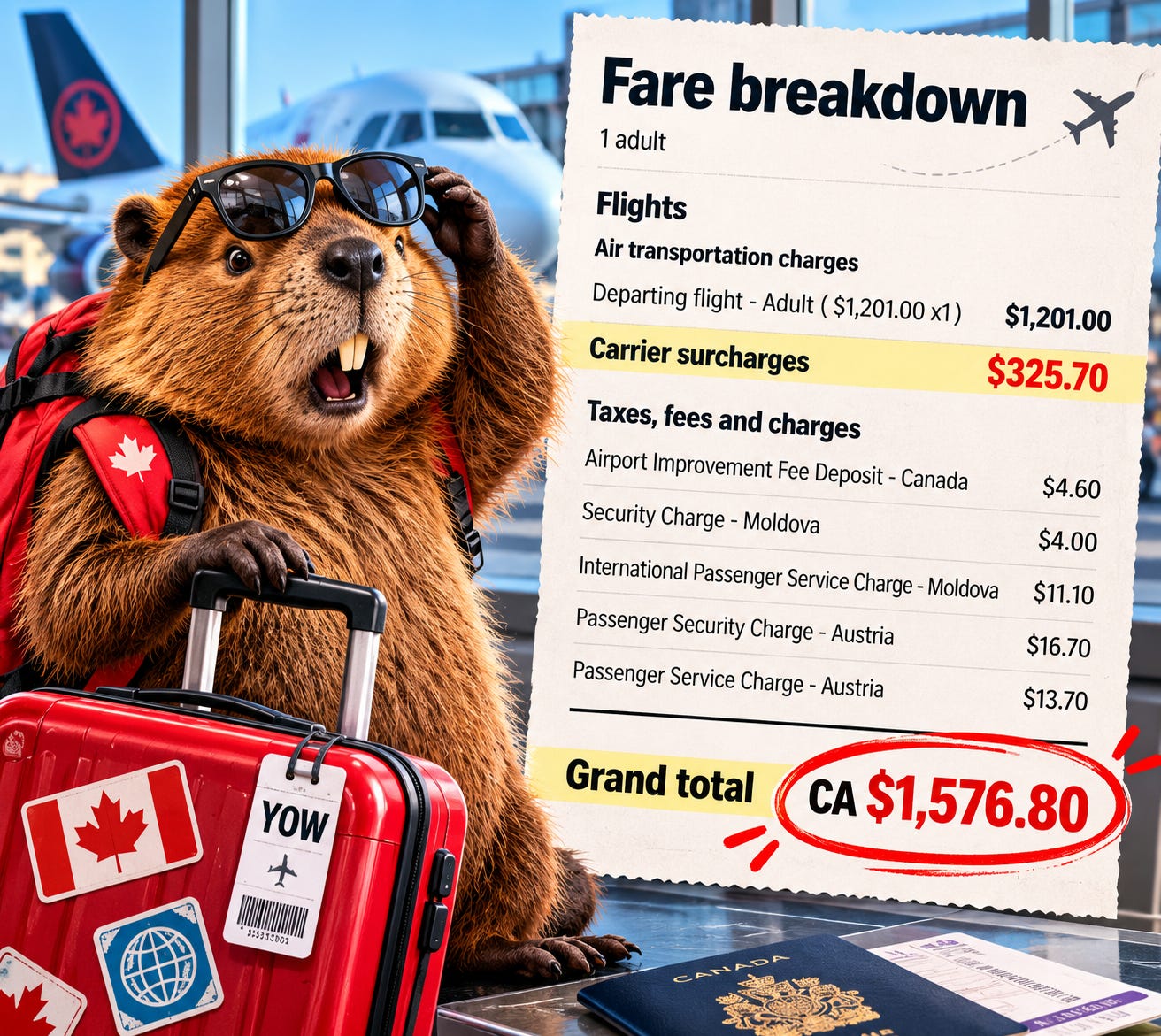
Today I priced two one-way economy tickets to Ottawa on Air Canada for early November. The cheapest fare from Chișinău, a bare-bones Basic ticket with no refund, no free checked bag and a 19½-hour layover in Montreal, came to C$1,576.80. The cheapest non-stop from London cost C$2,866.70. One way and off season!
Now look at the breakdown. On the Chișinău ticket, Moldovan, Austrian and Canadian taxes and fees totalled just C$50.10. Air Canada’s “carrier surcharge” was C$325.70, more than six times as much. From London, the UK’s steep Air Passenger Duty and service charge came to C$288.10, and Air Canada still topped that with a C$384.60 surcharge. What’s in it? According to Air Canada’s own website, a mix of fuel, navigation charges and environmental compliance costs, plus “fare premiums” for peak travel periods. In other words, part of it is simply more fare by another name. Passengers are never told how much of the surcharge is which.
O’Leary says Ryanair guarantees no fuel surcharges. Legacy carriers say theirs cover volatile costs such as fuel. Fair enough. But when fuel prices fall, do the surcharges follow, or do they become another permanent revenue stream? With the Middle East war driving up jet fuel, expect another nasty surprise.
Governments aren’t blameless either. On a recent trip from Ottawa via London and Istanbul to Chișinău, I paid a C$45.20 Canadian Airport Improvement Fee, C$34.42 for security and C$42.10 for a UK passenger service charge, before the Turkish and Moldovan charges. Even points don’t spare you. A Rome–Brussels Aeroplan redemption way back in late 2023 cost me 7,500 points plus C$84.40 in cash, including five separate Italian taxes and charges.
Someone has to pay for security, air traffic control and infrastructure. But who scrutinises this ever-growing pile of fees?
Then there are the airports, many now shopping malls with runways attached. At Gatwick, you navigate a luxury retail maze to reach your gate, and it costs £10 just to drop someone off, up from £7. Heathrow brought in its own £5 drop-off charge in late 2021, while passengers were still nervous about flying after Covid. According to an RAC analysis, drop-off charges at major UK airports have risen by a third on average since summer 2025. The pushback has been loud enough that the UK government has now ordered a review, urging airports to show restraint where public transport alternatives are limited. Revenue is rising faster than service.
O’Leary is no innocent bystander. Ryanair pioneered à-la-carte flying, charging for everything from bags to seats. But low-cost carriers also put flying within reach of millions.
Brussels, meanwhile, talks endlessly about competitiveness. Two years ago, former Italian prime minister and European Central Bank chief Mario Draghi handed the EU a blueprint to stop Europe falling behind the US and China. O’Leary claims not one of its recommendations has been implemented. A recent assessment puts the figure at about a quarter. Either way, it’s hardly the pace the moment demands.
One final note on accountability: I’ll soon appear on CBC’s Go Public, alongside other Canadian travellers, discussing flight cancellations and the explanations airlines give. My case involves Air Canada. I’ll leave the details to CBC.
For decades, low-cost carriers democratised flying. Now, between government taxes, airport charges, airline surcharges and soaring fuel, air travel risks becoming a privilege of the well-off again.
Everyone takes a slice. Nobody takes responsibility for the final bill.
Your turn. Have you been hit by a carrier surcharge bigger than the taxes on your ticket? Send me your fare breakdowns: just post in the comments (please black out your name and booking reference). I’ll go through what you send and follow up later this week. The airlines are giants, but receipts are hard to argue with. Let’s shake the tree.
What I Told CNN: Don’t Trust the Oslo Optimism
Speaking to Max Foster on CNN International tonight, I made the point that Washington’s actions over the past week, and Donald Trump’s words in the past few minutes, give me no faith whatsoever that he’s interested in giving Ukraine a fair break.
The upbeat messaging out of Oslo, where Zelensky met US envoy Steve Witkoff alongside Finland’s Alexander Stubb and Norway’s Jonas Gahr Støre, has been contradicted almost line by line by Washington. Consider the speed caps on Ukraine’s Starshield-linked drones, the Patriot deliveries that haven’t materialised, the waiver of new Russia sanctions and the intelligence pauses, which the US disputes. Then, hours after Russia struck a Kyiv cardiology hospital for the second time, Trump declared from the Oval Office that it’s “time for Ukraine to end this war.”
Oslo, frankly, is a sideshow. It will be Trump who decides what happens. Is Putin in the mood for a deal? Of course not. With the front foot, as Max put it, he wants it all. Hence his proposal for a three-way meeting with Trump and Xi in Shenzhen next month to discuss Ukraine, without Zelensky in the room, an idea Trump appears to be warming to. If they want to form that kind of club, they might as well invite Iran and North Korea too, since both are helping Russia wage this war.
And watch for the next move after the midterms: Trump encouraging Putin to attend the G20 at his Doral resort in December. What a contrast. Last year’s G20 host, South Africa’s democratically elected president, has been told not to come, while a man wanted by the International Criminal Court for war crimes gets the welcome mat.
Here’s the video. You can watch the full CNN interview below.
News Briefs
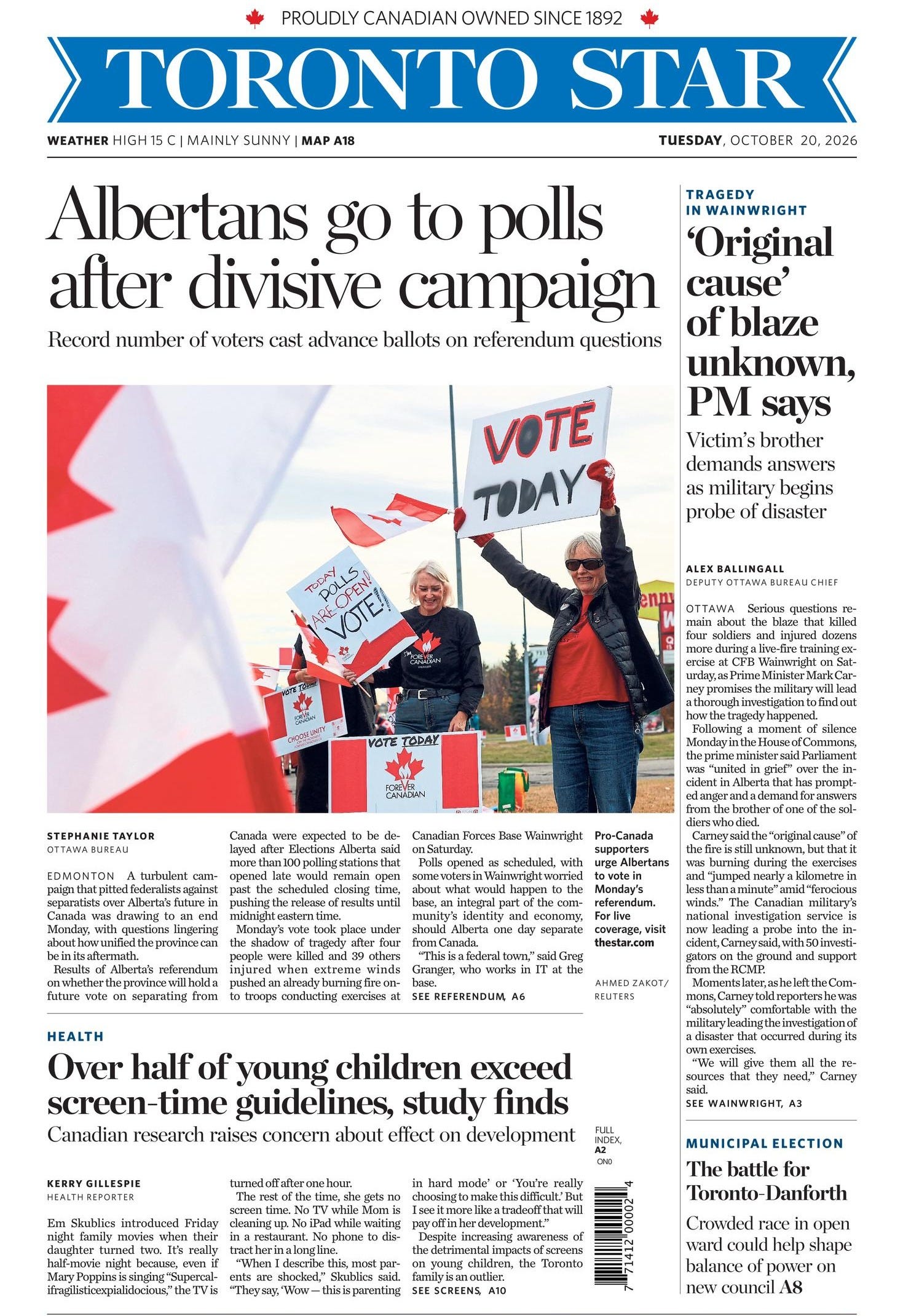
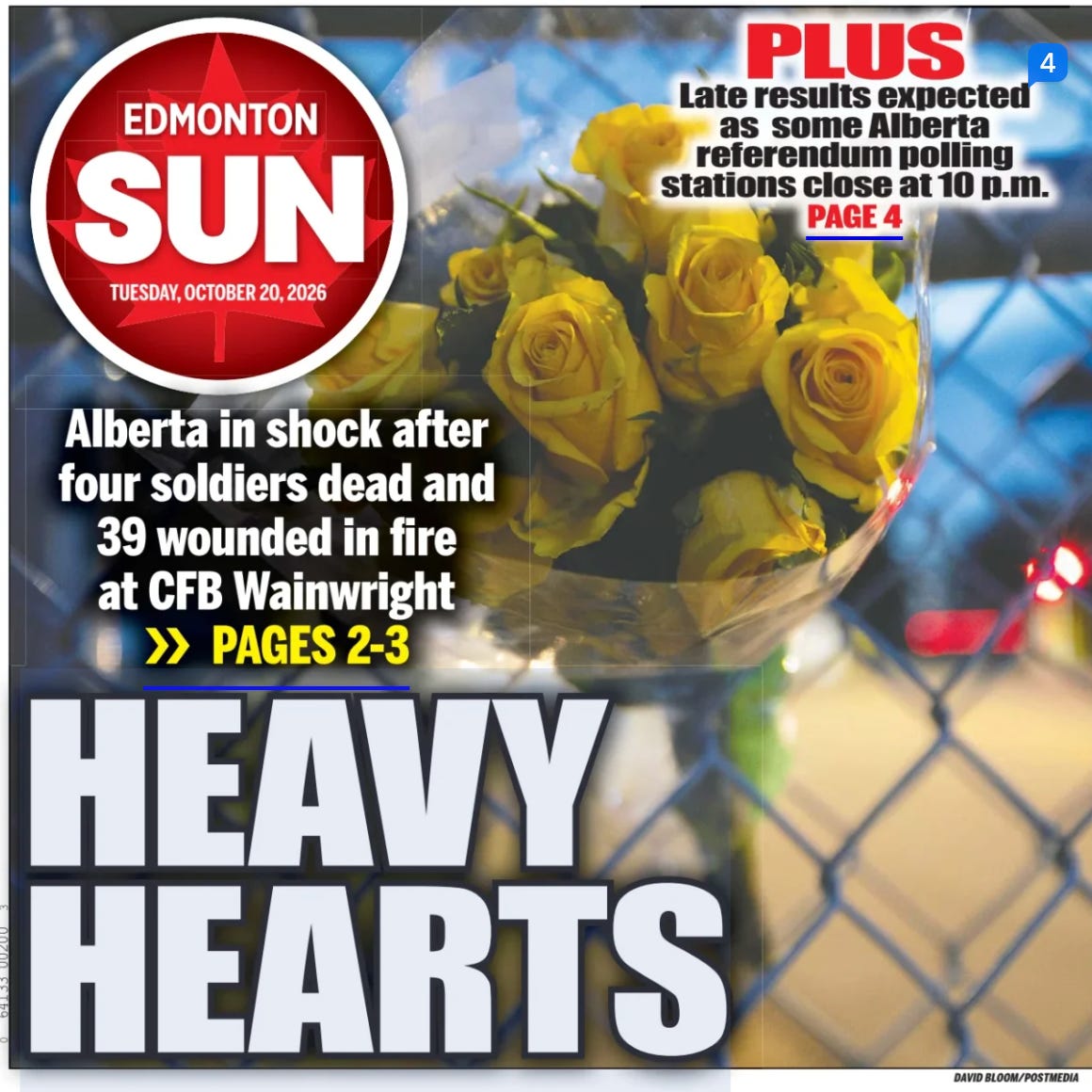
On Monday, people in the oil-rich, western Canadian province of Alberta voted in a referendum that could have important consequences for Canada’s future. But the question attracting the most attention may not be the one that matters most. The tenth question asked Albertans whether they want to remain in Canada or take the next step toward separation. As of the time of writing, only a quarter of Alberta voters opted for another referendum. Three-quarters opted against another referendum and said they wanted to remain in Canada. But results from the other nine questions may tell a more interesting story. All but Question 10 garnered majority support. Ipsos polling for Global News also found that Canadians outside Alberta supported eight of the nine proposals by majority. Albertans may have rejected separation for now, but they also endorsed an agenda for changing Canada that has considerable support elsewhere in the country. Prime Minister Mark Carney seems to understand the message he received. At a rally in Calgary on October 15, he urged Albertans to reject the other nine questions with the slogan “No to the Nine.” Carney wasn’t simply campaigning against separation. He was taking a position against proposals that could reshape our country. The remaining nine questions cover two broad areas. The first five concern immigration and access to public services. They propose greater provincial control over immigration, lower immigration levels, employment preferences and restrictions on access to publicly funded services for temporary residents. They also address proof of citizenship for provincial voting. The other four concern the federal system itself. They propose provincial control over appointments to superior courts, abolition of the Senate, the right to opt out of federal programs without losing funding and provincial laws taking precedence over federal laws in areas of provincial or shared jurisdiction. Some proposals would require constitutional changes. Others could be addressed through existing legislation. None automatically becomes law even though Albertans voted for them. But majority support has given Premier Danielle Smith justification to pursue them - Global News
Quebec’s recent election adds another layer. Voters there have just elected a sovereigntist Parti Québécois government. Alberta and Quebec have different objectives, but both could find common cause in demanding greater provincial autonomy. Ottawa could soon face demands from two provinces with very different motivations seeking fundamental changes to Confederation - Global News
French Prime Minister Sébastien Lecornu has promised a “massive” security operation for further protests expected on Saturday, after weekend cost-of-living demonstrations turned violent across France. Interior Minister Laurent Nuñez told parliament that soldiers from Operation Sentinelle, the 10,000-strong counter-terrorism force deployed since 2015 at schools, places of worship, stations and airports, will take over static guard duties. That frees police and gendarmes for public-order work against what he called “scattered” and “extremely mobile” groups. Paris imposed partial curfews in some neighbourhoods on Monday night, from 11pm to 6am, Euronews reported.
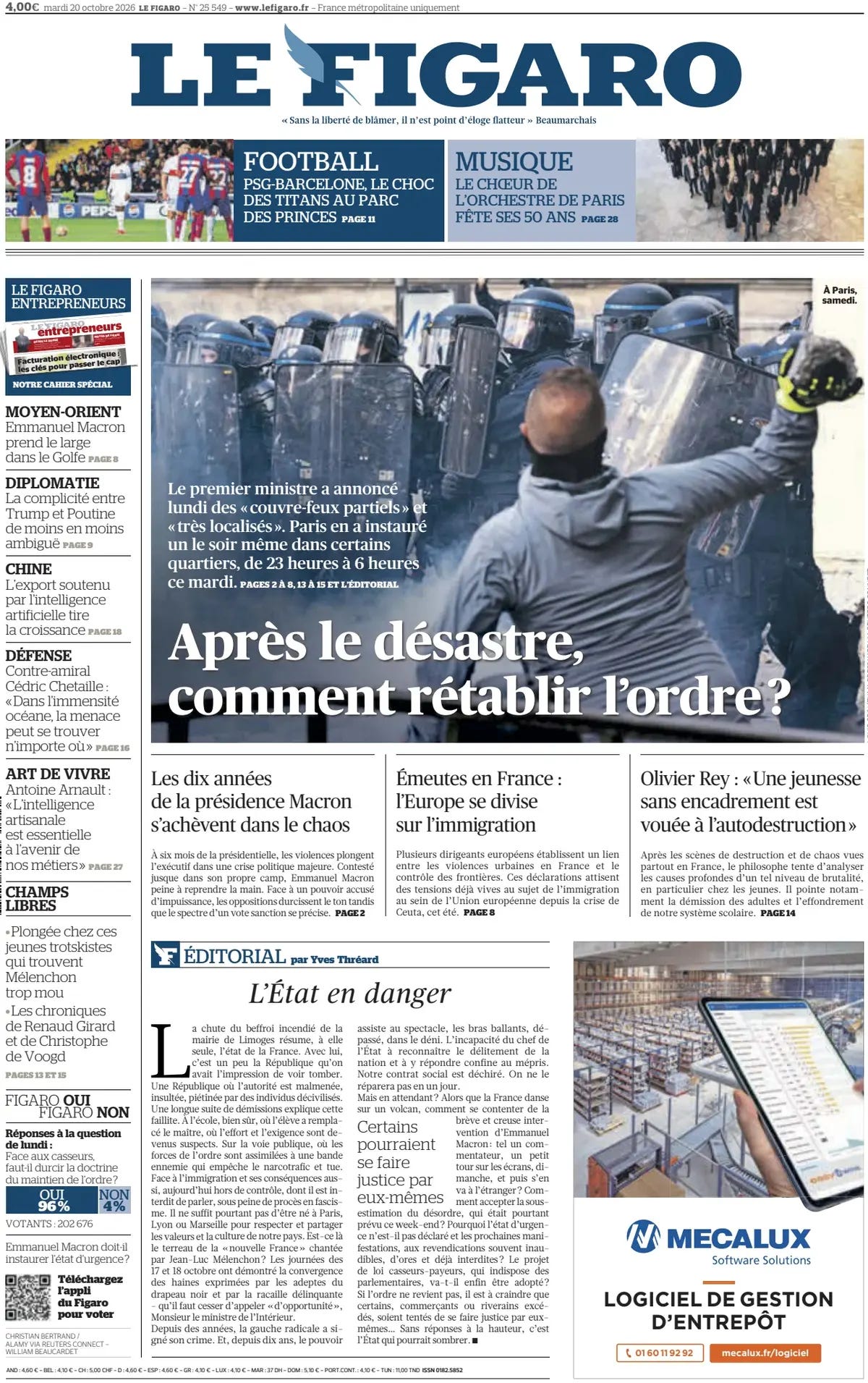
The mood in the French press is grim. Le Figaro’s front page today (see below) says Macron’s ten-year presidency is ending in chaos, six months before the next presidential election. In an editorial headlined “The State in Danger,” Yves Thréard takes the collapse of the fire-gutted belfry at Limoges town hall as a symbol of the country itself. He describes a republic where authority is mocked and police are treated as the enemy, and asks why no state of emergency has been declared. He also mocks the president’s brief television appearance on Sunday, after which he left for abroad. His warning: without a response equal to the moment, “it is the State that could founder.”
Meanwhile, seemingly unfazed by the turmoil at home, Macron was basking in full state honours in Doha, complete with cannon salvos and a cavalry procession. He is seeking Gulf energy deals to help ease fuel prices in France and positioning Paris as a player in regional stability.
It reminds me of the waning days of Justin Trudeau’s last term, when he seemed to spend more time abroad, basking in an adoring international press, than at home answering questions about the economy and his own scandals. Leaders on the way out often find a warmer welcome overseas than in their own capitals.
U.K. fighter jets will be sent to aid Saudi Arabia in defending itself against attacks on critical energy and civilian infrastructure by the Houthis. The Iranian-backed Islamist militia group, based in civil war-hit Yemen, has been launching ballistic missile strikes on Saudi Arabia for the past few weeks, successfully hitting three airports earlier this month. The Ministry of Defence announced Tuesday that Royal Air Force Typhoon fighters will be deployed to the Gulf Kingdom — while stressing that they will be only used in a defensive capacity. U.K. Defence Secretary Wes Streeting said the “continuing attacks” on the U.K.’s ally are “absolutely despicable.” “The targeting of the airport in Riyadh in particular shows the lengths the Houthis are going to escalate the situation in the region,” he added, referencing the attacks earlier this month that killed 14 people and injured hundreds more. Streeting said that the fighter jets will be used to protect Saudi airspace from drones and missiles. The U.K. will also send an Atlas A400M aircraft, used to transport the equipment, as well as military advisers - POLITICO
Counter Terrorism Policing in the United Kingdom have re-arrested the two men on Tuesday as part of the investigation into activity near RAF Fairford in Gloucestershire last month. The 24-year-old UK national and 25-year-old dual UK and Iranian national, both from the borough of Westminster, London, were arrested on suspicion of assisting a foreign intelligence service. Police added that it was “highly likely that there is Iranian state involvement” after three large vans were stopped near the airbase in the early hours of 27 September. The 24-year-old man was initially arrested that day near RAF Fairford and the 25-year-old was later arrested on 1 October in Westminster, central London. Five other UK nationals in their mid-20s were also arrested after the incident, all are still on police bail as the investigation continues. - Sky News
Georgia’s Constitutional Court will begin hearings on October 21 that seek an outright ban on the country’s largest opposition parties, a move critics say would undermine fundamental democratic freedoms in the Caucasus nation. The court will convene for three days in the Black Sea city of Batumi to consider the case brought by the ruling Georgian Dream party, which has been in power since 2012. A final ruling must be delivered by June 24, 2027. Rights groups, the European Union, and others have criticized the ban, saying it could further fracture Georgian politics and society and hinder the country’s ties with the West. An alliance of opposition parties in Georgia has vowed to protest the ban “fearlessly and forcefully” with a monthlong series of major rallies across the country. The opposition has denounced the proceedings, describing them as politically motivated and arguing the ruling party is seeking to eliminate its main competitors. Georgian Dream officials, including the party’s founder Bidzina Ivanishvili -- a billionaire businessman who amassed a fortune in Russia before serving as Georgia’s prime minister from 2012 to 2013 -- have repeatedly threatened to ban the opposition parties, saying the move protects the constitutional order - RFE/RL
The journals…