

World Briefing Hot Take
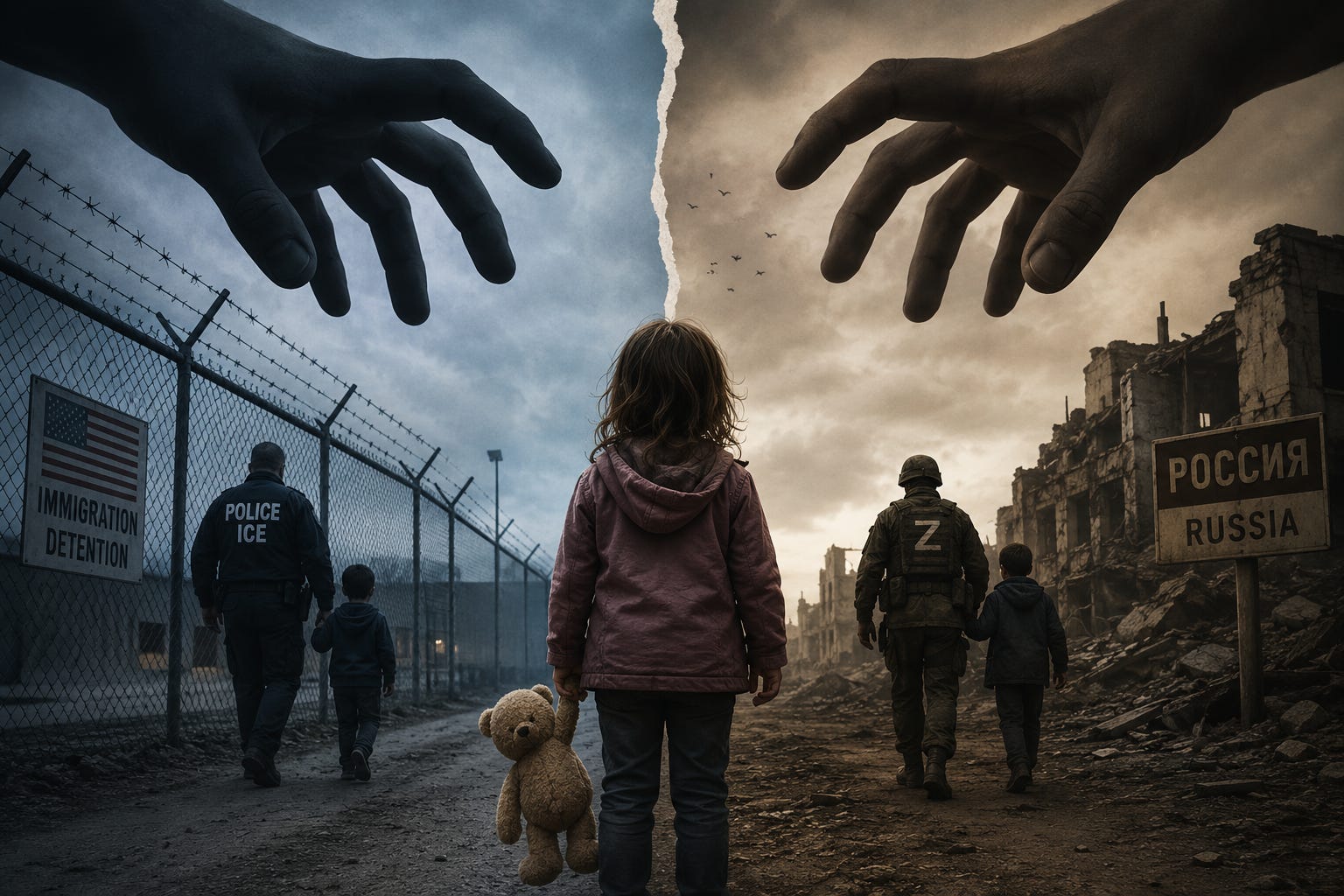
This edition pairs two stories that, on the surface, could not seem more different - one from the plains of North America, one from the killing fields of Eastern Europe. But they share a single, haunting thread: children separated from their parents by the decisions of states, with no adequate system to protect them, track them, or bring them home.
In the United States, an estimated 145,000 American citizen children have lost a parent to immigration detention - and the government, by its own admission, is barely keeping count. In Ukraine, 20,000 children have been taken across a border by force, their identities methodically erased. In both cases, the systems built to separate families move faster than the systems meant to protect children.
The scale is different. The intent is different. But the children are the same - voiceless, uncounted, and waiting.
Russia's forced deportation of thousands of Ukrainian children to the Russian Federation is a grave violation of international humanitarian law. The international community considers these actions to be war crimes, crimes against humanity, and acts of genocide - OSCE Parliamentary Assembly
The Children ICE Doesn’t Track
A new report from the Brookings Institution estimates that the Trump administration’s immigration enforcement campaign has separated roughly 145,000 American children from at least one parent since January 2025 - a figure more than double the 60,000 cited by the Department of Homeland Security.
The discrepancy, researchers say, reflects a deeper problem: the government simply isn’t tracking what happens to these children. ICE has no formal obligation to record detainees’ parental status, and immigrants are often reluctant to disclose it. Brookings estimates only about half of affected children are captured in official data.
Most of the children are U.S. citizens. Roughly a third are under the age of six. When a parent is detained or deported, there is no federal system to verify the child’s placement is safe - the child welfare system only intervenes in cases of alleged abuse or neglect. In at least one case reported by the Washington Post, a deported mother’s toddler - a U.S. citizen - was left with a violent relative, who allegedly killed him.
Brookings researcher Tara Watson is calling on the government to collect and publicly release data on affected children as a first step, noting that some U.S. citizen children are boarding deportation flights voluntarily alongside their parents — with no official accounting of the practice.
Ukraine’s Stolen Children
Since Russia’s full-scale invasion of Ukraine, an estimated 20,000 Ukrainian children have been forcibly deported to Russia - separated from their families, stripped of their identity, and subjected to systematic Russification. They are taught Russian, immersed in state propaganda, and encouraged to reject their Ukrainian identity.” Some reportedly receive military training. For those now entering their teens, the darkest projection is that they could one day be deployed to fight against Ukraine - possibly against their own relatives.
The situation is a race against time. The longer these children remain in Russia, the more deeply they are absorbed into a society built to make them forget who they are. Researchers at the Reckoning Project, among others, are working to track and identify the children, with the goal of eventual reunification with their families - but each passing month narrows that window.
The international response has been muted. From Washington, there has been little beyond occasional statements. Whether the issue was raised during President Trump’s recent letter (penned by his wife) - delivered by hand to Vladimir Putin and delivered in Alaska - remains unclear. Ukraine’s supporters say the U.S. has significant leverage it has yet to apply.
The forced deportation of children is classified as a war crime under international law. It is also the charge at the center of the ICC arrest warrant issued against Vladimir Putin in 2023, as well as Maria Lvova-Belova (Commissioner for Children's Rights).
And in both cases, some children may never fully be counted at all.
For those Ukrainian children now entering their teens, the darkest projection is that they could one day be deployed to fight against Ukraine - possibly against their own relatives

This is a special World Briefing edition - the kind of cross-border, connective reporting and analysis you are unlikely to find anywhere else. We believe the most important stories are often the ones hidden between headlines: the human consequences that link wars, migration, power and policy across continents.
If you value this kind of independent, out-of-the-box journalism and geopolitical analysis, please consider supporting World Briefing through an upgrade to a paid subscription - or via PayPal or Patreon. Your support helps keep this reporting independent, global and deeply human.