

I’m writing today’s edition from Bogotá, where conversations about cocaine quickly reveal an uncomfortable truth. Colombia is still expected to solve what is ultimately a global demand problem. Production has spread far beyond the days of Pablo Escobar because the economics remain irresistible - and because consumers elsewhere, shall we mention France and the United States? - continue to create the market. As a tough new president known as “El Tigre” - Abelardo de la Espriella - prepares to take office promising another crackdown, perhaps the more radical question isn’t how Colombia fights cocaine, but whether the rest of the world is prepared to confront its own role in sustaining the trade. More reporting from the ground over the coming days.
The world is our newsroom. This week, that newsroom is Bogotá.
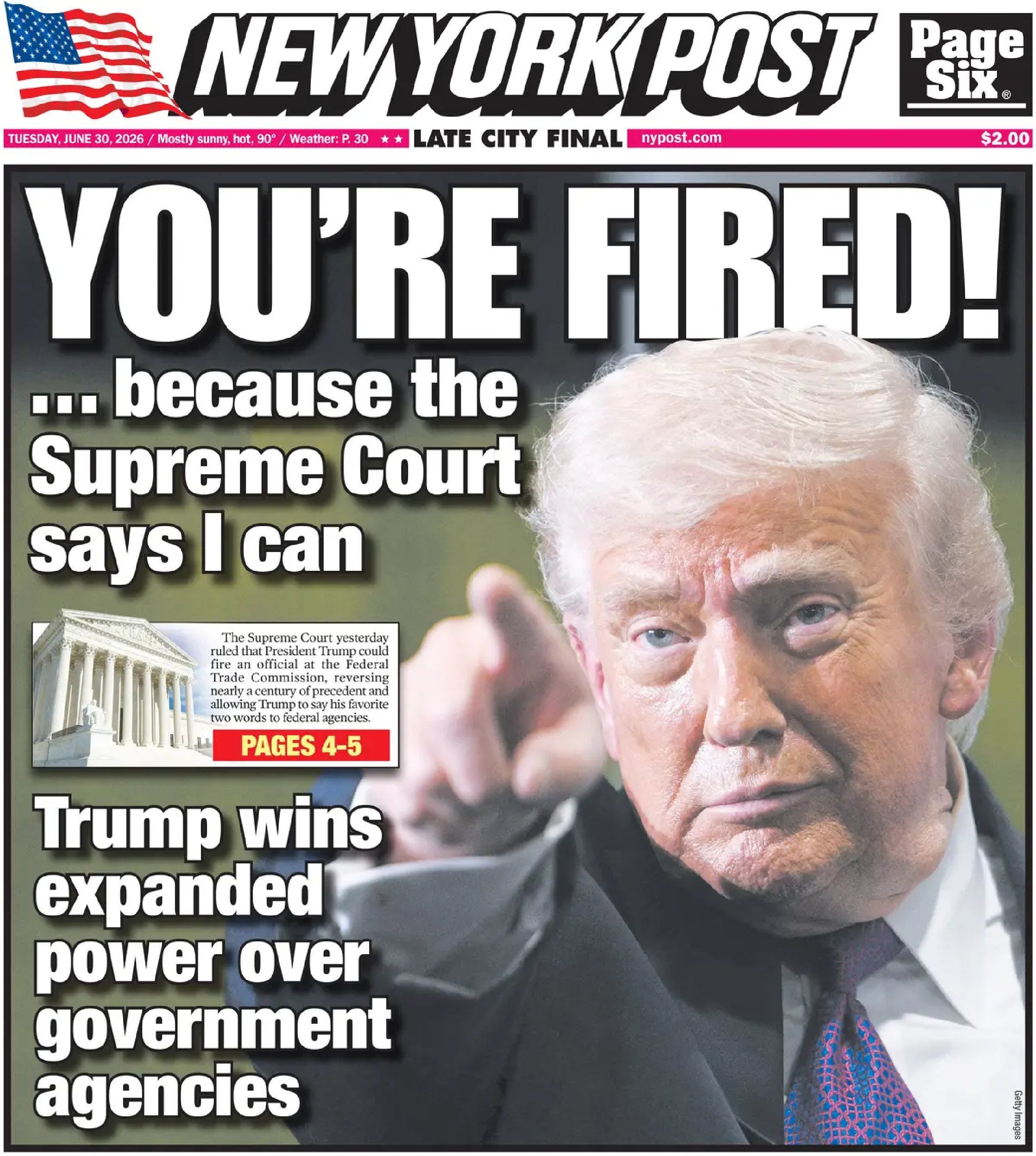
The Supreme Court rejected President Trump’s attempt to end birthright citizenship, and the justices reaffirmed the long-held principle that nearly all children who are born on U.S. soil are American citizens. Mr. Trump’s executive order had aimed to prevent babies born to undocumented immigrants and temporary foreign residents from automatically becoming Americans. Chief Justice John G. Roberts Jr., writing for the majority, explained that Mr. Trump’s executive order violated the 14th Amendment of the Constitution. “Citizenship, then and now, was the right to have rights — to freely participate in our political community,” Chief Justice Roberts wrote. “The framers of the 14th Amendment extended that promise to ‘every free-born person in this land.’” He added: “We keep that promise today.” The 6-3 decision capped a more than decade-long effort by Mr. Trump to use the issue as a political tool. In a social media post, the president called the Supreme Court’s decision “too bad for our Country.” He urged Congress to take up the issue with legislation and wrongly asserted that “no long and unwieldy Constitutional Amendment is necessary.” With their decision, five justices — a majority — found that birthright citizenship was guaranteed in the Constitution - NYT
President Trump, in a social media post, wrongly asserted that he could “easily make it up in Congress through Legislation,” and that “no long and unwieldy Constitutional Amendment is necessary.” He urged Congress to start immediately to “work on ending expensive and unfair to our Country, Birthright Citizenship.” In the hours since the Supreme Court’s ruling, some Senate Republicans have already urged Congress to pass legislation or a constitutional amendment to end birthright citizenship, The New York Times reported. But voting on such a measure, even just to placate President Trump, would carry severe political risks for Republican lawmakers, who are already worried about losing their narrow majority in both the House and Senate. Polls show that most Americans support the right to birthright citizenship, including about 40 percent of Republicans. Such a vote could also risk the inroads that Republicans have made with Hispanic voters, as Latino Republicans have historically been more supportive of birthright citizenship. With just over four months until November’s midterm elections, many Republicans will be loath to take a vote that might anger broad swaths of the electorate that could be crucial to the control of Congress.
Crimea is grappling with severe gasoline shortages, rolling blackouts, and water rationing as Ukraine intensifies strikes on supply routes and energy infrastructure serving the annexed peninsula, according to reporting by The Moscow Times. Sevastopol authorities have repeatedly tightened fuel restrictions in recent weeks, moving from cash-only sales to prepaid cards, then to a QR-code rationing system distributed via the state-backed Max messaging app, capping purchases at 20 liters per week. Sales were briefly suspended entirely before limited distribution resumed. Residents described spending hours, sometimes in groups, trying to secure a single code. Crimean and Sevastopol leaders Sergei Aksyonov and Mikhail Razvozhayev declared a state of emergency last week without a set end date. Unlike fuel shortages in fall 2025, which produced long station lines, gasoline is now largely unavailable to private motorists altogether, reserved instead for emergency services and contracted businesses. Some residents have driven to Russia’s Krasnodar and Rostov regions to buy fuel, only to be turned away by stations refusing to serve Crimean-plated vehicles. A black market has emerged, with gasoline reportedly reselling for roughly four times its pre-crisis price. Parallel diesel shortages have limited backup generator use, forcing cafes, shops and malls to close, while power cuts have disrupted water pumping systems - leaving some residents without reliable water in summer heat. The crisis is also hitting Crimea’s tourism sector hard, with hotel and guesthouse owners reporting a wave of cancellations as the peak summer season begins.

Subscribe here
The morality police units once notorious for enforcing Iran’s compulsory hijab law have largely disappeared from public life in major cities, with uncovered hair now common on Tehran’s streets, according to RFE/RL. Residents in Tehran told RFE/RL’s Radio Farda that women now move freely in sleeveless tops, fitted jeans, and uncovered hair without apparent monitoring - a sharp shift from the aggressive street patrols of past years. The change follows the 2022 Woman, Life, Freedom protests sparked by Mahsa Amini’s death in police custody, and has accelerated since Iran’s war with the United States and the unrest that followed deadly anti-government protests in February. Analysts cited by RFE/RL say the shift reflects political calculation rather than genuine reform, with authorities wary of provoking further unrest while the country absorbs the war’s aftermath. Women’s rights activist Mansoureh Shojaee said the law itself hasn’t changed, even as enforcement violence has receded and state TV occasionally shows unveiled women for propaganda purposes. Enforcement remains uneven outside the capital. In Mashhad, one of Iran’s most conservative cities, restrictions persist around religious sites like the Imam Reza Shrine, even as many women go uncovered elsewhere in the city. Risks also remain real nationally — singer Parastoo Ahmadi was sentenced to 74 lashes earlier this year for performing without a hijab. A cease-fire between the US and Iran, signed in April and renewed in June, has coincided with the further easing, sources told RFE/RL.
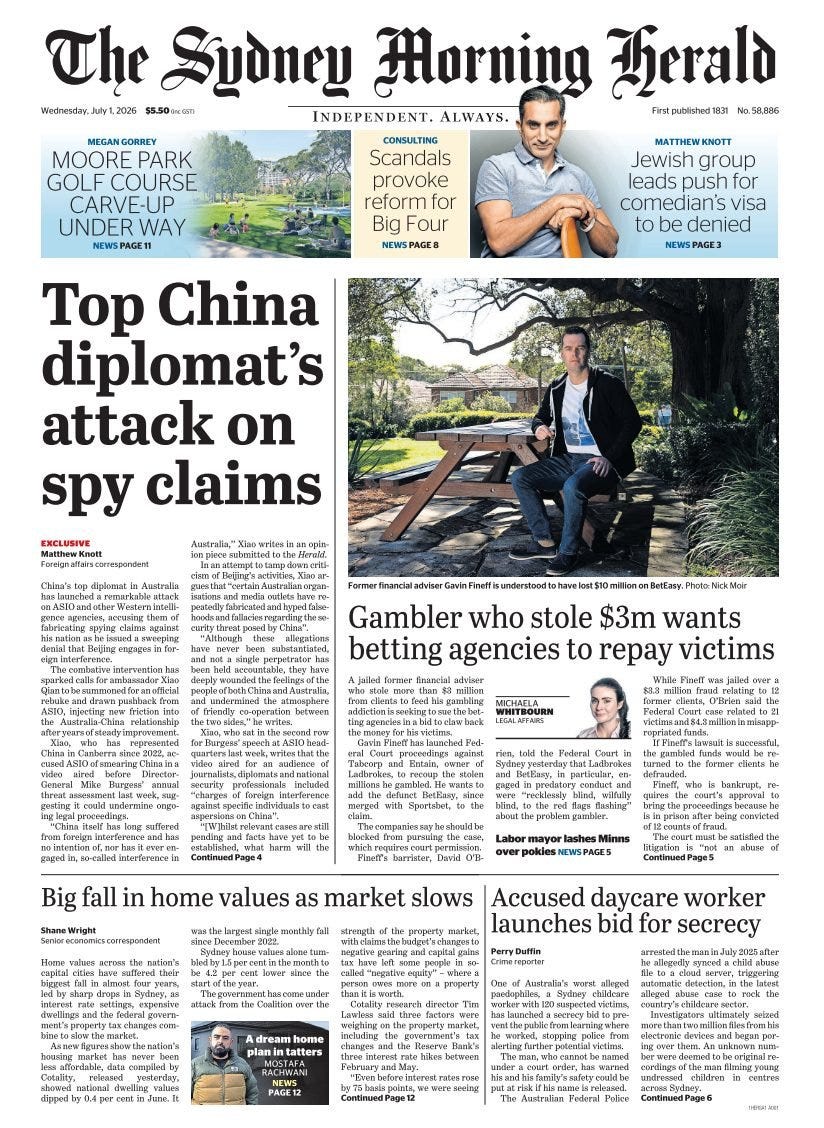
China’s ambassador to Australia has attacked Australia’s domestic spy agency over allegations of foreign interference, warning it risks harming Australia-China relations. Ambassador Xiao Qian has pointed to a video aired before a speech delivered by ASIO Director-General Mike Burgess last week as “casting aspersions” on China, prompting a sharp rebuke from the spy agency. In an opinion piece sent to Nine Newspapers, the ambassador also criticised a joint statement issued by Five Eyes spy agencies — from Australia, the UK, US, Canada and New Zealand — on the risk posed by Chinese intelligence services using sites such as LinkedIn to lure recruits. Mr Xiao labelled the statement “slanderous” and said it “failed to find (or fabricate) any substantive evidence”. The ambassador was in attendance as Mr Burgess delivered his annual threat assessment at the ASIO headquarters in Canberra last week, sitting in the second row during the address - ABC
Taylor Swift’s ex-boyfriend is trying to one-up her upcoming MSG nuptials with Travis Kelce. Conor Kennedy, 31, whom Swift dated in 2012, is planning to marry Brazilian pop star Giulia Marinho, 26, in front of the iconic Christ the Redeemer statue overlooking Rio de Janeiro. “One of the first things I said [to Conor was], ‘I love you, but I’m not getting married in Massachusetts,’” Marinho revealed in an interview with Gshow magazine, explaining her reluctance to hold their wedding near the Kennedy family’s home base. The couple already had a civil ceremony in the U.S. earlier this year, but plan to host a lavish, days-long celebration right beside one of the new Seven Wonders of the World. Invited guests include various members of the Kennedy dynasty and even President Donald Trump, who is invited to support Conor, who is Robert F. Kennedy Jr.’s son. Swift and Conor dated for a few months in 2012, when Swift was 22 and Conor, then 18, was in his senior year of high school. The pop star, once enamored with the Kennedys, bought a $4.8 million home near the family compound, but sold it just three months after finalizing the purchase. Swift is rumored to be marrying Chiefs tight end Travis Kelce in an extravagant ceremony at Madison Square Garden on July 3 - The Daily Beast
The journals…..
The "cartels" are now highly diversifying multi-national criminal organizations. Cocaine is only one of their income sources. Illegal mining, extortion, kidnapping, toll-extraction, and violence due to the complicity of recent government in allowing these gangs to control vast swaths of territory- that's the real problem for Colombians.