U.S. negotiators have been pressuring Ukraine to withdraw from the Donbas as part of a proposed peace deal shaped since last year’s Trump–Putin meeting in Alaska, according to Ukrainska Pravda. The report suggests talks have narrowed to a single trade-off: territory for guarantees and reconstruction funding. Ukrainian officials say this “spirit of Anchorage” dominates discussions - while other issues are largely cosmetic. Kyiv is resisting the U.S. push, arguing that withdrawing from Donbas would weaken defenses, benefit Russian forces, and be politically impossible at home (any deal would require parliamentary approval, which is highly unlikely; Ukrainian society and leadership are not ready to concede territory). Officials increasingly see Washington as aligned with a pre-set outcome, rather than acting as a neutral mediator. There is a growing concern that the U.S. may abandon the negotiation process altogether if no agreement is reached - shifting focus to other priorities like Iran or domestic politics, UP said.
The revelations come as Russia launched one of the largest assaults of the war, firing over 1,000 drones and missiles in 24 hours, including a rare daytime wave of 550 drones hitting cities across Ukraine. Civilian infrastructure, including homes, hospitals, and a UNESCO site, was damaged. An annex connected to the 17th century church, the Bernardine Monastery Ensemble, in the heart of Lviv’s historic quarter took a direct hit and burst into flames. At least two people were killed in Ivano-Frankivsk and one in Vinnytsya, according to local officials. President Volodymyr Zelensky said the attack shows Russia has no intention of ending the war.
The European Union on Tuesday postponed the unveiling of a law that would permanently ban Russian oil imports, coming amid supply disruptions caused by the war in the Middle East. The April 15 unveiling date has reportedly been removed from the European Commission’s REPowerEU roadmap calendar.
EU Commission energy spokeswoman Anna-Kaisa Itkonen said a new date has not yet been determined, but stressed that Brussels remains “committed to making this proposal.” “The proposal will be made,” she was quoted as saying by Euronews. Russian President Vladimir Putin has offered to resume long-term oil and gas supplies to European buyers amid skyrocketing energy prices since the United States and Israel began striking Iran on Feb. 28. European Commission President Ursula von der Leyen said abandoning the EU strategy that seeks to reduce Russia’s energy revenues from funding its war in Ukraine would be a “strategic blunder.” - Moscow Times
Moldova has announced plans to declare a 60-day state of emergency in its energy sector after a key Europe-linked power line was cut following Russian strikes in Ukraine. “We will propose declaring a state of emergency in the energy sector for 60 days. This is not a measure born of panic but of responsibility,” Moldovan Prime Minister Alexandru Munteanu said. Moldova imports most of its electricity from its neighbor, the European Union member Romania, via a power cable that passes through southern Ukraine. Moldovan President Maia Sandu has condemned the Russian strikes on civilian energy infrastructure in Ukraine as “a war crime -- and an attack on all of us…Overnight strikes disconnected Moldova’s key power link with Europe. Alternative routes are in place, but the situation remains fragile. Russia alone bears responsibility,” she said in a post on X - RFE/RL
Called it—wish I hadn’t.
Early in the war, I warned on CNN that Putin would go after Ukraine’s symbolic heart.
Now Lviv’s historic core is attacked - and not for the first time.
Prediction vs reality.
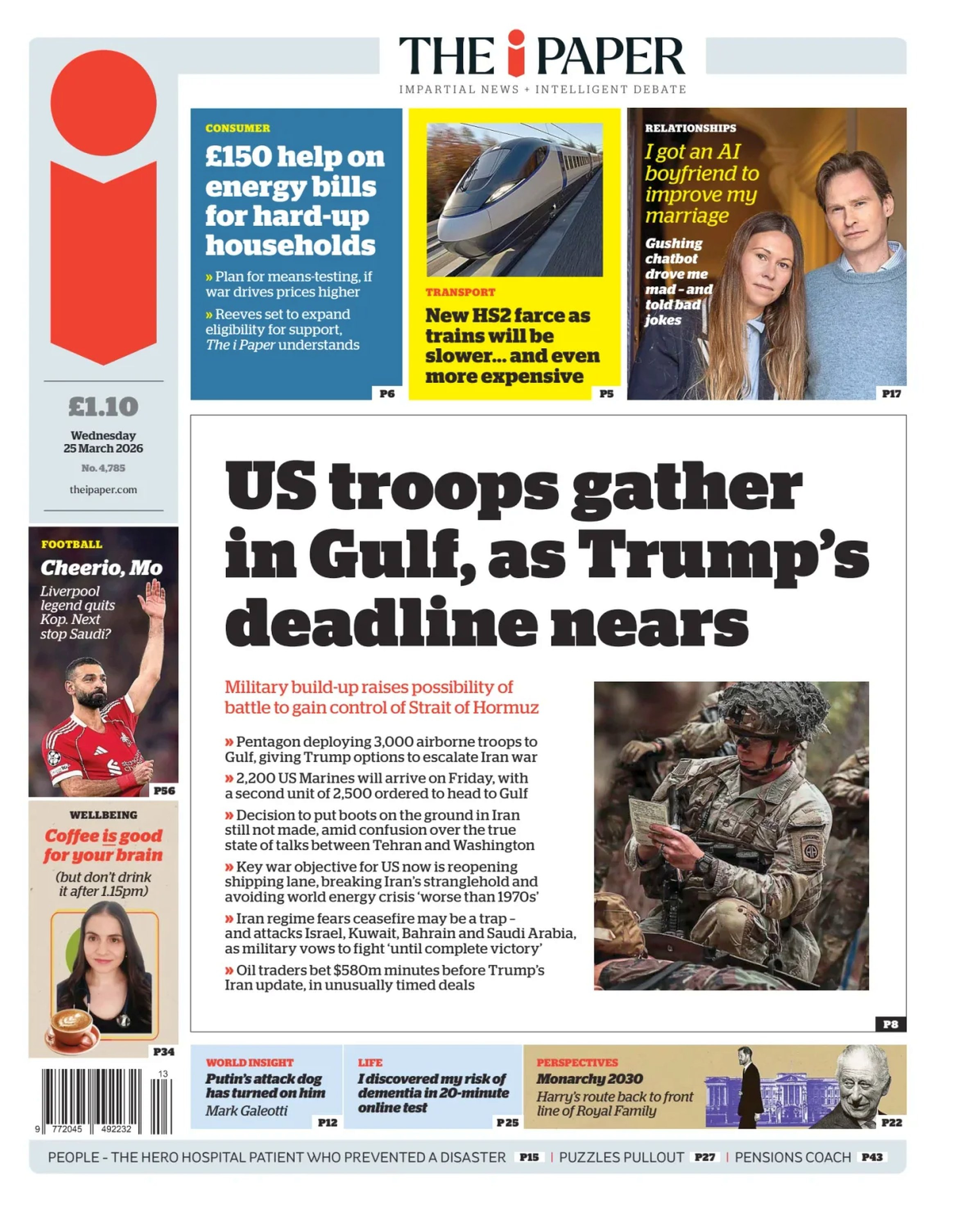
An Iranian military spokesperson mocked U.S. attempts at a ceasefire deal Wednesday, raising questions about whether a 15-point plan proposed by Washington has a chance to succeed. The comments from Lt. Col. Ebrahim Zolfaghari, a spokesperson for the Iranian military’s Khatam Al-Anbiya Central Headquarters, which jointly commands Iran’s regular military and paramilitary Revolutionary Guard, came after the plan was submitted to Iran by intermediaries. U.S. President Donald Trump has said that American officials are negotiating with Iran on the plan, but Zolfaghari, in a recorded video statement that aired on state television, suggested there were no talks. “Have your internal conflicts reached the point where you are negotiating with yourselves?” he said. “Our first and last word has been the same from day one, and it will stay that way: Someone like us will never come to terms with someone like you,” Zolfaghari said. “Not now, not ever.” The 15-point plan was submitted to Iran by intermediaries from Pakistan, who have offered to host renewed negotiations between Washington and Tehran, according to the person, who spoke on condition of anonymity because they were not authorized to speak publicly. The Pentagon is also in the process of deploying two Marine units that will add about 5,000 Marines and thousands of sailors to the region. The moves are being framed as Trump maneuvering to give himself “max flexibility” on what he will do next, the person added. Israeli officials, who have been advocating for Trump to continue the war against Iran, were surprised by the submission of a ceasefire plan, the person said. The White House did not respond to requests for comment. Meanwhile, airstrikes battered the Islamic Republic while Iranian missiles and drones targeted Israel and sites across the region - AP
Donald Trump’s messaging on what he wants from American allies in his war against Iran is so confusing that any effort to help in reopening the Strait of Hormuz remains deadlocked, according to four European government officials. Washington has not made any formal requests for equipment, said the officials, who were granted anonymity to speak freely on the sensitive talks, while allies are also reluctant to send military assets to the region over fears they would be attacked by Iran. More than 30 nations, including a majority of NATO countries, have pledged “appropriate efforts” to restart shipping through the critical trade chokepoint after the U.S. president slammed allies as “COWARDS” for failing to volunteer their assistance. But so far, discussions remain in their very early stages, according to government officials from seven European countries. “One would wish for more predictability, more clarity and more strategic foresight — not only in this case,” German Defense Minister Boris Pistorius told POLITICO on Tuesday, adding: “Let’s wait and see.” The slow-moving talks reflect Trump’s conflicting messaging more than three weeks into his war against Iran — where he has threatened allies for failing to back his campaign, then said they weren’t needed, all while providing scant detail on how they could support the U.S.
The lack of enthusiasm about getting involved also underscores Europe’s growing self-confidence in dealing with Washington, as the continent increasingly shifts its approach from placating Trump to confronting him over a war allies were not consulted on. “This war violates international law,” German President Frank-Walter Steinmeier said Tuesday. “There is little doubt that, in any case, the justification of an imminent attack on the U.S. does not hold water.” For some capitals, the latest demand also reveals a stark double standard: U.S. officials have repeatedly browbeaten Europeans into concentrating on defending their own continent so that Washington can focus its attention elsewhere. Now, Trump is asking them to deploy to the Middle East. “The big picture is: the U.S. has asked us to take care of and defend our own countries, take care of supporting Ukraine … and now [the] Middle East and global supply chains,” said one senior European government official, calling it “absurdly incoherent to put it mildly.” - Politico
Italian Prime Minister Giorgia Meloni is reshuffling her government following a bruising defeat in a referendum on Monday that has weakened her authority and emboldened the opposition. Voters convincingly rejected Meloni’s flagship justice reform in a high-stakes vote widely seen as a test of her leadership, turning what the government had framed as a technical overhaul into a broader political rebuke. The result has rattled the government and triggered an immediate political fallout. Two senior figures at the justice ministry resigned on Tuesday after the collapse of the reform, with a third, a cabinet minister facing fraud charges, expected to follow. The opposition accused Meloni of finding “easy scapegoats” for her own mistakes. All three figures have been targets of investigations by prosecutors, creating damaging optics for a government that has sought to curb the judiciary. Critics argued that the failed referendum’s real aim was to shield politicians from investigations - Politico
A New York Times investigation raises questions about the destruction of what the U.S. and Ecuador said was a drug trafficker’s training camp in rural Ecuador. The operation was part of what both the United States and Ecuador spotlighted as part of a new military alliance targeting drug traffickers. The video was meant to show that the U.S. military, which for months has bombed boats it says are carrying drugs from South America, was “now bombing Narco Terrorists on land,” Defense Secretary Pete Hegseth wrote on social media. The military strike appears to have destroyed a cattle and dairy farm, not a drug trafficking compound, according to interviews with the farm’s owner, four of its workers, human rights lawyers and residents and leaders in San Martín, the remote farming village in northern Ecuador where the strike took place. And though the Pentagon said at the time that it had “executed targeted action” against the site at Ecuador’s request, U.S. troops had no direct involvement in the strike shown in the video, according to four people with knowledge of the operation, three of whom spoke on the condition of anonymity to discuss a sensitive matter. In San Martín, which The Times visited over two days this month, residents told a different story about the bombardment and the actions by Ecuador’s military in the days leading up to the strike. Workers on the farm told The Times that Ecuadorean soldiers arrived by helicopter on March 3, doused several shelters and sheds with gasoline and ignited them after interrogating workers and beating four of them with the butts of their guns. Three of the workers, who requested anonymity for fear of retaliation by the government, said the soldiers later choked and subjected them to electrical shocks before letting them go. Village residents said Ecuadorean helicopters returned to the farm three days later, on March 6, and appeared to drop explosives on the farm’s smoldering remains. It was at that point, they said, that Ecuadorean soldiers recorded the footage that U.S. and Ecuadorean officials said captured the bombing of a traffickers’ compound. The Ecuadorean military referred questions to President Daniel Noboa, who did not respond to a detailed list of questions. Kingsley Wilson, the Pentagon’s press secretary, said the strike on March 6 was conducted “jointly” with Ecuador, adding, “Due to operations security, we will not discuss specific tactics or targeting details.” - NYT
New ratings data has revealed just how poorly CBS Evening News is performing under editor-in-chief Bari Weiss’ leadership. CBS Evening News has struggled to gain a foothold since relaunching with new anchor Tony Dokoupil in January. Ahead of the end of the first quarter later this week, the news program is on track for its lowest-rated first quarter this century, across both total viewers and the crucial 25-54 demographic, Status reports, citing preliminary Nielsen ratings. The program is currently averaging 4.3 million viewers; in the 25-54 demographic, ratings are down by 18 percent at just 541,000 viewers. The disastrous ratings are a blow to Weiss, 41, who was installed as editor-in-chief after billionaire nepo baby and Paramount Skydance owner David Ellison acquired her outlet, The Free Press, for $150 million in October. She had no experience in broadcast journalism and reports directly to Ellison. The network has suffered multiple setbacks under Weiss’ leadership, including losing key talent like 60 Minutes correspondent Anderson Cooper and being torched by departing employees on their way out the door amid historic layoffs and closures, including CBS’ celebrated radio division - The Daily Beast
Former Google executive Matt Brittin has been appointed the new director general of the BBC, succeeding beleaguered Tim Davie. He is set to take up the post on May 18. Davie is stepping down on April 2 after tendering his resignation last year following a documentary-editing scandal. Brittin spent 18 years at Google before stepping down as the tech giant’s EMEA president in 2024. He is currently a non-executive director of Guardian Media Group. The appointment of a tech insider to lead the BBC signals an internal shift at the British corporation, which over the past 100 years has morphed from a radio broadcaster to a behemoth that encompasses everything from television and streaming to IP licensing and production (largely via its commercial arm BBC Studios). The BBC’s past five director generals have all had news or at least media experience before taking the job. However leaked reports in the British press suggest that the job – which over the past few decades has almost inevitably ended up with the incumbent being forced to resign in ignominy over one internal scandal or another – has become a poisoned chalice. Many of the BBC board’s top choices allegedly could not be persuaded to apply, including Apple TV’s U.K. boss Jay Hunt and the BBC’s former head of content Charlotte Moore, now CEO of Left Bank Pictures - Variety
The journals….