World Briefing - Hot Take Analysis
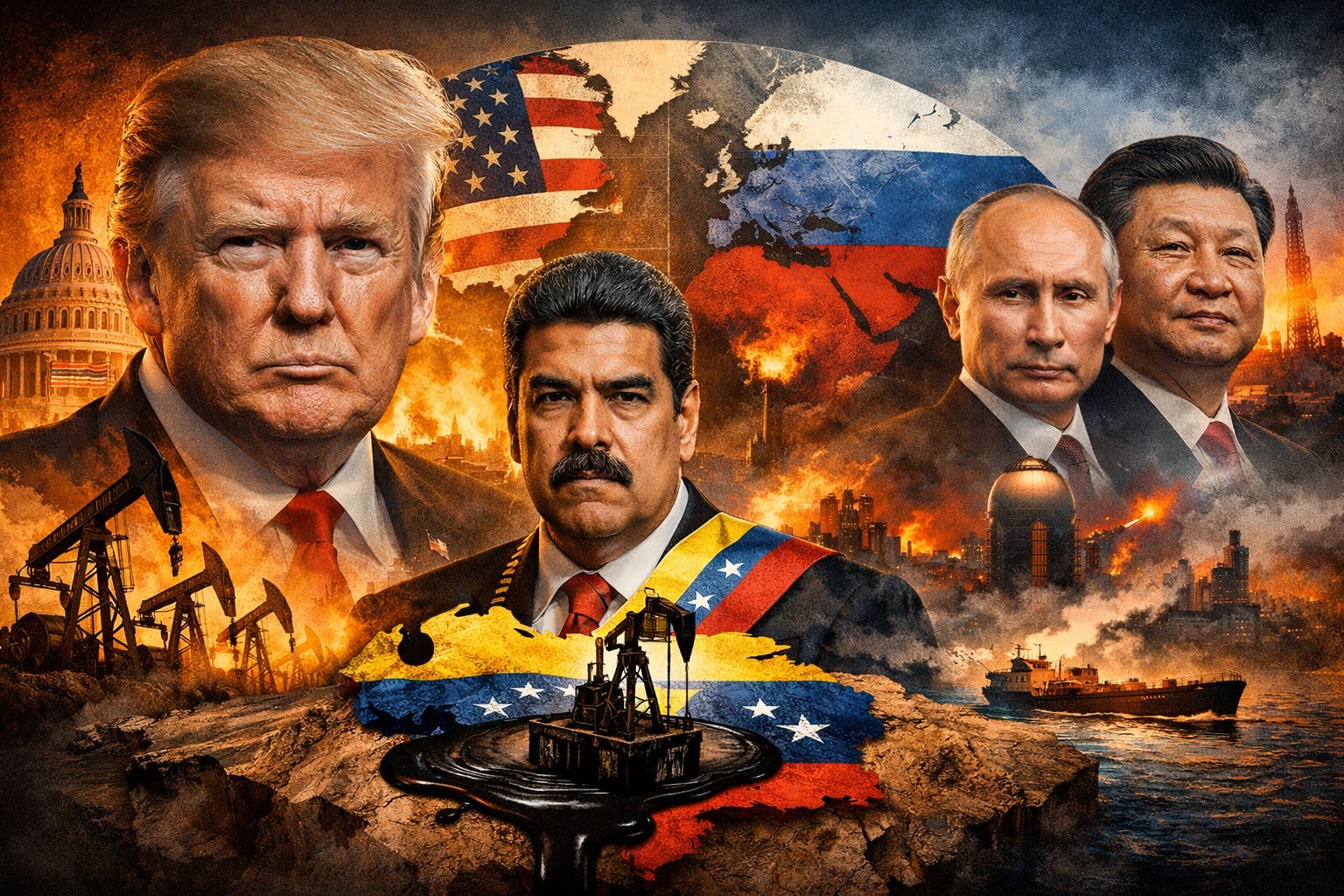
Whatever language Washington uses about restoring democracy in Venezuela, the reality may be far more transactional. This U.S. intervention looks less like a moral crusade and more like a strategic land grab - above all, for oil. Not just any oil, but the kind American refineries actually want. As World Briefing has noted before, Venezuela sits atop vast reserves of extra heavy crude - exactly the gloopier oil that under-utilized Gulf coast refineries were built to process, and a stark contrast to the lighter, “smoothie-coloured” crude flooding the U.S. market from fracking fields.
Seen through that prism, the move feels less democratic and more imperial: a maneuver typical of an aspirational overlord of the Americas - Donald Trump - reasserting dominance over what he views as Washington’s natural sphere of influence. Trump has claimed that U.S. oil companies are poised to enter Venezuela and revive production. Yet conspicuously, American oil firms and trade groups have gone quiet. One analyst offers a blunt reality check: restoring Venezuela’s output would require tens of billions of dollars and at least a decade - hardly a quick or painless geopolitical win.
The global consequences could be profound. A major U.S. intervention in Venezuela provides Vladimir Putin with a convenient distraction - political cover to escalate attacks on Ukrainian cities and critical infrastructure while Washington’s attention is diverted. Worse still, it risks normalizing a dangerous precedent: that powerful states can simply remove inconvenient leaders. Even President Volodymyr Zelensky has hinted at the slippery slope, asking pointedly whether such actions against dictators signal what the United States “should do next.”
If this logic hardens into doctrine, the world could fracture faster than expected into rival hemispheres and spheres of influence. Russia - which counted Nicolás Maduro as an ally yet failed to protect him or Venezuela with its flagship S-300 air-defence system - may feel emboldened to intensify hybrid warfare across Europe and press harder to subjugate Ukraine. China’s Xi Jinping, watching closely, could accelerate timelines for “reunification” with Taiwan. The rules-based international order would not erode gradually - it would snap.
And then there are America’s closest neighbours. Imagine how this weekend’s events are being read in Greenland, Mexico, and Canada. For Canada, the stakes could be existential. One analyst warns that within two years, Venezuelan heavy-oil imports could eliminate the need for additional Canadian supply. Within four years, Alberta’s oil exports to the U.S. could fall by 25 percent - enough to devastate the provincial economy and punch a serious hole in Ottawa’s finances. Within six years, that reduction could reach 50 percent. The geopolitical shockwaves would not stop at Venezuela’s borders. They would land squarely at home.
World Briefing will continue to follow the power plays behind the rhetoric - connecting the dots between oil, geopolitics, and the accelerating breakdown of the global order. If you value analysis that goes beyond headlines and official talking points, consider upgrading to a paid subscription. Your support helps keep World Briefing independent, on the frontlines, and focused on what really drives events shaping your world.
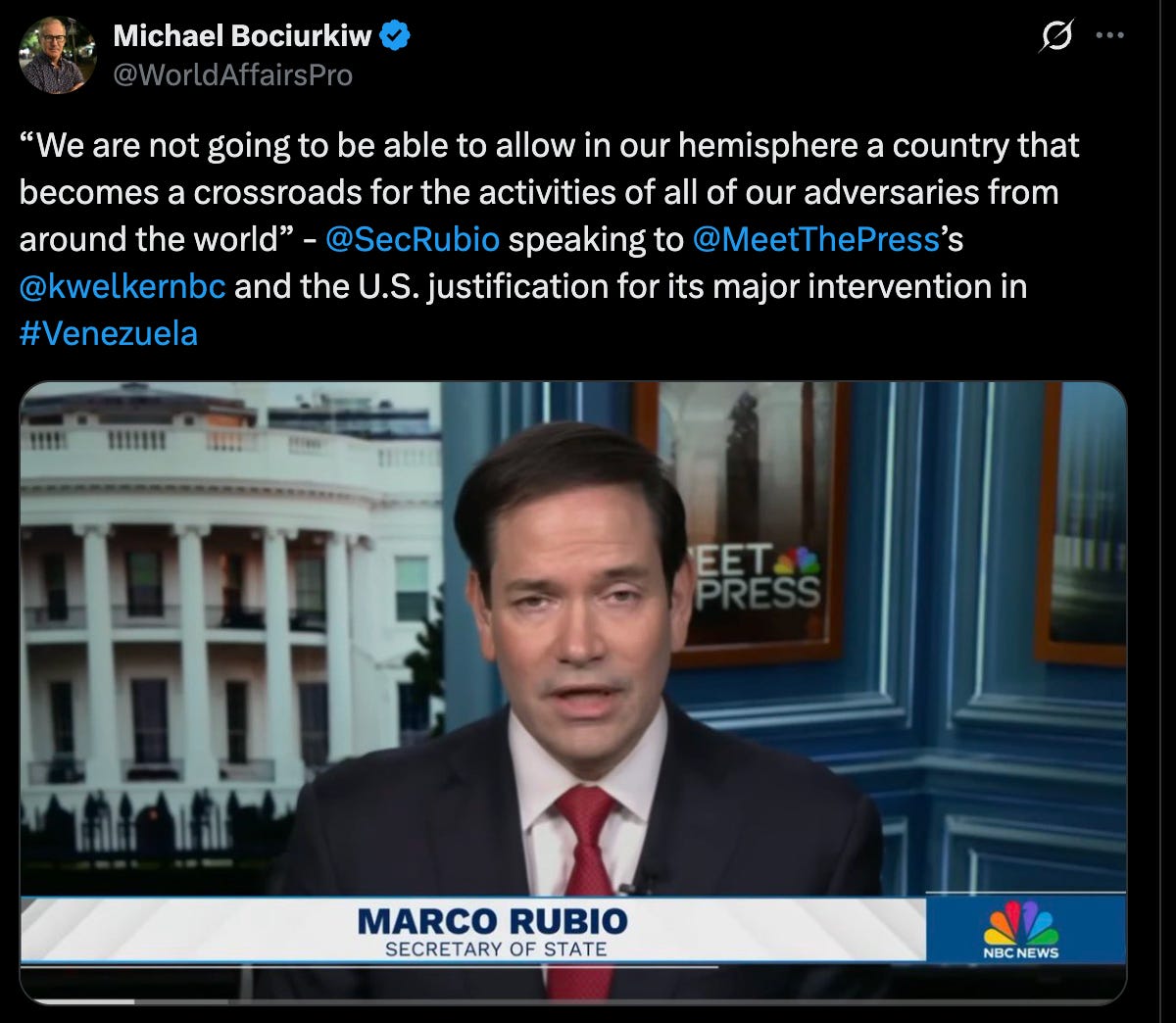
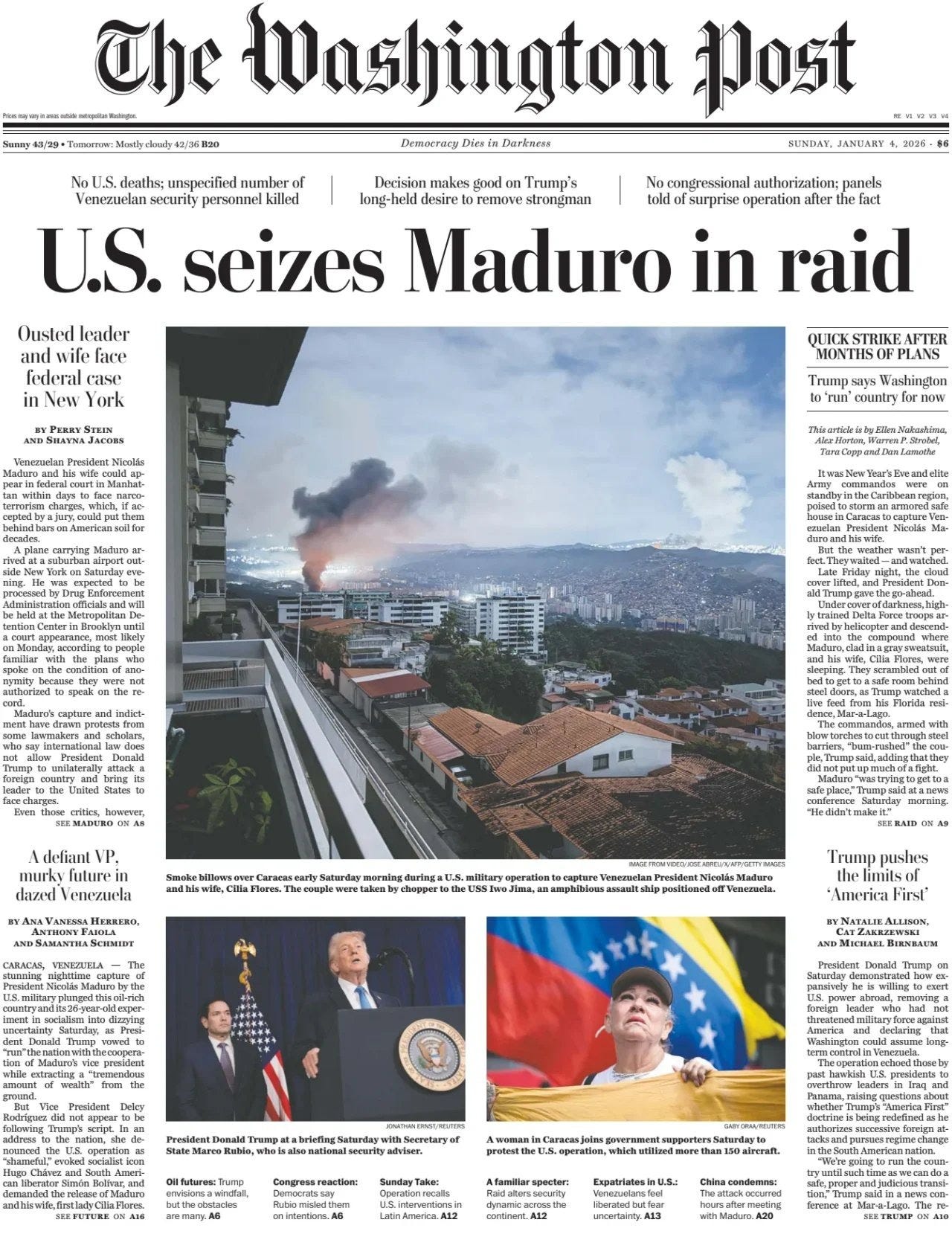
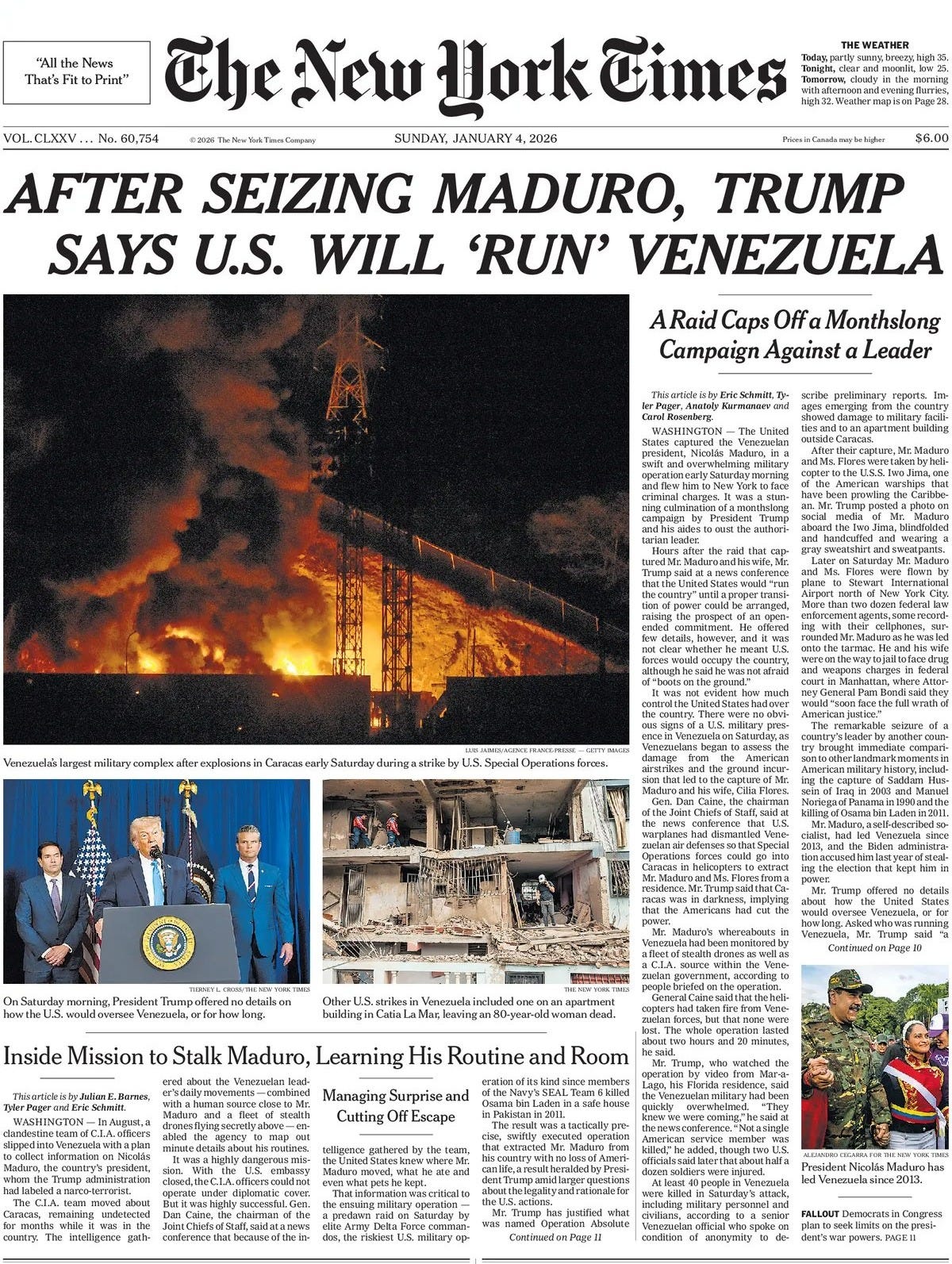
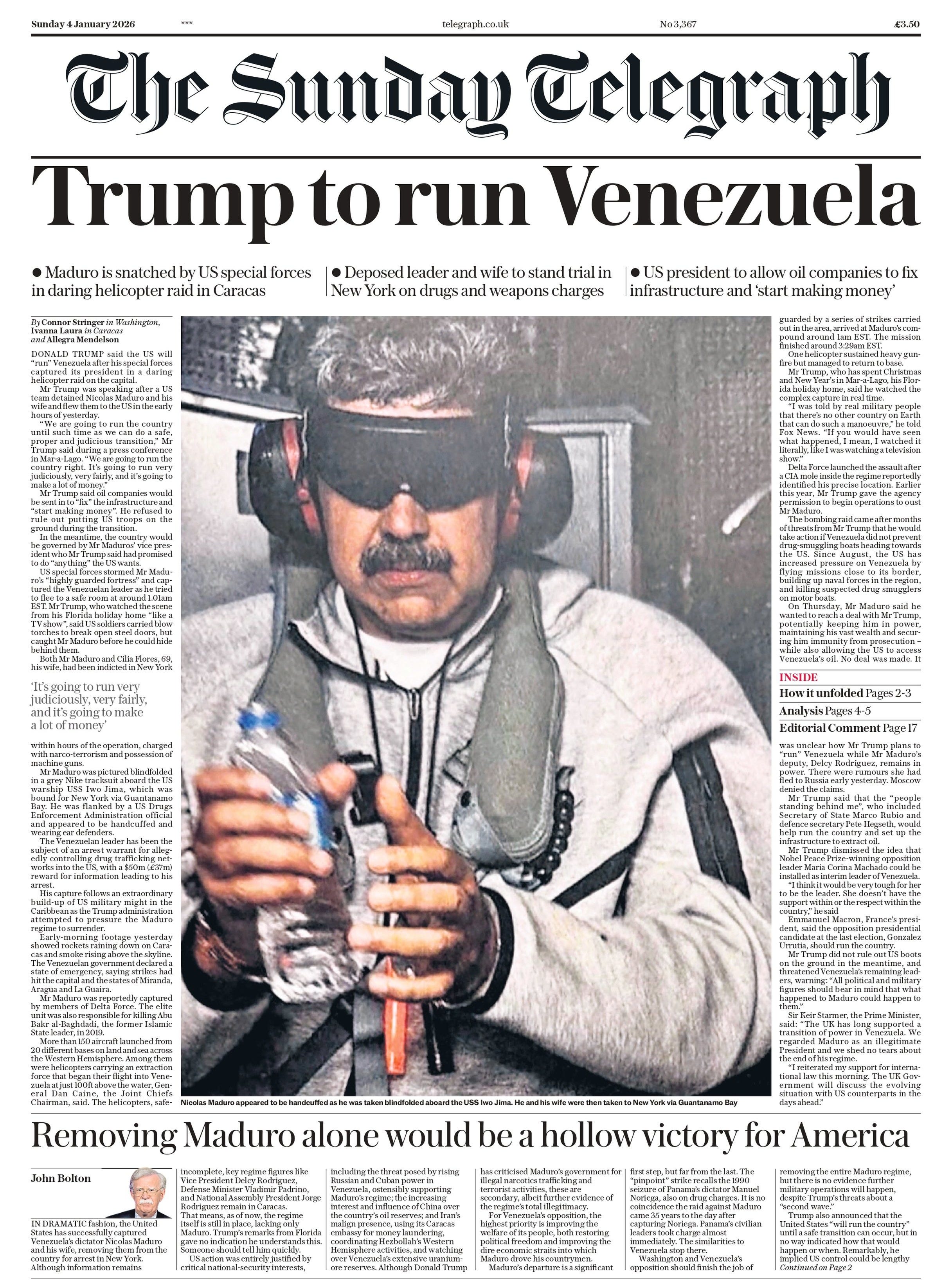
As President Donald Trump announced Saturday that the U.S. would “run” Venezuela for now, he and top aides made clear that the U.S. may not stop there — and demanded that the rest of the world take note. Secretary of Defense Pete Hegseth said Venezuela’s long-time dictator, Nicolas Maduro, captured in an overnight raid and extradited to New York on Saturday to be indicted on narco-conspiracy charges, “had a chance” to leave on his own before becoming the latest example of a leader paying a high price for not responding to Trump’s pressure. “He effed around and he found out,” Hegseth said of Maduro. The menacing comments were interwoven with specific threats toward three other countries that could soon be in the administration’s sights: Colombia, Cuba and Mexico. The rest of the hemisphere is paying attention, and attempting to push back on Trump through condemnations of the strike itself and warnings of what could come next. “All nations of the region must remain alert, as the threat hangs over all,” the Cuban government said in a statement. The administration’s warnings, meanwhile, are getting bolder and more definitive. Trump again accused Colombia’s president of “making cocaine” and reaffirmed his past threats that he “does need to watch his ass.” He predicted “we will be talking about Cuba.” Secretary of State Marco Rubio offered a more sinister threat of future American action. “Look, if I lived in Havana and I worked in the government, I’d be concerned,” Rubio said. Earlier during a phone interview with Fox News, Trump warned that “something will have to be done about Mexico,” stating that he’s asked President Claudia Sheinbaum if she wants the U.S. military’s “help” in rooting out drug cartels. “American dominance in the Western hemisphere will never be questioned again,” Trump said. Trump outlined a more aggressively expansionist foreign policy in his inaugural address nearly one year ago, shocking long-time allies with threats of making Canada “the 51st state” and colonizing Greenland, an autonomous region belonging to Denmark - Politico
US President Donald Trump says Venezuela’s opposition leader Maria Corina Machado lacks the support and respect to run the country, after announcing the US will ‘run’ Venezuela following its abduction of President Nicolas Maduro. Machado was awarded the Nobel Peace Prize last year and dedicated it, in part, to Trump. But Trump, who said he has not been in contact with Machado, said during a press conference on Saturday that he doesn’t believe she can assume the leadership role in Venezuela. “I think it would be very tough for her to be the leader. She doesn’t have the support within or the respect within the country. She’s a very nice woman, but she doesn’t have the respect,” Trump said.
In a letter released over the weekend to all Venezuelans, Machado wrote: “This is the hour of the citizens. Those of us who risked everything for democracy on June 28th. Those of us who elected Edmundo Gonzalez Urrutia as the legitimate President of Venezuela, who must immediately assume his constitutional mandate and be recognized as Commander-in-Chief of the National Armed Forces by all the officers and soldiers who comprise it. Today we are ready to assert our mandate and take power. Let us remain vigilant, active, and organized until the democratic transition is complete. A transition that needs ALL of us.”
World Briefing hot take: It’s no secret that Trump defaults to people he—and he alone—regards as tough and strong. Just as importantly, the narcissistic leader likely views María Corina Machado as having “stolen” the 2026 Nobel Peace Prize he so visibly coveted. As long as Trump’s inner circle holds sway over Venezuela policy, Machado and Urrutia are likely to remain sidelined in any U.S.-backed political transition in Caracas.
Contacted in Bogota Saturday by World Briefing, a former senior Colombian diplomat had this to say about events in Venezuela: “What is important is that once Maduro is gone, they assure the intervention goes until the democracy gets back. Because if they leave this in the hands of the Maduro people, it’s not going to work at all. I hope the Trump plan emphasizes getting democracy back to the Venezuelan people. If they get it back in the next six months, it will be a great deal for the region, great news for Colombia and, of course, great news for Venezuela. But if they just took Maduro away and don’t restore democracy, then it’ll be just the same thing but with different actors.”
For an ageing president, growing more petulant, irascible and incoherent with every day in office – facing diminishing popularity and desperate to distract attention from the Epstein child-trafficking scandal – a tightening embrace of military power is an ominous development - Julian Borger, The Guardian

The British defence ministry announced late on Saturday that its aircraft carried out joint strikes with France on an underground facility in central Syria, allegedly used by Islamic State militants to store weapons and explosives. The strikes occurred Saturday evening on a structure in the mountains just north of the historic town of Palmyra in the country’s Homs province, the ministry’s statement said. Britain and France are part of the US-led coalition that has been fighting IS militants for more than a decade. The ministry said the British military used Typhoon FGR4 fighter jets supported by a Voyager refueling tanker. The British air force used Paveway IV guided bombs to target a number of access tunnels down to the facility, the statement said, adding that while a detailed assessment is now underway, initial indications are “that the target was engaged successfully.” - Euronews
Ukrainian President Volodymyr Zelenskyy insisted that if a diplomatic end to the war cannot be struck during the current peace talks, his country would continue to defend itself against Russia’s full-scale invasion. “If Russia blocks all of this -- and as I said, it depends on our partners -- if our partners do not compel Russia to stop the war, there will be another path: to defend ourselves,” he said on January 3 ahead of another busy week of diplomacy. The comments echo those the Ukrainian leader expressed in his New Year’s Eve address, when he stressed that a peace agreement with Russia can’t come “at any cost.” Zelenskyy spoke as security advisers from 15 allies met in the Ukrainian capital, discussing fine points of the developing peace plan, including potential security guarantees for Ukraine.Few details emerged from the session, but Ukrainian negotiator Rustem Umerov said participants “discussed security guarantees, points of the peace plan, economic recovery, and military-political issues.” Umerov asserted that “most of the positions -- 90 percent of the peace plan -- have already been agreed, work continues on the details.” Trump’s special envoy, Steve Witkoff, joined the meeting through a video link, while representatives from NATO and the European Union participated in person. The meeting will be followed by at least two other important gatherings in the upcoming week. On January 5, Ukraine will host a meeting of the chiefs of general staffs of European countries and others “designed to ensure additional coordination of actions with allies in the security dimension,” Umerov said. The following day in Paris, French President Emmanuel Macron will host a gathering of European leaders - RFE/RL
Russia made its largest territorial gains in Ukraine last year since the early months of the full-scale invasion in 2022, according to an AFP analysis.
The Russian military captured more than 5,600 square kilometers (2,160 square miles) of Ukrainian territory in 2025 — about 0.94% of the country — based on data from the U.S.-based Institute for the Study of War. That figure includes areas that both Ukraine and independent analysts have confirmed as being under Russian control, as well as territory claimed by Moscow. Russia’s gains last year exceed those made in 2023 and 2024 combined, though they remain far below the more than 60,000 square kilometers seized in early 2022. The largest monthly advance in 2025 came in November, when Russian forces captured around 701 square kilometers. Their advance slowed in December to 244 square kilometers, the smallest monthly gain since March. Ukraine faced mounting pressure throughout the year from sustained Russian bombardment and ground offensives, gradually ceding territory as its forces grappled with manpower and ammunition shortages. Russia currently occupies just under one-fifth of Ukraine and has demanded that Kyiv withdraw its forces from the eastern Donbas region as a condition for peace - AFP
The managers of a bar where a fire killed 40 people and injured another 119 have been placed under criminal investigation, Swiss prosecutors have said. The French couple - named by the media as Jacques and Jessica Moretti - are suspected of manslaughter by negligence, bodily harm by negligence and arson by negligence, the prosecutors’ office in Valais said. Eight Swiss nationals from among those killed were the first to be identified on Saturday. The likely cause of the fire at Le Constellation bar in Crans-Montana was sparklers on bottles being carried too close to the ceiling, a preliminary investigation found. In a statement, Beatrice Pilloud, the lead prosecutor in the canton of Valais, said investigators were looking into whether the venue’s acoustic foam was “the cause of the problem”, as well as “whether it complies with regulations”. Among the dead and missing are many teenagers. Le Constellation was a venue known to be popular with a younger crowd in the ski resort town, where the drinking age is 16. A teenage golfer from Italy was the first death to be named, though Swiss and Italian officials have so far declined to confirm his death. Swiss authorities have not released the names of the eight people whose identification was completed on Saturday - all aged 16-24 - BBC
More than half of therapists who work with men with addiction have noticed a rise in out-of-control porn use over the past year, according to new data. Experts are urgently calling for a national strategy on pornography as a total of 53% of therapists surveyed by the British Association for Counselling and Psychotherapy (BACP) said they had seen a rise in people seeking help for problematic pornography use that was interfering with their life or driving them to seek out more extreme content. The BACP survey of nearly 3,000 accredited therapists and counsellors found a growing number of people claiming to be addicted to pornographic content, with many reporting that they were neglecting their responsibilities or damaging their relationships as a result. Some people arrived at therapy with physical sexual problems such as erectile dysfunction, having been referred by NHS sexual health clinics, experts said - The Guardian
The journals…