Washington’s foreign-policy posture is increasingly defined by contradiction. Even as President Donald Trump threatens land strikes inside Venezuela - casting the country as a narco-state and hinting at regime-change ambitions - his administration is rolling out a policy warmly welcomed by another regime deeply entrenched in the global drug trade: Myanmar’s military junta. A new UN report shows opium cultivation in Myanmar surging to its highest level in a decade, heroin flows shifting from Afghanistan to Southeast Asia, and sham elections designed to cement military rule. Yet the White House has just terminated protections for 4,000 Burmese nationals in the United States, echoing the junta’s own narrative that the country is “safe” again.
The juxtaposition is striking. Trump’s tough-on-cartels messaging is already muddied by moves like pardoning a convicted Honduran drug-trafficking ex-president - and experts warn his increasingly aggressive stance on Venezuela risks dragging Washington into a strategic and legal morass. But in Southeast Asia, the administration appears willing to overlook an expanding opium economy and deepening repression. Today’s World Briefing reveal a foreign policy struggling to balance principle, power and politics at a moment when drug flows, authoritarianism and regional instability are converging in dangerous ways.
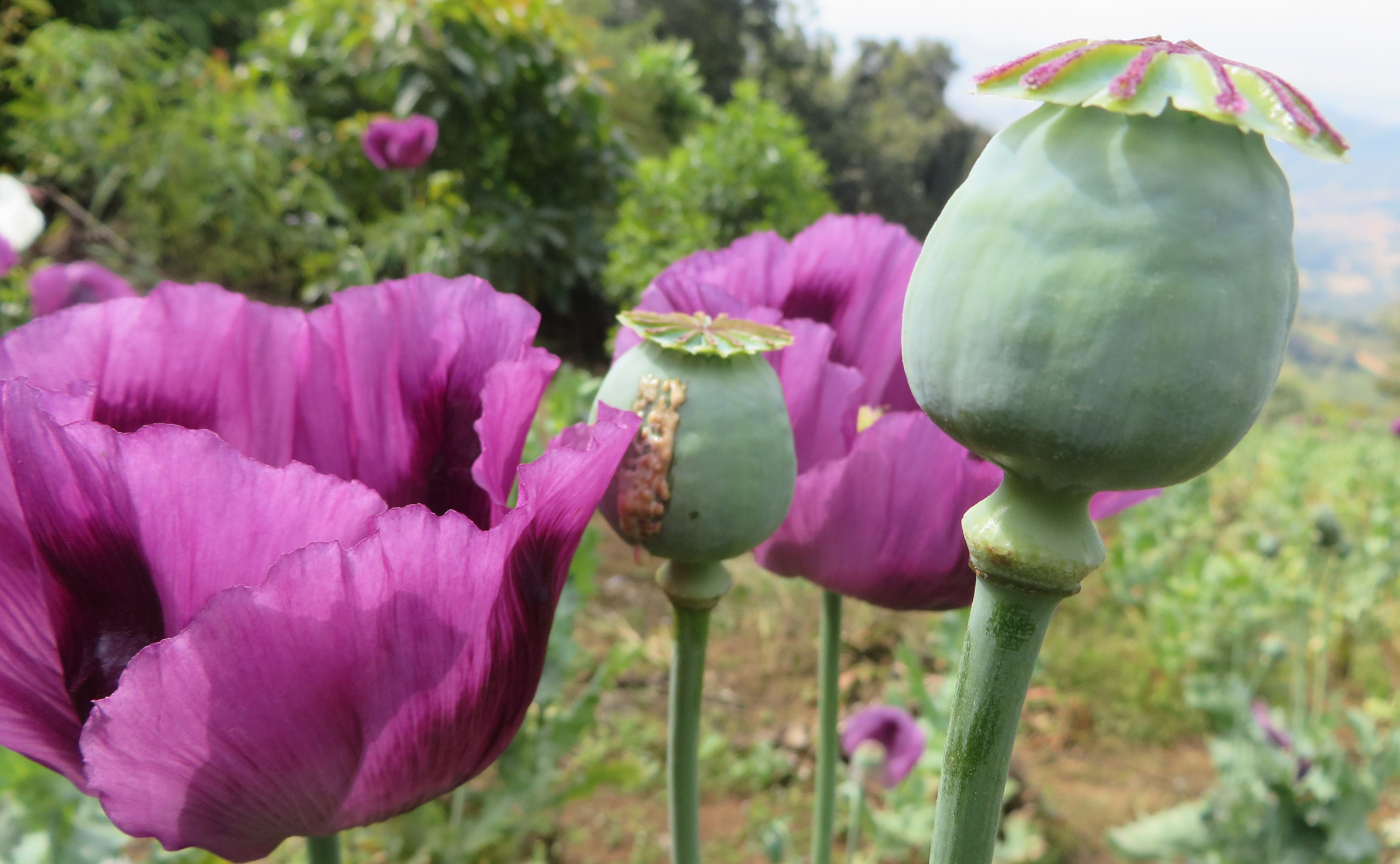
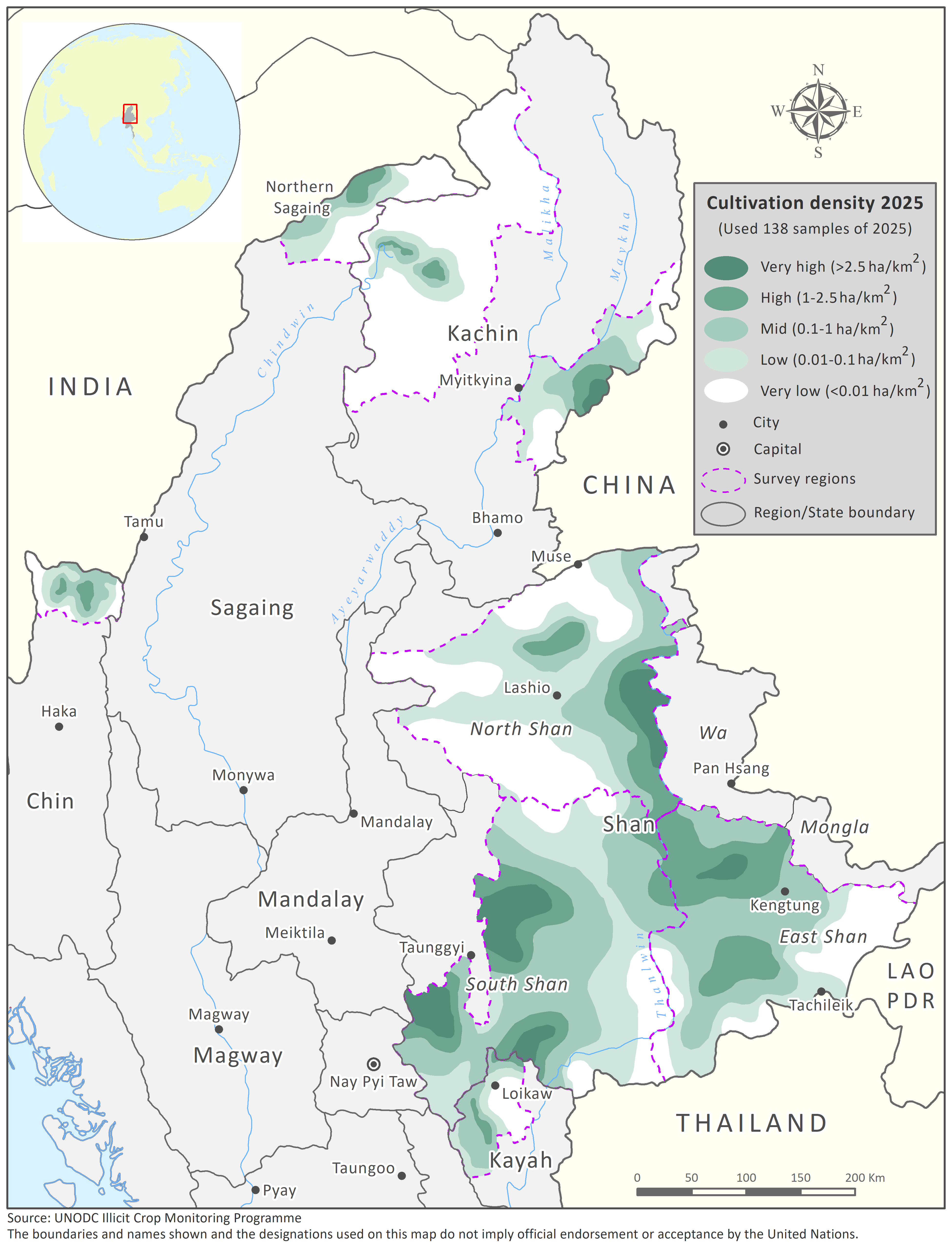
Opium poppy cultivation in Myanmar surged to its highest level in a decade this year as the nation crippled by civil war remains one of the world’s primary suppliers of illicit drugs, according to a new United Nations report. The growth solidifies Myanmar’s position as the world’s main known source of illicit opium, particularly following a sharp decline in production in Afghanistan after the Taliban imposed a ban following their 2021 takeover. The Myanmar Opium Survey 2025, issued on Wednesday by the United Nations Office on Drugs and Crime (UNODC), found the area where opium is cultivated expanded by 17% from 2024 to 531 square kilometres, the largest area since 2015. Opium, which is processed into morphine and heroin, is harvested from poppy flowers and Myanmar’s farmers have pushed deeper into harvesting as the country faces widespread poverty and instability during the ongoing civil war that erupted after the military ousted the democratically elected government of Aung San Suu Kyi in February 2021. A key driver of Myanmar’s production growth has been surging opium prices. Fresh opium now fetches around $329 (€281) per kilogram, more than double the 2019 price of $145 (€124). The opium economy in Myanmar is worth between $641 million (€549 million) and $1.05 billion (€900 million), which accounts for up to 1.4% of the country’s 2024 GDP, the report said. The report also points to emerging signs of heroin flowing from Myanmar to markets that were previously supplied by opium originating in Afghanistan. There have been several seizures of heroin from passengers traveling from the Southeast Asia region towards Europe over the past year. While these appeared to be mostly individual cases, the changed environment could encourage more cultivation and production of opium in Myanmar.
As Myanmar’s ruling junta plans to hold what are widely seen as sham elections this December, the US government has revoked temporary legal status for citizens of Myanmar – a decision that has put the lives of 4,000 nationals like Aung in jeopardy, all while lending legitimacy to the country’s military government. Myanmar’s military seized power in a February 2021 coup, overthrowing the elected government and violently suppressing dissent. A patchwork of armed resistance has emerged since, with some fighters joining longstanding ethnic armies as the junta increasingly uses airstrikes and fresh conscripts to counter opposition. But the Trump administration says the junta’s planned election, and successful ceasefire agreements, show progress in the south-east Asian nation. “The situation in Burma has improved enough that it is safe for Burmese citizens to return home, so we are terminating the Temporary Protected Status,” Secretary of Homeland Security Kristi Noem announced this week. The regime welcomed the decision, with spokesperson Major-General Zaw Min Tun telling media that Myanmar nationals in the US can return home to vote, extending “a welcoming hand” for them to participate in “building a modern, developed, and progressive nation”. International Crisis Group senior Myanmar adviser Richard Horsey says Myanmar remains “deeply unsafe with no meaningful improvements in security or governance”. Elections planned for the coming weeks are “provoking further repression”, he says, adding that those who returned would “almost certainly come under scrutiny and face serious risk of detention or mistreatment”. By framing these developments as justification for ending temporary protection, Washington “risks reinforcing the regime’s narrative” and could signal to other governments that they can restart ties based on elections, rather than real improvements, he warns - The Guardian
Opium cultivation in Afghanistan has dropped sharply, but regional trafficking has risen. According to a report by UNODC, 10,200 hectares were under opium cultivation this year, down from 12,800 hectares in 2024 and far below the 232,000 hectares recorded before a nationwide ban under the Taliban in 2022. Meanwhile, synthetic drug production, particularly methamphetamine, is going up, and seizures in and around Afghanistan were 50 per cent higher by late 2024 compared to the previous year. UNODC warns that organised crime groups may increasingly favour synthetic drugs, which are easier to produce, harder to detect and less vulnerable to climate shocks. “The dynamics of supply, demand and trafficking involve both Afghan and international actors. Addressing this challenge requires collaboration among key stakeholders,” a UN officials said. The report called for counternarcotics strategies which go beyond opium, integrating synthetic drugs into monitoring, interdiction and prevention efforts.
US President Donald Trump’s escalating showdown with Venezuela is a make-or-break moment for his foreign policy in Latin America, analysts said. Trump on Tuesday said he would soon start land strikes inside Venezuela, despite facing blowback over lethal attacks on suspected drug boats, a campaign he has cast as a crackdown on cartels. But Trump’s pardon of Honduras’ former president, a convicted drug trafficker, complicates Washington’s tough-on-drugs messaging, Semafor’s DC team noted. The strikes are doing little to staunch the flow of narcotics to the US primarily from Mexico and Colombia, and experts believe Trump ultimately wants to oust Venezuela’s strongman leader. It’s a “regime change adventure… in danger of degenerating into a strategic, political and legal morass,” a CNN analyst argued - Semafor
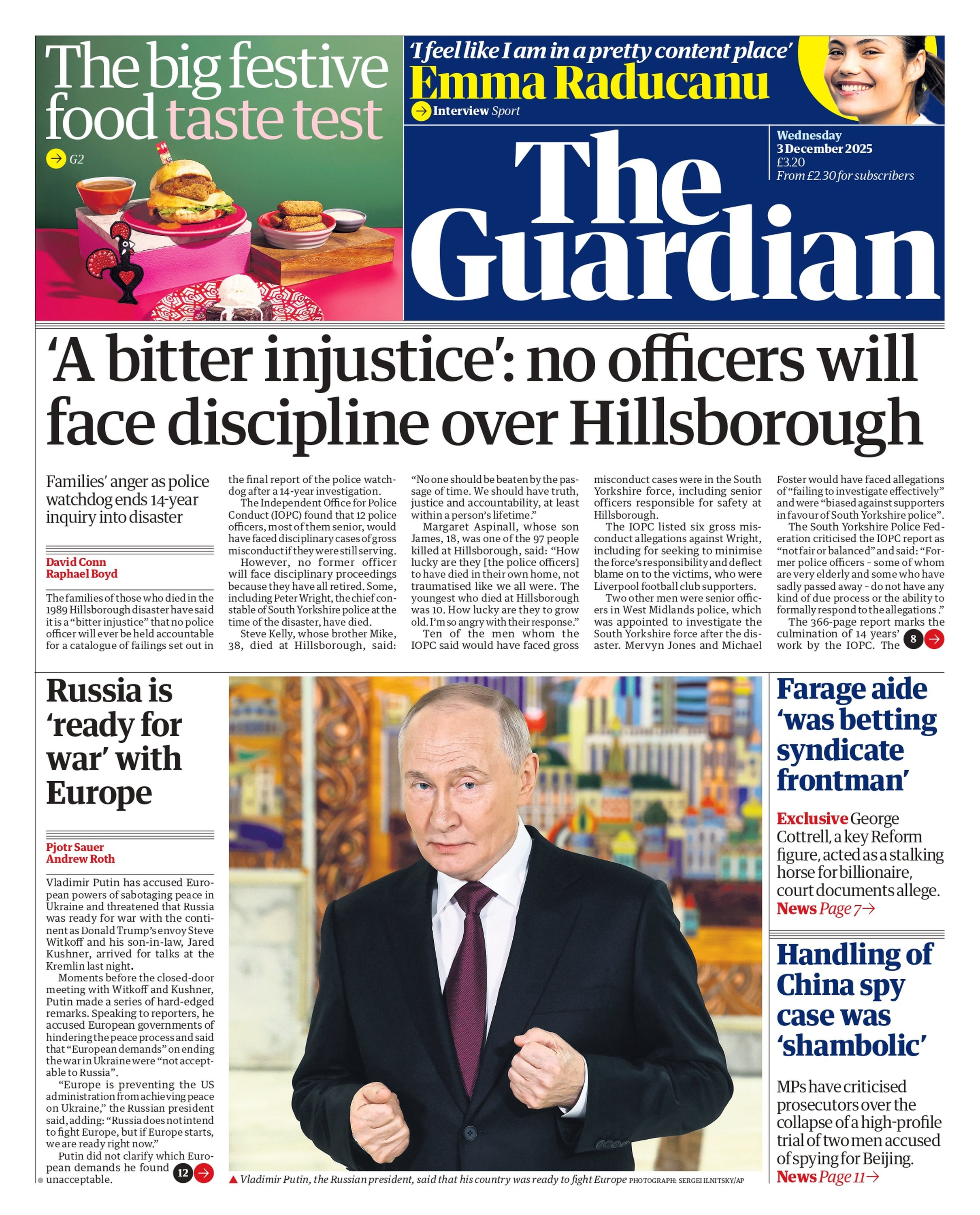
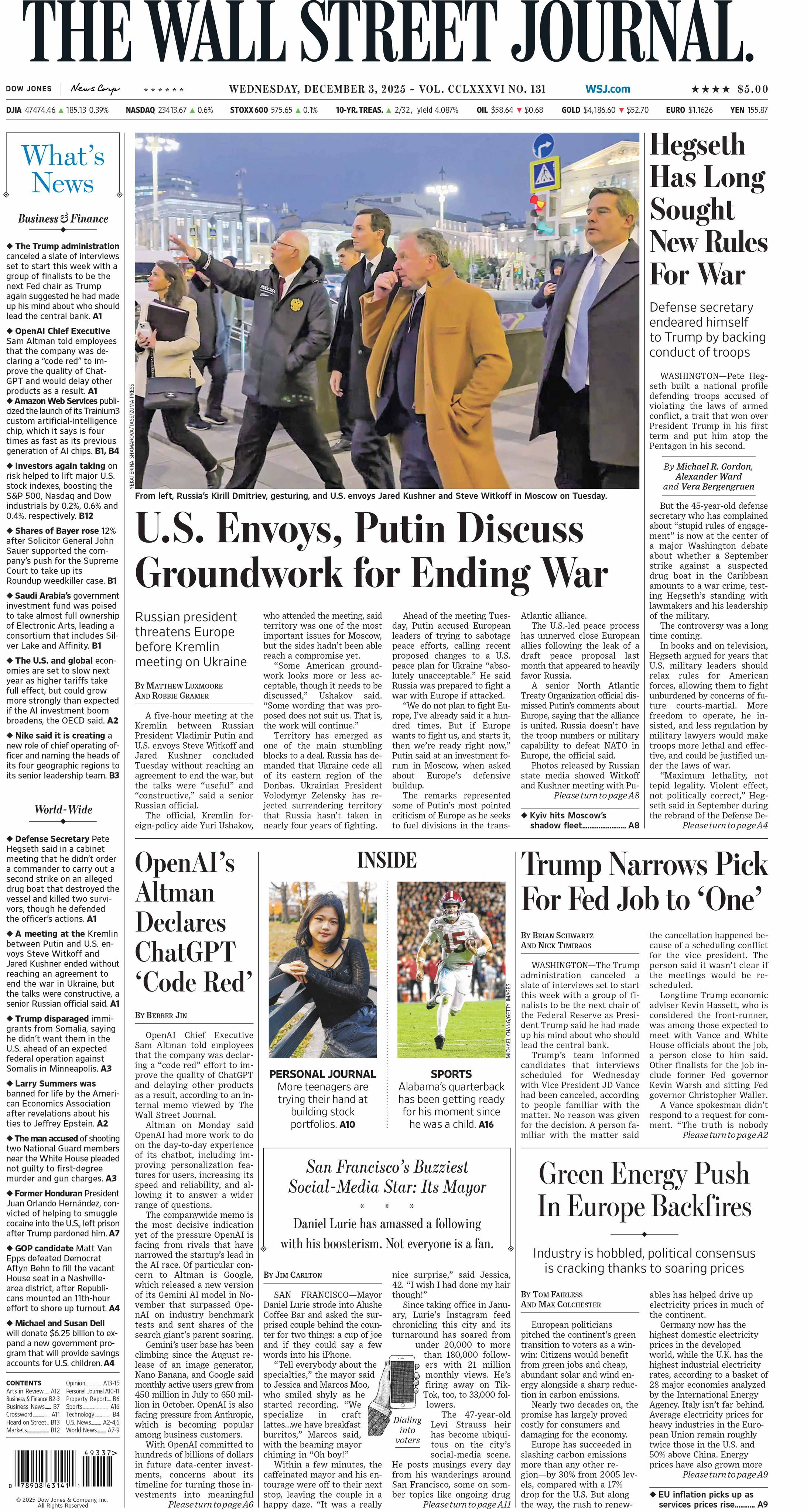
White House special envoy Steve Witkoff flew back to the United States without meeting Ukrainian President Volodymyr Zelensky, following five hours of Kremlin talks on a US-drafted peace proposal seen as heavily tilted toward Russian interests. It was widely expected that the US delegation, which included Witkoff and President Donald Trump’s son-in-law, Jared Kushner, would meet up with Zelenskyy somewhere in Europe afterward as the Ukrainian leader was in Ireland. Instead, a day after some of the most intense diplomatic efforts to end Europe’s largest conflict since World War II, Zelenskyy said Ukraine’s negotiators would hold talks with European national security advisers and then travel to the United States. “They will also discuss the European component of the necessary security architecture,” Zelenskyy wrote in a social media post. US President Donald Trump has yet to speak publicly on the meeting, but British Prime Minister Keir Starmer said the lack of any progress showed Putin currently has no interest in reaching an agreement to end Europe’s largest and deadliest conflict since World War II. “We all know that Putin is dragging his feet, not wanting to come to the table, not wanting to reach an agreement,” Starmer told Britain’s House of Commons during a question period on December 3.
Italy’s Prime Minister Giorgia Meloni has said that she won’t commit to the PURL (Prioritised Ukraine Requirements List) mechanism for funding ongoing weapons purchases for Ukraine from the US “for now”. While she’s long been a firm ally of Ukraine, dissenting voices here have grown louder - emboldened, it seems, by the rhetoric of Donald Trump’s White House. This week, Deputy PM Matteo Salvini, of Italy’s far-right League party, said that he “dreams” of restoring relations with Russia, warned about corruption in Kyiv and argued there’s “no need” to buy more weapons for Ukraine when the US is pushing for a peace deal. Officials in Rome have now confirmed there’s a delay in extending authorisation to continue sending military equipment to Kyiv, although the current decree is still valid for a few more weeks - BBC
A European Parliament delegation’s planned visit to Kyiv was canceled after Ukrainian authorities objected to the presence of a far-right German politician in the group. Members of Parliament from the Committee on Security and Defence (SEDE) had been scheduled to travel to Ukraine on Dec. 1. But Ukrainian officials contacted the legislature to voice “security” concerns over the inclusion of Hans Neuhoff, a member of the Alternative for Germany party (AfD). The trip was then canceled, according to Neuhoff and two officials from the Parliament who spoke to POLITICO on condition of anonymity as they were not authorized to speak publicly.
Romania’s Defense Ministry blew up a Ukrainian Sea Baby naval drone that it said was “threatening navigation in the Black Sea.” Nexta reported that the ministry claimed military divers neutralized the drone, which Ukraine has used in operations against Russian vessels. At the same time, Romania did not shoot down Russian drones that violated its airspace, instead waiting for them to return to Ukraine.
Live from Kyiv, I joined the BBC to break down the latest twist in the so-called Trump peace plan — after five hours of talks in Moscow between Donald Trump’s envoys and Vladimir Putin and his inner circle. The Russians emerged saying “no compromises were made.” That alone should tell us something. In my analysis, I describe the geopolitical landscape as a kind of high-stakes golf course:
• Trump and envoy Steve Witkoff — longtime golf buddies — are stuck in a sand trap built by Putin, swinging wildly with no clear plan.
• Putin is already laughing up the fairway, in full control of the game.
• Europe is still back in the clubhouse, struggling to understand the rules.
• Zelensky is stranded in the golf cart — forced to react to decisions made by others.
I warn that Ukraine is at a critical moment:
🇺🇦 If the U.S. is serious, it must offer strong security guarantees, maintain full Ukrainian military strength, and backstop the coalition of the willing with credible commitments, including air support and retaliation if foreign troops come under fire.
🇪🇺 Europe’s best move right now? Immediately unfreeze the billions in Russian assets sitting in Belgium — enough to cover three years of Ukraine’s budget needs. Without that money, Kyiv could face cuts to pensions and teachers’ salaries as early as February.
🇹🇷 And with Washington floundering, it may be time for Turkey — a far more competent interlocutor — to take over the negotiation process.
Ukraine is at one of the most dangerous junctures of the war to date. This interview explains why.
Stefano Sannino, a director general in the European Commission who was detained by Belgian authorities as part of a fraud probe, is no longer in his job, the Commission said. The confirmation came after Belgian authorities, acting at the request of the European Public Prosecutor’s Office (EPPO), conducted dawn raids on Tuesday and detained Sannino, who led the Commission’s Middle East, North Africa and the Gulf department and was the former secretary-general of the European External Action Service. Sannino, as well as the EU’s former top diplomat Federica Mogherini, who was also detained on Tuesday as part of the probe, was released from custody after being held for questioning for several hours - Politico
After weeks of turmoil in relations with China, Japanese Prime Minister Sanae Takaichi has sought to dial down tensions with Beijing over a hypothetical conflict in the Taiwan Strait. Responding to a lawmaker’s question on Wednesday, Takaichi told the Japanese parliament that Tokyo’s position on the island remained unchanged and referred to a 1972 commitment that led to the normalisation of ties between Beijing and Tokyo. “The Japanese government’s basic position regarding Taiwan remains as stated in the 1972 Japan-China Joint Communique, and there has been no change to this position,” Takaichi said - SCMP
More than 1,900 flights from China to Japan scheduled for this month have now been cancelled, according to state media reports and travel experts, as a political dispute between the two nations over Taiwan grinds on. The SCMP reported that the figure represented more than 40 per cent of the flights from mainland China to Japan scheduled for December, Chinese state broadcaster CCTV reported on Monday, citing data from online platforms. Li Hanming, an independent civil aviation analyst, said his research indicated that CCTV’s report was broadly accurate, adding that cancellations of flights to Japan also effectively stopped return flights, as airlines tended to schedule routes in pairs.
The journals….