


🔥 World Briefing Hot Take
If there’s one defining pattern in this moment, it’s this: the Trump team can announce ceasefires - but it can’t seem to make any of them stick.
From the Thai-Cambodian border to the Middle East to Eastern Europe, the same script keeps playing out. A burst of brinkmanship. A dramatic declaration. A short-term pause. And then - almost immediately - the unraveling.
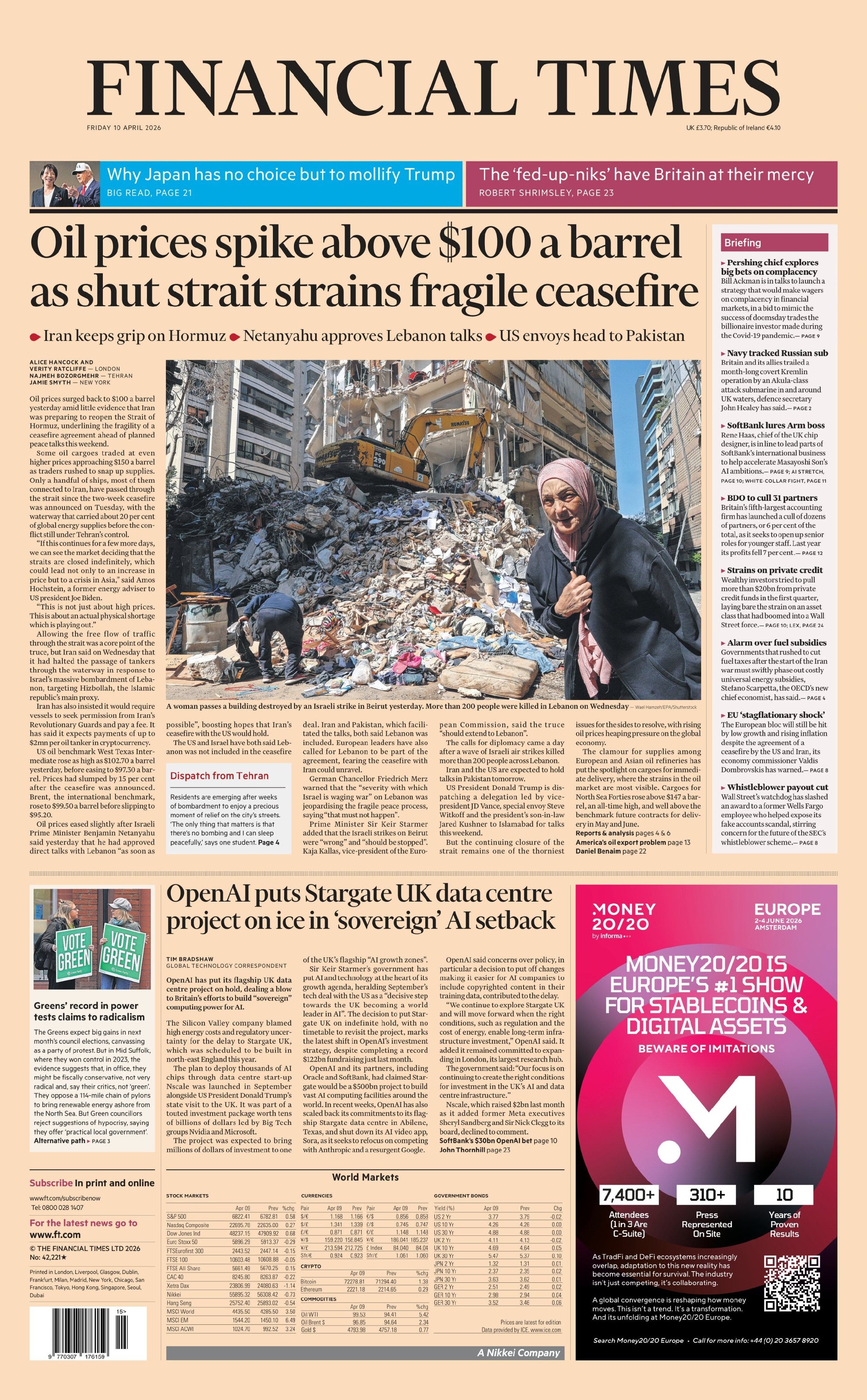
The Iran-Israel-U.S. ceasefire? Already riddled with contradictions, with strikes continuing in Lebanon and the Strait of Hormuz still effectively constrained.
The Gaza track? Stalled, underfunded, and drifting without a credible path forward.
Ukraine? Reduced to symbolic, time-bound pauses like an Easter truce - gestures that signal fatigue more than progress.
Even where Washington claims success, the details tell a different story: unclear terms, competing interpretations, and allies increasingly out of sync.
This isn’t dealmaking. It’s crisis management by headline - ceasefires as temporary optics rather than durable outcomes.
And that’s what makes this moment so dangerous: not the absence of diplomacy, but the illusion of it.
News Briefs
As Vice President JD Vance was heading to Pakistan on Friday for peace talks with Iran, a senior Iranian official laid out new conditions for the negotiations, adding even more uncertainty about the durability of the cease-fire and whether the two sides could reach a long-term deal. Mohammad Bagher Ghalibaf, the speaker of the Iranian Parliament, wrote in a post on X that two requirements — a cease-fire in Lebanon and the release of Iran’s blocked assets — “must be fulfilled before negotiations begin.” Mr. Ghalibaf, one of the key Iranian figures overseeing the war, did not say what he meant by blocked assets, but Iranian funds overseas are often frozen as a result of sanctions imposed by the United States and other Western nations. For his part, President Trump said on social media that Iran was overplaying its hand in advance of the talks. “The Iranians don’t seem to realize they have no cards, other than a short term extortion of the World by using International Waterways,” he wrote on Truth Social, referring to Iran’s control of the Strait of Hormuz. Despite a request from Mr. Trump to scale back its assault on Lebanon, Israel on Friday kept up its airstrikes in the southern part of the country, aiming at targets it said were related to Hezbollah, the Iran-backed militant group. The continuing war in Lebanon has exposed significant differences between Mr. Netanyahu, who has said all Israel’s goals still haven’t been met, and Mr. Trump, who appears eager to make a deal with Iran to end the war. Under pressure from Mr. Trump and European leaders, Mr. Netanyahu said on Thursday his country would start talks with the Lebanese government to disarm Hezbollah. But, hours later, he vowed to keep up strikes on the group, saying, “There is no cease-fire in Lebanon.” A senior Hezbollah official dismissed the idea of talks between Israel and Lebanon, saying that the Lebanese government did not speak for the group. One priority for Mr. Vance will be the full reopening of the Strait of Hormuz, a vital shipping passage for oil and gas that Iran has in effect blockaded since the war started. Even after the cease-fire was announced, marine traffic in the strait was at a trickle. Iran’s military signaled on Friday that it would maintain control of the passageway, saying in a statement carried by Iranian state media that it would “not give up our legitimate rights in any way” over the strait - NYT
UK Prime Minister Keir Starmer has said he is “fed up” with the effect that Donald Trump’s actions in the Middle East are having on the British public, while appearing to draw a comparison between the US president and Vladimir Putin.
Speaking to ITV’s Robert Peston on Thursday, the prime minister said: “I’m fed up with the fact that families across the country see their bills go up and down on energy, businesses’ bills go up and down on energy because of the actions of Putin or Trump across the world.” Starmer, who has been heavily criticised, and at times mocked, by Trump for not committing British forces to the war on Iran, also appeared to condemn Benjamin Netanyahu for Israel’s continued strikes on Lebanon, despite Iran calling for Lebanon to be included in the ceasefire that was agreed on 7 April. “That should stop – that’s my strong view – and therefore, the question isn’t a technical one of whether it’s a breach of the agreement or not,” Starmer said. Starmer also said on ITV that although Britain did not have “access to all the details of the ceasefire”, he disagreed with the attacks on Lebanon: “Let me be really clear about it: they’re wrong.” - The Guardian
Russia and Ukraine have agreed to a ceasefire during Orthodox Easter this weekend, marking a rare respite in the war that has dragged on for more than four years. In a statement late on Thursday, the Kremlin said President Vladimir Putin had ordered a pause in fighting that would begin at 4:00 p.m. on Saturday and last until the end of the day on Sunday. Ukrainian President Volodymyr Zelensky had earlier called for an Easter ceasefire, though the Kremlin’s statement made no mention of that, mentioning only that it expected Ukraine “to follow the example of the Russian Federation.” Hours after Russia’s announcement, Zelensky said Ukraine would reciprocate the ceasefire this weekend. “People need an Easter free from threats and real progress toward peace, and Russia has a chance to avoid returning to hostilities after Easter,” he said. The Kremlin previously dismissed Zelensky’s call for an Easter ceasefire, claiming his proposal was vague and fell short of reaching a lasting peace. In 2025, Putin unilaterally declared an Easter ceasefire with Ukraine, which was marred by mutual accusations of violations. Zelensky at the time urged Moscow to extend the 30-hour truce into 30 days to pave the way for a broader ceasefire, a proposal that Putin ignored - Moscow Times
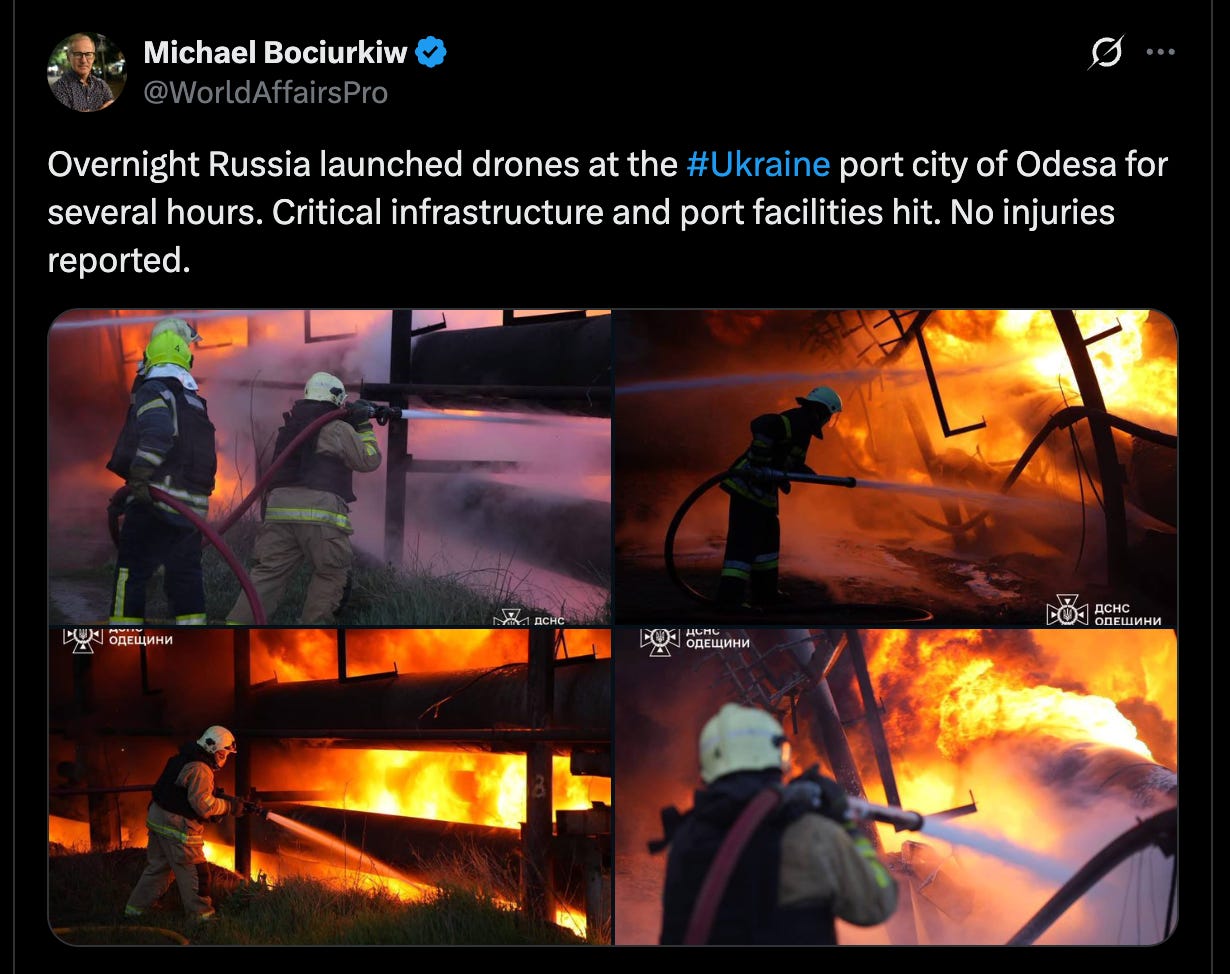
From the Strait of Hormuz to Odesa in under 48 hours — and the connection is impossible to ignore. Iran is now shaping both wars: confronting the U.S. and Israel in the Gulf while supplying the drones striking Ukraine again overnight. This is what a connected battlefield looks like.
👉 Watch my on-the-ground report above - filmed where these events are unfolding, not from an air-conditioned studio thousands of miles away.
🔓 Given the gravity of the moment, today’s video is open to all.
🔒 But if you value frontline, independent reporting that connects the geopolitical dots so you don’t have to — consider upgrading to a paid subscription to World Briefing.
Viktor Orbán and his centre-right rival, Péter Magyar, have traded accusations of enlisting foreign interference in a high-stakes election that polls suggest could mark the end of the nationalist Hungarian prime minister’s 16 years in power. As the two leaders’ campaigns entered their final stages before this weekend’s vote, which is being watched as keenly in Brussels, Moscow and Washington as in Budapest, Orbán said on social media on Friday that his opponent would “stop at nothing to seize power”. Magyar and his Tisza party, which according to most polls holds a comfortable double-digit lead over Orbán’s far-right Fidesz, were “colluding” with foreign intelligence and threatening the ruling party’s supporters with violence, the prime minister alleged. Magyar – a former Fidesz loyalist who broke away from the ruling party two years ago, accusing it of corruption and propaganda – hit back, saying Orbán would be “removed by the same people … he has abandoned and betrayed: millions of Hungarians”. Magyar added in a social media post: “The ongoing election fraud carried out for months by Fidesz, along with criminal acts, intelligence operations, disinformation and fake news cannot change the fact that Tisza is going to win this election.” He urged voters “not to fall for provocation” and said Orbán, whose transformation of Hungary into a self-styled “illiberal democracy” has inspired far-right leaders and led to fierce clashes with the EU, must “accept the Hungarian people’s judgment with dignity”. The populist prime minister, 62, is the EU’s most Moscow-friendly leader, and recent allegations of Russian interference in the ballot, along with revelations that Orbán’s ministers shared confidential EU information with Moscow, have prompted outrage across the bloc - The Guardian
Russia’s FSB security service announced Thursday the arrest of a former Radio Free Europe/Radio Liberty (RFE/RL) freelance reporter in the Zabaikalsky region on suspicion of treason. The man, a 65-year-old resident of Chita, is accused of funneling intelligence on critical infrastructure to Ukrainian special services. According to an FSB statement, the journalist provided information used to facilitate Ukrainian cyberattacks, which the agency claims “temporarily hindered regional authorities” in their official duties. A judge ordered him to be placed in pre-trial detention. If convicted of treason, he faces a maximum sentence of life in prison. While the FSB withheld the man’s name, local and independent media earlier identified him as Alexander Andreyev - Moscow Times
President Donald Trump’s Iran war threatens to cause “systemic” shortages of jet fuel in Europe within weeks. Reserves are running low, and the looming threat of the conflict deepening amid a fragile ceasefire is creating a concerning situation, ACI Europe, which represents EU airports, has warned, according to the Financial Times. The organization warned EU transport commissioner Apostolos Tzitzikostas about the partially shuttered Strait of Hormuz. “If the passage through the Strait of Hormuz does not resume in any significant and stable way within the next three weeks, systemic jet fuel shortage is set to become a reality for the EU,” the letter said. The incoming peak summer season has intensified concerns, it added. It comes as some Asian markets ration jet fuel as oil prices remain high, despite a two-week ceasefire between the U.S. and Israel, and Iran. “A supply crunch would severely disrupt airport operations and air connectivity, with the risk of harsh economic impacts for the communities affected and for Europe in case of a systemic shortage of jet fuel,” the letter warned - The Daily Beast
The war in the Middle East, home to some of the world’s largest air travel hubs, has upended the global aviation industry, driving carriers to new routes. British Airways said it would suspend some flights to the region through July, while opening more direct routes to Africa and India. Chinese airlines are also bypassing the Gulf’s hub-and-spoke ecosystem, adding thousands of direct flights to Europe. Meanwhile, fuel shortages caused by the conflict have forced airlines around the world to cut flights and raise prices. Still, some industry players eye an opportunity: Chinese and Indian airports are looking to position themselves as global hubs, threatening the Gulf’s future viability as an anchor for international travel - Semafor
A Lufthansa cabin crew strike caused widespread flight cancellations Friday at Germany’s busiest airports, affecting more than 90,000 passengers. At Frankfurt Airport, the country’s main international gateway, roughly 580 flights were scrapped out of about 1,350 scheduled departures and arrivals. Munich Airport, the airline’s second major hub, saw around 400 flights affected. The one-day strike, called by the Independent Flight Attendants Organization, ran from shortly after midnight until 10 pm local time (2000 GMT). Cabin crew at Lufthansa’s regional subsidiary CityLine also joined the walkout at nine German airports. Independent Flight Attendants Organization chair Joachim Vazquez Buerger accused Lufthansa of failing to present a negotiable offer, saying the disruption “would have been avoidable.” He noted that the union had refrained from action during the peak Easter travel days but warned that Friday’s strike could still hit passengers heading home at the end of the holiday - Anadolu
An African AIDS charity co-founded by Britain’s Prince Harry said on Friday it had launched legal proceedings against him for “reputational harm”, after a bitter dispute about its management. Harry helped found the Sentebale charity in 2006 in honour of his late mother, Princess Diana. But he quit the institution last year amid a bitter governance dispute with its chairperson. "The charity seeks the court's intervention, protection and restitution following a coordinated adverse media campaign conducted since 25 March 2025 that has caused operational disruption and reputational harm to the charity, its leadership and its strategic partners," it said. Online court filings show the prince is a defendant alongside Mark Dyer, who was also previously a trustee of Sentebale, according to UK media reports. In August 2025, the UK’s Charity Commission pointed to “mismanagement” at the charity. But it found no evidence of “bullying” -- a charge that had been levelled at Harry by the organisation’s chairperson, Sophie Chandauka, in March 2025. The charity was launched to help young people with HIV and AIDS in Lesotho and later Botswana - AFP
The journals….
Bravo Baikal!