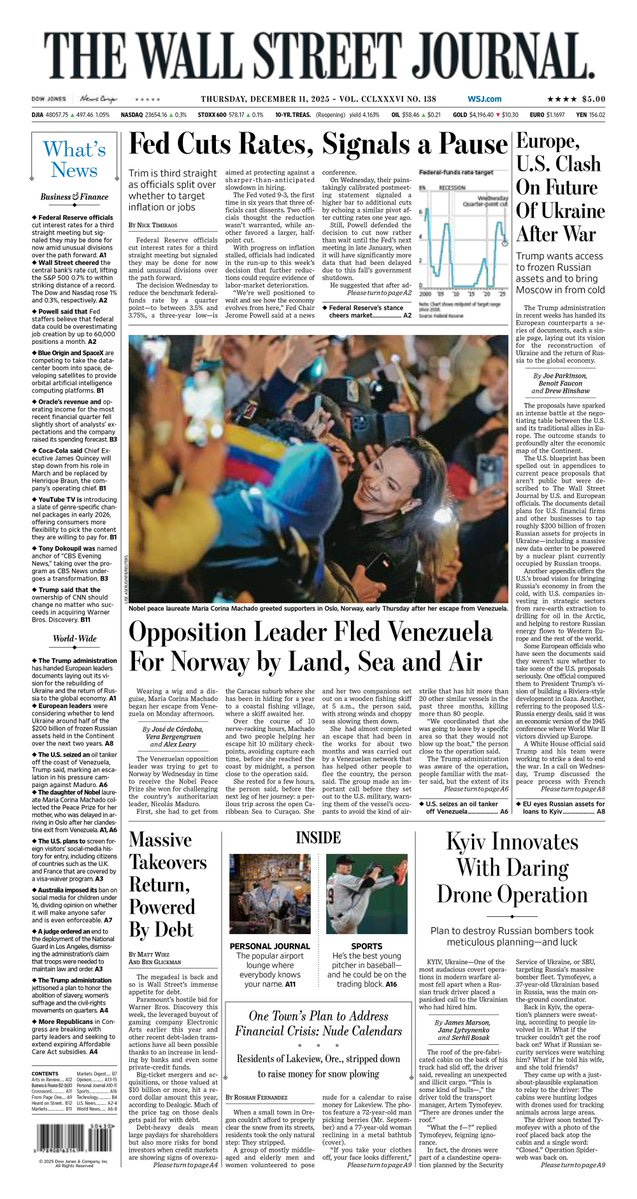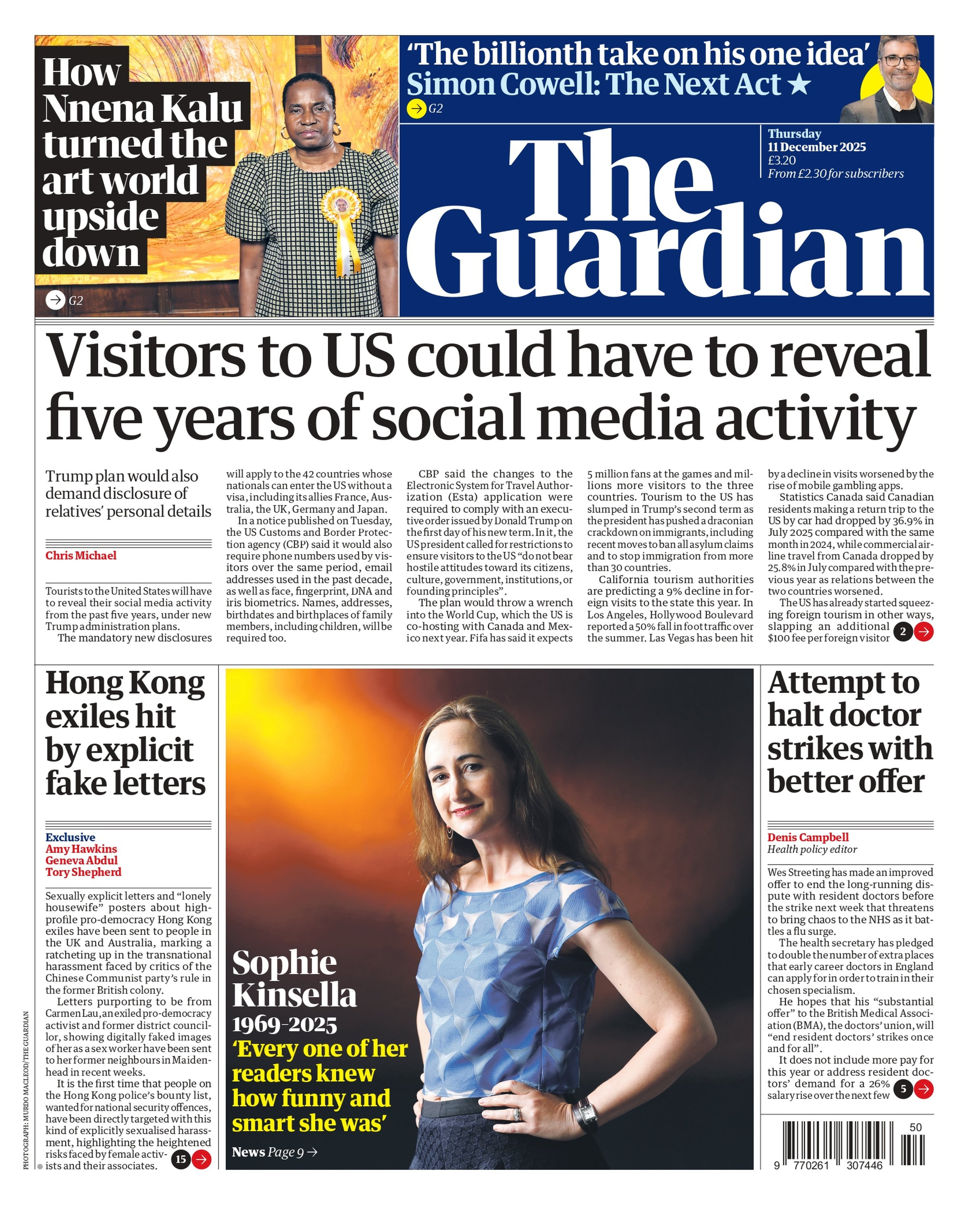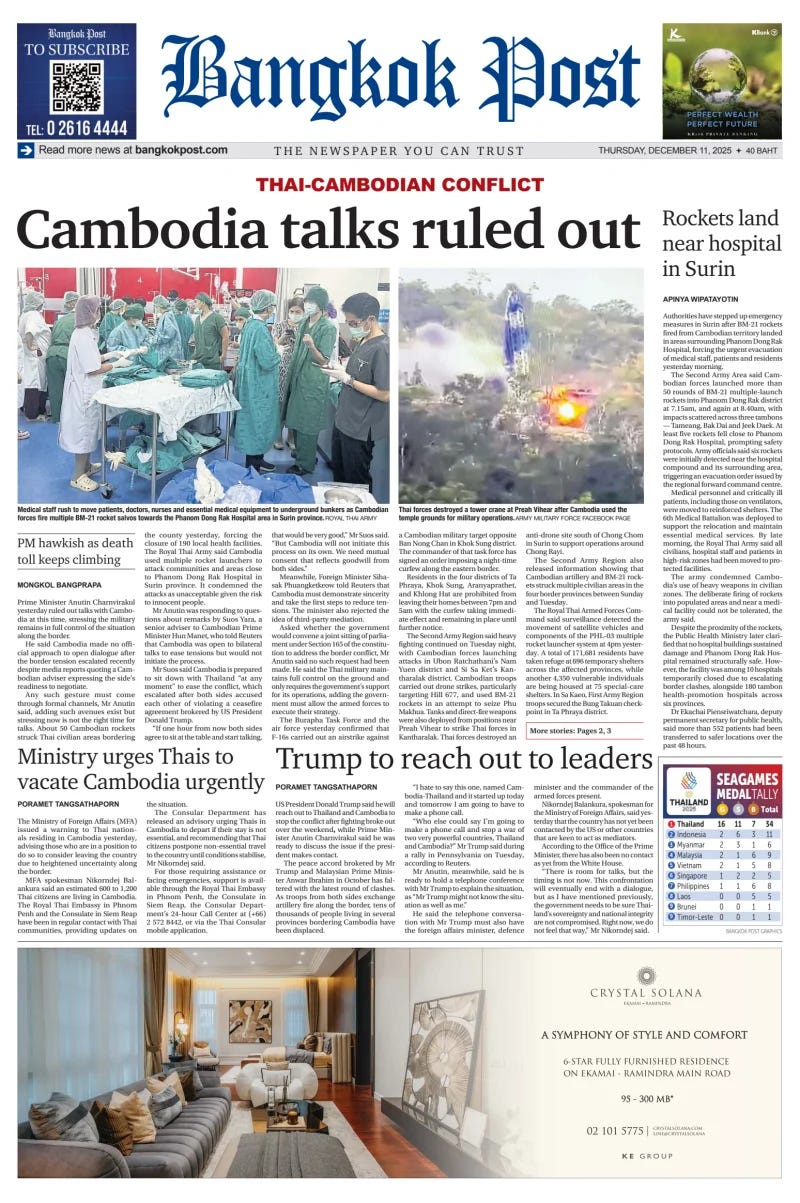
As President Trump intensifies his high-risk pressure campaign on Nicolás Maduro - boasting about keeping seized Venezuelan oil and expanding U.S. military operations in the region - it’s getting harder to reconcile his claim that he “never started a war,” or his promise to end the Russia-Ukraine war “within 24 hours” of taking office. The war not only grinds on, it now features increasingly heavy-handed US-led tactics aimed at pushing Zelenskyy into a corner. And while Trump projects muscle across the Western Hemisphere, a far more compelling drama is unfolding from Caracas to Oslo: Nobel Peace Prize laureate María Corina Machado slipping past ten military checkpoints and a U.S. strike zone to claim her award. Even another conflict Trump has repeatedly insisted he ‘settled’ is now flaring violently along the Thai-Cambodian border. In a week when Trump tried to dominate global headlines, it was Venezuela’s most hunted opposition leader - and a widening arc of instability - that seized the world’s attention.
The United States seized an oil tanker off the coast of Venezuela on Wednesday, a dramatic escalation in President Trump’s pressure campaign against Nicolás Maduro, the leader of Venezuela. Speaking at the White House before an event on a new luxury visa program, Mr. Trump announced the operation and said it was “a large tanker, very large,” adding, without elaboration, that “other things are happening.” When asked about the ship’s oil, Mr. Trump said, “Well, we keep it, I guess.” He declined to say who owned the tanker. “It was seized for a very good reason,” he added. Three U.S. officials, who spoke on the condition of anonymity to describe a law enforcement operation, said the ship was carrying Venezuelan oil. They said there was no resistance from the crew and no casualties. In a statement, Venezuela’s government called the seizure a “barefaced robbery and an act of international piracy” aimed at stripping the country of its oil wealth. The operation was the latest tactic in an expanding effort to squeeze Venezuela and pressure Mr. Maduro. The Trump administration has accused him of running a “narcoterrorist” cartel sending drugs to the United States, although many current and former officials in Washington say the campaign is ultimately aimed at regime change. Since September, the United States has launched more than 22 known strikes against boats in the region, killing more than 80 people. The Trump administration insists, without publicly providing evidence, that the boats are smuggling drugs. Legal experts say the strikes may violate international law. Attorney General Pam Bondi posted a video on Wednesday evening on social media showing armed U.S. forces rappelling from a helicopter onto the deck of the tanker. The video could not be independently verified. The U.S. officials said they expected additional seizures in the coming weeks as part of the administration’s efforts to weaken Mr. Maduro’s government by undermining its oil market - NYT
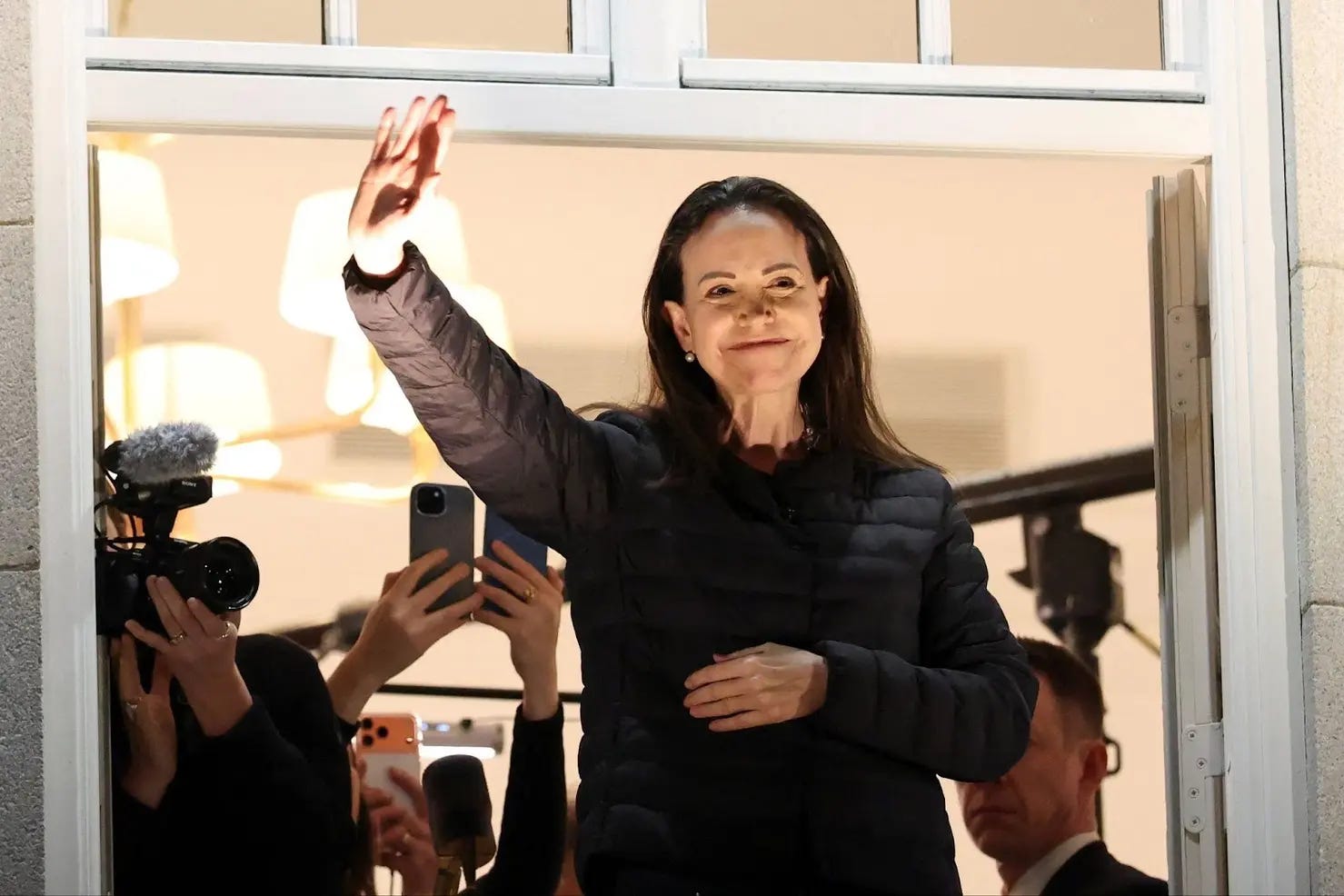
Venezuelan opposition leader María Corina Machado snuck out of the country and travelled to Oslo to celebrate her recent Nobel Peace Prize win, defying an arrest warrant by Caracas, which has pursued her for years. Machado — who has been in hiding for months — reportedly evaded 10 military checkpoints en route to the Venezuelan coast, where she boarded a wooden fishing boat to Curaçao. Ahead of her voyage, she alerted US authorities in order to avoid the type of strikes the US military has been carrying out on alleged drug-trafficking vessels in the region, The Wall Street Journal reported. Machado now faces the difficult task of returning to Venezuela, where Washington is accelerating a campaign against the country’s leader - Semafor
President Volodymyr Zelenskyy says he held a “substantive discussion” with members of Ukraine’s parliament on the possibility of holding elections, amid pressure from the United States to hold a vote despite wartime legal restrictions. Addressing Ukrainians in a nightly video on December 10, Zelenskyy said strong security guarantees from Kyiv’s allies -- especially Washington -- are needed to hold a vote. “If partners, including our key partner in Washington, speak so much and so specifically about elections in Ukraine, about elections under martial law, then we must provide legal Ukrainian answers to every question and every doubt,” he said, responding to a suggestion by US President Donald Trump that Kyiv was using the war as an excuse to avoid elections. “It is not easy, but pressure on this issue is definitely not what we need.... Security challenges depend on partners, primarily America. Political and legal challenges must be answered by Ukraine. And they will be,” he added. The White House has been pushing for Ukraine to hold elections -- Trump told Politico in an interview published on December 9 that “it’s time”-- even though Ukraine’s constitution doesn’t allow for elections during wartime. In a shift from previous statements, Zelenskyy told reporters on December 9 that he would push parliament to draft legislation allowing for elections during martial law. A vote could follow in 60 to 90 days once there are security guarantees in place to make sure voting would be safe for Ukrainians - RFE/RL
Europe’s strategy for convincing the Belgians to support its plan to fund Ukraine? Warn them they could be treated like Hungary. At their summit on Dec. 18, EU leaders’ key task will be to win over Bart De Wever, the bloc’s latest bête noire. Belgium’s prime minister is vetoing their efforts to pull together a €210 billion loan to Ukraine as it faces a huge financial black hole and as the war with Russian grinds on. De Wever has dug his heels in for so long over the plan to fund the loan using frozen Russian assets ― which just happen to be mostly housed in Belgium ― that diplomats from across the bloc are now working on strategies to get him on board. De Wever is holding out over fears Belgium will be on the hook should the money need to be paid back, and has now asked for more safety nets. Nearly all the Russian assets are housed in Euroclear, a financial depository in Brussels. He wants the EU to provide an extra cash buffer on top of financial guarantees and increased safeguards to cover potential legal disputes and settlements — an idea many governments oppose. Belgium has sent a list of amendments it wants, to ensure it isn’t forced to repay the money to Moscow alone if sanctions are lifted. De Wever said he won’t back the reparations loan if his concerns aren’t met.
Leaders thought they’d have a deal the last time they all met in October. Then, it was unthinkable they wouldn’t get one in December. Now it looks odds-on.
All hope isn’t lost yet, diplomats say. Ambassadors will go line by line through Belgium’s requests, figure out the biggest concerns and seek to address them. There’s still room for maneuver. The plan is to come as close to the Belgian position as they can. But a week before leaders meet, the EU is turning the screws. If De Wever continues to block the plan ― a path he’s been on for several months, putting forward additional conditions and demands ― he will find himself in an uncomfortable and remarkable position for the leader of a country that for so long has been pro-EU, according to an EU diplomat with knowledge of the discussions taking place. The Belgium leader would be frozen out and ignored, just like Hungary’s Viktor Orbán has been given the cold shoulder over democratic backsliding and his refusal to play ball on sanctioning Russia - Politico
In Wednesday’s episode of Al Arabiya’s W News with Leigh-Ann Gerrans, the opening segment unpacked President Zelenskyy’s confirmation that Ukraine and the United States are holding talks today on a draft peace plan — along with postwar reconstruction and economic recovery. The discussion comes on the heels of Zelenskyy’s pushback against Donald Trump’s claims that Kyiv is avoiding elections. I shared my perspectives on what this all means for Ukraine’s negotiating position and its long-term stability.
⬇️ Scroll down to watch the full segment.
The United States deported around 60 Russian nationals to Moscow on Tuesday, with men on the flight receiving military draft notices immediately after landing, according to human rights activist Dmitry Valuev. The deportation flight departed Arizona on 7 December and stopped in Cairo before arriving at Moscow’s Domodedovo Airport at 2:39 am local time on 9 December, Valuev, president of Russian America for Democracy in Russia, revealed to Euronews. Passengers on the flight flew in shackles and handcuffs attached to chains across their stomachs, according to relatives of deportees. The Russian Prosecutor General’s Office confirmed the detention of Zair Syamiullin, 70, who is wanted in Russia for fraud involving 123 million roubles. The rest of the deportees included rejected asylum seekers and those who overstayed visas, Valuev said. Russia’s federal security agency FSB interrogated deportees for several hours before releasing them, according to domestic outlets. Previous deportation cases have seen draft dodgers and activists face imprisonment after being returned to Russia - Euronews
When Vancouver Island resident Pamela Anderson and former blonde bombshell has become a makeup-free icon, and she’s ready to explain the reason for her bold move. In her cover story for People magazine, Anderson opened up about not wearing makeup anymore, her ever-changing hair color, and serving as a role model for women and girls. The Golden Globe nominee spoke about her newsworthy decision to go makeup-free at Paris Fashion Week in 2023. “I remember thinking, ‘Nobody’s even going to notice’—and people noticed,” she said. Anderson explains that going makeup-free—particularly after being known for her overdrawn lips, heavy eye makeup, and big, 1990s blowout for so long—was “part of peeling back the layers.” “I look like my Instagram photos every day. That’s where it stemmed from,” Anderson told People, adding that she felt inspired by the young women in her life, including her sons’ girlfriends and her nieces. “I just want to make sure that they feel confident in who they are...and to not worry so much.” Now, she hopes to inspire other women and girls to feel comfortable in their own skin. (This is especially fitting, as Anderson recently entered the serum game when she and her sons acquired the beauty brand Sonsie Skin in 2024. - The Daily Beast
The journals….