

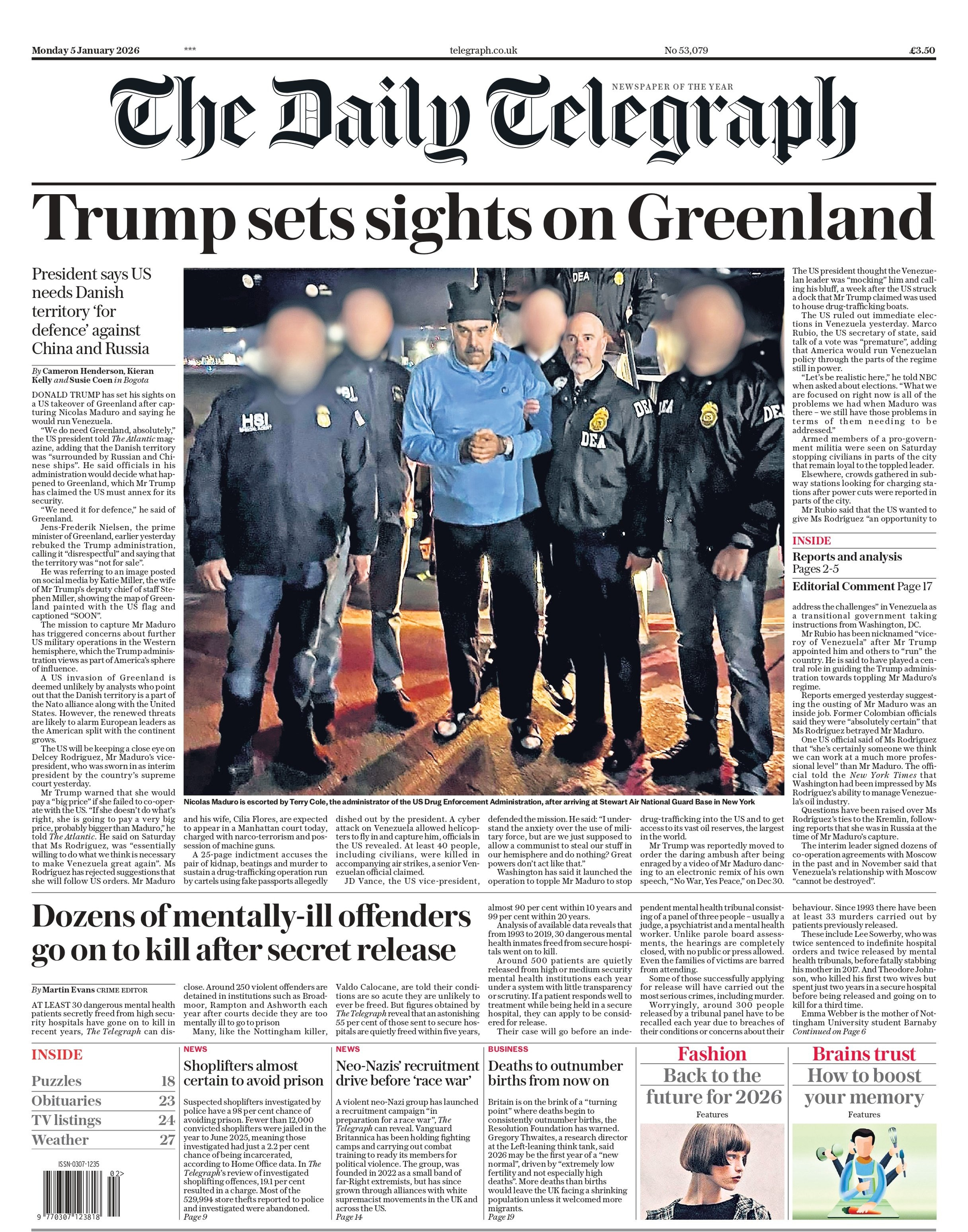
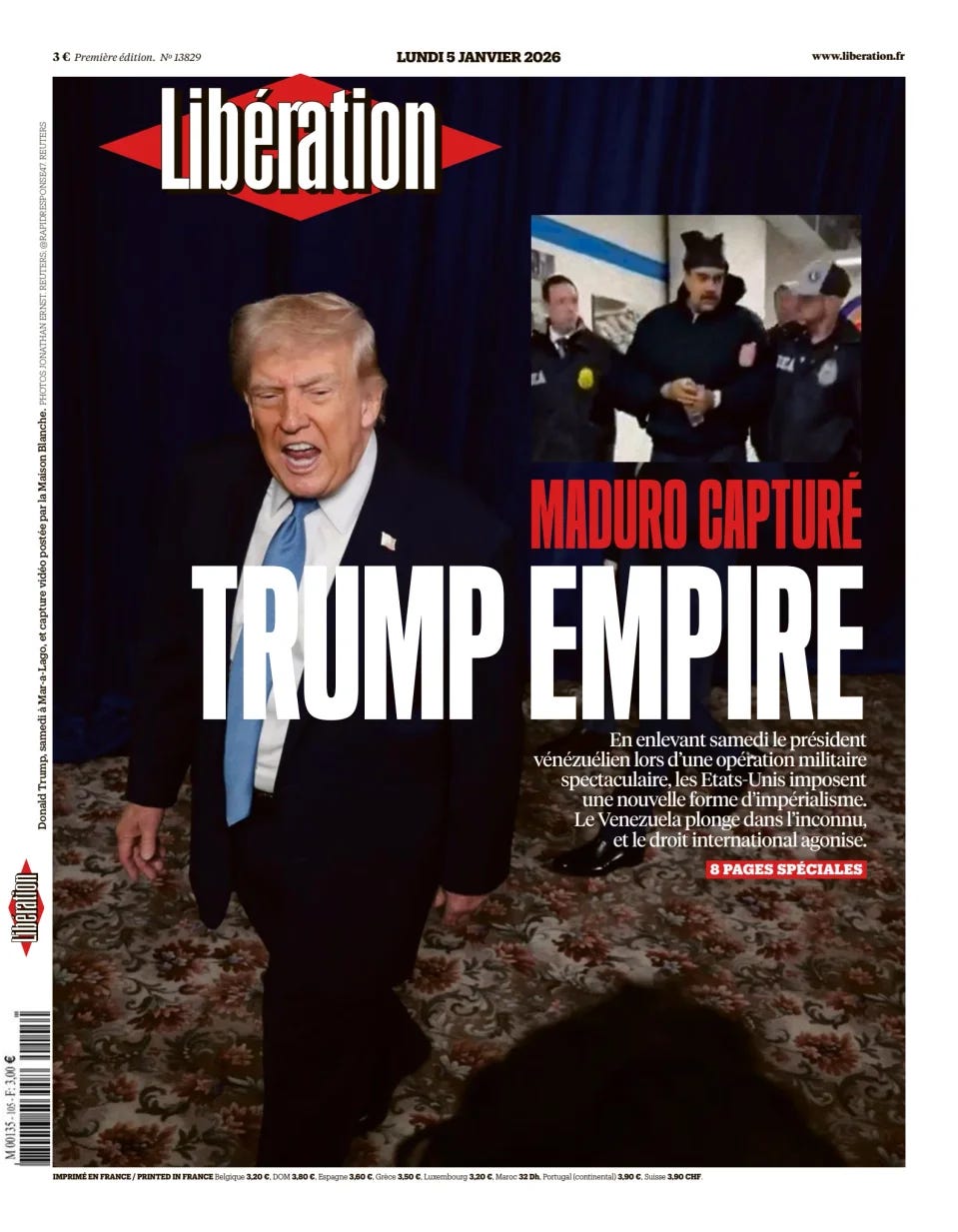
Deposed Venezuelan leader Nicolás Maduro declared himself “innocent” and a “decent man” as he pleaded not guilty to federal drug trafficking charges in a U.S. courtroom on Monday. “I’m innocent. I am not guilty. I am a decent man, the president of my country,” Maduro told a judge. Maduro was making his first appearance in an American courtroom Monday on the narco-terrorism charges the Trump administration used to justify capturing him and bringing him to New York. Maduro, wearing a blue jail uniform, and his wife were led into court around noon for a brief, but required, legal proceeding that will likely kick off a prolonged legal fight over whether he can be put on trial in the U.S. His next court date is set for March 17 - AP
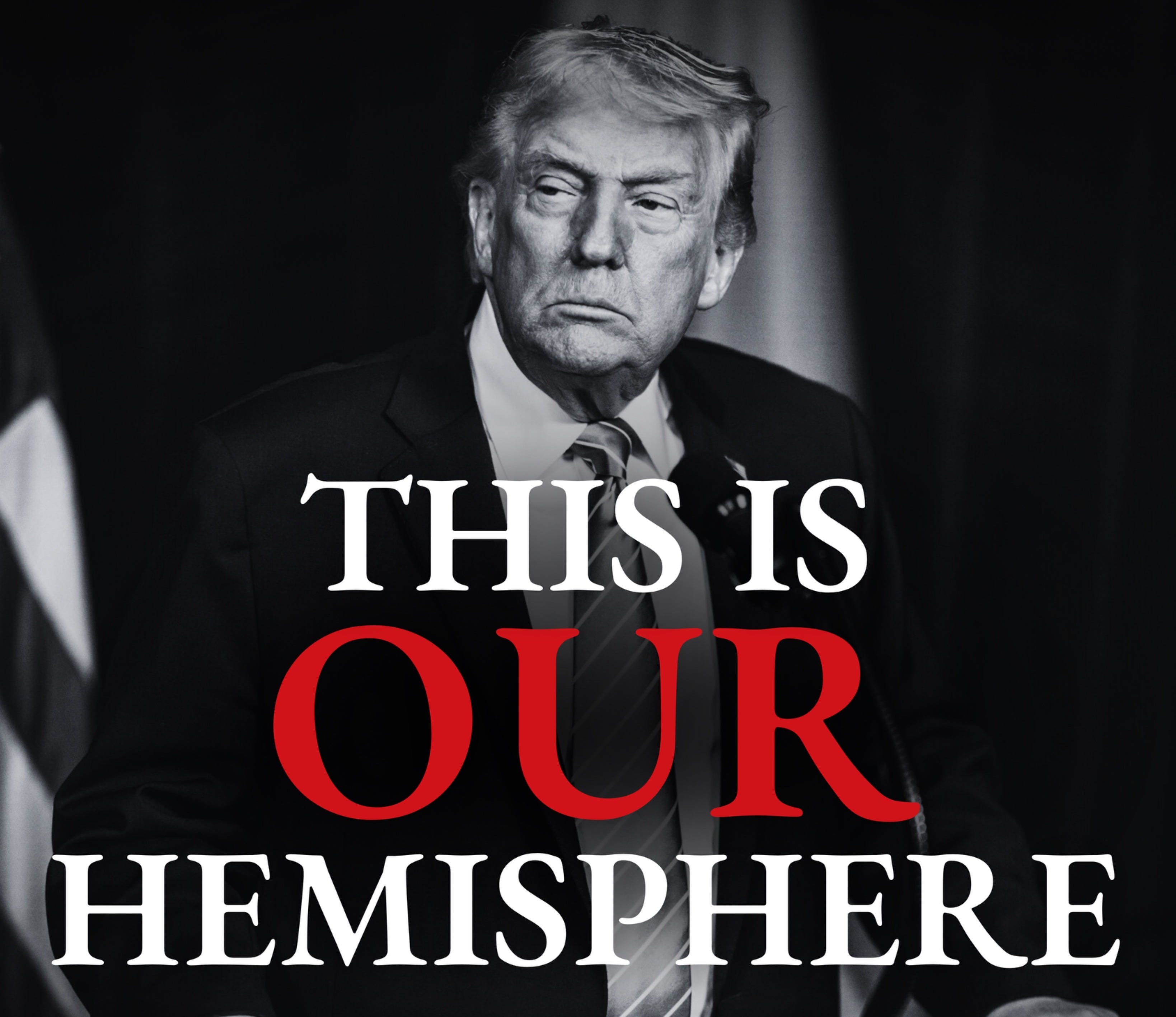
In a jarring—and widely criticized - post on X, the U.S. Department of State declared that the Western Hemisphere belongs to the United States, writing: “This is OUR Hemisphere, and President Trump will not allow our security to be threatened.” That framing was echoed the following day by Marco Rubio in appearances across multiple U.S. news networks. “This is the Western Hemisphere. This is where we live — and we’re not going to allow the Western Hemisphere to be a base of operation for adversaries, competitors, and rivals of the United States,” he said.
Taken together, the statements appear to validate what World Briefing and other analysts have been warning for months: that the world is rapidly sliding into rigid spheres of influence. In this emerging order, the Western Hemisphere is increasingly cast as Washington’s exclusive domain, Central and Eastern Europe as Vladimir Putin’s contested backyard, and the Asia-Pacific as the strategic prize of Xi Jinping’s China. In response to the post on X, Indian lawyer Kalpana Srivastava wrote: “On one hand, America raises the flag of democracy all over the world, on the other hand it claims its own backyard and says – this is our territory, don't try to play with anyone! Why this double standard? Is this the return of imperialism or just Trump's strong stance?”
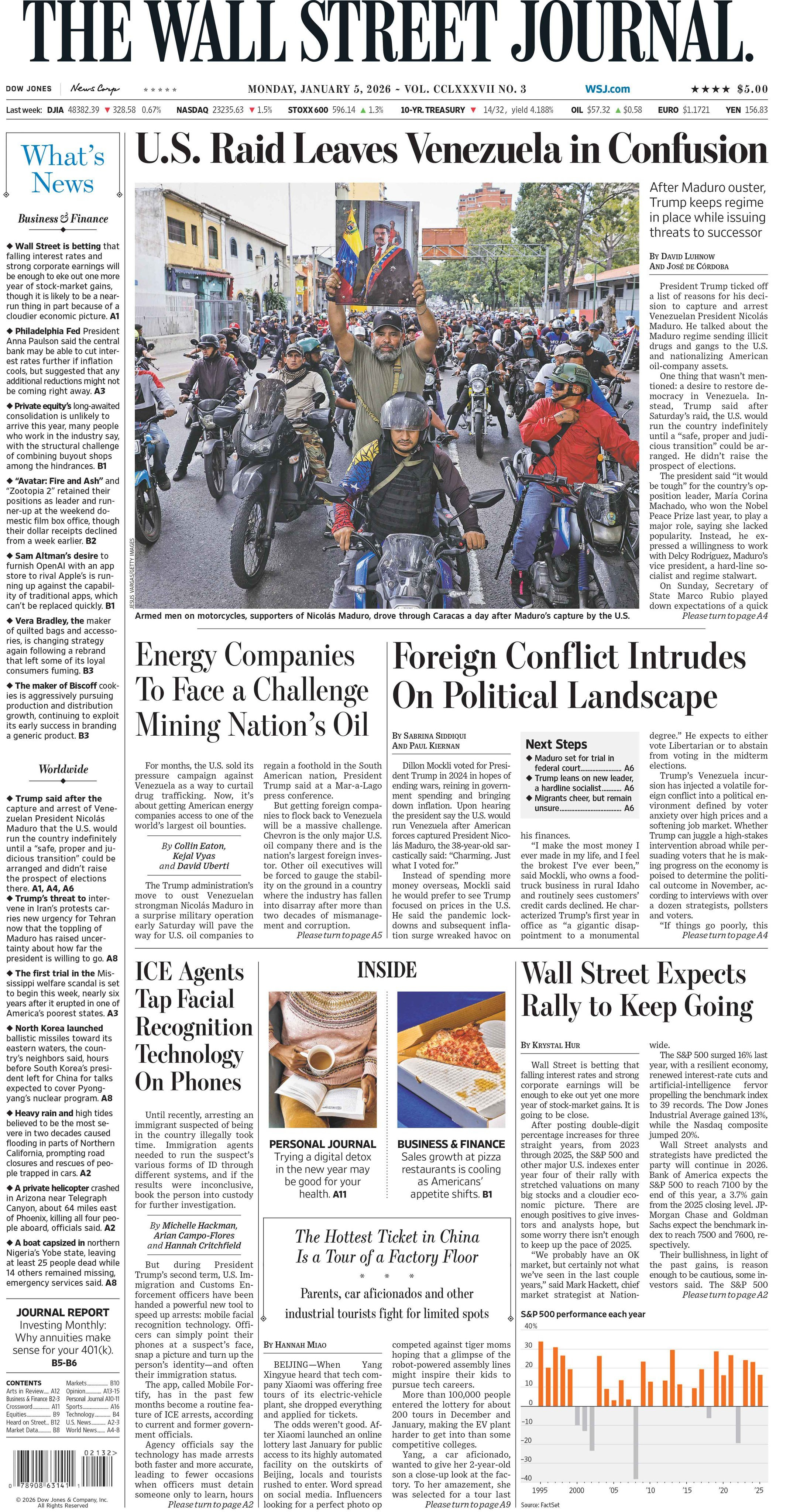
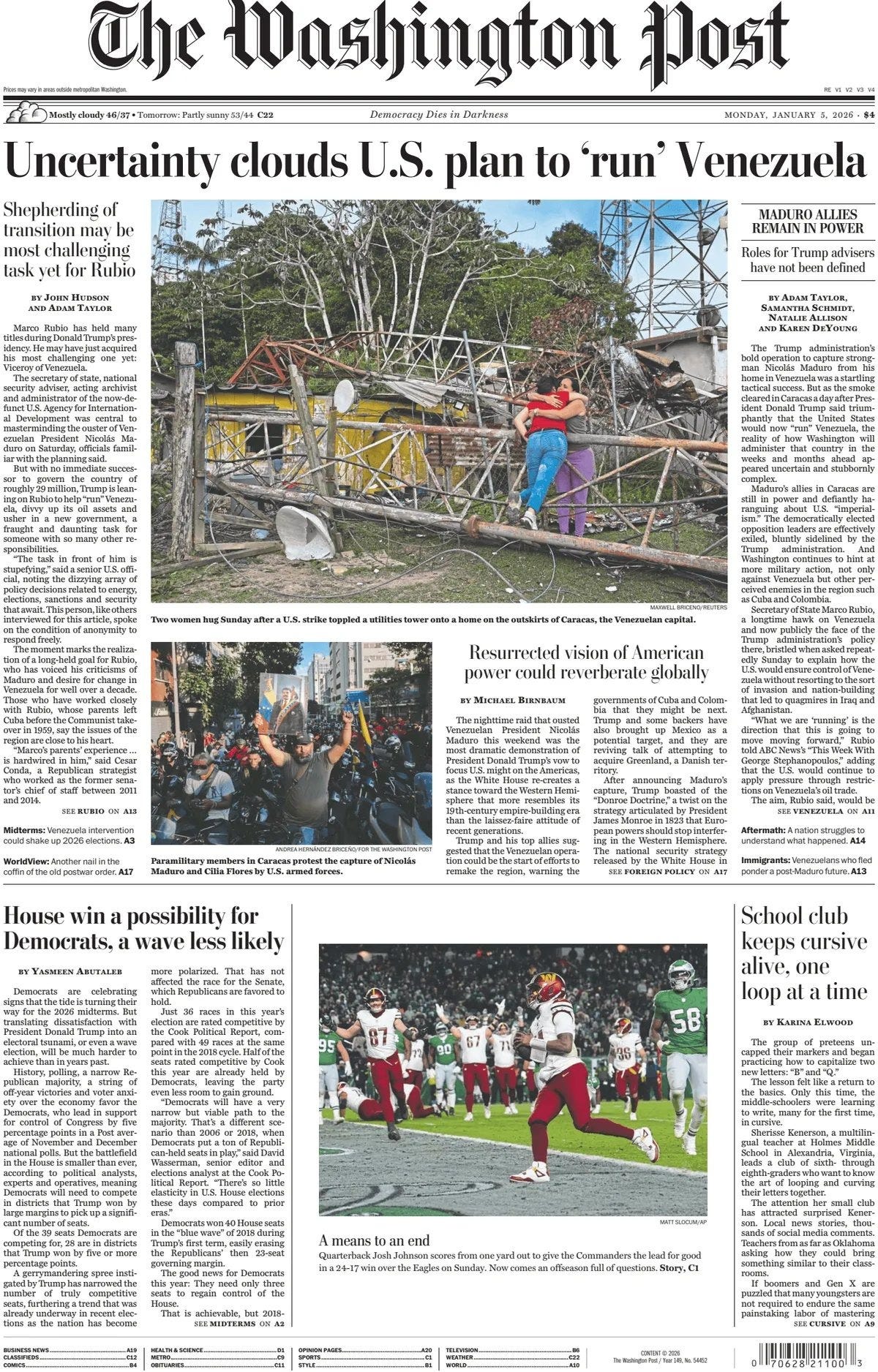
Secretary of State Marco Rubio said Sunday that the U.S. would not govern Venezuela day-to-day other than enforcing an existing “oil quarantine” on the country, walking back Trump’s comment that the U.S. would “run” Venezuela temporarily. Still, Trump’s plan to seize and revitalize Venezuela’s oil industry faces major hurdles.
Venezuela’s Delcy Rodríguez, who called Maduro’s capture an “atrocity” in the hours after the operation, has now invited Trump to “collaborate with us on an agenda of cooperation.” Her conciliatory message came after Trump threatened that she could “pay a very big price” if she didn’t fall in line with U.S. demands.
Trump repeated his threat to annex Greenland, prompting Denmark’s prime minister to demand Trump “stop the threats” against the autonomous Danish territory after the US leader told The Atlantic soon after Nicolás Maduro’s weekend capture that “we do need Greenland.” European leaders have “underpriced” the risk of the US taking Greenland, a top geopolitics analyst wrote. Meanwhile, Canada should be wary of “an imperial America,” The Globe and Mail wrote in an editorial.
At least 16 oil tankers hit by U.S. sanctions appear to have made an attempt to evade a major American naval blockade on Venezuela’s energy exports over the last two days, in part by disguising their true locations or turning off their transmission signals. For weeks, the ships had been spotted on satellite imagery docked in Venezuelan ports, according to an analysis by The New York Times. But by Saturday, in the wake of Maduro’s capture by U.S. forces, all were gone from those locations. Four have been tracked by satellite sailing east 30 miles from shore, using fake ship names and misrepresenting their positions, a deceptive tactic known as “spoofing.” These four have left port without the interim government’s authorization, according to internal communications from Venezuela’s state-owned oil company and two people in the Venezuelan oil industry, who spoke on condition of anonymity out of fear of retribution. The departures could be seen as an early act of defiance of interim President Delcy Rodríguez’s control. The other 12 are not broadcasting any signals and have not been located in new imagery. President Trump unilaterally imposed a “complete blockade” on sanctioned Venezuelan oil tankers on Dec. 16, an effort that Secretary of State Marco Rubio said on Sunday was one of the largest “quarantines” in modern history, and was successfully “paralyzing” the regime’s ability to generate revenue. The blockade has notably exempted oil shipped by American company Chevron to the U.S. Gulf Coast - NYT
Colombian President Gustavo Petro said on Monday he would “take up arms” in response to threats from US President Donald Trump, after the Delta Force-led operation resulted in the capture of Venezuela’s Nicolas Maduro over the weekend. Petro, a former guerrilla fighter who has faced months of harsh comments from Trump, wrote on X: “I swore not to touch a weapon again ... but for the homeland I will take up arms again.” Trump said over the weekend that Petro should “watch his *ss” and called Colombia’s leftist president “a sick man who likes making cocaine and selling it to the United States.” Petro’s M-19 urban guerrilla group disarmed under a 1989 peace agreement. He has traded barbs with Trump since the US president’s return to the White House in January - Euronews
Filmed in Odesa tonight. As Ukrainians follow the dramatic U.S. intervention in Venezuela, one local here summed it up simply: “Maybe Ukraine is the safest place to be at the moment.” From Maduro’s arrest to oil blockades and a blunt claim over the Western Hemisphere, Washington’s move looks less about democracy and more about control. Just as striking is who’s been sidelined - Venezuela’s democratic opposition - raising hard questions about what kind of “transition” the U.S. is really backing, and what precedent it sets in a world sliding fast into spheres of influence.
Iranian security forces shot and reportedly killed protesters as demonstrations continue across the country. The Norway-based human rights group Hengaw reported that at least four people were killed and 30 were wounded in the western Iranian city of Malekshahi on January 3. In its latest report, Human Rights Activists News Agency (HRANA), a US-based nonprofit that monitors human rights violations in Iran, says that over the past eight days, there have been protests, street gatherings, or strikes in at least 222 locations in 78 cities across 26 provinces of the country. Seventeen universities, according to the organization, have also been the scene of student protests. The report says that at least 990 citizens have been arrested during this period and at least 19 protesters have lost their lives. (Other reports claim the numbers of arrested and killed are higher.) According to HRANA, 51 injuries have been recorded so far, mostly from shotgun pellets and rubber bullets - RFE/RL
Meanwhile, Motahareh Gounei, a student activist and a human rights defender based in Iran who has been arrested several times in the past, said the situation has become so desperate that people are not afraid to die in their quest to try to bring about change: “I witnessed a scene in Qom where a crowd was moving toward the security forces without fear --unafraid that they might be shot. People are truly fed up. We have had enough. Even if they execute us, we are exhausted by the life the Islamic republic has imposed on us, by this suffocating atmosphere. Our most basic demands are inseparable from the survival of the Islamic republic itself: when will it end? When will [Iranian Supreme Leader Ayatollah Ali] Khamenei’s political life end? - RFE/RL
Finland seized a ship suspected of sabotaging a telecommunications cable in the Baltic Sea, the latest maneuver in a quiet battle over underwater infrastructure. Cables and pipelines carry vital data and fuel, and apparent sabotage is on the rise. Several cables to Taiwan are broken each year, allegedly by China, and Beijing also uses regulatory pressure to deny or delay installations and bolster its influence in the South China Sea; Russia has been linked to a series of incidents in the Baltic, usually involving ships dragging their anchors. International law is murky over whether cable sabotage is “piracy, terrorism, or even… an armed attack,” and legal loopholes hinder international efforts to prevent it, an expert wrote for Foreign Affairs. Meanwhile, China’s increasingly advanced military capabilities are alarming the West and reshaping the global balance of naval power, analysts said. Beijing recently unveiled research submarines capable of traversing the Arctic, and the US expects it to be able to send nuclear-armed boats to the North Pole within a few years, where they would be troublingly close to potential NATO targets, The Wall Street Journal reported. And the Pentagon believes that China now has anti-ship ballistic missiles capable of striking targets up to 5,000 miles away, a class of weapon described as “carrier killers.” The weapons “pose a potent threat to surface ships across much of the Pacific,” one analyst told the US Naval Institute’s news site - Semafor
President Donald Trump has told reporters that U.S. officials have determined that Ukraine did not target a residence belonging to Russian President Vladimir Putin in a drone attack last week, disputing Kremlin claims that Trump had initially greeted with deep concern. Russian Foreign Minister Sergey Lavrov last week said Ukraine launched a wave of drones at Putin’s state residence in the northwestern Novgorod region that the Russian defense systems were able to defeat. Lavrov also criticized Kyiv for launching the attack at a moment of intensive negotiations to end the war. The allegation came just a day after Ukrainian President Volodymyr Zelenskyy had traveled to Florida for talks with Trump on the U.S. administration’s still-evolving 20-point plan aimed at ending the war. Zelenskyy quickly denied the Kremlin allegation. Trump said that “something happened nearby” Putin’s residence but that Americans officials didn’t find the Russian president’s residence was targeted. “I don’t believe that strike happened,” Trump told reporters as he traveled back to Washington on Sunday after spending two weeks at his home in Florida. “We don’t believe that happened, now that we’ve been able to check.” At least initially, had appeared to take the Russian allegations at face value. He told reporters last Monday that Putin had also raised the matter during a phone he had with the Russian leader earlier that day. And Trump said he was “very angry” about the accusation - AP
U.S. Special Envoy Steve Witkoff and Jared Kushner — U.S. President Donald Trump’s son-in-law — will travel to Paris and attend a meeting of Ukraine’s allies on Tuesday, an Elysée official told reporters on Monday. U.S. Secretary of State Marco Rubio will not be there “for obvious reasons,” the official added, referring to the situation in Venezuela. “We have strived to bring the Americans closer to us, never resigning ourselves to the U.S. abandoning Ukraine. We have succeeded in this exercise of reconvergence between Ukraine, Europe, and America,” the official stressed - Politico
The journals…..
Narcissistic Personality Disorder (NPD) is a recognized mental illness, a serious condition involving pervasive grandiosity, a deep need for admiration, and a significant lack of empathy, causing significant impairment in life and relationships -- not that we need a clinic definition to understand that reason fails against arrogance; no shame for the moral equivalency of evil and good. he is proud to be the godfather, the bully in the high school parking lot - he has achieved his dream. and he inhuman enough to think that it is a good one.