🔥 World Briefing — Hot Take
The real story isn’t the $6 million - it’s the multiplier effect. With hundreds of cases lined up and billions already in play, the verdict against Meta Platforms and Google LLC could be the first crack in a dam facing $40 billion in potential claims. For a generation raised on Instagram and YouTube, the argument is shifting: from “user choice” to “platform design.” As I warned in Digital Pandemic, what looked like connection often masked something more deliberate - systems built to keep users inside them. The courtroom is now catching up to that reality. And Silicon Valley may find that the cost of engagement is far higher than it ever anticipated.
News Briefs
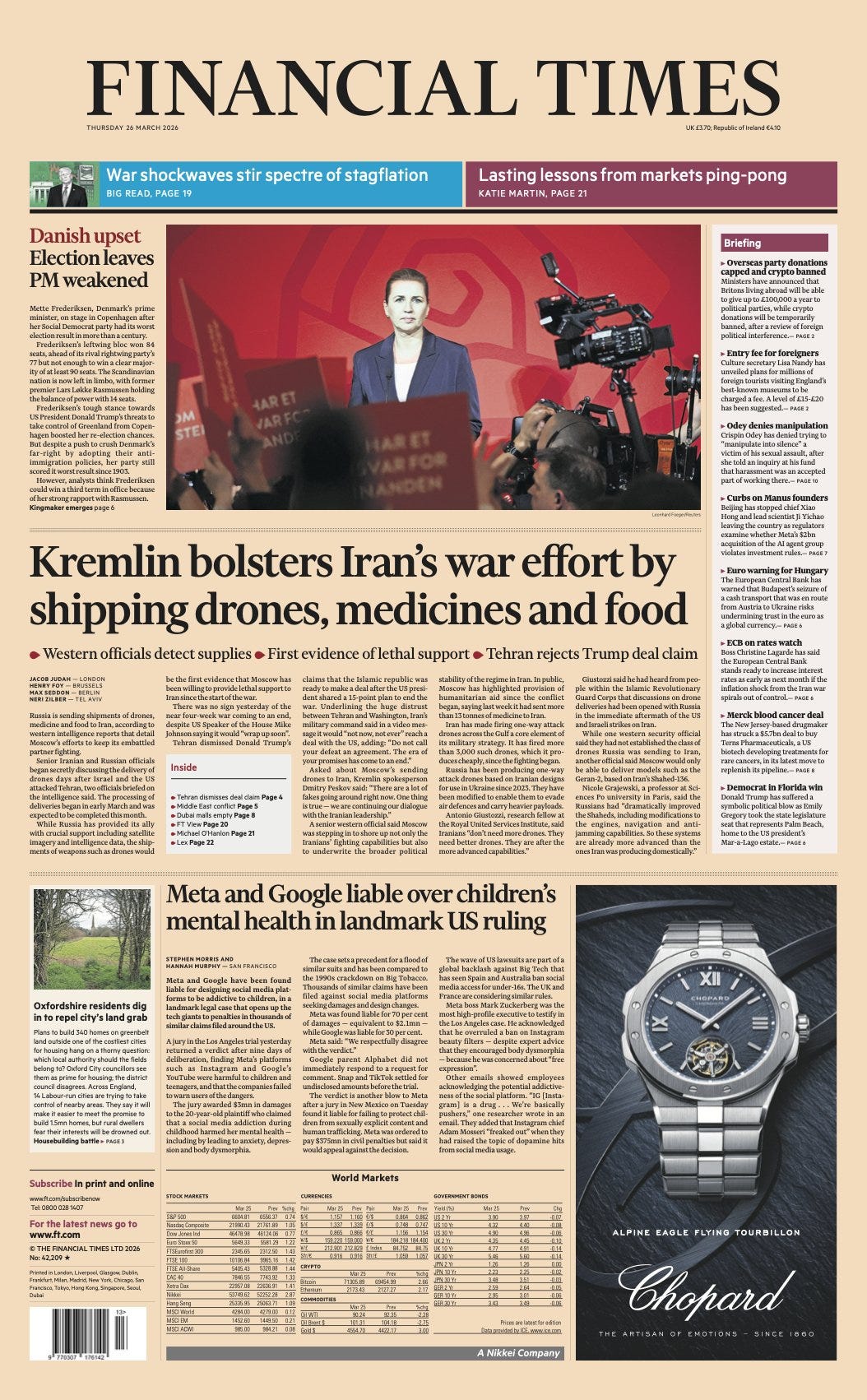
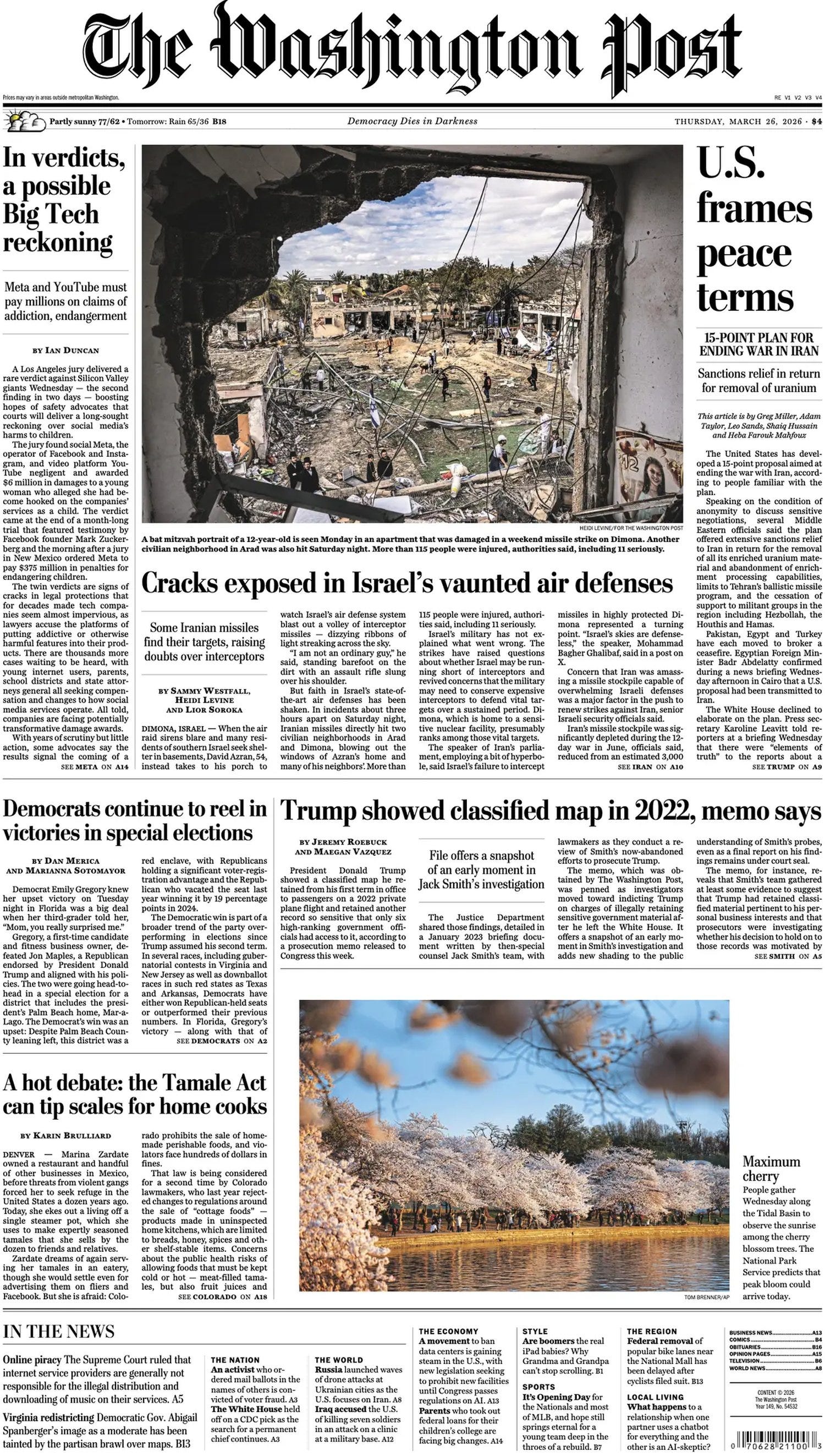
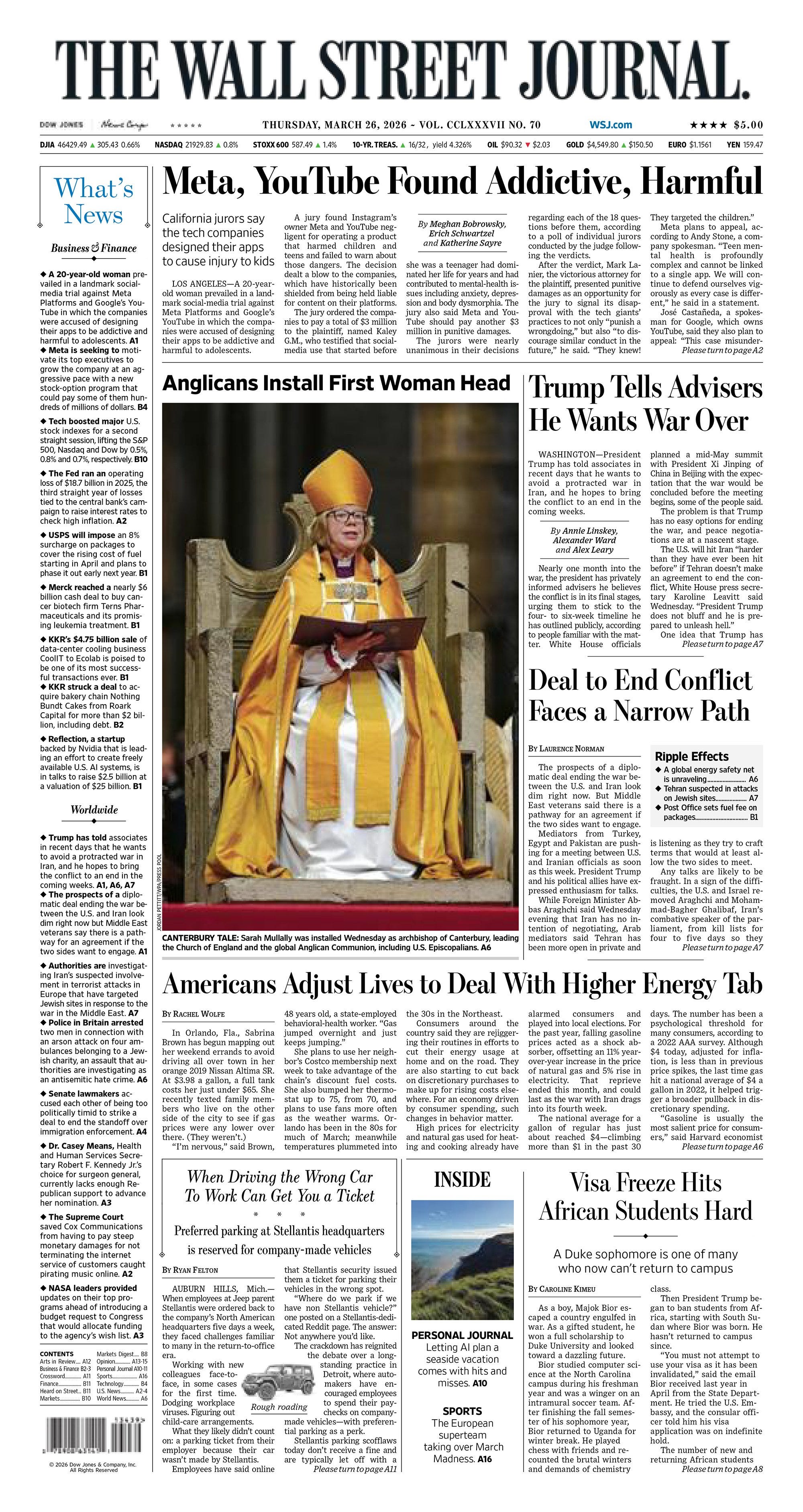
A jury on Wednesday ordered Meta and Google to pay $6 million to a 20-year-old woman who alleged that she was addicted to Instagram and YouTube as a child. The jury of seven women and five men found the companies liable for product design features that harmed the plaintiff’s mental health. The jurors awarded $3 million in compensatory damages, and later granted an additional $3 million in punitive damages. Meta was ordered to pay 70% of the damages, with Google responsible for the remaining 30%. The lawsuit is one among thousands nationwide to allege that companies like Meta and Google are responsible for making addictive products that have harmful effects. The case is the first of them to go to trial, and is considered a “bellwether” to assess how other claims could be resolved. The plaintiff, Kaley G.M., testified in February that she created YouTube and Instagram accounts when she was 8 and 9, respectively. As a young girl, she was soon spending all her free time on Instagram. “I was on it every single day,” she said. “First thing when I woke up, right after school, and then late at night.” She alleged that she gave up other hobbies and that the apps led her to suffer from anxiety, depression and body dysmorphia. Meta CEO Mark Zuckerberg also testified at the trial, which was held in Los Angeles Superior Court in downtown L.A. Zuckerberg defended the choices made at Instagram, particularly around beauty filters, saying that the company is trying to strike the right balance between potentially harmful content and free expression. Adam Mosseri, the head of Instagram, also testified, saying he did not believe it was possible to be addicted to social media apps. The plaintiffs’ lawyers argued that design choices — like “infinite scroll” — were intended to keep users hooked on the apps, which led to greater usage time and ultimately helped both companies’ bottom lines. Meta’s attorneys said they planned to appeal. TikTok and Snap were also named as defendants in the case, but settled before the trial - Variety
With similar cases pending in 250 school districts and in populous states such as Florida and New York, tech writer Jacob Ward told PBS The Newshour that the California jury ruling could be just the tip of the iceberg for the social media companies. “This essentially sets a per-plaintiff kind of price….If you look at all of the other cases that are coming down the pipeline…you’re looking at $40-billion alone. And that’s just the cases that have been filed.”
A New Mexico jury yesterday ordered META to pay $375-million after it said the social media giant concealed what it knew about child sexual exploitation on its platforms. The prosecutors had been asking for as judgement of $2-billion.
“This is going to be an enormous problems for these (social media) companies and that is why, of course, they are going to appeal like crazy” - Jacob Ward, tech writer
Russia has been shipping drones to Iran to aid its ally in the war against the United States and Israel, according to a Western intelligence report, the Financial Times reported. It comes as Moscow has been accused of providing intelligence support to Tehran, with President Volodymyr Zelensky claiming on March 24 that Kyiv has “irrefutable evidence” that Russia is helping Iran target U.S. assets in the Middle East. Senior Iranian and Russian officials began secretly discussing deliveries of drones, medicine, and food shortly after the U.S. and Israel launched coordinated attacks against Iran at the end of February, two officials briefed on the intelligence report told FT. Russia began sending drone deliveries in early March, and is close to the end of its phased shipment, officials said. The deliveries are expected to be completed by the end of the month. Drone shipments would represent the first lethal military aid Russia has provided Iran in the war with the U.S. and Israel, now in its fourth week. CIA Director John Ratcliffe confirmed on March 18 that Iran has sought intelligence from its allies, including Russia, but would not say publicly whether the U.S. had evidence that Russia provided any such intelligence - Kyiv Independent
The United States and Iran struggled to find a way to begin negotiations over peace terms on Wednesday, with each insisting it had the upper hand in the war. The United States circulated a 15-point peace plan, diplomats said, demanding what would amount to a complete termination of Iran’s nuclear program and strict limits on its missile arsenal. The White House press secretary, Karoline Leavitt, said Iran’s forces had been crushed after four weeks of strikes by the United States and Israel. “That’s why you are beginning to see the regime look for an exit ramp,” she said. But Iranian officials didn’t sound defeated. In a statement issued through state television, an official said the government would not end the attacks unless the United States paid war reparations and recognized Iranian control over a vital oil route, the Strait of Hormuz. Iran has effectively blocked the strait to most shipping. The Iranian official said that Tehran would not allow Mr. Trump “to dictate the timing of the war’s end.” Later, the Iranian foreign minister, Abbas Araghchi, said in an interview with a state broadcaster that Iran had no intention of negotiating. Still, Iranian officials signaled privately on Tuesday that they were open to negotiations, raising the prospect of a cessation in hostilities.
Israel’s military has not explained what went wrong with its state-of-the-art air defences recently with strikes on populated areas such as Dimona in the southern part of the country. More than 115 people were injured, including 11 seriously. The Washington Post reports that the strikes have raised questions about whether Israel may be running short of interceptors and revived concerns that the military may need to conserve expensive interceptors to defend vital targets over a sustained period. Dimona, which is home to a sensitive nuclear facility, presumably ranks among those vital targets. The speaker of Iran’s parliament, employing a bit of hyberbole, said Israel’s failure to intercept missiles in highly-protected represented a turning point. “Israel’s skies are defenceless,” said Mohammad Bagher Ghailbaif.
The Iran war is sending shockwaves far beyond the Middle East — and here in Southeast Asia, the impact is already being felt.
In the Philippines, rising fuel and electricity costs are exposing just how vulnerable economies can be to distant conflicts.
📍 Reporting from Manila, I connect the dots between geopolitics and the pressure now hitting households and businesses across the region.
👉 Upgrade to a World Briefing paid subscription to watch exclusive videos and get on-the-ground insight you won’t find in the headlines.
The Sudan conflict is at a tipping point similar to that of the Syrian civil war in 2011 and could soon see large numbers of people displaced into neighboring countries, the head of the United Nations migration agency in Sudan told POLITICO. The crisis comes three years into a civil war that has created the largest humanitarian crisis in the world, with more than 9 million people uprooted and an estimated 150,000 now facing catastrophic hunger, the U.N. said Wednesday. “If you compare this conflict to what happened in Syria in 2011, when the displacement started building up … the migration routes started building and then the sudden outbreak of the conflict started impacting all the regional and cross-regional countries,” said Mohamed Refaat, chief of mission for the International Organization for Migration in Sudan. Unless serious efforts are made to resolve the conflict, “you might see more and more displacement entering the cross-border and beyond,” he said. A meeting between U.N. agencies in Sudan and EU officials will take place Thursday. Rafaat’s warning comes as the bloc cracks down on migration amid a surge in support for right-wing parties and concerns that wars in the Middle East and Africa could prompt a fresh wave of migrants to seek refuge in the EU. In 2015, four years into the Syrian civil war, nearly a million displaced people arrived in Europe. At the time, Germany’s then-Chancellor Angela Merkel famously said “we can do it” (“wir schaffen das“) and encouraged EU leaders to welcome the displaced Syrians. But in the decade that followed, a backlash against more liberal immigration policies fueled the rise of far-right parties across the bloc.
A new report by the Yale School of Public Health’s Humanitarian Research Lab alleges that Russian state-linked energy giants Gazprom and Rosneft were directly involved in the transfer and political indoctrination of thousands of Ukrainian children. The report, Willing Accomplices: Gazprom & Rosneft’s Role In The Transport and Indoctrination of Ukraine’s Children, concludes “with high confidence” that the companies and their subsidiaries facilitated the transportation and/or reeducation of at least 2,158 children from Russian-occupied areas of Ukraine between 2022 and 2025. It identifies six camps in Russia and Russia-occupied territories where children were taken, including facilities owned by Gazprom subsidiaries, and says the effort is part of a broader, systematic campaign. “Gazprom and Rosneft are critical components of President [Vladimir] Putin’s industrial-scale campaign of child deportation, transportation indoctrination,” said Nathaniel Raymond, executive director of the research slab. The report says children from Ukraine’s Donetsk, Luhansk, and Zaporizhzhya regions were transported to camps where they were exposed to pro-Russian messaging and, in some cases, militarized activities described as “patriotic education. A companion analysis from Stanford University warns that a recent US sanctions waiver could allow the companies to continue generating revenue - RFE/RL
The world’s imbalance between incoming and outgoing energy is growing ever faster, the UN warned. The planet gains energy from the sun and releases it as heat. Under usual circumstances, the two are in equilibrium, but greenhouse gases trap more energy, and as concentrations increase, temperatures rise. The World Meteorological Organization report noted that the imbalance in 2025 was the greatest it’s been since measurement began in 1960. That is unsurprising, however, as it is implicit in the fact that atmospheric CO₂ concentrations are increasing. A more noteworthy fact is that ocean heat rose twice as fast in the last 20 years as in the 40 beforehand. This is the first time the WMO report has included energy imbalance - Semafor
Corey Lewandowski was ousted from the Trump administration after he was spotted on a tropical getaway with his alleged lover, fired Department of Homeland Security Secretary Kristi Noem. A White House official and three sources close to the Trump administration confirmed Lewandowski’s ousting to the New York Post—Donald Trump’s favorite newspaper—after the special government employee was spotted with Noem, 54, in balmy Guyana, where temperatures ranged from 75°F to 83°F. The stop in Guyana was the fourth leg of a five-country tour, which began when Noem was still in her old job. It is unclear if the alleged couple therefore flew in the leased luxury Boeing 737 with a private bedroom, which she had at her disposal. Other people fired by Trump mid-travel have found themselves stranded, including Signalgate leaker Mike Waltz, who had to watch Air Force One take off without him.
The journals…