This World Briefing begins on the streets of Bangkok, where Thailand’s election campaign is unfolding amid frustration - particularly among young voters who feel excluded from opportunity and locked out of the futures their parents once took for granted. From the moment we returned here Thursday evening, we heard complaints from voting-age youth and Thai professionals about the high living costs, stagnant wages, and the growing impossibility of affording housing, marriage, or children. These are no longer local complaints; they are global ones.
I’ve heard the same anxieties echoed during elections or mass protests in Cairo, Ottawa, and across parts of Europe, including Italy - where widening disenchantment among younger professionals with the government of Giorgia Meloni is growing amid inflation and economic stagnation. Across Africa, the youth vote is expanding rapidly, raising the stakes even higher for governments that fail to respond.
The message is getting louder: young voters are numerous, mobilizing, and increasingly willing to swing elections. Many ruling parties still appear unable - or unwilling - to grasp what that means. Today’s video takes this conversation further, with more on-the-ground reporting from Thailand and continued coverage from across the region in the days ahead. (Advance voting, a week ahead of the general election, took place today in Thailand with more than 2 million eligible voters registered to cast their ballots ahead of polling day on Feb 8).
From Bangkok today: Thailand’s election kicks off under a nationwide alcohol ban—but the bigger story is the mood of young voters. I’m hearing the same frustrations I’ve heard in Cairo, Ottawa and beyond: soaring costs, shrinking opportunities, and big life milestones - home, marriage, kids - slipping out of reach. Governments ignore this at their peril. The youth vote is massive, and it’s getting louder.

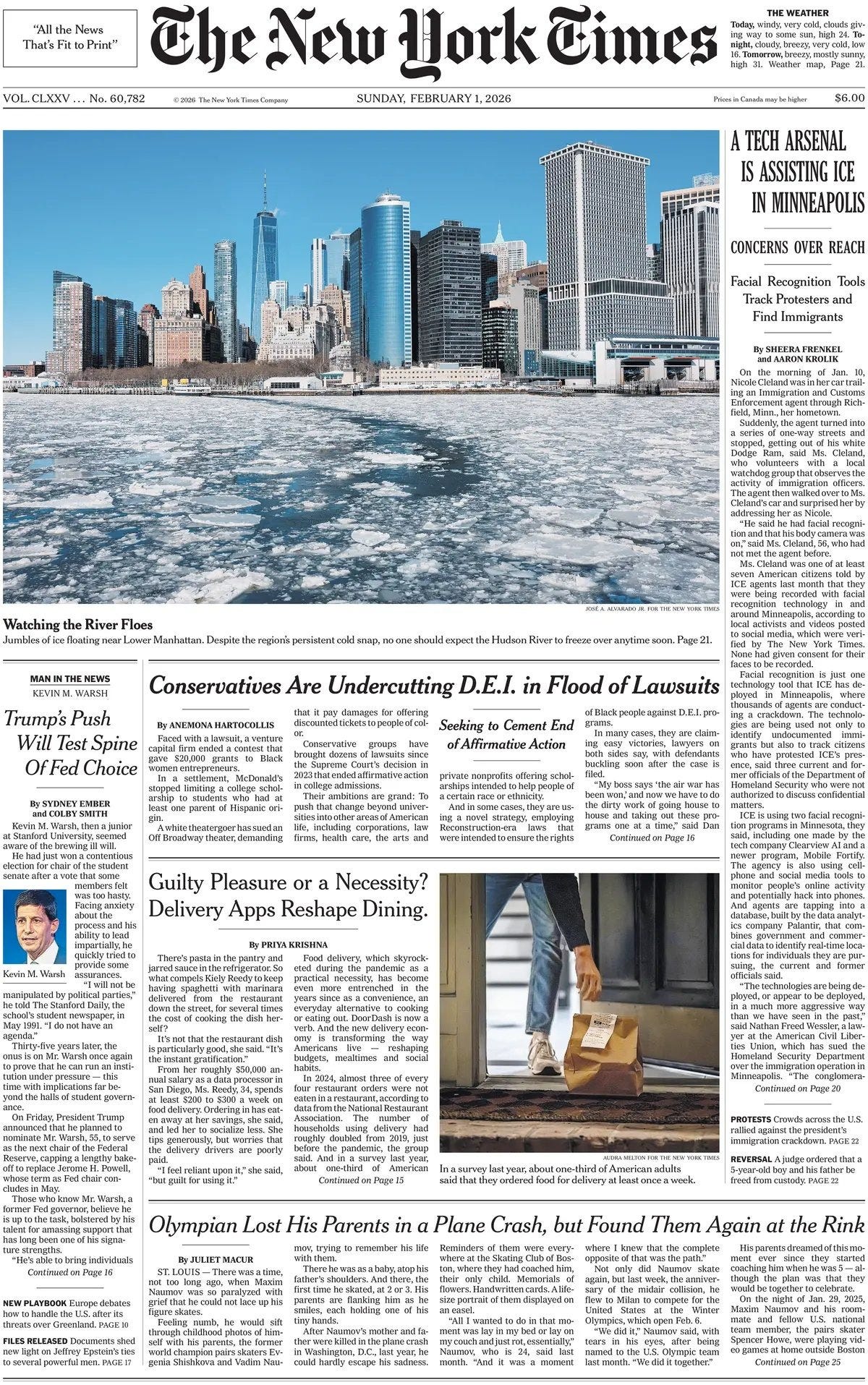
A U.S. federal judge has ordered the release of 5-year-old Liam Conejo Ramos and his father from the South Texas Family Residential Center in Texas, according to a ruling obtained by CNN. Liam and his father, Adrian, were taken by immigration agents from his snowy suburban Minneapolis driveway and sent 1,300 miles to a Texas detention facility designed to detain families. They have been detained for more than a week. The order specifies the preschooler and his father be released “as soon as practicable” and no later than Tuesday as their immigration case proceeds through the court system. In a scathing opinion, which at times read more like a civics lesson, US District Judge Fred Biery admonished “the government’s ignorance of an American historical document called the Declaration of Independence” and quoted Thomas Jefferson’s grievances against “a would-be authoritarian king,” saying today people “are hearing echos of that history.” Liam’s detention – and the striking photo of an agent clutching the boy’s Spider-Man backpack as he stared from under a cartoon bunny hat – fed mounting outrage over the Trump administration’s massive immigration crackdown in Minneapolis and renewed the question: what happens to children when their parents are abruptly taken by ICE? In another diversion from the norms of judicial writing, the judge included the now famous image of Liam at the end of his opinion, under his signature, along with references to the Bible passages Matthew 19:14 and John 11:35. Liam’s case, Biery wrote, originated in “the ill-conceived and incompetently-implemented government pursuit of daily deportation quotas, apparently even if it requires traumatizing children.” He added: “Observing human behavior confirms that for some among us, the perfidious lust for unbridled power and the imposition of cruelty in its quest know no bounds and are bereft of human decency,” wrote the judge. “And the rule of law be damned.” - CNN
The Israeli military launched a series of airstrikes on the Gaza Strip on Saturday, an attack that local health officials said was the deadliest in weeks and that comes as the cease-fire between Israel and Hamas was set to move into its next phase. Zaher al-Waheidi, an official at the Gaza health ministry, said at least 26 people had been killed in the strikes, which hit several locations, including Gaza City and a refugee camp near the city of Khan Younis, according to Mahmoud Basal, a spokesman for the Civil Defense rescue service. Several children were among those killed, according to Mr. al-Waheidi and Mohammed Abu Salmiya, the director of Al-Shifa Hospital in Gaza City, who said his hospital had received some of the injured and dead on Saturday. The Israeli military said in a statement that the airstrikes had targeted commanders and fighters from Hamas and another militant group, Palestinian Islamic Jihad, as well as weapons facilities. It said the strikes were a response to activity the day before, when it said militants had emerged from a tunnel in Rafah, in an Israeli-controlled area. The military described that as “a violation of the cease-fire agreement.” Hamas described the Israeli attacks themselves as a violation of the cease-fire - NYT
Israel says it reopened the critical Rafah border between Gaza and Egypt but only in a limited capacity, allowing passage solely for Palestinian residents of the territory. However, a security source told the Israeli newspaper Haaretz that Gaza residents are not expected to pass through it today. According to the source, “system checks” are being carried out along with the launch of an “initial operating model” in cooperation with Egypt and a European Union delegation tasked with overseeing the Gaza side of the crossing. According to COGAT, an Israeli military agency, entry into Gaza will be allowed only for Palestinians who left the territory during the genocidal war and who have received prior Israeli security approval. Meanwhile, at Egypt’s request, exit from Gaza will be permitted only for the sick and wounded along with their escorts. Israel will also erect a military checkpoint near the crossing on the Gaza side close to the yellow line demcarcation, Haaretz reported. Egypt had opposed placing the checkpoint at or near the border. A security official said about 150 people per day would be allowed to enter and exit through the crossing, with those traveling to be brought in groups by bus. About 80,000 Palestinians who left Gaza during Israel’s war are seeking to return, an official says. An estimated 22,000 wounded and sick people are also “in dire need” of leaving the Gaza Strip for treatment abroad - Al Jazeera

We’re outside for a reason. The best reporting doesn’t come from distant studios - it happens in the messy, uncertain places where decisions collide with real lives. If you believe independent journalism and sharp commentary are worth backing, please upgrade to a paid subscription to support World Briefing. Your contribution helps fund reporting, travel, verification, and the work that turns chaos into clarity. You can also support World Briefing through Patreon or PayPal.
At a moment when all eyes were on a possible U.S. strike against Iran, several explosions were reported in different Iranian cities. The most significant occurred in the southern port city of Bandar Abbas, where reports suggested that an Islamic Revolutionary Guard Corps (IRGC) or army-related facility may have been targeted. Iranian officials quickly denied this, but it is worth recalling that just weeks before the 12‑day war last June, a major blast in Bandar Abbas was also officially classified as an “accident.” Now, with a large U.S. naval armada present in the Persian Gulf and expectations of a Trump-ordered strike higher than ever, renewed diplomatic efforts by neighboring countries appear to have once again delayed a final decision by the U.S. president. Qatar’s foreign minister was in Iran yesterday, meeting Ali Larijani, secretary of Iran’s Supreme National Security Council, who signaled positive developments in negotiations with Washington. At the same time, a widespread rumor suggests that Tehran has agreed to transfer its enriched uranium to Turkey as part of mediation efforts led by President Recep Tayyip Erdoğan. On the other side, Israel has denied any involvement in the Bandar Abbas explosion. The Israeli army chief has stated that Israel assesses a potential U.S. attack on Iran could take place within a timeframe of two weeks to two months - Euronews
A nationwide power outage hit Moldova on January 31 after a serious failure in Ukraine’s electricity network triggered the collapse of a key high-voltage transmission line, cutting power to large parts of the country, including the capital, Chisinau. Authorities said electricity supply was fully restored later the same day. The blackout began at 10:42 a.m. local time, when voltage collapsed on the 400 kV Isaccea–Vulcanesti–MGRES transmission line, which Moldova uses to import electricity from Romania via Ukraine and the Russian-backed Transdniester region, according to the Energy Ministry. The failure forced an emergency disconnection of Moldova’s entire power system, as Moldova and Ukraine operate within a shared electricity generation bloc. Large parts of Chisinau were left without electricity, halting trolleybus services, knocking out traffic lights and disrupting border and customs operations. The police warned that non-functioning traffic signals increased the risk of accidents, deploying officers to major intersections and urging drivers to slow down and follow road signs. Border crossings faced delays as outages hit customs facilities. While backup generators were activated, Ukraine’s Border Police said manual processing was required due to technical failures at the main customs headquarters. The outage lasted more than five hours, authorities said. Shortly after the incident, Chisinau Mayor Ion Ceban said the “largest part” of the capital had been left without electricity. - RFE/RL
Ukraine’s President Volodymyr Zelensky said the next trilateral talks with Russia and the United States will take place on Wednesday and Thursday after meetings planned for Sunday were cancelled due to Washington’s focus on rising tensions with in the Middle East. “The dates for the next trilateral meetings have been set: February 4 and 5 in Abu Dhabi,” Zelenskyy said in a post on Telegram Sunday. “Ukraine is ready for substantive talks, and we are interested in the outcome bringing us closer to a real and dignified end to the war.” In his nightly video address Saturday, Zelenskyy had said that Kyiv was still waiting for clarity from U.S. officials — who are mediating the negotiation process — on when and where the next round would take place.
The journals….