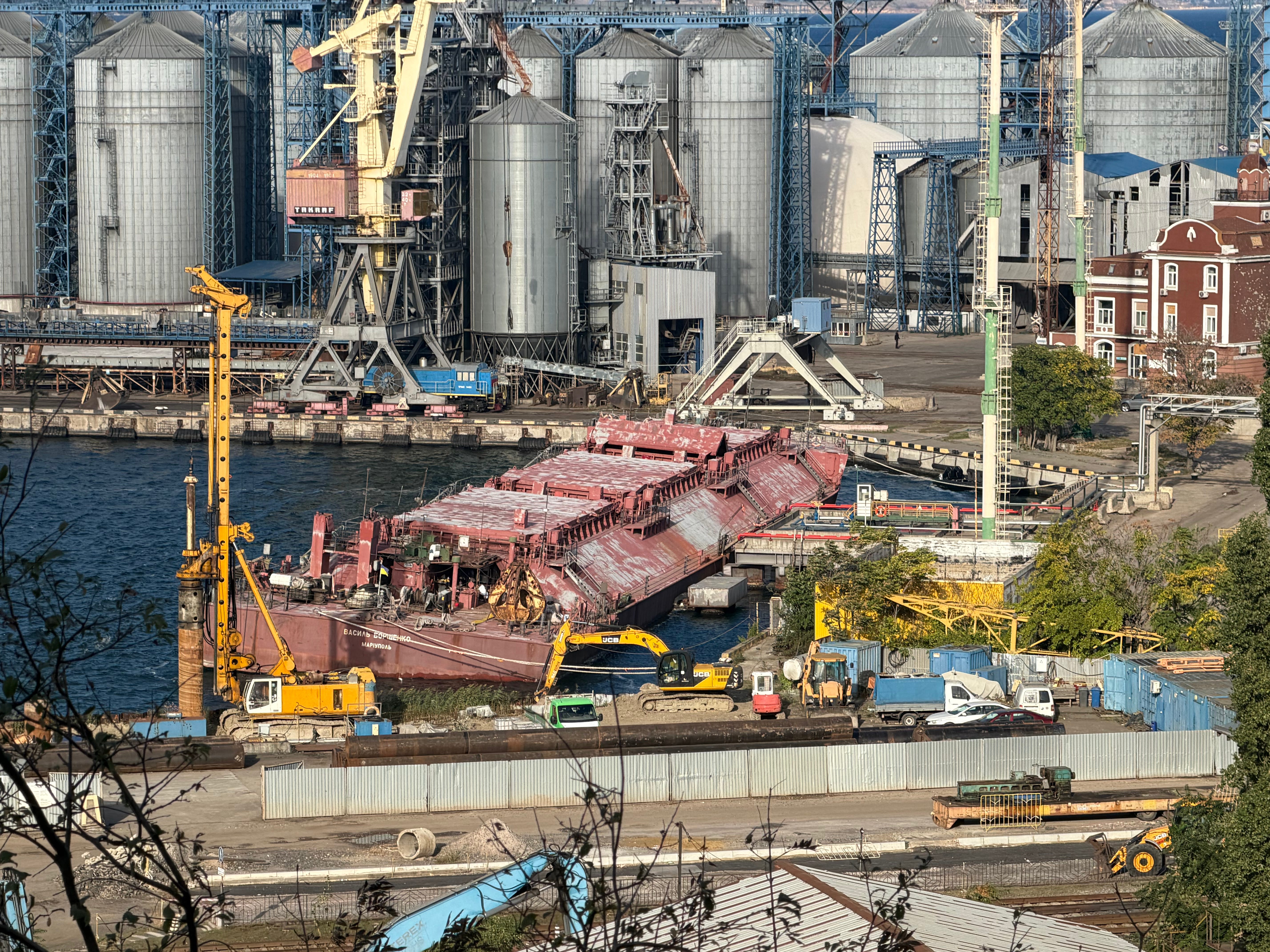
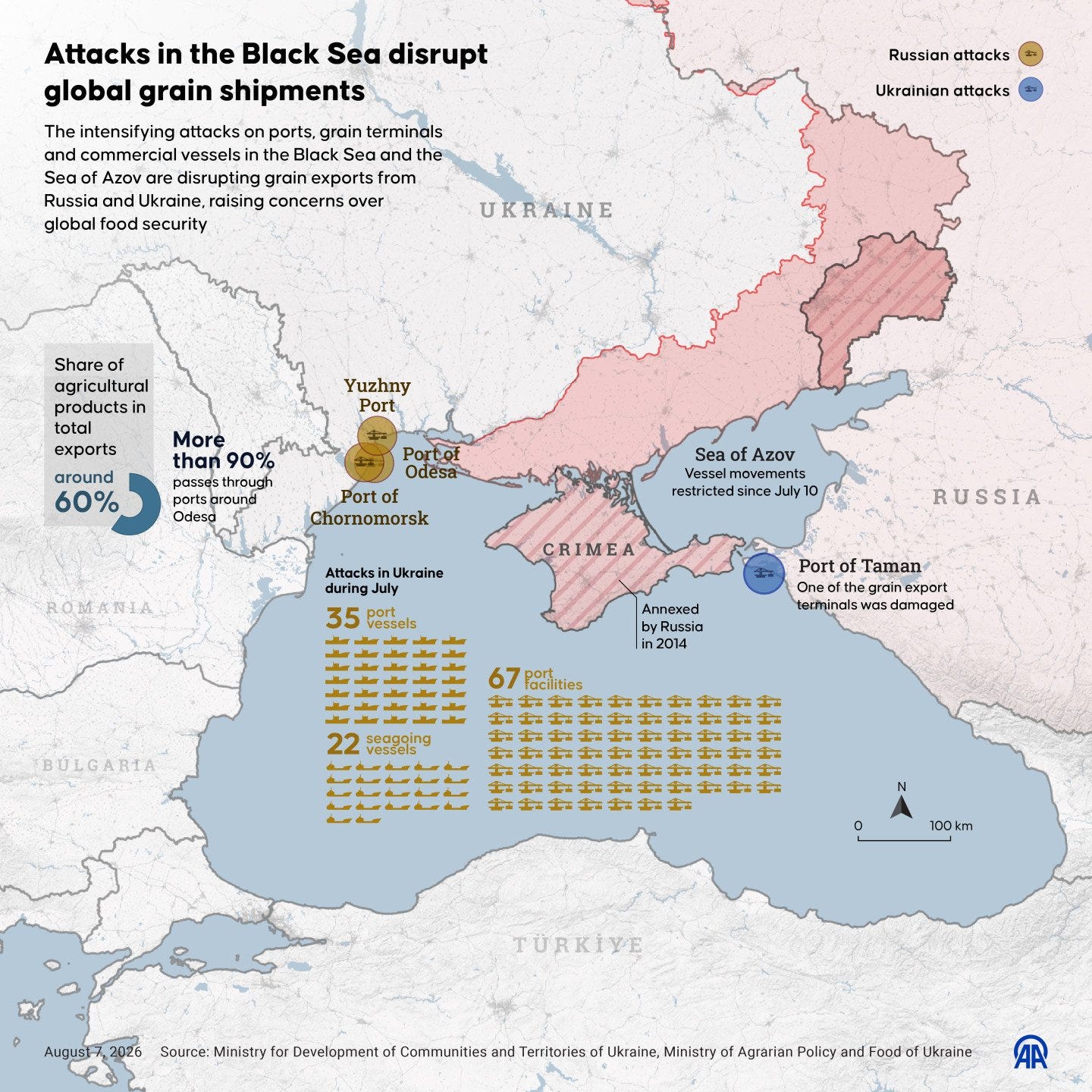
For weeks I have watched Odesa’s central port almost daily, logging even the smallest changes. In the past three weeks, I’ve seen exactly one commercial vessel move: the Barbados-flagged bulk carrier Golden Arrow, with an Egyptian crew, which slipped out under cover of darkness earlier this month. Two vessels remain at berth. One of them, the Mariupol dry-cargo ship Vasyl Borshchenko, is listing to one side and blocking access to a crucial fuel storage area. Cranes and fuel tanks lie damaged. Offshore, two large ships sit immobilized, and nearby the Golden Leo rests on the sea bed with its cargo of corn and bunker oil.
Russia hit the Turkish-owned ship with three cruise missiles on 19 July as it left Chornomorsk through Ukraine’s Black Sea corridor. Nine crew members and a Ukrainian pilot were killed. The ship sank in Odesa port waters eight days later.
The numbers explain the clam waters. The Black Sea has overtaken the Strait of Hormuz as the world’s deadliest waterway for merchant mariners. Citing data from maritime security firm Ambrey and the International Maritime Organization, the Financial Times reports that more than 570 vessels have been attacked there since the start of 2026, killing at least 40 sailors. In Hormuz, 24 deaths have been confirmed over the same period.
The violence spiked over the summer. Ambrey counted roughly 387 attacks between July and September, more than five times the previous quarter and over four a day. Crews face aerial drones, missiles, sea mines, GPS jamming and explosive-laden sea drones. The attacks haven’t let up: on 25 October, Ambrey reported that a dry-cargo vessel was hit by a Russian drone in Ukrainian territorial waters off the Odesa coast. Many other ships are hit as collateral damage in strikes on port infrastructure.”
Russia has kept up its assault on Ukrainian ports since the UN- and Turkey-brokered grain deal collapsed in 2023. Ukraine, or its part, has expanded its drone campaign from disrupting Crimean diesel supplies to hitting shipping through the Kerch Strait. According to Ambrey, about 90% of strikes on vessels in the past 45 days targeted Russia. But Moscow’s campaign is of a different kind, aimed at strangling a country’s access to the sea.
The commercial toll is severe. TIS, Ukraine’s largest private port operator, says Greater Odesa’s ports handled fewer than 10 ships last month, down from about 400 in July. War-risk insurance premiums are climbing, and some carriers are refusing to sail at all, raising costs for Ukrainian grain exports.
“Sailing through the Black Sea and calling at Ukrainian ports is practically suicide,” Oleg Grygoryuk, head of the Ukrainian Maritime Transport Workers’ Union, told the FT. Bridget Diakun of Lloyd’s List Intelligence said she had never seen anything like it in years of tracking the war’s impact on maritime trade.
The danger is also spreading beyond Ukrainian and Russian waters. Romanian President Nicușor Dan has accused Moscow of escalating the war on NATO’s doorstep.
It’s worth remembering what is at stake. Agricultural products make up around 60% of Ukraine’s exports, and more than 90% of them pass through the ports around Odesa, shipping grain, corn, sunflower oil and other commodities to markets from North Africa to Asia. The ports are also the lifeblood of the regional economy. What I’m seeing fits a broader Russian pattern: strikes on ports, bridges, roads and border crossings that appear designed to cut Ukraine off from the outside world. The goal, it seems, is to make Ukraine landlocked.
News Briefs
Aleksandar Vucic, Serbia’s former president and dominant political figure for more than a decade, conceded defeat to the student-led protest movement in the country’s parliamentary elections, potentially ushering in a new era of politics more closely aligned with Europe and away from the Kremlin. “It is clear that we have lost these elections,” he told a news conference late on October 25, after polling stations closed across Serbia. “The Students’ List has won, they will have between 135 and 140 seats and we will have 105. No one else has entered parliament,” Vucic said, citing preliminary results as celebrations erupted among student leaders and supporters in Belgrade, Novi Sad, and other cities. Some observers compared Vucic’s loss to the defeat suffered by fellow Russia-friendly authoritarian leader of Hungary, Viktor Orban, in parliamentary elections in April. A total of 18 electoral lists, with more than 2,400 candidates, participated in the Serbian election, with 250 to enter parliament in the effort to form a new government. While the final election results were yet to be announced, independent observers reported that voter turnout could reach its highest level in decades, approaching 70 percent after a day of long lines at polling stations throughout the Balkan nation of some 6.6 million people. Having served as president since 2017, Vucic resigned in late September. Unable to seek a third term, he was hoping to become prime minister after calling for a snap election - RFE/RL
This is not simply a change of government. It is the collapse of a political order that has defined Serbia since 2012 - Politico
Brazilian President Luiz Inacio Lula da Silva won an unprecedented fourth term on Sunday, the country’s electoral court said, in a shock result that defied polls, precedent and global anti-incumbent sentiment to put the brakes on a wave of right-wing election victories across Latin America. Lula, an icon of the global left and the most dominant force in Brazilian politics this century, defeated Senator Flavio Bolsonaro, the eldest son of former President Jair Bolsonaro. The senator had finished first in the election’s first round and hoped to revive his father’s far-right movement. Bolsonaro is serving a 27-year jail term for attempting a coup after his loss to Lula in the country’s last election in 2022. Sunday’s vote was marked by confusion after a Supreme Court ruling extended voting by two hours as some polling stations had already closed. The move came at the request of Lula who complained that buses had been pulled from circulation in various cities, barring citizens from voting. Flavio Bolsonaro also requested an extension in some regions due to heavy rains, but he described the decision as "unacceptable" and a "dirty trick". No candidate who lost the first round has gone on to win the second in Brazil since 1989, the first direct election after the end of the country’s military dictatorship. “People went to vote because we managed to convince them that voting was very important for ensuring democracy in the country,” Lula said in his first comments after the win. Fireworks and vuvuzelas rang out in Rio de Janeiro, while thousands of people dressed in red, the color of Lula’s Workers’ Party, streamed into the streets of Sao Paulo to celebrate - France 24
Washington wants Viktor Orbán to run the UN, and believes Moscow and Beijing will back him
The Trump administration has been pushing Viktor Orbán, Hungary’s former prime minister, to run for United Nations Secretary-General, according to the Wall Street Journal’s editorial board. Citing sources in three countries, the board says US officials first raised the idea with Orbán and encouraged him to enter the race. Washington believes Russia and China would back him as a joint candidate. A final decision is still pending.
A State Department official told the paper the idea sounds crazy at first, but counted eight Security Council votes for Orbán “comfortably” and 10 within reach. The bet is that Britain and France, both cautious with their vetoes, would not block a candidate backed by the US, Russia and China together. The same official called Orbán the “dream MAGA-conservative candidate,” citing his record on migration, NGOs, the courts and the press. Any announcement is reportedly being held until after the US midterms. Orbán, who lost power in April despite endorsements from President Trump and Vice President JD Vance, declined to comment. The paper says he was receptive but will only run if he is confident of winning.
Orbán would not be Washington’s first unorthodox pick. In July, President Trump was reported to want FIFA president Gianni Infantino for the job, an idea that went nowhere; Infantino is now seeking re-election at FIFA.
The idea to push for Orbán to move to New York isn’t entirely new. In May, reports citing diplomatic sources said figures linked to the MAGA movement were discussing a senior UN post for the bombastic politician, and noted that under the 1946 UN Convention the Secretary-General enjoys full diplomatic immunity.
The race to replace António Guterres, whose term ends 31 December, is deadlocked. In the latest straw poll, every contender received an effective veto. The frontrunner, Costa Rica’s Rebeca Grynspan, won nine “encourage” votes but also two disapprovals from veto-wielding members, as did IAEA chief Rafael Grossi. The UAE’s Lana Nusseibeh entered last week, and she faces questions over Emirati support for a paramilitary in Sudan’s civil war. By informal rotation, it is Latin America’s turn for the post.
For Kyiv, the prospect is alarming. A Secretary-General who spent years shielding the Kremlin inside the EU would be an apologist for Putin at the top of the UN, a concern even the Journal’s board raises.
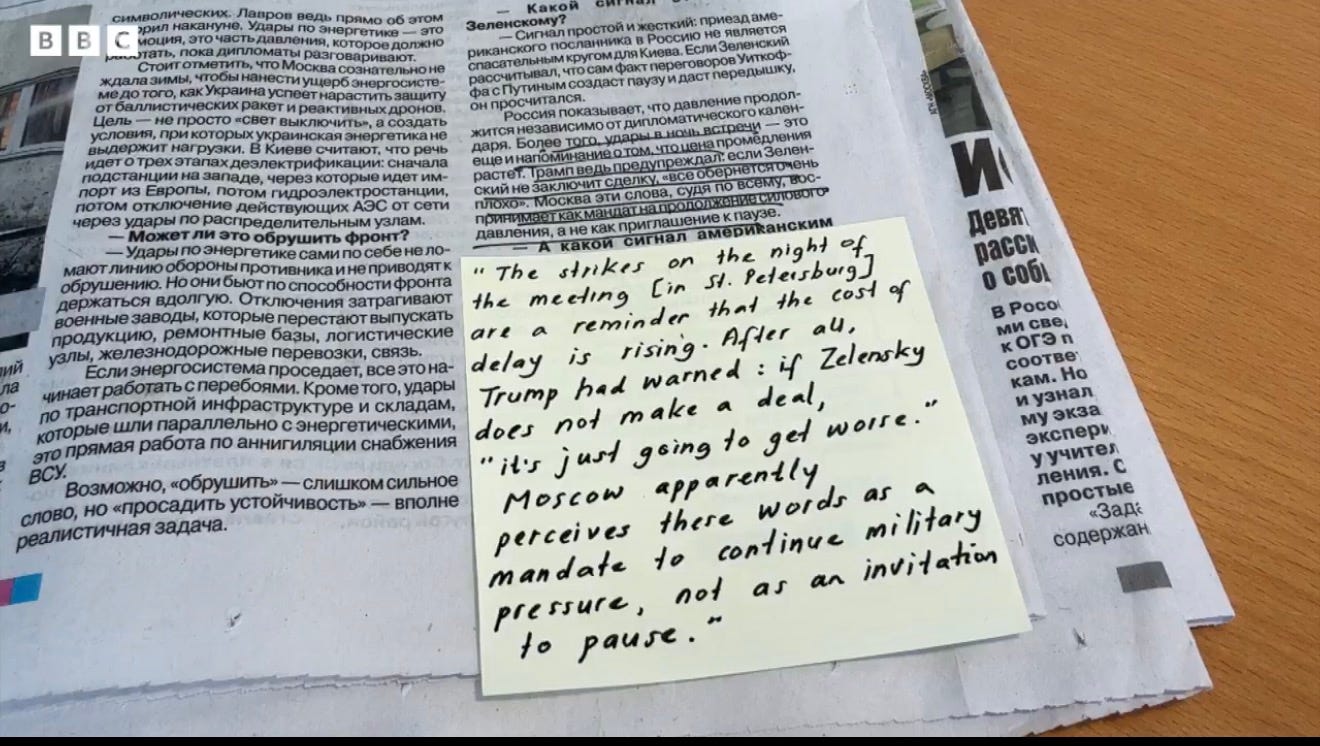
Russia’s pro-Kremlin press is reading Donald Trump’s tough words for Volodymyr Zelensky as a licence to keep bombing Ukraine. That’s the takeaway from the BBC’s Steve Rosenberg, whose latest “Reading Russia” dispatch from Moscow (25 October) walks through how Russian newspapers are framing Washington’s diplomacy. Moskovsky Komsomolets noted pointedly that Russia’s strikes on Ukrainian energy and military infrastructure on the night of 21 October carried on even as Trump’s special envoy, Steve Witkoff, arrived in St Petersburg for talks with Vladimir Putin. The message, the paper wrote, is that Moscow won’t make concessions or pause combat operations “for the sake of a round of diplomacy.” In the same edition, MK went further. It recalled Trump’s warning that things would “just get worse” for Zelensky if he didn’t make a deal, and argued that Moscow sees those words as a mandate to keep up military pressure, not an invitation to pause. The strikes on the night of the Witkoff meeting, it said, were a reminder that the cost of delay keeps rising. Argumenty Nedeli, meanwhile, is betting on Europe’s political drift. It argues that support for Kyiv is less solid than it looks: Nigel Farage won’t take Britain to war over Ukraine, Marine Le Pen wants to end direct financial aid, and the AfD is pushing for power in Germany. If even one major European government changes, the paper concludes, “that’s the end for Ukraine.” The pattern is familiar. The Kremlin treats every American nudge toward Kyiv as proof that time is on its side, and is willing to wait out Western resolve.
Moscow will host the 2030 World Weightlifting Championships, the International Weightlifting Federation (IWF) announced on Sunday. No world championships in an Olympic sport, summer or winter, have been held in Russia since the start of the war in Ukraine. The 2025 World Aquatics Championships, originally awarded to the Russian city of Kazan, were later moved to Singapore. “Concerning the IWF Senior World Championships, Ahmedabad (India) will host the 2029 edition and Moscow (Russia) will host the 2030 edition,” the IWF said in a statement. It will be the first time since 1983 that Moscow has hosted the World Weightlifting Championships. Russian and Belarusian weightlifters have been eligible to compete in IWF events since the International Olympic Committee provisionally lifted its suspension of the Russian Olympic Committee in July, a step seen as advancing Russia’s gradual return to international sport. The IOC Executive Board, when it lifted the suspension, said athletes should not be held responsible for the actions of their governments. No decision has yet been taken on whether Russian athletes will compete under their national flag, colors and anthem at the Olympic Games. The National Olympic Committee of Ukraine has appealed to the Court of Arbitration for Sport against the IOC’s decision - Moscow Times
In the largest European experiment to counter mosquito-borne diseases, Barcelona has released more than half a million male mosquitoes carrying a parasite that causes effective sterility. The trials, which will continue until mid-November, aim to replicate results from Singapore that demonstrated the wolbachia parasite’s effectiveness in reducing dengue cases by 70%; wolbachia’s significant advantage is the ability to bypass regulations against gene editing, which — by sowing male populations with a so-called “lethal gene” that prevents viable offspring — has also shown promise in checking mosquito-borne illnesses. As climate change expands the insect’s range, “the technology to eradicate mosquito-borne disease already exists,” Works in Progress wrote. “We just have to be brave enough to use it.” - Semafor
The journals…