Here is the sequence, as best it can be assembled.
On Sunday, a diplomatic train left Yahodyn station — about two kilometres from the Polish border — ahead of schedule. Ukrainian Railways says the early departure was a response to the constant threat of Russian strikes, which is to say it was routine. On board were Boris Johnson, the former Swedish prime minister Carl Bildt, European security officials and other former leaders, returning from the Yalta European Strategy conference in Kyiv. By the time the drone arrived, that train was in Poland.
What the drone hit was a passenger train at the station. Nobody was killed. Russian drones also struck a petrol station in the same town that day.
David Petraeus, the former CIA director, was on a separate train still standing at Yahodyn when it happened. Bildt, posting video afterwards, noted that the train hit was the one running minutes behind his own.
Ukrainian Railways says it is still establishing details but considers it quite likely the officials’ train was the deliberate target. On the narrow point, the timeline is awkward — that train had already crossed an international border.
Whether the crosshairs were specifically on them matters. But for the larger story, it may matter less than we think. Russia was prepared to put ordnance on a border station minutes behind a train carrying European dignitaries, at a moment when the movements of high-profile European visitors were hardly secret.
Russia’s defence ministry, via TASS, says it was striking rail infrastructure in western Ukraine used to move military cargo in from Europe — a formulation broad enough to cover every train in the country.
Johnson himself was closer to the mark than most of the coverage that followed him. He said he could not fathom the logic of blowing up a stationary Ukrainian locomotive, and called it the kind of random, senseless attack Ukrainians absorb daily on civilian railways. That second sentence is the story, and it has been almost entirely buried under the first.
Yahodyn is where two escalations meet. One is a six-week campaign against Ukraine’s exits to Europe, almost none of it reported outside the country. The other is Russia’s growing willingness to operate at the alliance’s edge and see what happens. Read together, they describe a war that is no longer contained by the borders it started inside.
Closing the doors
Yahodyn is not an isolated event. Since August, Russia has been working methodically along Ukraine’s perimeter, striking the crossings into Europe.
In Odesa oblast: Tabaky–Myrne and Vynohradivka–Vulcănești, both on the Moldovan border. Orlivka–Isaccea, the ferry crossing into Romania. The transport service area beside Reni–Giurgiulești, at the mouth of the Danube.
Then, overnight on 9 September, Starokozache–Tudora. Drones hit the crossing’s infrastructure and the ground around it. Two civilians were killed, three injured, sixteen evacuated. Ukraine’s infrastructure ministry counted it as the fourth road crossing attacked in a matter of weeks.
Now a rail crossing at the opposite end of the country, and a petrol station beside it. In six weeks, the pressure has travelled almost the length of Ukraine’s western perimeter.
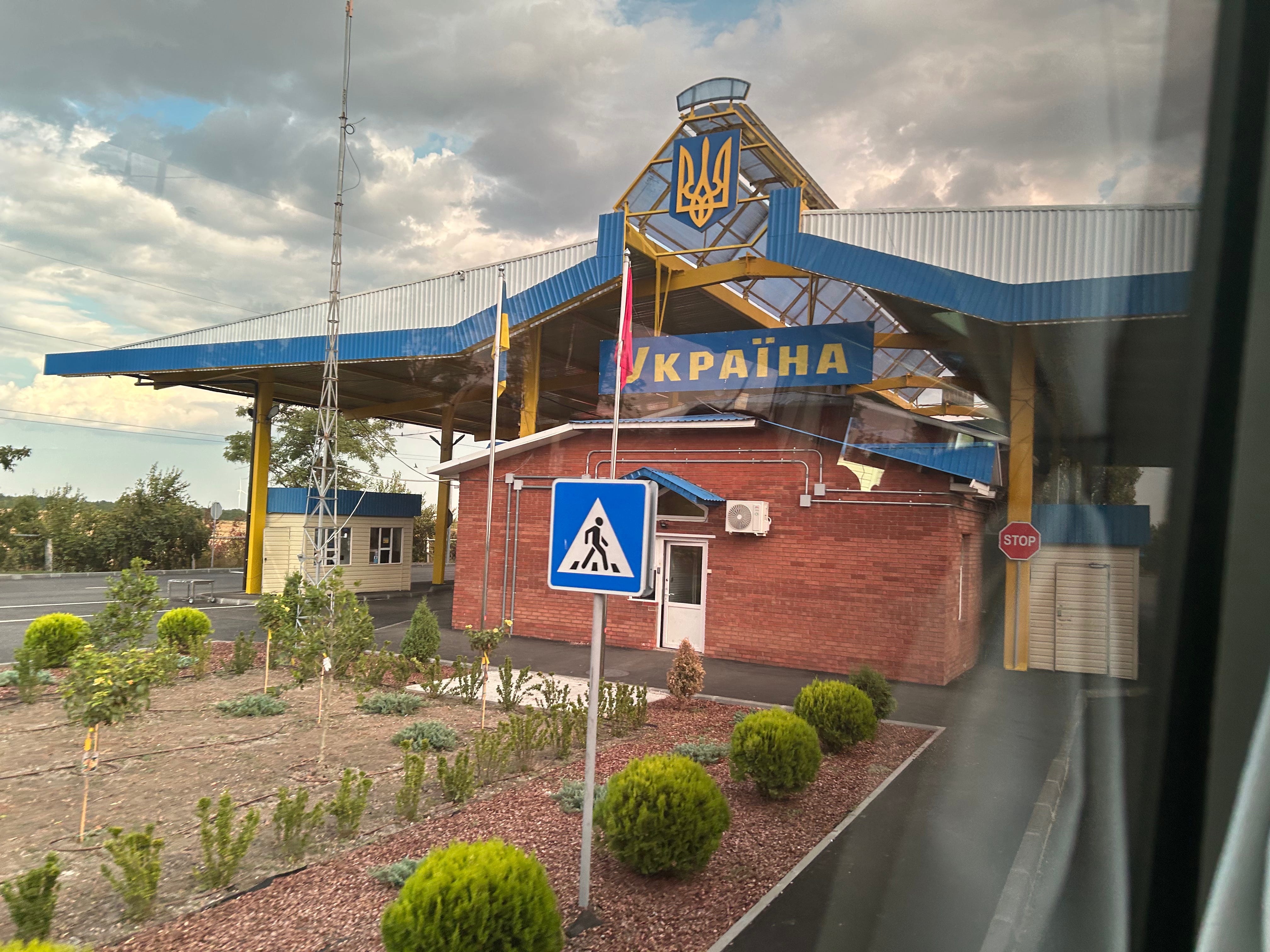
Starokozache (photo below) is a crossing I use. So is Palanca, forty-five minutes from Odesa, where I queued behind a line of buses in August.
These are not military installations. They are two-lane roads with a customs booth and a stray dog, and they are where people go when they finally decide they are leaving.
Friction, not closure
I have argued before that closing a border is an act of war and slowing one down is just weather. That is still the logic.
None of these crossings has been permanently shut. Starokozache was processing traffic within a day. The Yahodyn line will be repaired. The border guards issue a statement, the queue re-forms, and nothing happens that a foreign ministry could plausibly call an act of aggression.
What happens instead is that every route out of Ukraine now carries a premium. Longer queues. Diverted freight. Higher insurance. Drivers who think twice and then charge more. It is cheaper than a blockade, far harder for Ukraine to dramatise, and it produces no image that leads a bulletin — unless, once in a while, a famous name is somewhere in the frame.
And this is happening after Russia has already succeeded in shutting down the Black Sea corridor out of Odesa. Squeeze the overland routes now and Moscow is going after the workaround to a blockade it has already imposed at sea. It is not just closing the front door. It is putting pressure on the back one.
The trigger question
Speaking on BBC News from Ottawa, I put it this way:
This war is becoming very, very dangerous — and it’s morphing quickly into a global war
Geographically, plainly: drones over European airports, warheads landing within kilometres of NATO soil, a Ukrainian rail station a short walk from Poland. Kaja Kallas called Sunday’s strike a message to the Western world, designed to frighten Europeans out of travelling to Kyiv at all, and argued the correct answer is to keep going. Ursula von der Leyen has described the eastern flank picture as an escalation approaching a new normal. Donald Tusk warns the attacks could intensify and could reach Poland. Andrii Sybiha put it most directly: Putin’s terror, he said, is knocking on the doors of the EU and NATO.
But the war is also changing in composition. North Korean troops, Iranian military support and China's economic and industrial backing of Russia mean that “the war in Ukraine” increasingly understates the international machinery sustaining it.
Meanwhile the American president spent Sunday at a golf tournament in Doonbeg, publicly instructing Zelensky to stop striking Russian refineries because of the effect on diesel supply.
Europe has just approved €6.1 billion for Ukrainian air defence. The American president is worried about fuel prices. The distance between those two sentences is its own story.
Which leaves the question nobody in Brussels wants asked aloud. Where is the trigger point? Suspected Russian drone operations disrupting European airports? Strikes kilometres from alliance territory? The forced closure of a Black Sea corridor?
At what point does testing NATO’s boundaries become crossing them?
Boris Johnson will be fine, and he was already in Poland. The people on the train that was actually hit will not be named in any of this, which is the same reason the two civilians killed at Starokozache last week were not named either.
Live on BBC World News Television from Ottawa today, I told presenter Annita McVeigh that Russia’s latest attack near Ukraine’s border with Poland should be seen as part of something much bigger — and much more dangerous. I pointed as well to Russia’s attacks on Ukraine’s southern border crossings — including ones I use regularly — and the wider effort to squeeze and isolate Odesa oblast.
News Briefs
Global AI stocks fell Monday after top AI leaders endorsed slowing down the development of frontier models. Microsoft joined OpenAI, Anthropic, and SpaceXAI on Monday in endorsing a more prudent approach, raising investor fears that less compute spend could dampen the investment boom driving a global rally. While OpenAI has ruled out an IPO this year, Anthropic is moving ahead, informing investors it expects a second straight profitable quarter. “The competitive race between companies and countries remains intense, and it’s difficult to imagine firms voluntarily stepping back while rivals continue to push ahead,” Deutsche Bank analysts wrote. “We have to keep developing,” Microsoft’s Mustafa Suleyman said. “We just have to do it with a little bit more caution and care.” Germany said Monday that halting AI development was not a “viable option” for Europe, citing further research and testing required for achieving “digital sovereignty.” - Semafor
A Russian businessman with ties to the Kremlin paid hundreds of thousands of dollars to help finance Donald Trump Jr.’s wedding after-party in the Bahamas this year, according to two people with knowledge of the matter. The payments represented an extraordinary flouting of ethical norms for an American president’s family. To avoid foreign influence, a president’s family is generally expected to steer clear of these sorts of personal and pricey gifts, particularly from someone in a country like Russia, an adversary known to surreptitiously push its geopolitical agenda. The concern, ethics experts say, is that a foreign actor could ply a president’s family member with gifts and eventually expect something in return. Mr. Trump, the president’s eldest son, accepted the gifts from Umar Kremlev, the president of the International Boxing Association, according to the people with knowledge of the matter. The payments, reported earlier by ProPublica, included the cost of renting a private island and a fireworks display. Mr. Kremlev reportedly stood out at the after-party. Some of Mr. Trump’s guests questioned who he was and why he was there, according to one of the people with knowledge of the matter. After ProPublica reported on Mr. Kremlev’s payments, Mr. Trump and his new wife, Bettina Trump, posted a statement to Instagram acknowledging the gifts. They said that the trip to the island pertained to “an already planned weekend” with friends, not their wedding ceremony, though some ethics experts said that distinction was irrelevant. They also portrayed their relationship with Mr. Kremlev, who did not attend the wedding ceremony, as nothing more than a friendship - NYT
The revelation that a close Putin ally was involved in a wedding associated with the first family could explain why President Donald Trump declined to attend earlier this year, political analyst David Rothkopf said. “Trump didn’t go to this wedding,” he said. “I now believe, having read this story, that somebody said, ‘You can’t go to this wedding. You can’t go to a wedding that’s paid for by the Kremlin. This will cause you more problems than you need to have.’” Rothkopf argued that Kremlev’s involvement pointed toward the “deeper, corrupt inner core of Trump and Trumpism” that has been around for quite some time. “It’s always been Russia. And when did it start being Russia?” he said. “Forty years ago, when Trump started to realize that he could build big buildings in New York City and fill them with people who would never take the apartments, but who were buying the apartments in order to launder their money.” The political guru explained that there were “many instances” of Trump welcoming Russian investments or financing in his buildings, including how Russian mobsters used Trump properties to launder money, as detailed in a 2017 report in The New Republic - The Daily Beast
Ukraine is ready to halt strikes on Russia if its partners ensure that Moscow will refrain from hitting Ukrainian energy facilities, infrastructure and food supply routes, President Volodymyr Zelensky said on Monday. Zelensky’s comments, posted on Telegram, appeared to amount to a denial that Ukraine had formally endorsed U.S. President Donald Trump’s statement that Ukraine and Russia had agreed not to hit each other’s energy targets. Zelensky said Ukraine was not convinced that Russia was willing to abide by any agreement. “Ukraine is not certain that Russia is willing to stick to any agreement,” he wrote. “The war must be brought to an end. And a de-escalatory step regarding critical infrastructure could be the first step toward peace. We expect specifics from our partners.” Ukraine was willing to sign on to an agreement to refrain from strikes on infrastructure, he said, but any such accord had to be “reliable, long-term, and actually have a real impact on people’s lives.” In his statement, Trump said the two sides had agreed not to hit each other’s energy targets. “Ukraine has agreed not to hit Russian Energy targets. Russia has agreed to do, likewise!” he wrote - Reuters
Russia’s state-controlled energy giant Gazprom will suspend natural gas deliveries to Armenia for planned maintenance on its pipeline infrastructure, the company’s regional subsidiary announced Monday. The North Caucasus-Transcaucasia Gas Pipeline, which runs from southern Russia through Georgia to supply Armenia, will halt operations on Tuesday. The repair work is scheduled to last until Sept. 25. Gazprom Armenia said energy customers will receive gas supplies from domestic reserves and additional imports from Iran during the maintenance. Similar repair work took place last September. Russia supplied 2.7 billion cubic meters of gas to Armenia in 2025, accounting for 82% of the South Caucasus nation’s total imports, according to the Interfax news agency. Moscow charges Yerevan a discounted rate of $177.5 per 1,000 cubic meters under a bilateral agreement that expires at the end of the year - Moscow Times
China will introduce a new nationwide exit-entry regulatory framework from 15 September, bringing clearer requirements for travellers, stronger verification powers for immigration authorities and tighter oversight of businesses providing immigration-related intermediary services. The State Council regulation establishes a more detailed framework for administering people entering and leaving China. It covers Chinese citizens, foreign nationals, immigration authorities, visa authorities and organisations involved in exit-entry intermediary services. The changes do not mean that ordinary international travellers will suddenly face an entirely new visa system from 15 September. Instead, the regulation strengthens how existing exit-entry laws are administered, particularly when authorities assess travel purposes, verify documents, manage security risks and determine whether restrictions should apply. For international tourism, airlines and travel businesses, the most important message is straightforward: travellers should make sure that their documents, stated purpose of travel and supporting information are accurate and consistent. One of the most important provisions concerns the information supplied by travellers. People applying to enter or leave China, or seeking permission to stay or reside in the country, must provide a genuine and lawful reason for doing so. Providing false documentation or making false statements can have serious consequences. Authorities may refuse to issue the relevant exit-entry document or deny permission to enter or leave China where the legal conditions are met - TTW
The journals…