A Russian military satellite has been stalking a commercial radar-imaging satellite believed to supply intelligence to Ukraine, and space-security experts say it may be an early glimpse of how war in orbit begins, Sky News reports.
Sky says the satellite, Cosmos 2612, came within metres of ICEYE-X36, a spacecraft run by the Finnish company ICEYE that passes over Russia and Ukraine. ICEYE operates a constellation of roughly 80 satellites, and their synthetic aperture radar can image the ground at night and through cloud. As one expert told Sky, that means “in Ukraine, you can see through the foliage.” According to satellite-tracking data shown by Sky, Cosmos 2612 moved into an orbit about 591 km above the Earth. On 15 and 16 October it dropped below and behind the ICEYE craft, then shadowed it in the same orbit, “sometimes closer, sometimes further away.” One analyst interviewed by Sky said Moscow would like to learn how to jam this kind of imaging satellite.
The tracking firm LeoLabs called it the “most advanced and potentially dangerous uncooperative” close approach it has ever observed, Breaking Defense reported. LeoLabs put the closest pass within about 500 metres. Space watcher Marco Langbroek said Cosmos 2612, launched in April, began manoeuvring toward its target on 30 September. ICEYE agreed in 2022 to supply Ukraine with radar imagery from a dedicated satellite but has never said which one. X36 is operated by ICEYE US and was launched from the United States in 2024. Victoria Samson of the Secure World Foundation has asked why Washington has said nothing.
This is the most advanced and potentially dangerous uncooperative satellite rendezvous and proximity operation (RPO) we’ve observed - Adam Marsh, Leolabs
The experts Sky interviewed say this is only the beginning. The open question, one said, is whether to expect “a sort of space Pearl Harbor” or an attritional conflict in orbit, where the ability to replenish decides the outcome. A satellite collision could also scatter dangerous debris across orbit. Manoeuvring satellites as aggressively as Russia is doing burns fuel and energy, so any sustained campaign would require refuelling operations in space.
Britain’s Ministry of Defence told Sky it is investing more than £3 billion in space capabilities over the next four years.
The warning matches what I heard on the sidelines of the UN General Assembly last month. A retired US general told us Russia is much further ahead in space capabilities than the West believes. He said those capabilities could, sooner rather than later, be used to immobilise entire countries by knocking out electricity grids, refrigeration, sanitation and mobile networks. It was the starkest warning I have heard from him - pretty much sent chills down my back.
In today’s bonus video
The space theme continues in today’s Friday bonus video, free for all subscribers. Off the back of my BBC interview, I look at the breaking news from Ukraine that its military says drones fitted with Starshield equipment still face speed caps. Put that next to Cosmos 2612’s pursuit of ICEYE-X36 and the picture is hard to miss. Ukraine’s battlefield edge increasingly depends on space-based systems it doesn’t control, and Russia is working out how to blind, jam or shadow them. Watch below.
Upgrade to World Briefing Plus
If you value this kind of coverage, now is a good time to go paid. Annual World Briefing Plus subscriptions are 30% off until the end of October. Paid subscribers get exclusive Saturday video briefings and support on-the-ground reporting from the Black Sea frontier. We’re also considering a series of Year Ahead briefings in the New Year, for paid subscribers only. Upgrade now using this link.
News Briefs
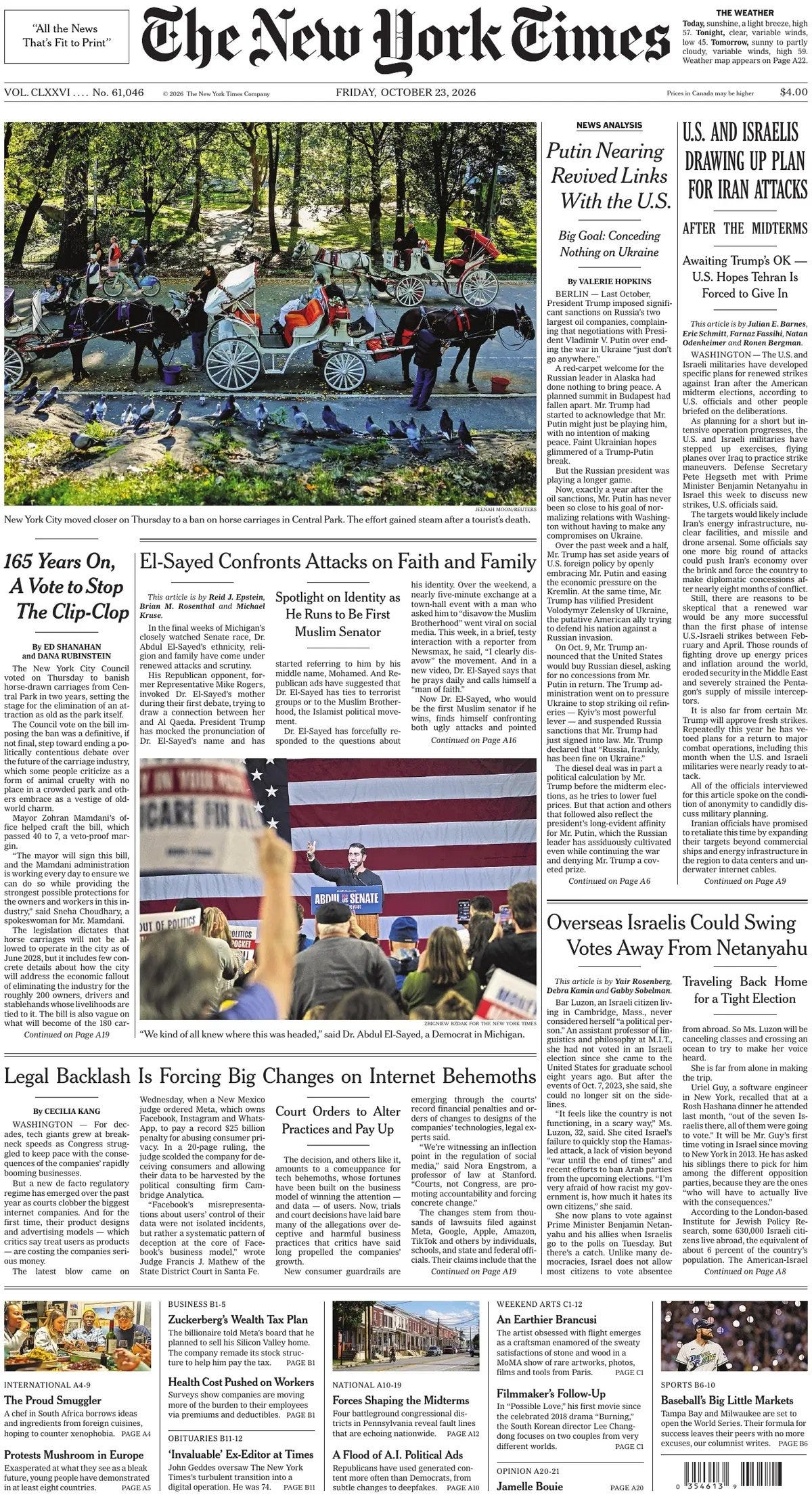
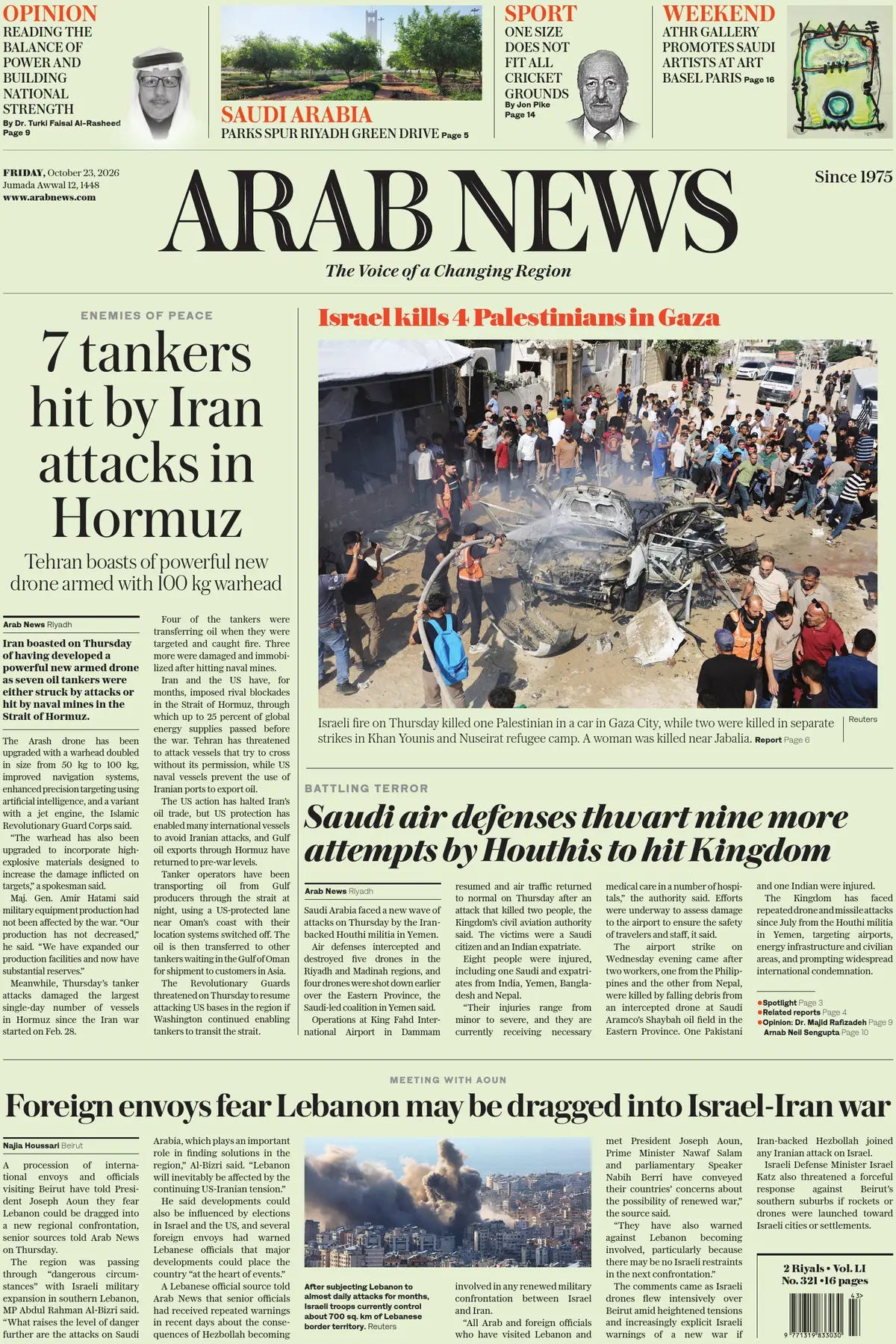
Israel and Iran ramped up their rhetoric against one another, raising the prospect of a return to open conflict in the Middle East. The US-Israel war with Iran has been dormant for months, beyond sporadic flareups, with Washington and Tehran concentrating on controlling shipping traffic. Israel’s prime minister, who faces a tight battle for reelection, argued this week in favor of overthrowing Iran’s regime, while the US ambassador to the UN told the Financial Times that Washington was ready for a protracted conflict with Tehran. Iran, meanwhile, said it had struck multiple tankers and threatened US bases across the Middle East: “Everyone must understand,” a senior Iranian general told Drop Site News, “that action against Iran carries a cost.” - Semafor
Some 70,000 security forces will be mobilised to keep order at protests throughout France on Saturday, Interior Minister Laurent Nunez said Friday. His announcement came as President Emmanuel Macron was due to meet with student organisations in Paris Friday afternoon, for the first time since high school protests began over a month ago. To identify rioters across France last weekend, French authorities are calling on people who filmed scenes of looting to assist the investigation by handing the videos in, an unprecedented decision causing debate. Meanwhile, the Louvre and several other major Paris museums will be closed on Saturday over concerns about potential violence during planned protests, France’s culture ministry said. In a statement to The Associated Press, the ministry said the Orsay and Picasso museums were also among those that will close. Others are taking the same tack. After two days when admission was invite-only, Art Basel Paris opened to the public on Friday — but only for the day, with the threat of unrest prompting organizers on Thursday to cancel the weekend programme. Paris’s Grand Palais is hosting 211 international galleries and their exhibitions for Art Basel, considered one of the world’s most prestigious contemporary art fairs - France 24
Germany, France and at least six other EU countries are pushing against “associate membership” as the name for closer EU ties with Canada, six diplomats involved in the negotiations said. The label is one of the main sticking points in talks over a joint declaration setting areas of deeper cooperation between Brussels and Ottawa ahead of the EU-Canada summit in Montreal on Oct. 29-30, the six diplomats and two EU officials told POLITICO. They were granted anonymity to discuss the sensitive negotiations. The diplomats said the objections center on the wording of “associate membership,” not the broader goal of closer ties. Five weeks after European Commission President Ursula von der Leyen first proposed Canada becoming an “associate member” of the EU in her State of the Union speech — to the surprise of both Ottawa and EU capitals — and one week out from the summit itself, the disagreements show the term remains a political and messaging hurdle.
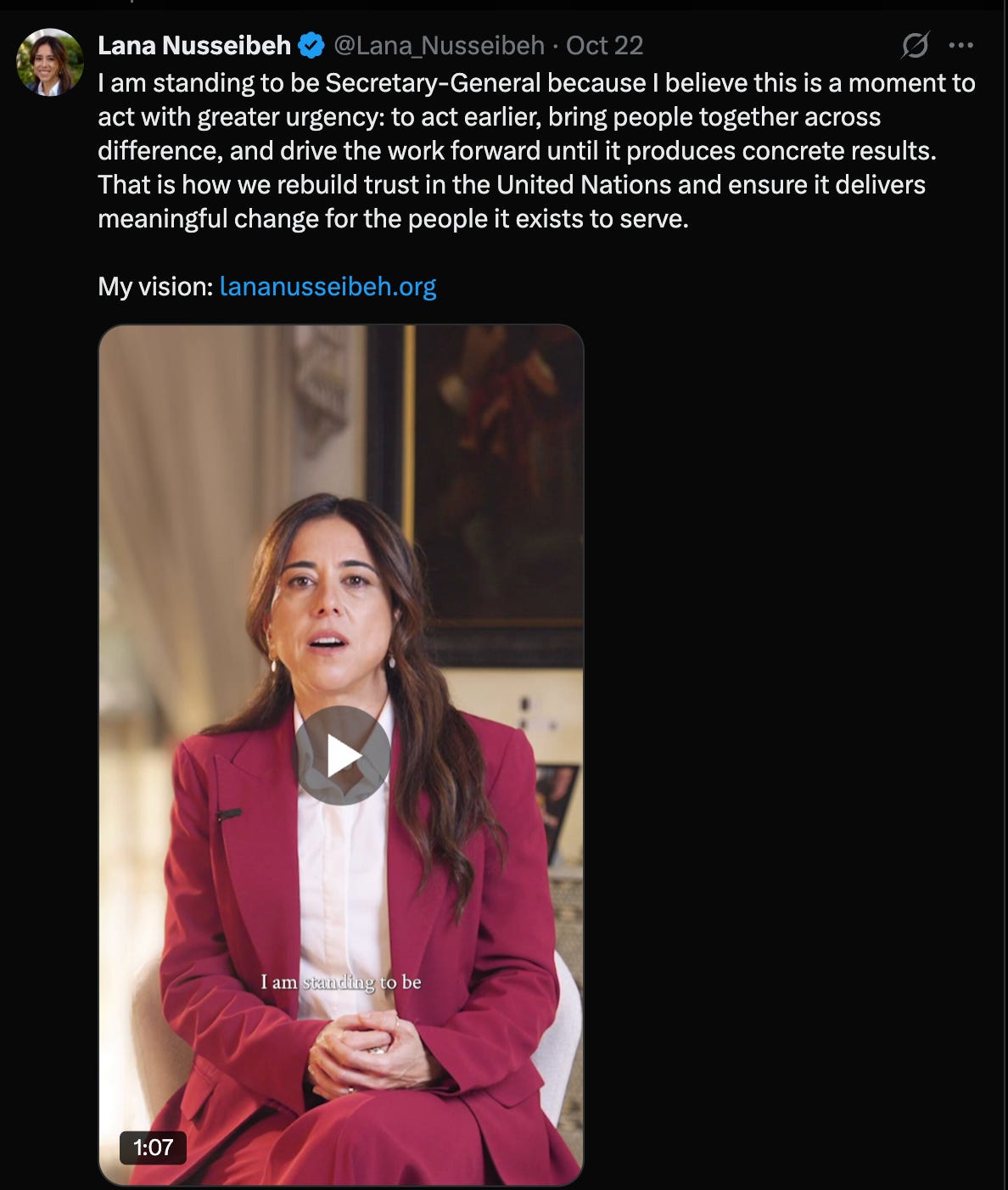
UAE diplomat Lana Nusseibeh has jumped into the race to succeed António Guterres. Her timing is shrewd: six rounds of Security Council voting have failed to produce a candidate backed by all five veto-holding powers, and even front-runner Rebeca Grynspan drew opposing votes from permanent members last week. If selected, Nusseibeh, 48, would be the first woman to lead the UN and only the second from the Middle East, after Egypt’s Boutros Boutros-Ghali. She is pitching herself as the antidote to a paralysed organisation, telling Reuters the UN must act as “a problem-solver rather than as a spectator to the world’s crises.” Diplomats in New York regard her as a competent manager, and she points to her role in securing Resolution 2720 on Gaza aid in 2023 as proof of what she calls creative, entrepreneurial diplomacy. But the baggage arrived with her. As a senior Emirati diplomat, Nusseibeh defended Abu Dhabi’s role in Sudan, where UN sanctions monitors found credible allegations that the UAE armed the paramilitary RSF, which Abu Dhabi denies. The New York Times’ Nicholas Kristof, one of the loudest voices on Sudan, called her a compelling candidate in some ways but said she proved her effectiveness by backing the UAE’s support for a militia accused of mass killing and rape. “Shouldn’t that be disqualifying?” he asked. Nusseibeh says she has taken leave from her government post and will focus on Sudan’s humanitarian crisis.
We’ll be taking a much deeper look at her candidacy, and what it says about the state of the race, in the coming days.
Austria has expelled four Russian diplomats accused of secretly working for Moscow’s intelligence services, among them an official on Russia’s delegation to the Organization for Security and Co-operation in Europe (OSCE), where he handled military security and arms control. The other three were accredited to Russia’s embassy in Vienna, the Financial Times reports. Austrian officials said the domestic intelligence service had been watching all four for some time. The move signals a harder line from a country long seen as a soft touch. The FT notes that Vienna is one of Russia’s largest diplomatic hubs in Europe, with roughly 250 people registered as official representatives of the Russian state. According to Austrian intelligence, as many as a third of them are actually intelligence officers, many running agent networks beyond Austria’s borders. Constitutional neutrality, weak espionage laws and the establishment’s historically close ties to Moscow have made Austria a haven for Russian spies, even as the Kremlin’s agents face mounting pressure elsewhere in Europe. Successive Austrian governments frustrated Kyiv and EU capitals by resisting expulsions after the 2014 annexation of Crimea and the 2018 Skripal poisoning in the UK. Moscow promised retaliation. Deputy Foreign Minister Dmitry Lyubinsky said a response would “follow inevitably,” Interfax reported.
The OSCE, meanwhile, has questions of its own to answer. Earlier this month I called on the organization to speak out after two Ukrainian journalists were violently detained in Vienna: Mykhailo Tkach, head of investigations at Ukrainska Pravda, and his cameraman, Yaroslav Bondarenko. They were in the city tracking the whereabouts of fugitive former prosecutor general Ruslan Kravchenko. Austrian special forces smashed the windows of their rental car at a traffic light in broad daylight and held both men on flimsy suspicions of espionage, which Austrian authorities later conceded were unsubstantiated. Vienna insists the arrests were unrelated to their journalism. Tkach was freed after 12 hours. Bondarenko, who has since been released, wrote on Facebook that he was pressed face-first into the broken glass. He said doctors removed three shards from under his eye in surgery while he was still handcuffed behind his back, and that no one ever explained his rights to him. International press-freedom organizations demanded answers. The Committee to Protect Journalists and the Vienna-based International Press Institute called for the pair’s release and an urgent explanation from Austrian authorities. Reporters Without Borders said the two had been “subjected to a violent police arrest in Vienna” and urged the authorities “to shed full light on these events and to ensure the protection of their equipment and sources,” AFP reported. From the OSCE, headquartered in the same city, there was not a peep, and none from the one official whose job it is to speak up in exactly these cases: its Representative on Freedom of the Media Jan Braathu. When the OSCE can’t defend journalists on its own doorstep, it’s fair to ask how much heft it still has.
The journals…