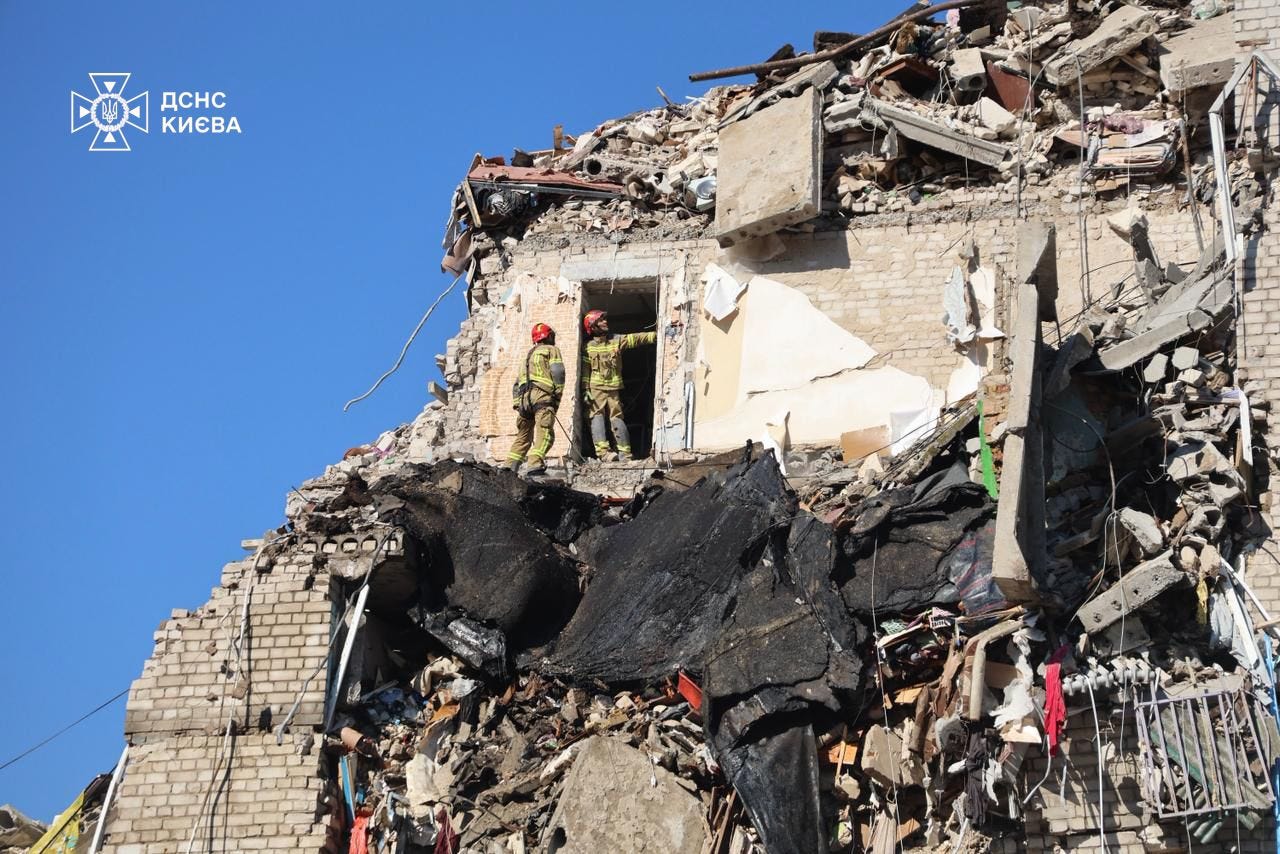
Waves of Russian missiles and strike drones pummeled Kyiv overnight on July 2, just hours after President Volodymyr Zelensky warned that Russia was preparing another large-scale attack against Ukraine. At least 30 people have been killed, Kyiv City Military Administration Head Tymur Tkachenko said. Ukraine’s State Emergency Service (DSNS) added that search and rescue operations were ongoing at several sites including a partially collapsed multi-story residential building in the Darnitskyi District. The death toll is likely to rise further. Later on July 2, despite widespread destruction and civilian casualties, Kremlin spokesperson Dmitry Peskov claimed Russian forces had targeted only “military or quasi-military targets,” adding that Russian leader Vladimir Putin had been briefed on the attack. Speaking to journalists at the site of a Russian strike in Kyiv’s Darnytskyi district, Zelensky said Russia’s attack exposed Ukraine’s continuing shortage of air defense interceptors. “If our partners had delivered what they promised on time, I think we could have saved more homes and, frankly, more lives,” he said. Zelensky said Ukraine would need at least 140 Patriot missiles to intercept an attack involving around 70 ballistic missiles, arguing that Kyiv was not asking for additional commitments but for previously agreed military assistance to be delivered. Kyiv Mayor Vitali Klitschko put the number of injured at 86, 70 of whom had been hospitalized, and described the attack as the “most massive” of the war on the capital. “It was a terrible night for Kyiv,” he said, adding there was “damage in all districts of the city.” A Day of Mourning on July 3 has been declared in Kyiv, Klitschko said. Two of the injured are children, DSNS said. Ukraine’s Air Force said Russia launched 74 missiles and 496 long-range drones during the attack, most of which targeted Kyiv. Forty-eight missiles and 476 drones were shot down or suppressed but 25 ballistic missiles and 12 drones struck 33 locations. Twenty-eight of the missiles fired at Kyiv were ballistic missiles, a record number for a single attack on the capital, Yuriy Ignat, spokesman for the Ukrainian Air Force, said on national TV. As of 7:00 a.m. local time, damage and destruction had been recorded at more than 30 locations across all districts of Kyiv as a result of the attack. “An ambulance station, a scientific institute, a hotel, and businesses have also been destroyed,” Zelensky said in a post on social media. DTEK, Ukraine’s largest private energy company, said the attack also damaged its energy infrastructure in Kyiv, leaving some residents without electricity. The company said emergency crews were dispatched to the affected sites as soon as the security situation allowed. Kyiv's metro sheltered a record 52,500 people, including nearly 4,500 children, during Russia's overnight attack, the Kyiv Metro said on Telegram. All 46 underground stations served as bomb shelters during the air raid - Kyiv Independent
Russia is increasingly using jet-powered drones in its mass attacks, counting on the fact that missiles used by Ukraine's air defences to intercept them are in limited supply. According to Ukraine’s Air Force spokesperson Colonel Yurii Ihnat, Moscow is now deploying jet-powered drones “virtually around the clock” alongside other kamikaze UAVs. Reaching speeds of up to 500 km/h, they can outpace Ukraine’s own interceptor drones. “These drones are no longer within the reach of interceptor drones, whose speed is up to 300 km/h,” Colonel Ihnat said. “That means mobile fire groups and anti-drone interceptors can no longer be relied upon,” he added. “Missiles have to be used, and that is what the Air Force and other units of the defence forces are doing.” - Euronews
Russia's Recruitment Machine Runs Dry — So the Kidnapping Vans Roll
The money isn’t working anymore. According to new reporting from RFE/RL’s regional services, Russian recruiters have shifted from cash incentives to outright abduction - snatching men off the streets, hauling them to enlistment offices, and forcing them to sign contracts that put them on the fast track to the Ukrainian front. rferl The epicentre is Penza, a regional capital southeast of Moscow, where witnesses describe men being detained, held overnight, and coerced into signing - with police now going door-to-door. Video of weeping wives trying to block a minivan full of freshly “recruited” men went viral before authorities dismissed the reports as untrue and the footage was scrubbed from VK. But the pattern extends far beyond one city: in Vladivostok, a 26-year-old was grabbed after a birthday party, beaten, issued fresh documents, and surfaced weeks later in Rostov-on-Don - the staging ground for troops heading to Ukraine. The math explains the desperation. British intelligence puts Russian war dead at nearly 500,000, with at least twice as many wounded, and Ukrainian drone strikes have been nearly keeping pace with Russia’s recruitment pipeline. The Kremlin has already burned through prisoners, migrants, and conscripts pressured into contracts. Now rumours are swirling of a second mass mobilization, possibly this fall - a move that triggered a societal earthquake the first time, in 2022. Bottom line: Moscow spent four years buying its army. Now it’s stealing one — and the irony is rich: Russia is adopting the very “busification” tactics it has long mocked Ukraine for. As one Penza resident put it, it’s simply dangerous for men to walk the streets - in a war their government still insists is going to plan.
Europe’s Defence Confidence Gap: Brave Talk; Nervous Public
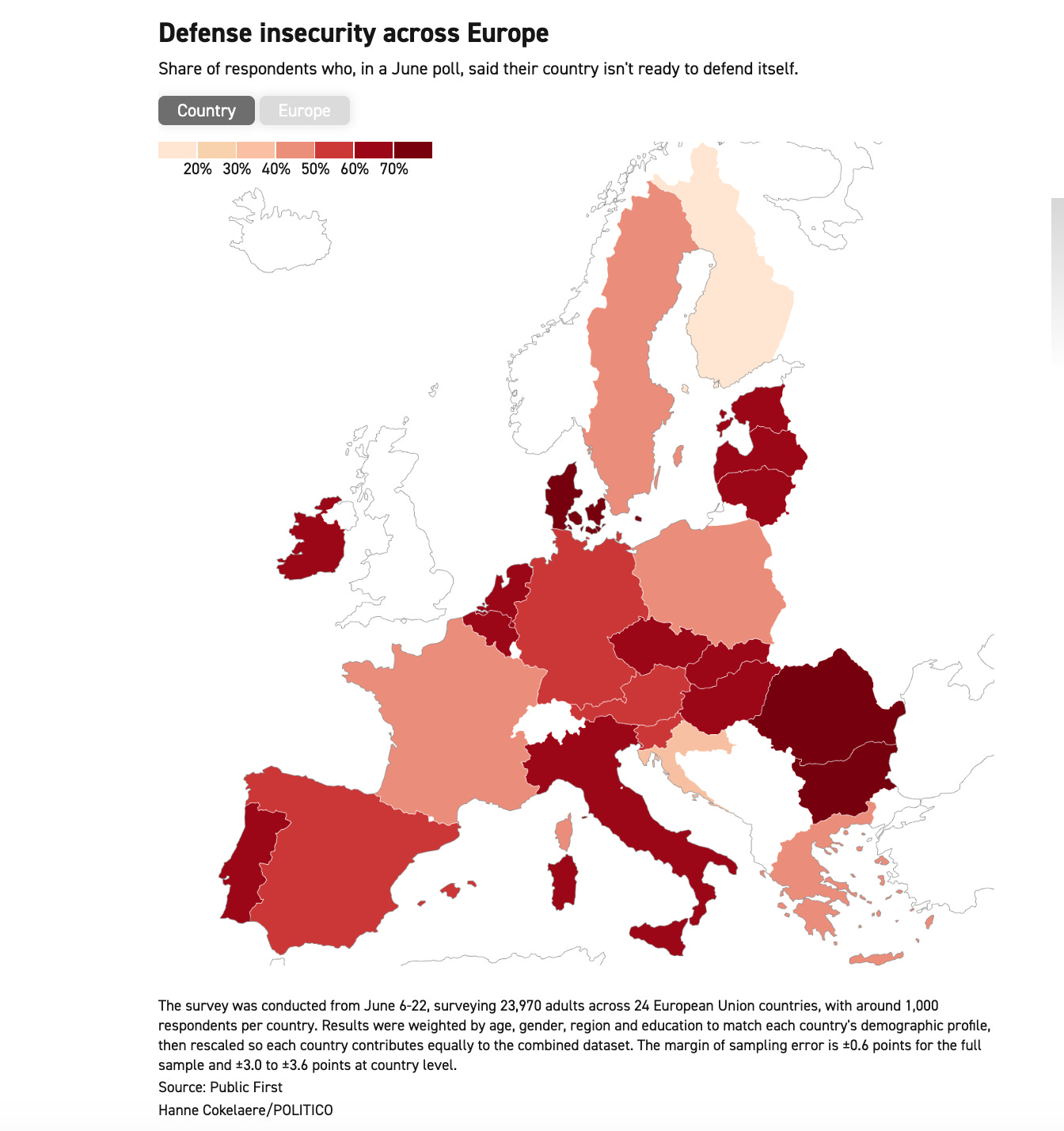
The verdict from Europe’s living rooms is in - and it should unsettle every defence ministry from Lisbon to Tallinn. A new Public First poll for Politico finds Europeans deeply skeptical that the continent could defend itself without America. Some 43 per cent of respondents say Europe is not prepared to defend itself in a conflict, against 41 per cent who disagree - and the numbers get bleaker closer to home, with 58 per cent saying their own country couldn’t mount an independent defence.
The geography of doubt is telling. Respondents ranked the Baltic states, Romania, Bulgaria, Denmark, Portugal, Italy and Ireland as least prepared to fight alone - while Finland and Croatia drew the most confidence. Translation: the countries closest to Russia’s shadow, minus Helsinki, are the ones their fellow Europeans consider most exposed. The survey canvassed nearly 24,000 people across 24 EU countries in early-to-mid June.
"Europeans feel less safe and believe the U.S. is less reliable. Whether that implies a willingness to confront some of the acute trade-offs a more autonomous European defense will imply — particularly the need for greater investment that is not necessarily focused on firms in their own country — remains an open question," said Anand Menon, director at Public First.
The Trump factor. This lands atop a season of sobering polling. The European Council on Foreign Relations’ May survey of 15 countries - pointedly titled “Home Alone” - found only 11 per cent of Europeans now view the United States as an ally, down from 22 per cent in November 2024, with majorities in every country doubting Washington would come to their defence if attacked.
But here’s the twist. Europeans aren’t paralyzed - they’re adjusting. ECFR found publics in most member states shifting in favour of higher defence spending since November, with new openness to a European nuclear deterrent - Danes and Italians warming to the idea, and Britons, once firmly opposed to sharing their arsenal, now evenly split. Yet most still expect transatlantic relations to improve once Trump leaves office - clinging, like Kevin McCallister, to the hope that the family eventually comes home.
The bottom line: Europe’s citizens have absorbed a truth their leaders spent a decade avoiding - the American security umbrella is leaking, and the repair crew isn’t coming. The public is ready to pay for the fix. The question, with major European elections looming in 2027, is whether governments can convert that realism into hardware before the window - and the patience - closes.
Justin Bieber may be headed to one of the biggest stages in sports ... ‘cause TMZ has learned he’s in talks to perform at halftime of the FIFA World Cup final. FIFA World Cup sources tell TMZ ... FIFA officials are discussing bringing Justin aboard an already stacked lineup featuring Madonna, Shakira and BTS for the July 19 spectacle at MetLife Stadium in New Jersey. Bringing the Biebs into the fold would make sense for FIFA. Justin and Hailey Bieber were front and center at the FIFA World Cup opening ceremony in Inglewood, CA just a few weeks ago ... and Justin even surprised VIP guests with an intimate backstage performance of “Yukon.” It’s also the latest twist in a busy summer for Justin. TMZ recently reported he’s not planning a tour anytime soon, despite speculation ... but a one-off performance on the world’s biggest soccer stage? That’s a whole different ball game. And if Team USA keeps making a run? Imagine Bieber closing out the tournament. Sure, he’s Canadian -- and even showed some love for Mexico during the opening festivities -- but that’s kind of the point of the World Cup ... bringing the whole world together! - TMZ
The journals…..