🔥 World Briefing — Hot Take
What we’re seeing unfold in the Strait of Hormuz is more than disruption - it’s leverage.
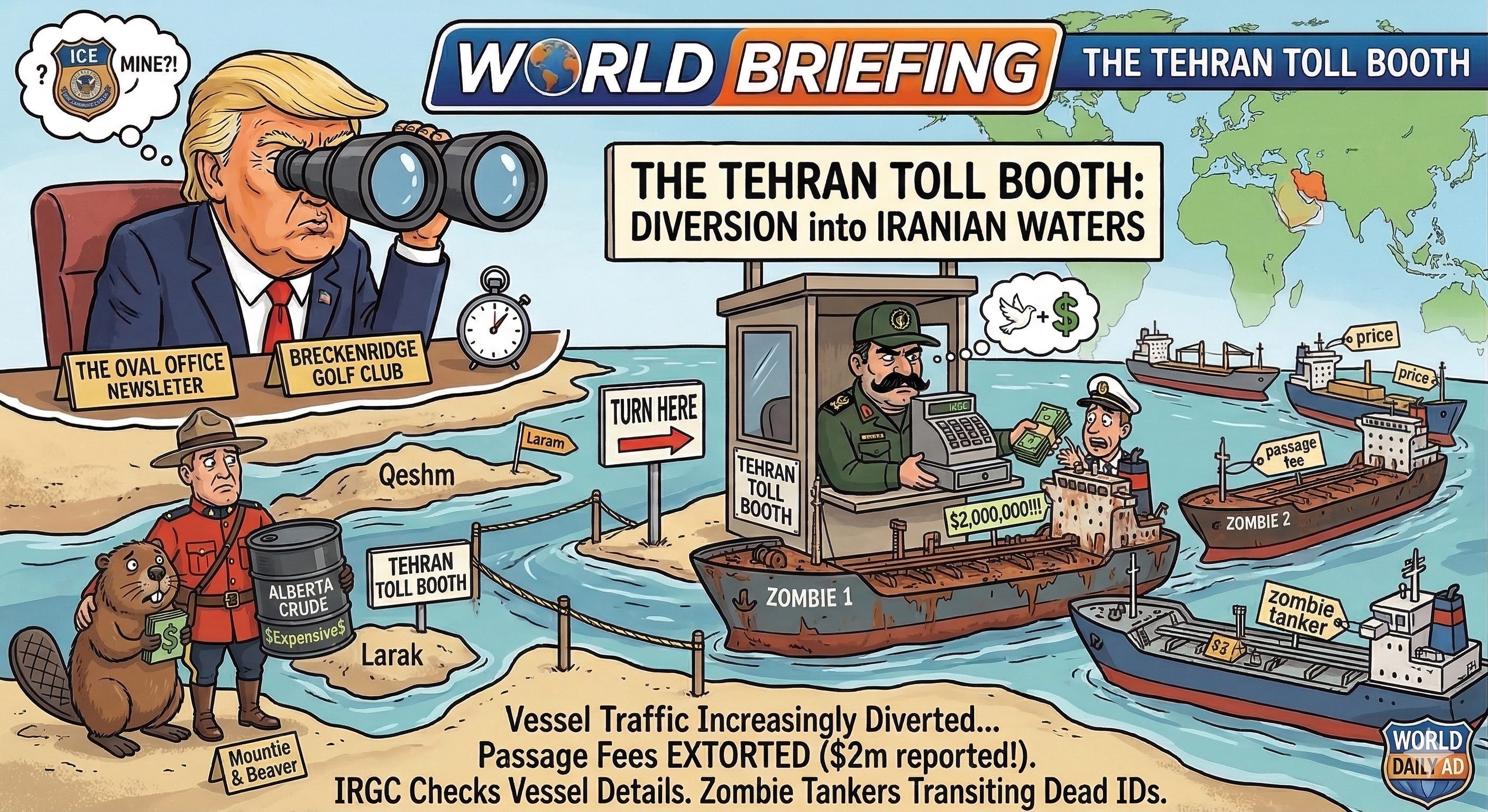
Iran is effectively turning one of the world’s most critical chokepoints into a revenue stream - a “Tehran Toll Booth” - and in doing so, openly thumbing its nose at Donald Trump’s repeated threats.
Because here’s the uncomfortable truth:
Tehran - and its partners - are, at least for now, finding ways to benefit from this war.
From reported transit fees to deepening ties with actors like North Korea, Russia and China, Iran’s war effort is no longer isolated - it’s networked. As one Philippine military expert put it today in Manila: “Its supply chain doesn’t end at its borders.”
And that should set off alarm bells.
At the same time, Trump’s signaling is becoming harder to read - and harder to trust. Escalatory rhetoric one day, hesitation the next. For allies and adversaries alike, the contradictions are stacking up - and many analysts believe very little can now be taken at face value.
The result? Strategic recalibration.
From the Gulf to Southeast Asia, governments are quietly reassessing their exposure - not just to the conflict, but to Washington itself. The question is no longer just about security guarantees, but about risk:
Is alignment with the United States becoming a liability?
In places like Manila - where treaty obligations with the U.S. run deep - even raising that question would have been unthinkable not long ago.
Now, it’s being discussed openly in conference rooms.
And that may be one of the most consequential shifts of all.
News Briefs
Traffic through the Strait of Hormuz is increasingly being diverted into Iranian territorial waters in what has been dubbed the “Tehran Toll Booth”, where the Islamic Revolutionary Guard Corps is understood to be verifying vessel details and, in some cases, extolling a passage fee. At least two vessels transiting through the strait are understood to have paid in exchange for safe passage, with one fee reported to have been around $2m. More than 20 vessels of over 10,000 dwt have thus far made the detour, which goes between Iran’s Qeshm and Larak Islands. Among them were two “zombie” tankers that transited while assuming the identity of dead vessels. While the Strait of Hormuz remains dramatically reduced as a result of the conflict, which has seen more than 20 maritime incidents involving commercial vessels and offshore infrastructure since February 28, the pace of vessel transits across the strait picked up over the weekend. Analysis of Lloyd’s List Intelligence data reveals that at least 16 vessels have transited the strait since Friday. Thirteen vessels headed east out of the Middle East Gulf, while three entered westbound. Twelve were tracked via Automatic Identification System data sailing through the new route that transits Iranian territorial waters; three either did not have enough AIS data to assess their route or transit date with confidence, while a fourth, an Iran-flagged bulker, transited the strait but stopped near Larak Island. Increasing use of the new route appears to have been bolstered by diplomatic agreements made between Iran and other states - Lloyds List
Less than 48 hours before the U.S.-Israeli strike on Iran began, Prime Minister Benjamin Netanyahu spoke by phone to President Donald Trump about the reasons for launching the kind of complex, far-off war the American leader once had campaigned against. Both Trump and Netanyahu knew from intelligence briefings earlier in the week that Iranian Supreme Leader Ayatollah Ali Khamenei and his key lieutenants would soon meet at his compound in Tehran, making them vulnerable to a “decapitation strike” – an attack against a country’s top leaders often used by Israelis but traditionally less so by the United States. But new intelligence suggested that the meeting had been moved forward to Saturday morning from Saturday night, according to three people briefed on the call. The call has not been previously reported. Reuters was unable to determine how Netanyahu’s argument affected Trump as he contemplated issuing orders to strike, but the call amounted to the Israeli leader’s closing argument to his U.S. counterpart. The three sources briefed on the call said they believed it - along with the intelligence showing a closing window to kill Iran’s leader - was a catalyst for Trump’s final decision to order the military on February 27 to move ahead with Operation Epic Fury - Reuters
North Korea enters Iran’s war supply chain — and shifts the center of gravity
North Korea is now part of the “supply chain” helping Iran prosecute its war in the Middle East, according to a former Philippine naval admiral and prominent security analyst.
Rommel Jude Ong said Pyongyang has effectively joined Russia and China in arming Tehran - a development that broadens the conflict’s geopolitical footprint.
“This means the center of gravity is not in Iran,” said Rommel Jude Ong.
While Pyongyang has not previously been widely cited as a direct contributor to Iran’s current war effort, the relationship is far from new. North Korea has long supplied arms and military technology to Iran, often in exchange for oil, and has deep experience in sanctions evasion.
It is already playing a visible role in another theater - supporting Russia’s war against Ukraine with weapons and personnel - underscoring its growing importance as a parallel supplier to U.S. adversaries.
Early in the conflict, Pyongyang denounced U.S. and Israeli strikes on Iran and praised the selection of the country’s new leadership, signaling clear political alignment.
“Given the fact that North Korea has already gained economic and strategic benefits through troop deployments and arms support in the Ukraine war, it seems possible that North Korea may seek further gains by providing missile technology, drones, and other weapons systems to Iran and other actors in the future,” Ellen Kim, director of academic affairs at the Korean Economic Institute of America, wrote in a paper published yesterday.


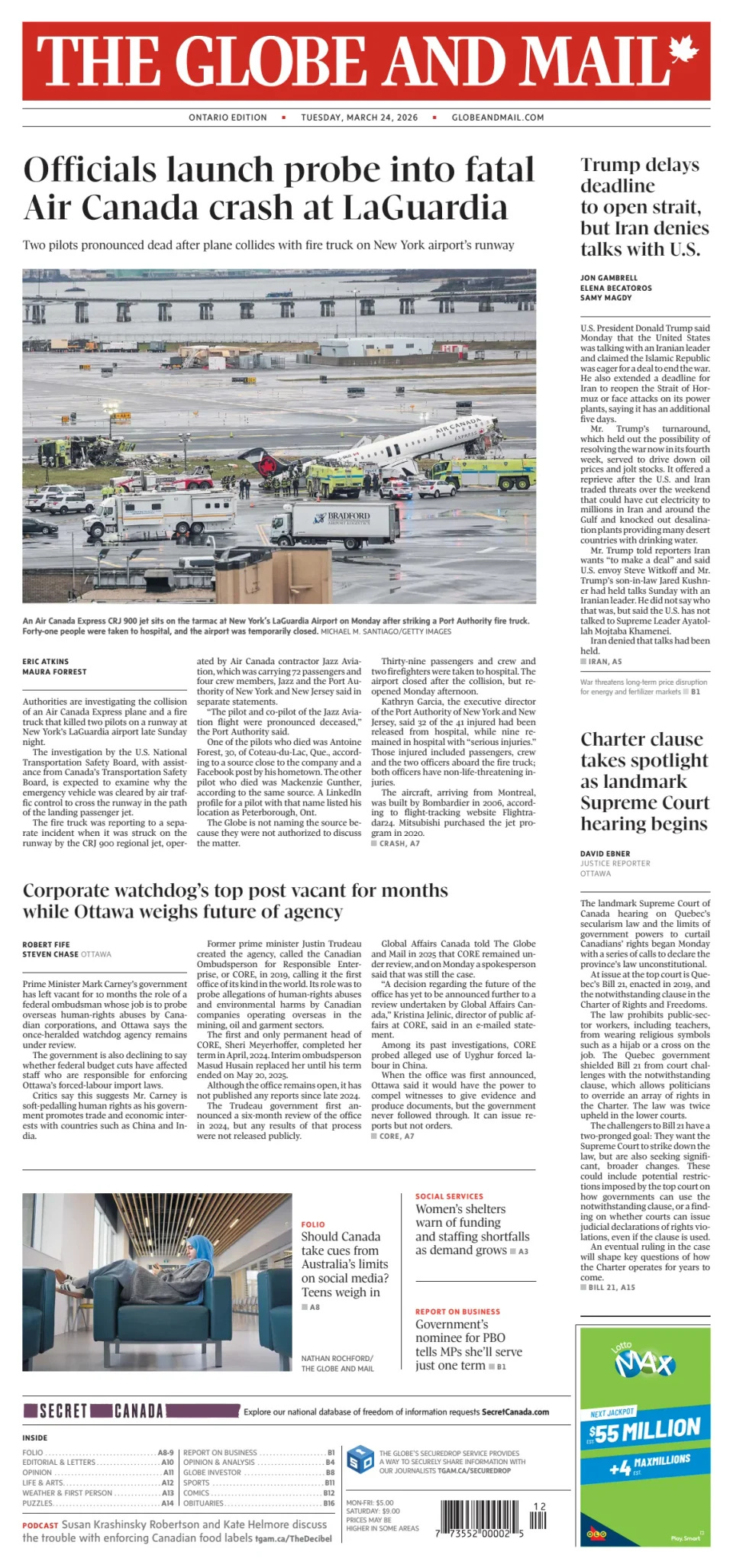
The investigation into a deadly collision between an Air Canada jet and a fire truck at LaGuardia Airport was initially slowed by complications of the federal government shutdown, the chairwoman of the National Transportation Safety Board said Monday night. The chairwoman, Jennifer Homendy, said long security lines at other airports delayed the travel of some of the more than two dozen specialists who will take part in the investigation, and that some were not expected to arrive in New York until early Tuesday. She said N.T.S.B. officials had to “beg” the Transportation Security Administration to help one investigator who waited in line for three hours in Houston. LaGuardia Airport reopened Monday afternoon, nearly 14 hours after the accident in which an Air Canada jet struck a Port Authority fire truck that had crossed into its path as it landed, killing two pilots. Ms. Homendy said investigators were able to recover the plane’s undamaged cockpit voice recorder by cutting a hole in its roof but had not been able to conduct a full day of investigation because of travel delays. “It has been a really big challenge to get the entire team here,” said Ms. Homendy, who said she had driven to New York from Washington - NYT
Journalists at Voice of America sued Trump administration officials on Monday, accusing them of infringing on reporters’ First Amendment rights by turning the news group, which is federally funded, into a propaganda “mouthpiece” that published content favorable to President Trump without legally mandated editorial balance. The journalists claimed in their complaint that Mr. Trump’s political appointees had interfered with editorial decisions of Voice of America reporters and editors, violating a safeguard Congress set out in law called the “firewall” that protects their independence. Mr. Trump and his appointees, the lawsuit claimed, viewed such statutory requirements with “antipathy and contempt.” The journalists said in the complaint that one official, Hui Jing, demanded “loyalty” to the Trump administration if reporters wanted to “keep their jobs.” The administration, the lawsuit said, is trying “to use its governmental authority to control V.O.A.’s substantive output — the content of its broadcasts and publications — by suppressing coverage of events that it wishes had not occurred, and, separately, by directing that its own partisan messages be passed off to viewers and listeners as ‘news.’” - NYT
Hungary’s foreign minister reportedly conspired with his Russian counterpart, Sergei Lavrov, to promote pro-Russian politics not just in Hungary but other countries in Europe such as Slovakia. This comes at a pivotal time, with Hungary facing a national election in less than two weeks and Hungarian President Viktor Orban trailing far behind his opponent. Separately, the European Commission has called for clarity from Hungary after a United States media outlet reported that the country’s foreign minister passed on information about negotiations with the European Union to Russia. The Washington Post reported on Saturday that Hungary’s Foreign Minister Peter Szijjarto had regularly called Lavrov during breaks in EU meetings to provide “direct reports on what was discussed” and possible next steps, Al Jazeera reported.
Ukraine and Russia exchanged drone strikes, involving over 200 drones from each side, following US-Ukrainian talks in Florida that also addressed potential prisoner exchanges between Russia and Ukraine. Russian air defense forces reported intercepting and destroying 249 Ukrainian drones overnight, marking one of the largest Ukrainian drone attacks recorded as Ukraine intensifies its attacks on Russian energy facilities. Meanwhile, the Ukrainian Air Force said Russian forces launched 251 strike drones during the same period. In Ukraine, Russian drones targeted residential areas and port infrastructure in the southern Odesa region on the Black Sea, according to the regional governor. At least four people were injured in Kryviy Rih, a major industrial city in central Ukraine, after Russian strikes, with damage to infrastructure and fires reported. In Russia, a drone strike set fire to a fuel reservoir at the Baltic Sea port of Primorsk, the country’s largest western oil-exporting hub, according to Aleksandr Drozdenko, governor of the Leningrad region. Over 70 drones were destroyed in the region in the last 24 hours, Drozdenko wrote on his Telegram account - RFE/RL
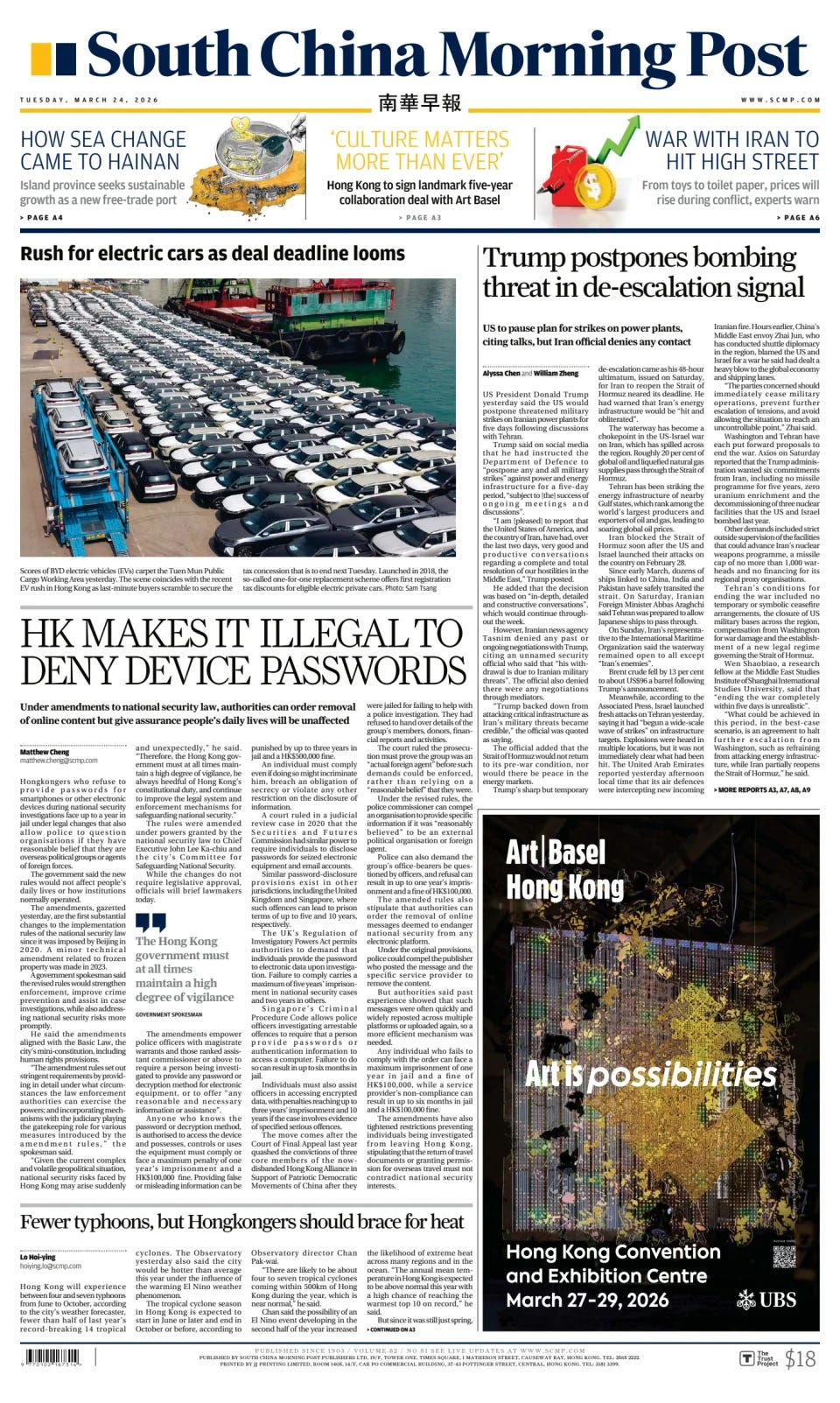
Hongkongers who refuse to provide passwords for smartphones or other electronic devices during national security investigations face up to a year in jail under legal changes that also allow police to question organisations if they have reasonable belief that they are overseas political groups or agents of foreign forces.The government said the new rules would not affect people’s daily lives or how institutions normally operated.The amendments, gazetted on Monday, are the first substantial changes to the implementation rules of the national security law since it was imposed by Beijing in 2020. A minor technical amendment related to frozen property was made in 2023.A government spokesman said the revised rules would strengthen enforcement, improve crime prevention and assist in case investigations, while also addressing national security risks more promptly. Similar password‑disclosure provisions exist in other jurisdictions, including the United Kingdom and Singapore, where such offences can lead to prison terms of up to five and 10 years, respectively, the SCMP reported
President Donald Trump’s head-scratching idea to deploy ICE agents to a handful of security-strapped airports appears to have come from a caller to a right wing radio show known as “Linda from Arizona.” Trump’s abrupt order came shortly after the radio host Clay Travis shared the idea—originally from one of his show’s callers - on one of the president’s favorite Fox News shows. The connection, first reported by CNN’s Brian Stelter, began with Linda’s call to The Clay Travis and Buck Sexton Show on Friday. “I think I have a solution to the TSA problem,” Linda told Travis, referring to the hours-long security wait times brought on by TSA agents not being paid. “We need to bring in ICE agents.” Travis reportedly responded, “It’s kind of a brilliant idea.” From there, the 46-year-old radio host took Linda’s pitch to Fox News, where he repeated it to Charlie Hurt, who was filling in on Jesse Watters Primetime—a de facto megaphone to the Oval Office. Travis told Hurt about a “great call” he received earlier in the day. “What if President Trump announced that ICE agents were now going to be supplementing TSA agents inside all of the airports,” he said, referencing Linda’s idea. Lo and behold, Trump announced his intentions to deploy ICE—described as his “personal police force” by critics like California Gov. Gavin Newsom—into airports at 8 a.m. the following morning, blindsiding those in his own administration, who gave conflicting accounts of what ICE’s job would actually be. Travis quickly claimed credit for getting Linda’s message to the president. However, the 79-year-old president claimed the idea as his own during a press gaggle on Monday. Asked by a reporter whose idea the deployment was, Trump responded, “Mine.” - The Daily Beast
The journals….