

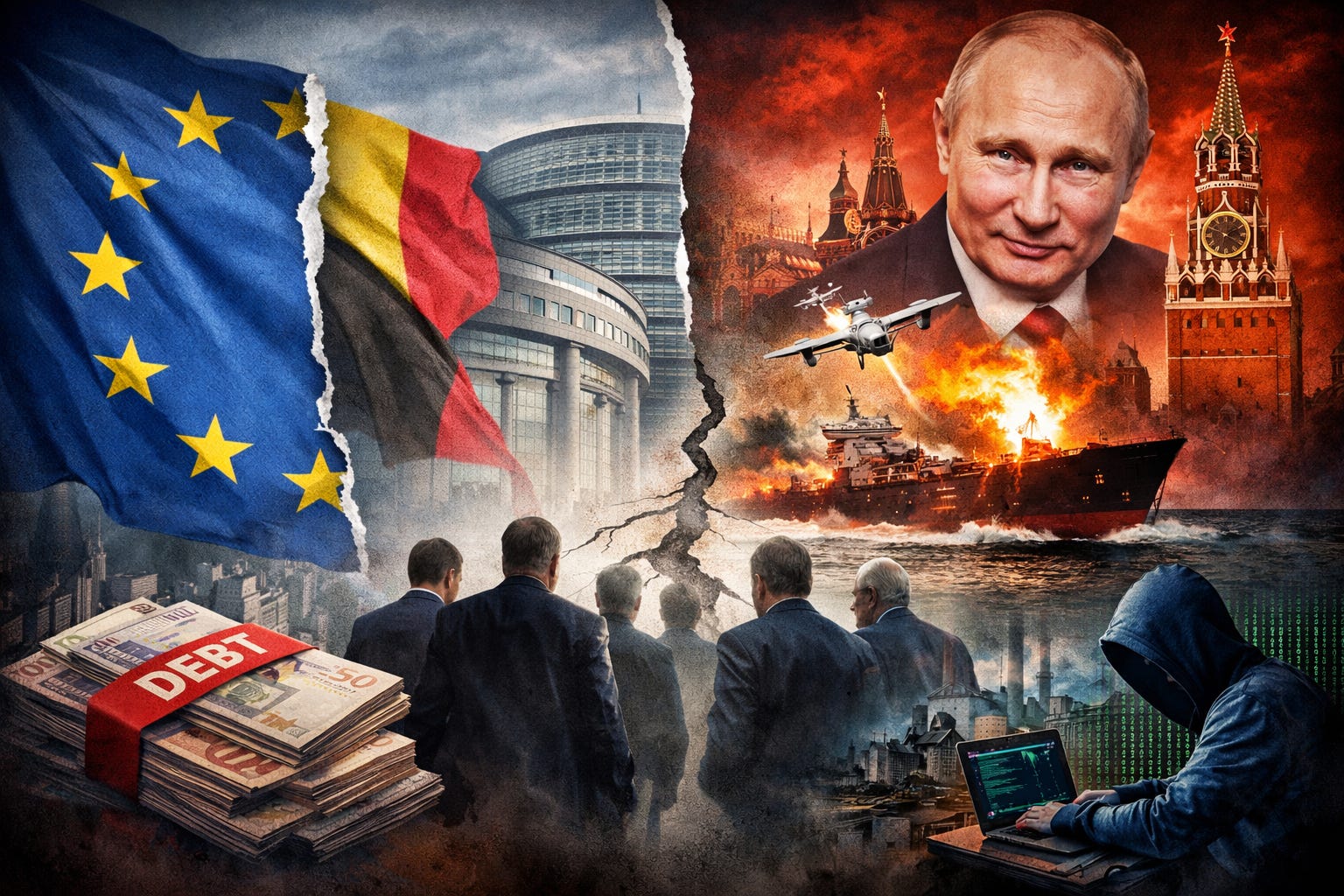
Europe’s leaders talked late into the night - and emerged with a deal that gives Ukraine money, Russia comfort, and European taxpayers the bill. Under pressure from Moscow, Belgium balked at using frozen Russian assets, triggering a retreat toward EU joint debt instead. Several countries demanded carve-outs, turning what was billed as unity into another display of fragmentation.
The Kremlin may not be popping champagne, but it is clearly encouraged. As Brussels hesitated, Ukraine struck a Russian shadow-fleet tanker in the Mediterranean, signaling that Kyiv understands something Europe still struggles to grasp: deterrence only works when it is visible and costly.
At his marathon press conference, a Vladimir Putin oozing chutzpah, dismissed responsibility for the war, shifted Russia’s main enemy from Washington to Europe, and even threw public support behind Donald Trump - a glimpse of a geopolitical alignment Europe appears unprepared to confront.
From cyberattacks on Danish water systems to election interference, Russia’s hybrid war is already hitting European homes. The choice facing EU leaders is stark: act now and pay the price of security - or delay, dither, and pay far more when the war arrives even closer and more intensively to home.
Belgium, the guardian of Russia’s frozen billions, melted like Belgian chocolate in a microwave — buckling under Kremlin intimidation and handing Europe’s most powerful bargaining chip back to Moscow. 🎥 World Briefing Plus exclusive for paid subscribers: Scroll down for my video breakdown of how Europe blinked in Brussels — and why Moscow is taking notes.
After a marathon summit, leaders agreed on a plan to provide funding for Ukraine based on EU joint debt, although three countries refused to sign up. That wasn’t the plan most EU countries had been pushing for, which was to use frozen Russian assets to help Kyiv’s war effort. The agreement is to give Ukraine a €90bn (£79bn; $105bn) interest-free loan to stop it from going bankrupt. This EU loan is about two-thirds of the €135bn that Kyiv is thought to need to stay afloat over the next two years However, Ukraine's president welcomed the deal, having previously urged the EU to use €210bn (£183bn; $246bn) of frozen Russian assets instead. But Belgium, where the vast bulk of these assets are held, demanded guarantees against risks from potential Russian retaliation that proved too much for some countries. This wasn't the only split - with Hungary, Slovakia and the Czech Republic only agreeing to support the loan if they were exempt from liability, in "yet another indication of the divisions in Europe over attitudes to Ukraine and to Moscow.” Put simply, the EU went from using Russia’s money to EU taxpayer cash. But not even all. The Czech Republic -- with its new-old prime minister, Andrej Babis, back in power -- Hungary, and Slovakia all secured carve-outs meaning that this is a deal of EU-24, not EU-27. In that sense it is even less impressive than when Brussels in early 2024 agreed to use a similar method of raising nearly 50 billion euros for Ukraine on the markets. Then everyone was onboard, even Hungarian Prime Minister Viktor Orban who got assurances that Hungary’s share wouldn’t go to the Ukrainian military. The Russian assets will remain frozen until then with the EU having changed the rules last week to allow them to remain immobilized as long as is needed with no roll-over via unanimity needed every six months any longer. The final text agreed by the leaders even states that it “reserves its right to make use of them to repay the loan.” A sort of “reparations loan light,” after all.- Politico/BBC/RFE-RL
In an unprecedented attack, Ukrainian aerial drones struck a Russian shadow fleet tanker in neutral waters of the Mediterranean Sea, an official at Ukraine’s Security Service (SBU) told POLITICO on Friday. The SBU official said the drones hit the tanker Qendil more than 2,000 kilometers from Ukraine, causing critical damage. The vessel was empty at the time of the strike, the official added. The official stressed the attack did not pose any threat to the environment in the region. According to the Marine Traffic website, the Oman-flagged tanker Qendil is currently in the eastern Mediterranean near Crete and en route to the Russian port of Ust Luga. “The Russian Federation used this tanker to circumvent sanctions and earn money that went to the war against Ukraine; therefore, from the point of view of international law and the laws and customs of war, this is an absolutely legitimate target for the SBU,” the official said. “The attack in international waters demonstrates that Ukraine will pursue Russian assets wherever they operate and will not allow vessels supporting Moscow’s war effort to act with impunity.” The strike was announced while Vladimir Putin was holding his annual end-of-year press conference.
Here’s what we heard this year at the nearly five-hour, marathon press conference:
Putin blamed Ukraine for “unleashing the war” and alleged Kyiv is “refusing to end this conflict using peaceful means.” He said “we did not start this war” when asked by NBC whether he would consider himself responsible for the deaths of Ukrainians and Russians if he rejected US President Donald Trump’s peace plan proposal. BBC Russia editor Steve Rosenberg asked whether there will be any new special military operations. Putin delivers a lengthy response, in which he defends Russia’s political system and raises the problem of “fake news.” Some of the questions and comments sent in by members of the public and shown on screen during the press conference were critical of the Russian leader. One refers to the Q&A as a “circus”, another demands an end to “crazy price growth” - BBC
“One key difference from past years is that America is no longer presented as an enemy. Since Donald Trump’s re-election, it is Europe that is portrayed as Russia’s enemy number one in the West,” wrote the BBC’s Vitaliy Shevchenko
Putin sent President Donald Trump a little morale boost Friday as the release of the explosive Epstein files looms. The Russian president waded into Trump’s $10 billion defamation lawsuit against the BBC in the middle of his end-of-year press conference, throwing his support behind the American leader. Calling the lawsuit a “family matter” and claiming he didn’t want to “rub salt” in the wound by commenting on it, Putin nonetheless went on to prop up Trump, telling reporters that inaccurate reporting in the press really is a “problem.” “It’s obvious. I think President Trump is right,” he said. Trump filed the lawsuit against the British broadcaster earlier this month after claiming they “intentionally, maliciously, and deceptively” edited a speech he made before the Jan. 6 Capitol riot to imply he’d encouraged the insurrection. The BBC has since apologized to Trump for editing the clip but said it will defend itself against the case. Putin’s support for Trump comes as the U.S. president and his team brace for the release of files related to the late sex trafficker Jeffrey Epstein, a former pal of Trump - Reuters
Denmark accused Russia on Thursday of cyberattacks in 2024 and 2025 against a water utility company that caused pipes to burst and targeting government websites ahead of the November elections, marking the first time Copenhagen has publicly attributed such attacks to Moscow. Pro-Russian hacking group Z-Pentest attacked the Tureby Alkestrup Waterworks in late 2024, altering water pressure and causing at least three pipes to burst in Køge, 35 kilometres south of Copenhagen, Denmark’s Defence Intelligence Service said. Around 50 households were without water for seven hours while 450 homes lost supply for one hour. A separate pro-Russian group, NoName057(16), carried out distributed denial-of-service attacks on Danish websites in November ahead of regional and local elections, the intelligence service said. Both groups have links to the Russian state, according to Danish authorities. "The Russian state uses both groups as instruments of its hybrid war against the West," Denmark's intelligence agency said in a statement. "The aim is to create insecurity in the targeted countries and to punish those that support Ukraine” - Euronews
Russia’s war in Ukraine, which Western estimates say has inflicted the country’s heaviest military losses since World War II, has driven a sharp increase in revenue for the country’s leading funeral companies. According to data cited by industry outlet Funeral Trust, the top five funeral businesses in Russia earned a combined 14.872 billion rubles ($184 million) in 2024, up 2.923 billion rubles ($36 million), or 24%, from the previous year. Moscow-based state enterprise Ritual led the market, increasing revenue by 22% to 5.5 billion rubles ($68.2 million). St. Petersburg entrepreneur Valery Larkin, who controls more than three dozen companies including the Memory Eternal center, reported 5.463 billion rubles ($67.8 million) in revenue, a 21% increase. In the Ural Mountains city of Yekaterinburg, funeral operators Anatoly Glukhov and Dmitry Khazov grew revenue across their eight companies by 18%, to 1.433 billion rubles ($17.8 million). The surge in funeral revenue comes amid rising demand and record inflation in funeral services. According to state statistics agency Rosstat, the cost of a coffin has risen 84% and grave digging 51% since early 2022 - Moscow Times
Christian Turner — a career diplomat hailed as “a first-rate problem solver” — has been chosen as Britain’s new ambassador to the United States after an extensive search to fill the top transatlantic post. The U.K. government on Thursday night confirmed it has chosen Turner — who was supposed to become Britain’s representative to the United Nations in the coming months — for the role, which was vacated by Peter Mandelson back in September. Veteran Labour politician Mandelson left office amid deep controversy over his friendship with convicted sex offender Jeffrey Epstein. The prime minister’s business adviser Varun Chandra had been seen as the frontrunner for the post as recently as this week, earning praise from some Trump administration officials. But Turner secured the plum job after Keir Starmer was persuaded to appoint from within the Foreign, Commonwealth and Development Office (FCDO). One FCDO official familiar with the final shortlist process said there had been a “massive fightback in the past days” to sway the PM towards appointing a longstanding diplomat. The White House will still have to rubber stamp the appointment ahead of Starmer’s nominee taking up his post. Foreign Secretary Yvette Cooper recommended Turner as her first choice to Starmer, said one person with knowledge of the process. They added that Cooper had been impressed by Turner’s calm head and thorough knowledge of the diplomatic service. One person who has worked with Turner, granted anonymity like others in this article to speak frankly, said he was “massively energetic” and “at the heart” of pushing Britain’s place in multilateral relations, including representing the U.K. during talks with E3 nations on Iran - Politico
Pakistan’s navy on December 17 launched its fourth Hangor-class submarine, the PNS Ghazi, in Wuhan, marking the completion of construction for all four China-built boats in a landmark eight-submarine program. Under a 2015 defense contract valued at roughly $5 billion with China Shipbuilding & Offshore International Company, Pakistan is acquiring eight advanced Hangor-class diesel-electric attack submarines to modernize its undersea warfare capabilities and replace its aging Agosta 90B fleet. The Hangor program represents one of the largest and most sophisticated foreign military procurements in Pakistan’s history, reflecting deepening China–Pakistan defense cooperation that spans fighter jets, missile systems, and nuclear energy projects. Four vessels, including the PNS Ghazi, were constructed at Wuchang; the remaining four are being built domestically at Karachi Shipyard & Engineering Works under a comprehensive technology transfer arrangement, with deliveries planned through 2028 despite earlier delays related to foreign engine supply issues. Pakistan’s military has hailed the program as a major boost to its undersea deterrent, enhancing operational flexibility and its ability to maintain a credible presence in the Arabian Sea and wider Indian Ocean region - RFE/RL
