Read the speech from Washington and it scans as boilerplate. Read it from here in Southeast Asia, where Chinese coast guard vessels now patrol contested waters as though the 2016 arbitration ruling had never happened, and the omission is deafening.
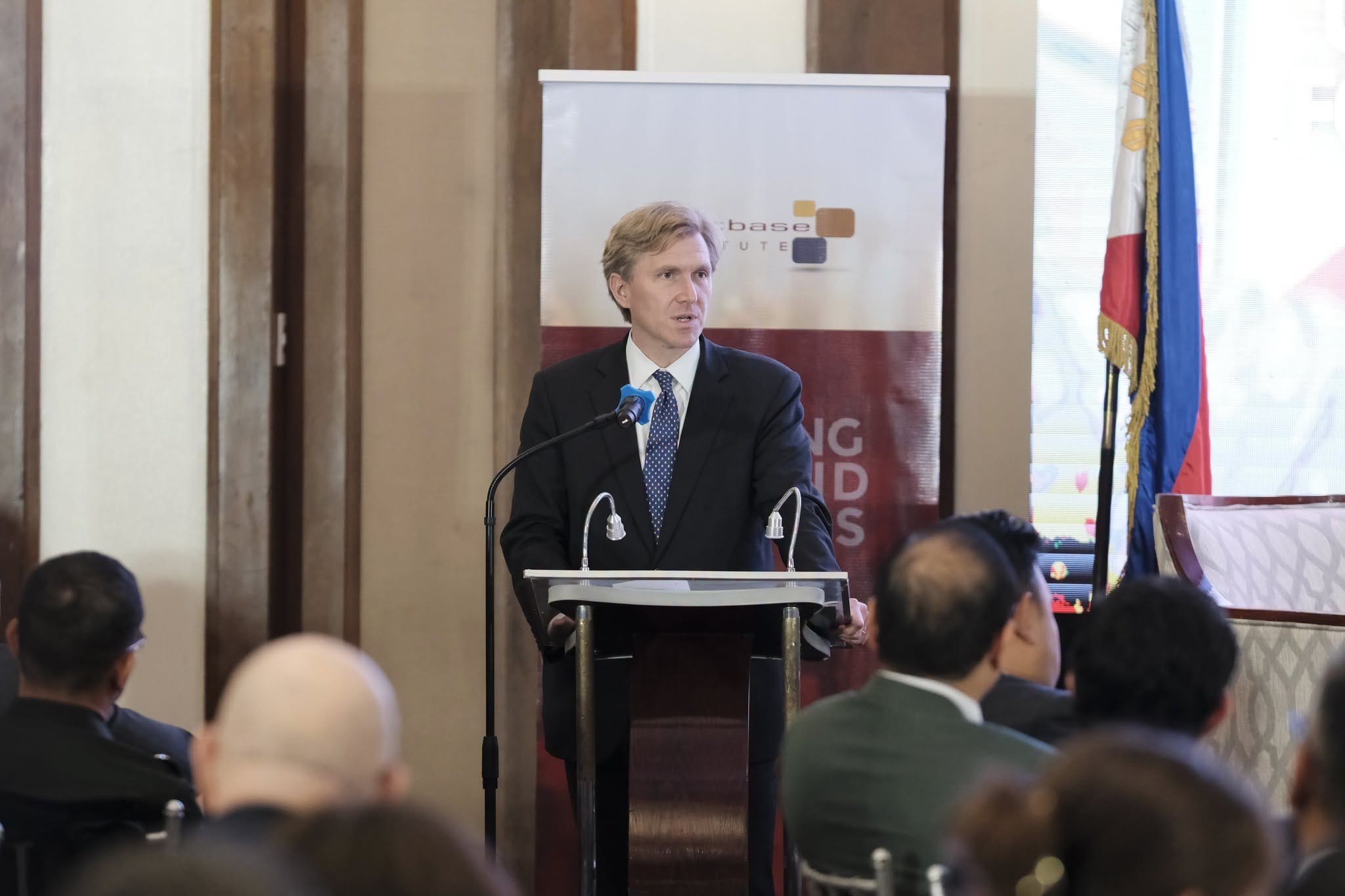
Elbridge Colby went to Manila this week to deliver what he called a message both bracing and reassuring. Across some 3,000 words on deterrence along the first island chain, delivered in a capital whose fishermen are routinely water-cannoned inside their own exclusive economic zone, the Under Secretary of War for Policy did not once say the word China. Nor Taiwan. Nor the South China Sea, nor Scarborough Shoal. Nor Mischief Reef. The adversary surfaced only as a hegemon, as coercion, as external encroachment.
His Filipino host had no such difficulty. Introducing him, Stratbase president Dindo Manhit — a friend — noted that Filipinos rank the United States first among partners they want alongside them in defending the West Philippine Sea, naming in Manila’s own terminology the body of water his guest would spend his prepared remarks not naming.
What Colby did name, repeatedly, was the press.
The speech was the opening stop of his first Southeast Asia tour, delivered at the Stratbase Institute on August 10, with Jakarta, Bangkok and Phnom Penh to follow. The stated theme was “flexible realism” — American strength, allied burden-sharing, and an end to what Colby dismissed as the post-Cold War era of high-flown abstraction. What emerged was something more revealing: a portrait of an administration that has decided its biggest problem in Asia is not Beijing, but the people writing about it.
No fewer than six references to “the commentariat.” Two to “the cognoscenti.” Assorted swipes at “the outlets of the old order” and, memorably, at “the panjandrums of the global elite” — a word coined in 1755 as deliberate nonsense verse. Roughly a fifth of a speech billed as hard-nosed realism was spent litigating its own coverage.
The actual news
Strip out the throat-clearing and three things matter.
First, the warning against middle powers. Colby urged the region to reject what he called the delusion of middle power alliances designed to exclude America, insisting such efforts must be complementary to Washington’s. It is the bluntest public shot yet at the hedging architecture that Tokyo, Canberra, Seoul, Ottawa and Brussels have quietly been assembling since 2025 — and it arrives dressed, awkwardly, as encouragement.
The timing is the problem. Three days before Colby took the stage in Manila, Mohammed bin Salman, Recep Tayyip Erdogan and Shehbaz Sharif signed the Mecca Joint Defence Agreement, committing a top oil exporter, NATO’s second-largest army and the Muslim world’s only nuclear power to treat an attack on one as an attack on all. Islamabad says the pact is defensive and open to others. Riyadh insists it is not an axis.
But nobody in the Gulf pretends the agreement grew out of confidence in American security guarantees. It was a year in the making and was sealed after months of Iranian drone and missile strikes on Saudi territory that left Riyadh openly questioning the value of the US umbrella. That is the precise behaviour Colby travelled to Asia to discourage — sovereign states (in this case all partners of Uncle Sam), doubting Washington’s reliability, building collective deterrence among themselves. It happened while he was packing.
Southeast Asian officials will have noticed. The lesson they draw from Mecca is unlikely to be that middle-power alignment is a delusion.
Second, conditionality is finished. No ideological lectures for Thailand, which Colby referred to as “our oldest diplomatic partner in Asia and only mainland ally.” Yesterday’s preconditions left at the door with Vietnam and Malaysia. Deep respect for Indonesia’s proud traditions.
Read alongside the itinerary, this is the formal decoupling of human rights from American security ties in ASEAN. Colby landed in Phnom Penh today — a country that earned exactly one line in his Manila text, bundled into a closing list. Ream, the naval base Washington spent years accusing Cambodia of handing to Beijing, now hosts visiting American admirals; Angkor Sentinel is back after eight dormant years and joint naval drills are slated for 2027. Cambodianess put the bargain plainly this morning: the transactional turn lets Phnom Penh deepen defence ties without being pressured on human rights or democratic backsliding. That is not my inference. That is the read from the capital receiving him.
Colby will have been in Bangkok earlier. Between the two capitals sits a conflict Trump claimed credit for solving in Malaysia. It collapsed within months into fighting that killed more than a hundred people and displaced half a million, and Washington did not broker the replacement ceasefire — China stepped up to audition. A year on, Bangkok reports troops deployed without gaps across five provinces, an air force acquiring loitering munitions, and contingency planning for strikes deeper inside Cambodia. Twenty thousand Cambodians still cannot go home. Judged by deliverables, as Colby proposes, this is not a solved conflict. It is a frozen one with both sides rearming.
On Vietnam and Malaysia, Colby’s exact words were that “we leave yesterday’s ideological preconditions at the door.” He closed the speech promising no “peacocking or moralizing speeches.” It is a genuine policy shift, announced almost in passing.
I was in Kuala Lumpur in November 1998 when Al Gore rose at an APEC dinner hosted by Mahathir Mohamad and declared that America stood with reformasi — the movement built around Anwar Ibrahim, by then sacked, beaten in custody and awaiting trial. His hosts were furious. It was undiplomatic and it changed nothing overnight. But nobody in that ballroom left wondering where Washington stood.
Anwar is prime minister today. It was his government that brokered the ceasefire Trump would later claim as his own. Nearly three decades on, an American official flies into the same region and offers the precise inversion of that evening: no lectures, no preconditions, no moralising. Whether that is maturity or abdication is the argument worth having. What it plainly is not is a minor adjustment.
Third, the hardware. One concrete deliverable in the entire text: four Fast Response Cutters rotating alongside the Philippine Coast Guard on EEZ patrols. Everything else is posture language about hardening footprints and driving interoperability.
The tell
Colby praised a “Trump Corollary” to the Monroe Doctrine as a return to America’s best tradition — in a speech whose central argument is that no single power should dominate Asia. Every foreign ministry between Hanoi and Jakarta will draw the obvious inference: spheres of influence are acceptable, Washington would simply like to keep its own.
Also absent: Japan, Korea, Australia, AUKUS, the Quad — and tariffs, which remain the single largest source of friction between the United States and Southeast Asia, including close buddies Thailand and Singapore. For a speech insisting on concrete practical interests over symbolism, that is a considerable amount of concrete left out of the mix. Nor was the absence only rhetorical. Watch the video and note who Canada and Australia sent: representatives. Two of the middle powers Colby came to warn against turned up to hear it at the working level.
The region was told to judge Washington by what it delivers rather than what it says. Fair enough. It is a standard the speech itself struggles to meet. Full disclosure: by Colby's taxonomy I am the commentariat. Which is presumably why I read the whole thing.
News Briefs
President Vladimir Putin said Russia would seize ships belonging to European countries if they tried to sell cargo confiscated from Russia-linked vessels suspected of belonging to Moscow’s so-called shadow fleet. “This is nothing less than piracy and robbery,” Putin said during drills by Russia’s Pacific Fleet on August 12, referring to Europe’s plans to tighten measures against vessels suspected of helping Moscow evade Western sanctions. “If this begins to be put into practice, we shall be forced to respond in kind,” he added, saying that Moscow would not limit its response to the waters where Russian ships were being detained. He did not provide other details. Western governments have stepped up efforts to target the shadow fleet -- a network of opaquely owned or insured vessels that Russia has used to keep its oil exports flowing despite sanctions imposed over its invasion of Ukraine - RFE/RL
Vladimir Putin visited the far-eastern Kuril islands for the first time on Thursday, prompting a "strong" protest by Japan which also claims the territory. Russian-Japanese relations have long been dogged by tensions over the contested islands, known in Japan as the Northern Territories and seized by the Soviet Union in 1945. The Kremlin posted a video of Putin in the Kuril Islands, with Russian media saying he visited a fish-processing plant where he was given caviar. Putin travelled to the Kurils after visiting the nearby Russian island of Sakhalin, where Russia’s navy was conducting drills. In Sakhalin, Putin held a meeting "on ensuring the security of Russia's eastern borders," state-run media outlet RIA Novosti said. Japan, whose ties with Russia have worsened further since the full-scale invasion of Ukraine in 2022 – just as Moscow’s relations with China and North Korea have warmed – objected strongly. “The Northern Territories are an inherent part of Japan’s territory both historically and under international law, and the government of Japan strongly protests this visit,” said Foreign Minister Toshimitsu Motegi in a statement. The Soviet Union took the strategically located volcanic archipelago north of Hokkaido in the final days of World War II, and has maintained a military presence there ever since - Euronews
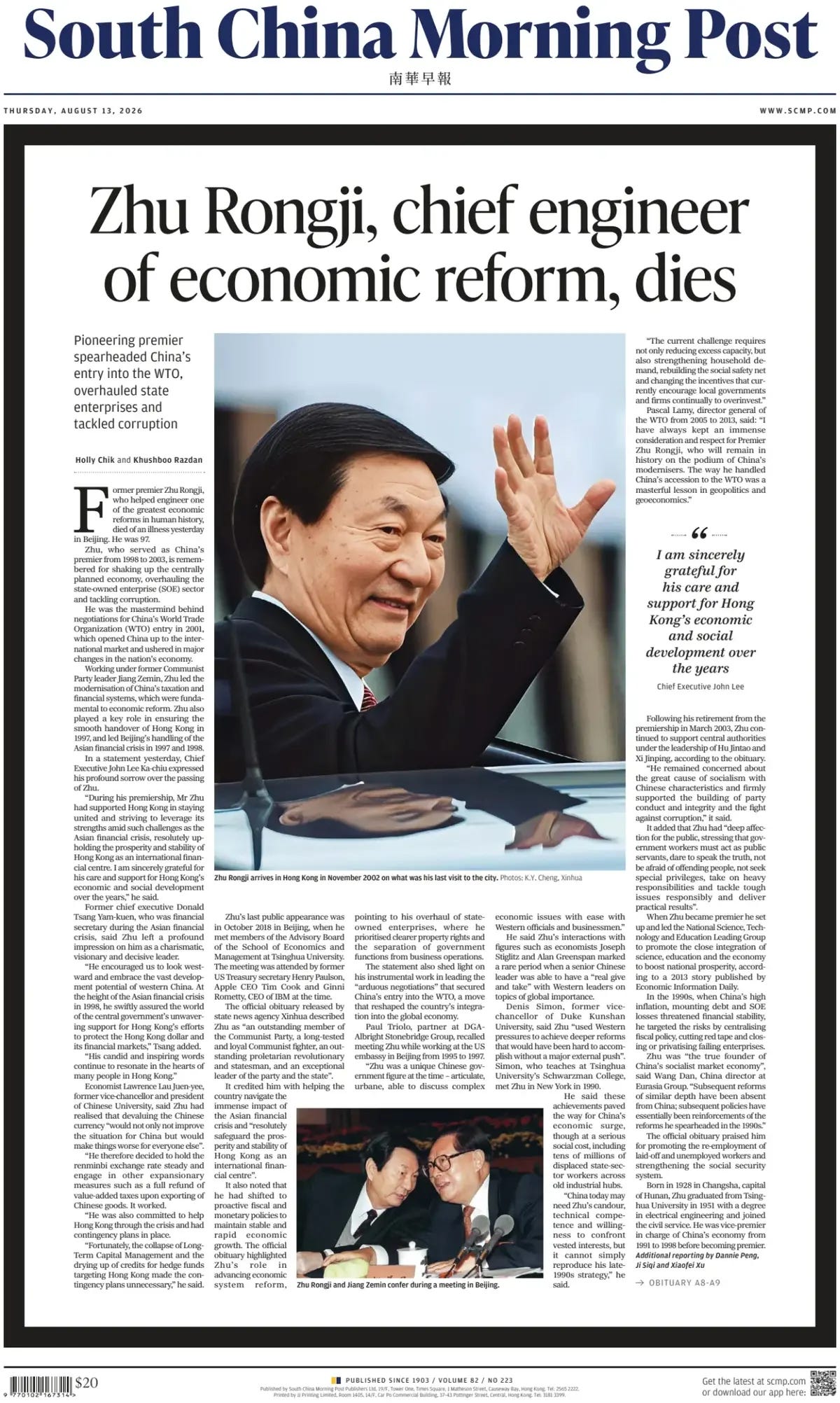
Former Chinese Premier Zhu Rongji, a leading architect of the country’s economic rise, has died aged 97. Zhu’s signal accomplishment was steering China into the World Trade Organization in 2001, after laying the groundwork with a host of reforms: overhauling the tax system, commercializing state banks, and smashing the “iron ricebowl” of guaranteed employment by shuttering hundreds of loss-making state enterprises. Up to 30 million workers lost their jobs. Yet Zhu also privatized the housing stock, instantly creating an urban middle class. The US assumed that Zhu’s policies were just the start of a promised Chinese economic opening. In fact, they represented the high point of reform; gigantic state enterprises now dominate the economy, and prospects for foreign investors are narrowing - Semafor
The Israeli military says it will deploy additional troops to the occupied West Bank after failing to force away Israeli settlers who have trapped two Palestinian families in their homes since Sunday. The Abu Ridi and Hassan families - who live on the outskirts of the village of Qusra, south of Nablus - made appeals for help after their water and power supplies were cut off and their food stocks ran low. The case is the latest to draw attention to the relative impunity of settlers and how Israeli forces are struggling to deal with rising settler violence. Videos shared from Qusra overnight show a dozen Israeli security vehicles – including a bulldozer. In later footage – filmed in the daylight – there is a long line of Israeli security forces on the road to the Palestinian village, which remains a closed military zone. Local media reports say that a nearby Israeli settler outpost was demolished. Qusay Abu Ridi, who has been trapped by settlers in his home since Sunday with his water and power cut off, told the BBC that the house had been attacked again overnight and that a few settlers remained in the area, hiding from the army. His brother – who owns the property – is a Palestinian-American businessman who had complained to the US embassy. The US ambassador to Israel Mike Huckabee said his embassy had asked Israel to remove the settlers, describing them as "Israeli terrorists" - BBC
White House press secretary Karoline Leavitt is leaving her role at the end of August, President Donald Trump said Wednesday. The president, in a post on Truth Social, said Leavitt is departing to spend more time with her family, but will remain one of his “top outside advisors” and an “influential voice within the Republican Party.” “Karoline has been one of the best White House Press Secretaries in the History of the Office,” Trump wrote. Leavitt’s departure comes on the heels of a leave of absence this summer after the May birth of her second child, Viviana. She returned to the White House last month. Leavitt gave birth to her first child, Niko, during the 2024 presidential campaign, returning to work quickly when the president was shot in Butler, Pennsylvania. Leavitt, in a post on X, described the job as “the honor and adventure of a lifetime,” but said she had decided to step away to devote her time to being a mom - Politico
A shock name is considered the favorite to replace Leavitt as the next White House press secretary. MAGA political commentator Scott Jennings is the current frontrunner to take on the prominent role in Donald Trump’s administration, sources with knowledge of the situation told the Daily Beast. Jennings, known for his argumentative and childish appearances defending Trump on CNN, has a history of working in public relations and served in the George W. Bush administration as a special assistant to the president and deputy director of political affairs. Alina Habba, Trump’s former defense attorney and disbarred acting U.S. attorney for New Jersey, is also considered a strong candidate, sources told the New York Post. Habba essentially acted as Trump’s press secretary during his New York civil fraud trial in 2024, including making several ill-advised media appearances during the court proceedings. Other names being floated include deputy press secretary Anna Kelly, a former beauty pageant winner who also served as national press secretary for the Republican National Committee. Natalie Harp, Trump’s favorite blonde White House aide who accompanied him in a catering truck to escape Air Force One into a decoy plane amid reports of an Iranian assassination threat, is given a 23 percent chance on the prediction betting market, Kalshi.
Mon Dieu! Europe’s drought reaches the balance sheet: France rations water, Italy’s cheese vaults burn power
France is in the grip of another heatwave, and the drought beneath it is doing the real damage. Seventy-eight departments were placed on oraMon Dieu! Europe’s drought reaches the balance sheet: France rations water, Italy’s cheese vaults burn power
France is in the grip of another heatwave, and the drought beneath it is doing the real damage. Seventy-eight departments were placed on orange alert on Wednesday, with temperatures climbing past 35°C in several regions and Corsica forecast to top 40°C on Thursday, Euronews reports. Relief isn’t expected before the weekend.
The more consequential number is underground. Weeks without meaningful rain have left soils parched and small rivers in a critical state — the French Office for Biodiversity estimates nearly 1,400 waterways have run dry — and water-use restrictions now cover a very large majority of mainland France and Corsica.
France 24 puts the agricultural bill in sharper relief: with close to 70% of the country under restrictions, farming is absorbing the worst of it. Milk output has fallen markedly as scorched vegetation gave way, and the broadcaster reports that dairy quality — cheese above all — is now under threat.
Where it becomes a banking story
Cross the Alps and the same thermometer is showing up in a loan book. Credito Emiliano — Credem — has accepted young wheels of Parmigiano Reggiano as collateral since 1953, ageing them through a subsidiary in Reggio Emilia and Modena that holds more than half a million wheels worth well over €300 million. Farmers draw 60% to 80% of a wheel’s value upfront, because Parmigiano must age at least 12 months and often 24 or 36 — cash small dairies cannot afford to leave sitting on a shelf. At the peak of this year’s heat, daily power consumption at those vaults rose by roughly 30%, forcing Credem to upgrade cooling and boilers, add insulation and expand its own renewable generation.
With some wheels maturing for three years, every hot summer compounds the cost long before the cheese can be sold — and 2026 is tracking as one of the hottest in Italy’s recorded history. The damage starts in the barn. Above 40°C, cows lie down more and eat less, cutting yields by as much as 10%. “Extreme heat impacts milk’s quality and quantity,” says Nicola Bertinelli, president of the Parmigiano Reggiano Consortium.
The designation’s own rules tighten the vice: the cheese may only be made in five provinces, from cows fed on grass and hay grown there — so a dry season hits feed and herd at once. Italy turned out 4.19 million wheels in 2025, roughly €4 billion at consumer level.
The verdict
This is where climate stress stops being a weather story and becomes an economic and political one. A drought that throttles milk yields doesn’t just raise supermarket prices; it strikes at protected-designation products that underwrite rural incomes, export earnings and no small amount of national identity — and, in Emilia-Romagna, the collateral behind regional credit. An ECB working paper in March found the growth hit from extreme heat is milder in Italy and Spain than in Germany, southern economies being better adapted — but a tidy headline figure hides exactly this kind of damage, several links down the chain, arriving late.
And restrictions covering seven in ten French departments in mid-August, with no rain in the forecast, mean Paris is rationing a resource it has always treated as abundant, in an election-sensitive countryside that will notice.
Watch for compensation demands from French farm lobbies within days, and for Brussels to be asked to pay for them. It would hardly be a first. During my pre-Covid book writing sojourn in southwest Portugal, we watched growers leave oranges hanging on the trees — non-harvesting is a recognised EU crisis measure, and the Common Market Organisation regulation allows producer organisations, and even farmers outside them, to be paid for fruit that never reaches a crate. A bloc already comfortable subsidising unpicked fruit will not find it hard to subsidise unproduced milk.
Sources: Euronews — Laure Valentin, 12 Aug 2026, and Quirino Mealha, 11 Aug 2026 · France 24
The journals…