Two of America’s most cited foreign policy scholars have declared the United States defeated in Iran, saying Washington has no way left to pressure Tehran and no realistic alternative to paying for passage through the Strait of Hormuz.
Asked by Australian journalist Tom Switzer why Donald Trump appeared ready to accept an arrangement under which Iran charges transiting ships fees to reopen the strait, University of Chicago political scientist John Mearsheimer said the president had no choice. “He lost the war. This is a devastating defeat for the United States,” he said, challenging his interviewer to name any means by which Washington could regain leverage — and answering that none exists.
Threats of escalation are hollow for two reasons, Mearsheimer argued: the US is out of munitions, and Gulf allies have ruled it out, having been warned by Tehran that any further American strikes would be answered against oil facilities and desalination plants.
Vali Nasr of Johns Hopkins SAIS, in the same discussion, said the era of pressuring Iran into submission is over and that much of the Washington establishment has yet to absorb it. Tehran is not overplaying its hand, he said — “it’s just playing its hand.”
Daniel DePetris of Defense Priorities, writing Monday, called the toll regime unwelcome but inevitable from the moment Trump went to war without congressional authorisation. The strait has been all but closed since late February; roughly a fifth of the world’s seaborne oil and LNG normally transits it.
Reported by Brad Reed for Common Dreams
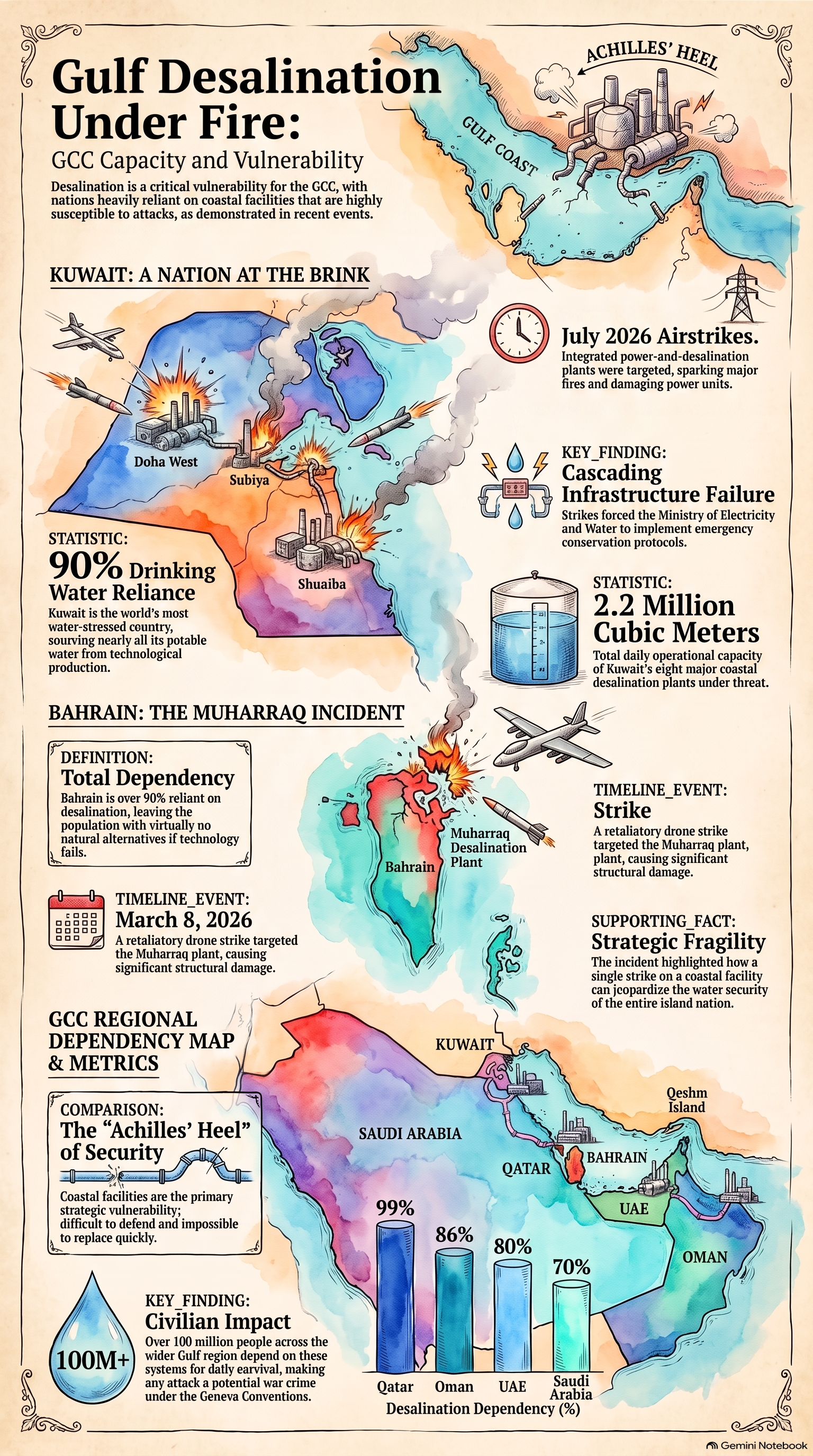
The approximately 400 plants in the Gulf states, which are mainly powered by oil and gas, produce about 40 percent of the world’s desalinated water. Bahrain is estimated to generate the majority of its drinking water from such plants.
News Briefs
The US Strategic Petroleum Reserve fell below 300 million barrels for the first time since 1983 on Monday, as Brent crude prices spiked after Middle East negotiations stalled. Washington has leaned heavily on reserves since the US-Iran war began, raising concerns about depletion. Meanwhile, China has been able to turn its own appetite for crude imports on and off with little noticeable effect on growth: “We don’t really know how they did that,” Bloomberg’s Javier Blas told Columbia Energy Exchange, adding that China, more than any other country, is “really truly… embracing all of the above,” leading in both emissions and green energy. Beijing’s ability to control oil prices is now unrivaled, The Economist argued, suggesting “China is the new OPEC.” - Semafor
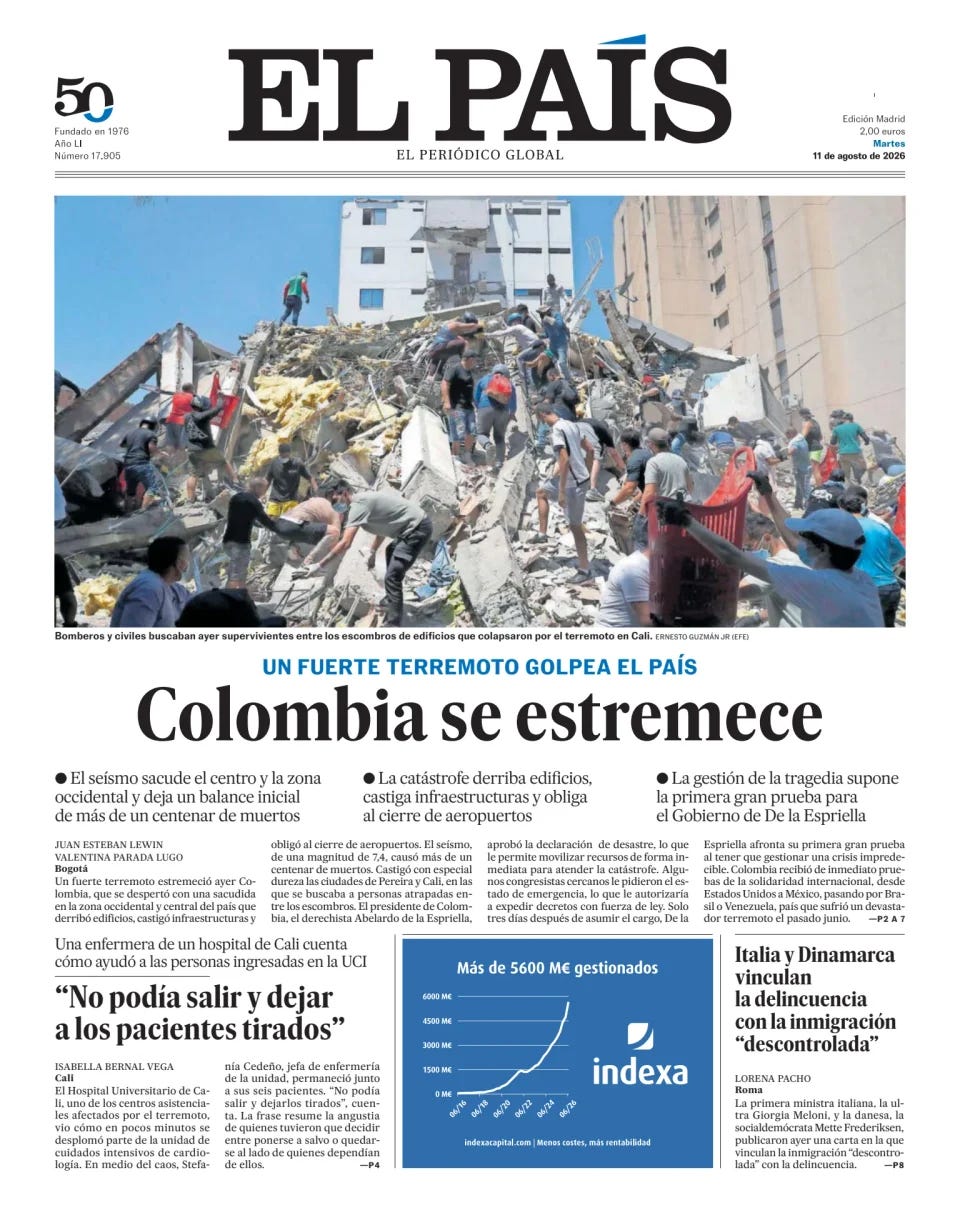
A powerful magnitude 7.4 earthquake struck western Colombia on Monday morning, killing at least two people and causing significant damage across the country, with buildings collapsing in several cities and a tower of the historic cathedral in Manizales partially collapsing. The earthquake struck at 7:34 a.m. local time, with its epicenter near San José del Palmar in the department of Chocó, according to the Colombia Geological Service (SGC). The quake was initially registered at a lower magnitude before being revised upward to 7.4. Its depth was reported at roughly 100 kilometers. The tremor was felt strongly across much of Colombia, including the coffee-growing cities of Pereira, Manizales and Armenia, as well as Medellín, Colombia’s second-largest city. In Cali, dust clouds were reported rising over the departmental capital of Valle del Cauca, as multiple buildings collapsed. The shaking was also felt in high-altitude Bogotá, and as far away as neighboring Panama, Ecuador and Venezuela. The earthquake is the strongest recorded in Colombia in a decade, according to the SGC. The agency’s earthquake record identifies San José del Palmar as the epicentral location. The scale of the shaking revived memories of Colombia’s devastating 1999 Eje Cafetero earthquake, which struck the coffee-growing region on January 25 of that year. The magnitude 6.2 earthquake devastated Armenia and surrounding areas, killing approximately 1,185 people, injuring thousands and leaving hundreds of thousands affected. Monday’s earthquake, however, struck at a considerably greater depth than the 1999 disaster, potentially limiting some of the damage that might otherwise have resulted from a shallow earthquake of similar magnitude. Recently inaugurated President Abelardo de la Espriella said he was overseeing the national emergency response and was expected to travel to Pereira as authorities coordinated rescue and recovery operations. Emergency agencies continued to assess damage across the affected departments as reports of collapsed structures and trapped residents emerged. The death toll and extent of the damage are expected to rise as rescue crews reach affected areas and communications were restored. As of midday on Monday, 74 persons have been confirmed dead across the region, including 19 in the southern city of Cali - The City Paper, Bogota
Russia’s Supreme Court on Monday canceled the registration of the liberal Yabloko party’s federal slate of candidates for next month’s State Duma elections. In a high-stakes hearing, the court granted a lawsuit filed by the small nationalist party Rodina, which accused Yabloko of receiving foreign funding, violating copyright law and promoting “extremism.” The ruling removes Russia’s oldest liberal party — and what was the only registered party campaigning on a pro-peace platform — from the nationwide party-list ballot. Yabloko chairman Nikolai Rybakov said the party would appeal the ruling within the five-day deadline and that it would do everything possible to take part in the election. Rybakov told supporters outside the court that he could see how many people wanted peace and an end to the loss of life, in a reference to the war in Ukraine. Hundreds of people had gathered outside the Supreme Court in Moscow on Monday morning to support Yabloko. The party estimated that around 500 people had lined up to enter the building, though the courtroom had space for only 150. Supporters responded to the ruling with chants of “Shame! Shame!” as law enforcement prepared to disperse the crowd. “You have two minutes to leave. No one will come to get you out of the military enlistment offices afterward,” a police officer warned through a loudspeaker in footage published by the RusNews media outlet - Moscow Times
Ukraine’s European backers are combing their own arsenals and each other’s for Patriot interceptors ahead of an expected Russian winter offensive against the power grid, and are running into a hard floor: most say they have almost nothing left they can safely give away, POLITICO reports. The numbers explain the panic. Ukrainian air defence stopped 29 of 195 Russian ballistic missiles in July, according to Kyiv’s defence ministry — a roughly 15 percent intercept rate, with another 40 failing on their own. Former defence minister Mykhailo Fedorov said Russia now fires more missiles in a week than partners supply in months. Germany has handed over five Patriot systems, three from Bundeswehr stocks and two under a US replenishment arrangement, and a senior defence ministry official, Brig. Gen. Jürgen Schrödl, told a Berlin panel that Berlin is “really reaching our limits.” Poland released PAC-3 rounds after appeals from NATO Secretary-General Mark Rutte and US commanders — five missiles, per Defence24 — and took a domestic political beating for it. Attention has now turned south, to Spain and Greece; Greek media report Kyiv asked Athens for up to 200 older PAC-2s. Neither defence ministry answered POLITICO’s questions. Washington is the bottleneck. Trump’s Ankara offer of a Patriot production licence has been walked back — the technology is a hard thing to give away, he now says — and after a Reuters report that the Iran war had nearly exhausted American long-range precision stocks, he answered Zelensky’s appeals bluntly: “We want missiles too.” Ukraine’s own Freyja interceptor is not ready, and German-built PAC-2s are unlikely before next year. Foreign Minister Andrii Sybiha’s summary: “We are literally fighting for every missile.” Reporting by POLITICO Europe.
“They will be taken over”
The line to note in the ABC’s Foreign Correspondent dispatch from Pag-asa isn’t the coast guard shadowing — it’s Victor Gao. The Center for China and Globalisation vice-president, one of Beijing’s most-used English-language voices, told the ABC that any Filipino expecting security west of 118 degrees east longitude is indulging a fantasy, and that those islands “will be taken over.” Asked about the fewer than 100 families living there under nightly Chinese spotlights, he said they should “go back to where [they] belong.”
Serving officials say the Philippines occupies Zhongye Dao illegally. They don’t say when, or tell residents to leave.
Two things make it more than bluster. Gao grounded the claim in the 1898 Treaty of Paris and post-war Japanese forfeiture rather than the nine-dash line — shifting the fight from maritime entitlements, where the 2016 Hague award went against Beijing, to the Philippines’ western frontier itself. And he aimed it at Pag-asa, which sits outside the Philippine EEZ with sovereignty never formally settled: the one feature where Manila has the least legal cover.
Defence Secretary Gilberto Teodoro’s reply travels well beyond Asia. He called China’s conduct “irresponsible, escalatory and provocative” and said appeasement doesn’t work.
Watch: whether Beijing’s foreign ministry disowns Gao. It won’t. That’s how a position gets tested before it’s adopted.
Four Singaporeans worked for years as personal assistants and company directors inside the corporate structure of Chen Zhi’s Prince Holding Group, flying on private jets and fronting firms later named in US sanctions, according to a six-month investigation by The Straits Times. The reporters combed hundreds of pages of records to identify Alfred Law Hon Kit, Ryan Lee Chee Keong, Jason Teo Jing Shen and Alex Lim Zhongliang, all of whom took up roles from 2017 with entities tied to the Cambodian tycoon whose conglomerate US Treasury describes as the front for a multibillion-dollar criminal syndicate. Law, Lee and Teo told ST they had no knowledge of criminal activity and cut ties once Washington moved in October 2025; Lim could not be reached. The detail that matters is how ordinary the recruitment was. Law was approached by a client who became his boss; he was then instructed to hire further assistants and brought in Lee. Teo met his eventual employer at a Singapore bar and was offered a partnership over drinks, on the strength of the man’s “guan xi” with people in financial institutions. Lim’s employment contract, obtained by ST, put him on S$8,000 a month keeping Chen Zhi’s schedule and providing “lifestyle support” to the family. Lee and Teo appear on the manifest of an April 2019 flight from Singapore to Palau alongside the syndicate’s senior figures, aboard a jet belonging to the man US authorities call Chen Zhi’s second-in-command. Reported by The Straits Times.
Donald Trump appeared to go back to his “normal” hairstyle on Monday after a week of various looks. Trump, 80, held an afternoon event in the Oval Office to sign an executive order on childhood vaccines. When he wasn’t seemingly struggling to stay awake, he made wildly exaggerated and unsafe claims about vaccines, like how “they have a vaccination that looks like the size of a bottle of soda poured into a little child’s body, and bad things happen in... too many cases.” While he had plenty to say about vaccines, Trump made no mention of his hair. Last Wednesday, the president’s appearance in Las Vegas led to chatter about whether he was wearing a wig. A day later, his hair looked like it had volume again, but on Friday it seemed to be a shade darker. According to Trump biographer Michael Wolff, Trump uses elaborate styling tricks to conceal his bald spot. “I can tell you what’s... under Donald Trump’s hair,” Wolff said last week on the Daily Beast’s Inside Trump’s Head Podcast. “Nothing.” In his 2018 book about the Trump administration, Fire and Fury, Wolff wrote that the president’s daughter, Ivanka, “often described the mechanics behind [her father’s head] to friends: an absolutely clean pate—a contained island after scalp reduction surgery—surrounded by a furry circle of hair around the sides and front, from which all ends are drawn up to meet in the center and then swept back and secured by a stiffening spray.” During his first term in office, Trump’s medical reports listed hair-loss drug Propecia. But since his inauguration in January 2025, the drug hasn’t appeared in any publicly released records - The Daily Beast
The journals…