Berlin’s timing could not be worse for Tatiana Navka.
On 1 September, German Interior Minister Alexander Dobrindt said police work and intelligence findings had established Russian responsibility for the attempted drone attack on Leipzig/Halle Airport. More than just an airfield, it is one of the handful of hubs that keeps NATO airlift and Western munitions moving toward Ukraine. Germany raised its threat level, ordered the Russian consulate in Bonn shut by the end of this week, and terminated the lease on the Russian House in Berlin. German media report that the alleged perpetrator entered the Schengen zone on a tourist visa issued by the Italian embassy in Belarus. Within forty-eight hours, Berlin was pressing its EU partners to cut the number of tourist visas going to Russian citizens.
But if Berlin is trying to close the door, Brussels has suddenly developed doubts about who should remain outside it.
On Monday, EU ambassadors failed to agree on the routine renewal of sanctions against roughly 2,600 Russian-linked individuals and entities. France joined Slovakia in demanding that Russian-Uzbek billionaire Alisher Usmanov be removed from the list, forcing the bloc into an extraordinary seven-day extension until 22 September while negotiations continue. Paris has cited a “national security” concern; European officials say France is seeking the release of French nationals detained in Azerbaijan.
That is the unpredictable political weather into which Navka has sailed her lawsuit.
Two million for the insult

On 27 July, filings on the EU’s EUR-Lex portal revealed that Navka - Olympic ice-dance champion, born in Soviet Ukraine, wife of Kremlin spokesman Dmitry Peskov - had gone to the EU General Court to have her June 2022 sanctions listing annulled. She argues the Council never established a sufficient link between her and the war. She has also invoked human dignity and respect for family life.
She wants a bit of compensation too: just over €2 million.
Here is the part worth pausing on. The material loss she claims is roughly €135,000. The remaining €1.9 million is for reputational and other non-material harm. Ninety-three percent of the suit is for the injury of being named.
A parallel case runs alongside it: Yekaterina Ignatova, wife of Sergei Chemezov, who runs Rostec - the state conglomerate that builds the weapons being fired at Ukrainian cities.
She may well win something. It is unlikely to matter. When the Court annulled the listing of Yevgeny Prigozhin's mother in 2023, it ruled that a family relationship alone was not enough. The Council subsequently tightened and redrafted its grounds in cases it wanted to preserve. Petr Aven and Mikhail Fridman won annulment of their earlier listings in 2024 and remain sanctioned today. Winning one round in Luxembourg does not necessarily get your name off the list.
As for the money: on September 9, the same court dismissed Roman Abramovich's latest challenge to his EU sanctions, including his claim for compensation for non-material harm. Nothing paid.
What her own feed shows

World Briefing commissioned a review of the public social media of Navka and her family since the listing. We combed through the social feeds of Navka, those of her immediate circle and Ignatova. What we found does not describe a woman in retreat.
She is promoting the world premiere of a large ice show, Orpheus and Euridice. Running from mid-December at Megasport, one of Moscow's biggest arenas - commercial spectacle at the top of the Russian entertainment market, an odd look for someone claiming her earning power has been ruined. Her Instagram feed also doubles as an enthusiastic catalogue of domestic and curated international travel. From an Altai ski resort she insisted to her 1.3-million fans that her praise was “not advertising” but her “sincere opinion,” marvelling at the slopes and lifts. She even assured followers that the images were real, not AI. In June, she posted from Murmansk and Kirovsk in the Arctic, praising domestic tourism and crediting the governor by name. A sanctioned public figure converting her own travel restrictions into patriotic content.
The comment threads were less obliging. Followers spent them identifying the Western luxury labels in her outfits. Comments have since been limited.
But the sharpest finding is a pattern across three women in one blended family. Navka geotags precisely and captions warmly - but only inside Russia, almost always with a patriotic frame. Abroad, she becomes more careful. A May post shows her travelling with family in Emirates business class, saying only that they were “going home.” The destination isn't identified, but one thing is certain: it wasn't a domestic Russian flight.
Elizaveta Peskova, Peskov's sanctioned daughter from his first marriage, is more circumspect with her 212k followers - but not grounded. In July 2025 she posted from Istanbul, calling it a “weekend getaway in the most romantic city in the world.” Turkey is outside the EU and Schengen area, so the trip was perfectly compatible with her sanctions.

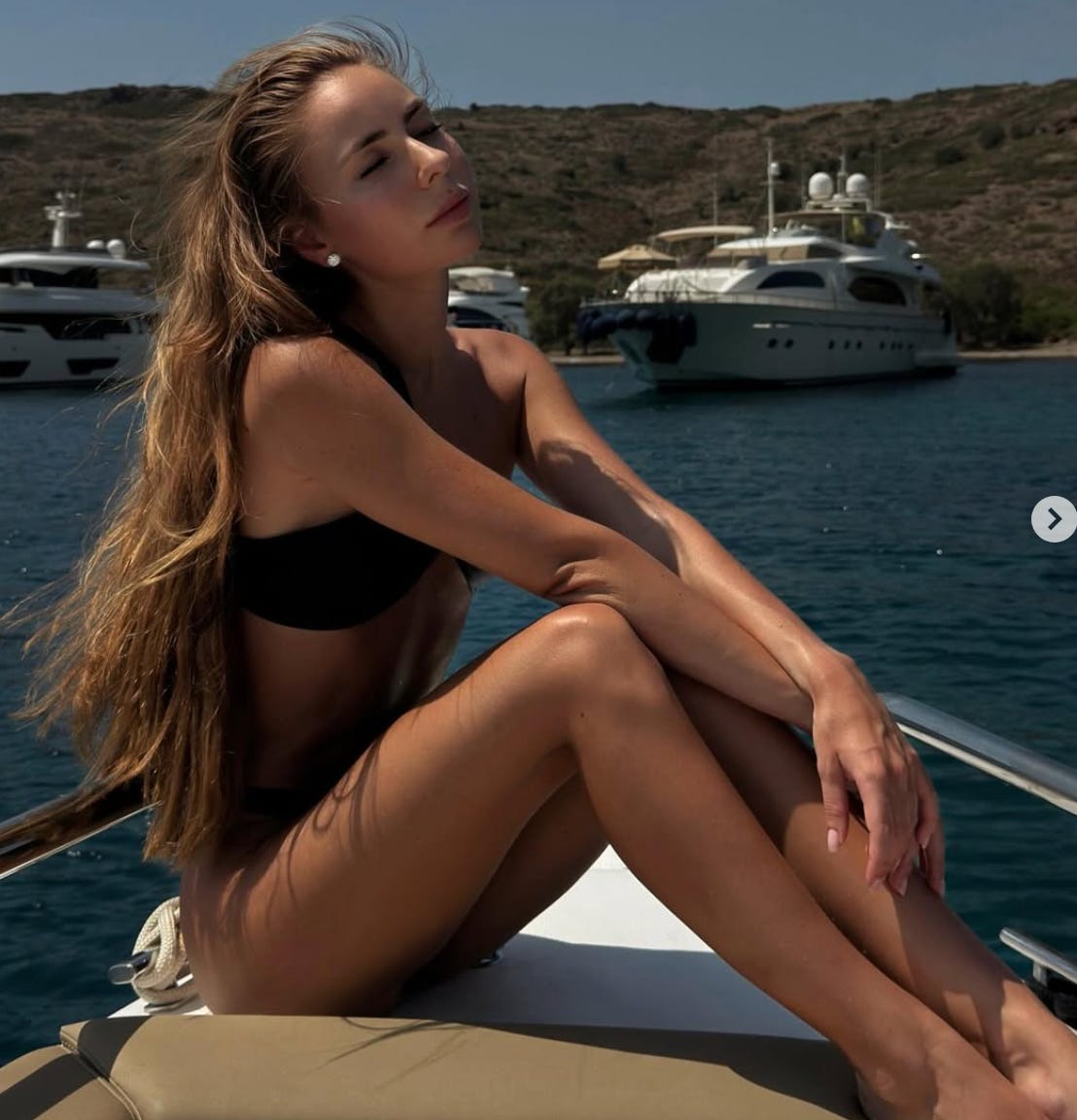
Alexandra Zhulina - Navka’s adult daughter, who is not listed - has fewer reasons for discretion: Rome in September 2025, the Burj Al Arab in Dubai in May 2025, barely a caption. Her IG stories come to us from London, China, southern France, Italy and Greece.
Nothing here is a breach. Zhulina is not listed and her travel is lawful. That is precisely why the contrast is legible: sanctions status changes what members of the same household will document in public, even when the lifestyle does not change much at all.
Moscow’s own witness
The Dubai entry is the one to sit with, because the Russian government has conceded the point. On August 30, the head of the foreign ministry’s consular department told RIA Novosti that Europe was shooting itself in the foot with visa curbs, since Russian tourist spending has simply relocated to Turkey, the UAE and Southeast Asia (Phuket and Pattaya being huge draws).
Set that beside a €2 million claim for reputational suffering and the two positions collapse into each other. Either the sanctions cost these families something real, in which case Moscow’s talking point is false - or the money moved to Dubai, in which case the damages claim is theatre.
And the map is narrowing from the other direction too. Ukrainian long-range drones have made Russian airspace genuinely unreliable: closures, ground stops and diversions are now routine for exactly the class of Russian who used to weekend in Europe. Europe is closing the door by policy. Ukraine is closing the ceiling by drone. What remains is Dubai, Antalya, Bangkok - and a great deal of Murmansk.
The irony, stated plainly
The propaganda ecosystem these families sit at the centre of has spent four years teaching Russians that Europe is decadent, hostile and finished. Peskov’s own briefings are the metronome of that message.
And yet it is Europe his wife has gone to court to get back into, Europe’s judges she is asking to vindicate her, Europe’s guarantees of dignity and family life she is invoking, and Europe’s taxpayers she wants to write the cheque. The West is a moral wasteland in the morning broadcast and a shopping destination by the afternoon.
The court may even rule in her favour. What it cannot do is hand back the Europe she is asking for. The family’s own social-media map tells that story well enough: Murmansk for the sanctioned mother, Dubai and Rome for the unsanctioned daughter - and a €2 million lawsuit in Luxembourg trying to reopen the door.
With reporting files from Enzokuhle Jojo in Cape Town
News Briefs
Denmark has summoned Russia’s ambassador after accusing a Russian frigate of firing flares toward a Danish military helicopter in international waters on Monday, narrowly missing the aircraft. The Fennec military helicopter was on a routine mission to photograph the Russian frigate, Danish military officials said in a statement late Monday. One of the flares — pyrotechnics usually used as a warning signal at sea — passed close to the helicopter. Prime Minister Mette Frederiksen said the incident was serious but not surprising, describing it as part of a pattern in which Russia has intensified its so-called hybrid campaign against the European Union and NATO. “Russia wants to sow fear and discord. Our answer is to stand closer together and strengthen the defense of Denmark and Europe,” Frederiksen said. Foreign Minister Lars Løkke Rasmussen said he had summoned Russia‘s ambassador to Denmark for a meeting. The Danish straits are the main sea route in and out of the Baltic Sea for commercial and military shipping. They are also a major artery for global oil shipments, including from Russia‘s so-called “shadow fleet” of oil tankers used to circumvent Western sanctions - Moscow Times
A NATO fighter jet shot down a drone carrying an explosive device after it entered Lithuanian airspace early on September 15, Lithuanian authorities said, as a series of incidents involving Russia and NATO members raised fresh concerns about the spillover of the war in Ukraine. Lithuanian Defense Minister Robertas Kaunas said an explosive device was detected on the drone and that it was neutralized by bomb-disposal experts. The drone came from neighboring Belarus and was heading west, according to preliminary data from Lithuania’s National Crisis Management Centre cited by Lithuanian public broadcaster LRT. Lithuanian authorities said an alert had been issued earlier in the capital, Vilnius, and the surrounding region after the drone entered the country’s airspace - RFE/RL
Russia’s Foreign Ministry on Tuesday once again urged foreign embassies in Kyiv to evacuate following a Russian strike on a passenger train near the Polish border shortly after European diplomats used the same rail track. Foreign Ministry spokeswoman Maria Zakharova said the warning, first issued this spring, “remains relevant” despite occasional diplomatic requests to grant Western “political tourists” safe passage into Ukraine. “Western politicians and diplomats should make a sober assessment of the existing risks,” Zakharova said in response to a question about Sunday’s attack on a passenger train around 2 kilometers (1.2 miles) from the Polish border. The rail track that was attacked had been used minutes earlier by another train carrying a group including former British prime minister Boris Johnson and former Swedish prime minister Carl Bildt - Moscow Times
The Trump administration is redirecting $52 million in military aid from countries in Europe and the Middle East to help back US-aligned governments in the Americas. The US State Department notified Congress on Tuesday that it would divert the funds from Iraq, Tunisia and NATO members Slovakia and North Macedonia to Colombia, Ecuador, Peru and Panama. The US State Department said the funding would go towards combatting “narcoterrorism in our backyard” and helping “continue to secure the Panama Canal,” adding that it would “prevent adversaries from establishing strategic footholds in our hemisphere.” The impacted countries are still expected to receive some assistance despite the change, although the exact amount is unclear. Trump has increasingly turned his attention to the Americas since his return to the White House in January 2025, carrying out strikes on alleged drug-trafficking boats coming from the region and launching an operation to capture former Venezuelan leader Nicolás Maduro. He has also sought to gain access to Venezuela’s oil industry - striking a major oil deal with Caracas in August. But Trump has also worked to deepen relations with governments he considers aligned to his goals as he looks to build the US’ presence in the region - Euronews
Average diesel prices in the United States struck a record high of just under $6.27 a gallon Tuesday, pressuring President Donald Trump ahead of midterm congressional elections. Diesel prices have soared as Washington's war with Iran disrupts the world's flow of fuel, though Trump has repeatedly downplayed the effects of the war, pinning the blame on Kyiv instead for its attacks on Russian oil refineries - France 24
A Democratically controlled city on the shores of Lake Erie is trolling Donald Trump by renaming its territorial waters “the Gulf of Cleveland.” Ohio’s largest city’s council members voted 13 to one for the new name, which will affect 18.5 miles of waters off the smallest of the Great Lakes. The city council made the move in a jab at Trump’s own efforts to rename geographical features across the country. On his first day in office, Trump signed an executive order renaming the Gulf of Mexico and Denali as the “Gulf of America” and “Mount McKinley.” In August, he moved to rename Lake Ontario “Lake America,” to which tech giants Apple and Google bowed. Earlier this month, the president also floated the idea of rebranding New Mexico as “New America”, then drifted offshore by demanding a rebrand of the Strait of Hormuz. Cleveland will now formally refer to the lake as the Gulf of Cleveland in all official communications - The Daily Beast
The journals…