

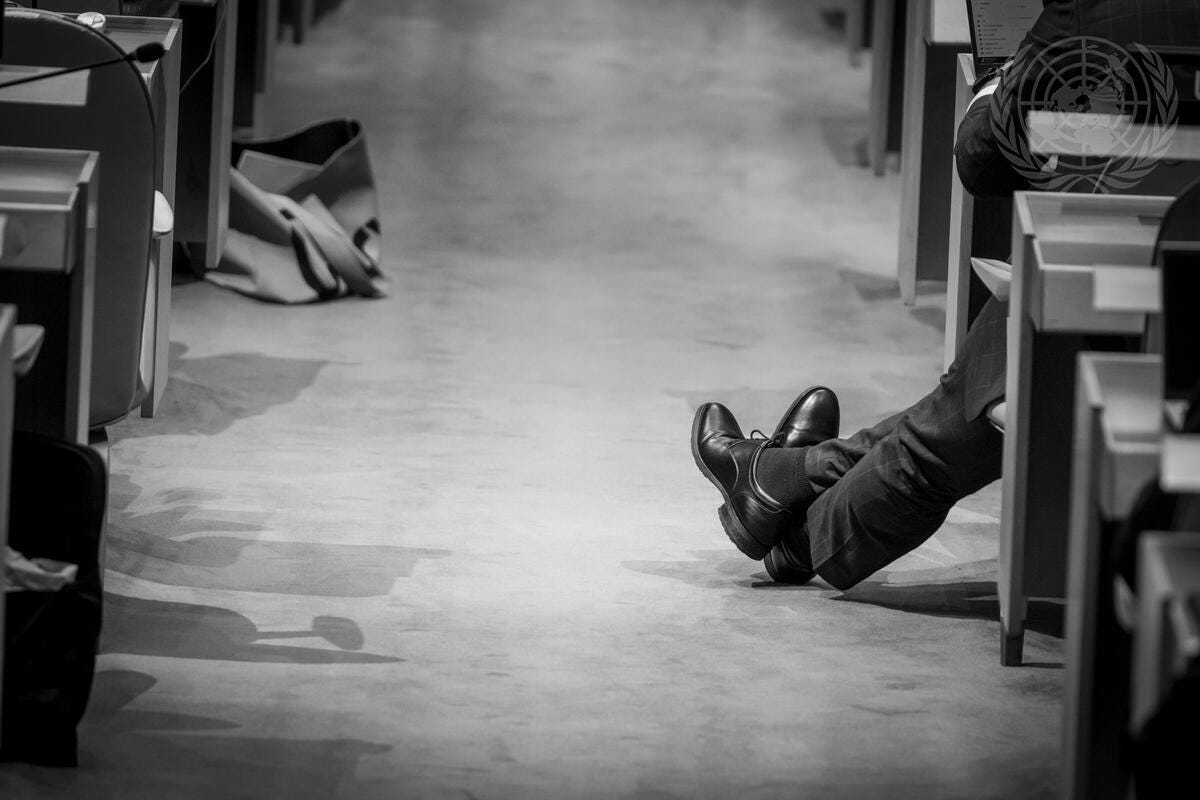
Good morning from New York, where UN Week is winding down.
On Thursday night at Tavern on the Green, I made an argument that some people in the room may not have wanted to hear: the United Nations has no hard power, and it isn’t making full use of the one power it does have. Its strength is convening, getting the world into one room. But I’ve worked inside the system, at UNICEF and the WHO, and too often that room produces watered-down statements, aggressors who go unnamed, and reforms that crawl along while the crises speed up.
Russia and China aren’t the only ones pressuring member states to vote their way. The United States does it too. There is real rot and plenty of fat. Reform is happening, but not nearly fast enough, and that failure costs the world as well as the UN.
The video below lays out that case, with examples from my years on the inside. I also offer an update on the rapidly deteriorating situation in Ukraine.
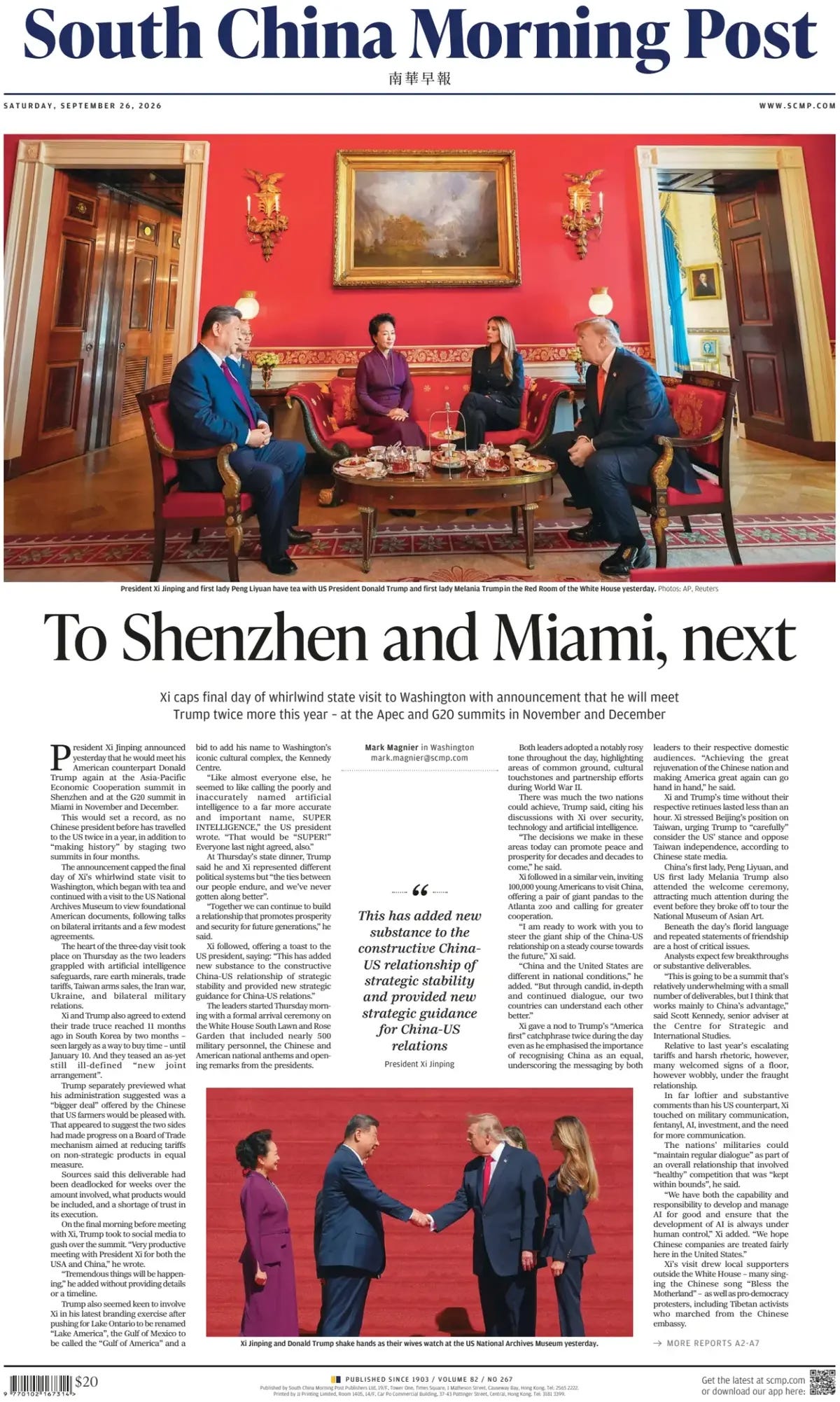
Below it, the news from beyond the UNGA bubble shows why this matters. Trump offered Xi pandas and pageantry but made little progress on substance. Putin has been invited to the G20 in Miami. Russia’s Duma now includes war veterans accused of war crimes. And overnight, a Russian drone strike killed a 14-year-old boy in Kyiv. There is some good news: the EU has finally released €6.6 billion in military aid for Ukraine after a Hungarian veto held it up for years.
Our on-the-ground UNGA coverage is made possible by paid subscribers. If you value independent reporting from inside the rooms where these decisions get made, please consider upgrading to World Briefing Plus. You’ll get exclusive Saturday video briefings and support this work directly. For a limited time, annual subscriptions are 30% off:
👉 Get 30% off World Briefing Plus
Israeli Prime Minister Benjamin Netanyahu defended the Iran war and railed against Israel’s critics in a UN General Assembly speech Thursday that showcased the country’s growing isolation. Hundreds of diplomats filed out as Netanyahu approached the lectern from where leaders of France, Brazil, and the UK assailed Israel this week. Facing an uphill re-election, Netanyahu’s talking points were tailored to an Israeli audience “for his political survival,” an Atlantic Council expert said. The “campaign speech” may have worked had Netanyahu managed to secure meetings with major world leaders, including the US president, Israel’s former US ambassador said. Netanyahu also neglected to reach out to Abraham Accords partners, an expert noted, instead using the platform to criticize New York City’s mayor - Semafor
Beyond the UNGA
US President Donald Trump and Chinese leader Xi Jinping were set to conclude a superpower summit that was long on ceremony and short on substance. The pair made minor concessions on trade, Beijing pledged more student visas, and Xi said two pandas would soon arrive at a zoo in Atlanta. Yet little progress was made on the most pressing issues, including AI regulation, China’s opposition to American support for Taiwan, or Beijing’s reported support for Iran. If anything, the pageantry irked Trump’s fellow Republicans, who noted he campaigned on constraining China. The contrast to the White House’s treatment of a key ally, Japan — whose leader arrived on an empty tarmac then faced pressure over her country’s currency — was stark - Semafor
Russia’s ruling party, United Russia, won a record number of seats in the lower-house State Duma, election officials announced Friday in confirming the final results of the country’s first wartime parliamentary elections, an outcome that was all but predetermined in Russia’s tightly controlled political system, where true opposition had been barred from the ballot and public criticism of the war remains illegal. Central Election Commission (CEC) Chairwoman Ella Pamfilova said United Russia received 349 seats in the 450-seat State Duma, beating its previous record of 343 seats set in 2016. Nominally opposition parties captured the remaining seats, led by the Communist Party with 37, the Liberal Democratic Party with 23, New People with 19 and A Just Russia with 17. Pamfilova also said that, for the first time ever, Ukraine war veterans who ran for political office won 46 seats. President Vladimir Putin has repeatedly hailed veterans-turned-politicians as Russia’s “new elite.” The Kremlin welcomed their electoral victory. “This is excellent. The experience of our heroes is in high demand. The results of the vote have clearly confirmed this,” spokesman Dmitry Peskov told reports on Friday. Independent Russian media reported that several of the newly elected veteran lawmakers have been accused of committing war crimes in Ukraine - Moscow Times
The Kremlin said it appreciates an invitation from the United States for President Vladimir Putin to attend the upcoming G20 summit in Miami, Florida, and will consider whether to accept. U.S. Secretary of State Marco Rubio confirmed earlier in the day that the Trump administration had formally invited the Russian leader to the annual gathering, scheduled for December. Kremlin spokesman Dmitry Peskov said that Russia was “grateful for and appreciative of this invitation.”
“We will make a decision and work through it via diplomatic channels,” Peskov was quoted as saying by state media. Putin and U.S. President Donald Trump last met in Anchorage, Alaska, in August 2025, which marked the Russian leader’s first visit to the United States in a decade. Putin has not visited the lower 48 states since before the full-scale invasion of Ukraine.
Russia continued its pattern of relentless attacks on Kyiv overnight, killing a 14-year-old boy and injuring seven other people in a drone strike on an apartment building in the capital on September 25, Ukrainian authorities said. Russian forces also targeted the southeastern city of Zaporizhzhya and the Black Sea port city of Odesa, where officials said one man was killed and another injured. Residential and commercial buildings were damaged and rescue efforts were delayed by frequent air-raid alerts. Metals giant ArcelorMittal announced on September 25 that it is “no longer able to safely operate” its factory in Kriviy Rih, Ukraine’s largest steel plant, after a series of missile attacks over the past five weeks killed five people, injured 17 others, and caused “extensive damage to production facilities.” The Luxembourg-based company will “focus on preserving the infrastructure, so when peace finally returns, options for restarting production remain available,” it said. In Russia, officials said Ukrainian drone strikes killed two people in a car in the border region of Belgorod and one man in the Perm region, where Kyiv may have been targeting a major oil refinery as part of its campaign of attacks on Russian energy infrastructure that fuels and finances its war against Ukraine - RFE/RL
European Union countries have agreed to release a €6.6 billion programme of military aid for Ukraine that had stalled since spring 2023, when Hungary imposed a controversial veto that paralysed the initiative. The agreement at the political level was reached on Friday during a meeting of the Political and Security Committee in Brussels. The so-called European Peace Facility (EPF) was designed to partially reimburse weapons and ammunition that member states donate to Ukraine - Euronews
Saudi Arabia said it intercepted six ballistic missiles fired by Yemen’s Iran-backed Houthis, pushing oil prices up on fears the Middle East conflict could expand and intensify. Though Riyadh recently signed a mutual defense agreement with Pakistan and Türkiye, neither has been willing to deploy troops to help the kingdom, forcing Saudi Arabia to turn to European countries for assistance. The Trump administration has also failed to come to Saudi Arabia’s aid despite their long-term defense relations, a decision that risks further fraying ties between the erstwhile allies. Saudi Arabia’s de facto ruler “will not forget this,” a former senior US defense official told the Financial Times.
The journals…
dozens of small(er) countries cannot afford to maintain embassies and consulates in 150-190 nations worldwide. an original goal of the UN was to offer a year-round venue for diplomats to meet, discuss, relay information to/from home countries re foreign policy realities of other countries on the assumption that accurate information and consistent communication is good. Expectations that the UN "never does anything" are misplaced. Except for a few specific UN organizations/programs, the UN in tooto was not established as nor given the authority to be an action body, rather, as you noted - networking, information sharing, partnership development. With the advent of SM and a real upgrade in UN WebTV during past decade, has become a genuine communication boon for above mentioned small(er) countries. Until his departure in early 2025, PMU Representative, Amb. Serhiy Kyslytsia became masterful at using UN venues. His UNSC statements condeming russia's illegal invasion of Ukraine provided tight, nibble summations, some dripping with sarcasm, aimed at russia and its soviet-style representative, Nebenzya, of the war's realities, information that was then picked up by the media and in turn, sent forth into the public. Besides offering the ability for state representatives to communicate among themselves, the UN is an outward-facing PR tool for those who know how to use it. at an event two-three years ago at the PMU, former UNGA President Dennis Francis, who seemed to have had a genuinely cordial relationship with Amb. Kyslytsia - not always so common at the UN - noted to me, and I paraphrase slightly -"Ambassador Kyslytsia has reminded all of us of why we are here - not to just attend receptions, but to do our job, to be diplomats." Ukraine has benefitted during the past four-five years from the UN - not because it "does" something "action-oriented" but because it provides a public platform for Ukraine, and other smaller nations, to tell to tell their stories, consistently. Is it perfect? No. Is there waste and bloat? Sure - as is the case with many if not most bureaucracies. But the condemnations that that the UN "never does anything" or "is useless" are inaccurate since they are rooted in a misunderstanding of the basic purpose of the UN.
The first time you brought tears to my eyes. I have a friend across the street. She is from Ukraine. Two years ago she went, with her young son, to visit her Mother in Ukraine. A Grandmother that had never met her Grandson. Today, she worries about her Mother making it through the winter. She rarely smiles.
Thanks for your work with UNICEF and WHO. I agree with your claim that the UN is toothless especially with its goal of maintaining International Peace. I recall, as a young man, being proud of Canadian peacekeepers in their light blue uniforms. However, sixty-five years later the World is a much different place, The number of countries with autocratic, dictatorial leaders has increased 50% since the 1960's and even more since 1945. This has created a political environment where consensus is impossible. It's better to use funding for the other humanitarian objectives of the UN and stop fooling ourselves.