Donald Trump calls himself the “Peace President.” But this week, as he outlined his plans to capture Greenland and hijack Venezuelan oil, his real agenda became obvious. It’s not peace. It’s extortion, conquest, and theft - American writer Will Saletan
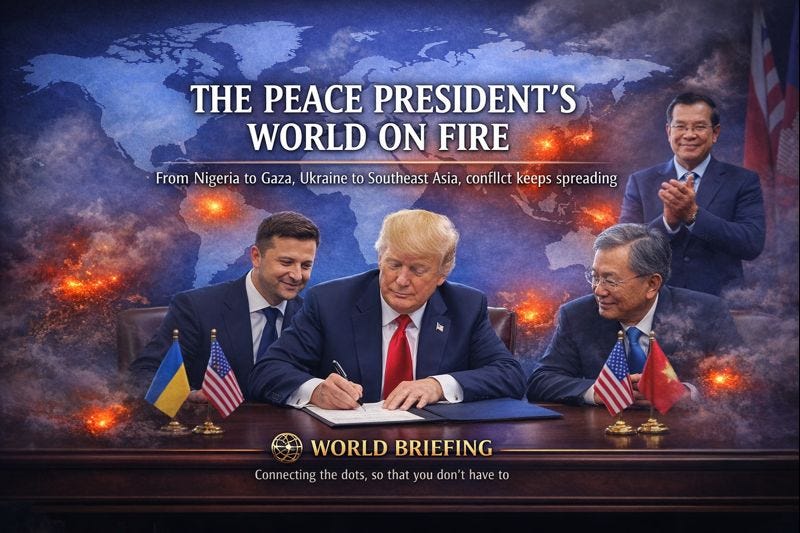
The self-styled “peace president” returned to the White House promising to quiet the world’s conflicts. Instead, the map is lighting up. U.S. forces have launched strikes against Islamic State-linked militants in north-western Nigeria, even as competing narratives emerge over who is being targeted - and why. In Southeast Asia, tensions are rising once again along the Thai-Cambodian border, a dispute Donald Trump once claimed to have resolved. Washington is also escalating military pressure off the coast of Venezuela, while its signature peace project - ending Russia’s war on Ukraine - remains stubbornly unsigned. Meanwhile, far from the battlefield headlines, the Palestinian economy is sliding into severe contraction, crushed by Gaza’s devastation, tightening restrictions in the West Bank, and a collapse in financial lifelines. For an administration that promised calm, the world feels anything but.
The US has launched strikes against militants linked to the Islamic State group (IS) in north-western Nigeria, where militants have sought to establish a foothold. Camps run by the group in Sokoto state were hit near the border with Niger, the US military said. Casualty numbers are unclear, but both US and Nigerian officials say militants were killed. US President Donald Trump said the Christmas Day strikes had been “deadly” and labelled the group “terrorist scum”, saying they had been “targeting and viciously killing, primarily, innocent Christians”. Nigerian Foreign Minister Yusuf Maitama Tuggar told the BBC it was a “joint operation” and had “nothing to do with a particular religion”. Tuggar said the strikes had been planned “for quite some time” using intelligence provided by Nigeria. He also did not rule out further strikes. Referencing the timing of strikes - which took place late on Thursday - he said they did not have “anything to do with Christmas”. The Nigerian government has long been fighting an array of jihadist groups, including Boko Haram and IS-linked factions, but largely in the north-east. But in recent years a smaller group - known locally as Lakurawa - has sought to establish a base in north-western Sokoto state. On Friday morning, the Nigerian foreign ministry said authorities were engaged in “security co-operation with international partners”, including the US. “This has led to precision hits on terrorist targets in Nigeria by air strikes in the north-west,” it said. The US military said an “initial assessment” suggested “multiple” fatalities in Sokoto state. The chairman of the Tangaza local government area, Isa Salihu Bashir, told the BBC the strikes had “hit some Lakurawa terrorist camps”. He said many fighters had been killed but could not confirm the death toll. Bashir added that border patrols on the Niger side reported seeing Lakurawa fighters fleeing the targeted areas - BBC
Mr Trump has accused IS of “targeting and viciously killing, primarily, innocent Christians.” But analysts say that the situation on the ground is far more complicated. Sokoto State, which was hit by more than 12 Tomahawk missiles Thursday night, is populated overwhelmingly by Muslims, who bear the brunt of terrorist attacks there, according to analysts and groups that monitor conflict. Bishop Matthew Hassan Kukah of Sokoto said recently that the area does “not have a problem with persecution” of Christians. And analysts are divided over the existence of ties between insurgent groups in Sokoto and the Islamic State. Some analysts say that the violent attackers in Sokoto, which are colloquially known as the Lakurawa, have links to the Islamic State’s Sahel Province branch, which is mostly farther north and west, in Mali, Niger and Burkina Faso. But other analysts say evidence of those links is inconclusive, as the identity of the Lakurawa group remains very murky. Its militants have operated in Sokoto and other Nigerian states for years, winning popularity by fighting local bandits at first and then turning on the rural population. Even as the Nigerian authorities have disputed Mr. Trump’s claims about a Christian “genocide,” they have chosen to respond to his threats by cooperating with his administration - NYT
Cambodia has accused Thai forces of carrying out “ruthless” aerial attacks against it, even as the two sides hold new talks aimed at easing their long-running border conflict. Thai fighter jets dropped dozens of bombs near the northwestern Cambodian village of Chouk Chey early on Friday morning, causing “extensive destruction to civilians’ homes, properties, and public infrastructure”, Cambodia’s state news agency cited the defence ministry as saying. Later in the morning, Thai forces also launched artillery attacks in the Stung Bot area near the border, reported the Cambodian news agency Agence Kampuchea Presse. Cambodia’s defence ministry condemned the attacks as “grave acts of aggression” that intentionally endangered “civilian lives and civilian infrastructure”. It said the attacks in Chouk Chey were “exceptionally ruthless and inhumane”. The violence marks the latest flare-up since renewed clashes broke out on December 8, derailing an expanded ceasefire brokered by the United States and Malaysia in October. Fighting this month has killed at least 96 people, according to authorities on both sides, while displacing about one million people. Defence officials from Thailand and Cambodia held their first talks since renewed clashes started, on Wednesday, though they did not appear to produce any major diplomatic breakthrough. Cambodia’s Defence Ministry spokesperson Maly Socheata said the two sides planned to continue further talks under a bilateral border committee on Friday, according to the Anadolu news agency - AJE
Volodymyr Zelenskyy is to travel to the US for a planned meeting with Donald Trump on Sunday, as Washington continues to push for a possible peace deal between Kyiv and Moscow. The Ukrainian president announced the visit on Friday in a social media post, saying he had received a briefing from Rustem Umerov, the secretary of Ukraine’s national security and defence council, on new contacts with US officials. “We are not losing a single day. We have agreed on a meeting at the highest level – with President Trump in the near future,” Zelenskyy said, adding that “a lot can be decided before the New Year”. Zelenskyy later told journalists the high-stakes meeting with Trump was planned for Sunday and would focus on Ukrainian security guarantees and reconstruction. He added that the proposed 20-point peace plan was “90% ready”. The plan is considered an updated version of an earlier 28-point document agreed several weeks ago between the US envoys and Russian officials – a proposal widely viewed as skewed towards the Kremlin’s demands. Ukraine has pushed for security guarantees modelled on Nato’s article 5 mutual defence pledge under any proposed peace deal with Russia, though it remains unclear whether Moscow would accept such terms. “Icannot say whether the meeting with President Trump on Sunday will lead to the signing of any agreements,” Zelenskyy said Washington has not publicly confirmed the meeting - The Guardian
Mr. Zelensky told Axios on Friday that he hopes to agree on a framework with President Trump for ending the war when they meet on Sunday. Zelensky also revealed he’s willing to bring that plan up for a referendum if Russia agrees to a ceasefire of at least 60 days. While Zelensky emphasized that great progress has been made, Trump’s plan still demands painful territorial concessions from Ukraine in the east. Zelensky is still hoping to improve those terms and said he’ll need to seek approval of the Ukrainian people if they can’t get to a “strong” position on territory.
Trump on his upcoming meeting with Zelenskyy on Sunday: “I think it’s going to go good with him. I think it’s going to go good with Putin,” Trump told POLITICO, adding that he expects to speak with Putin “soon, as much as I want.” On the peace plan mentioned earlier by Zelenskyy, Trump said: “He doesn’t have anything until I approve it. So we’ll see what he’s got.”
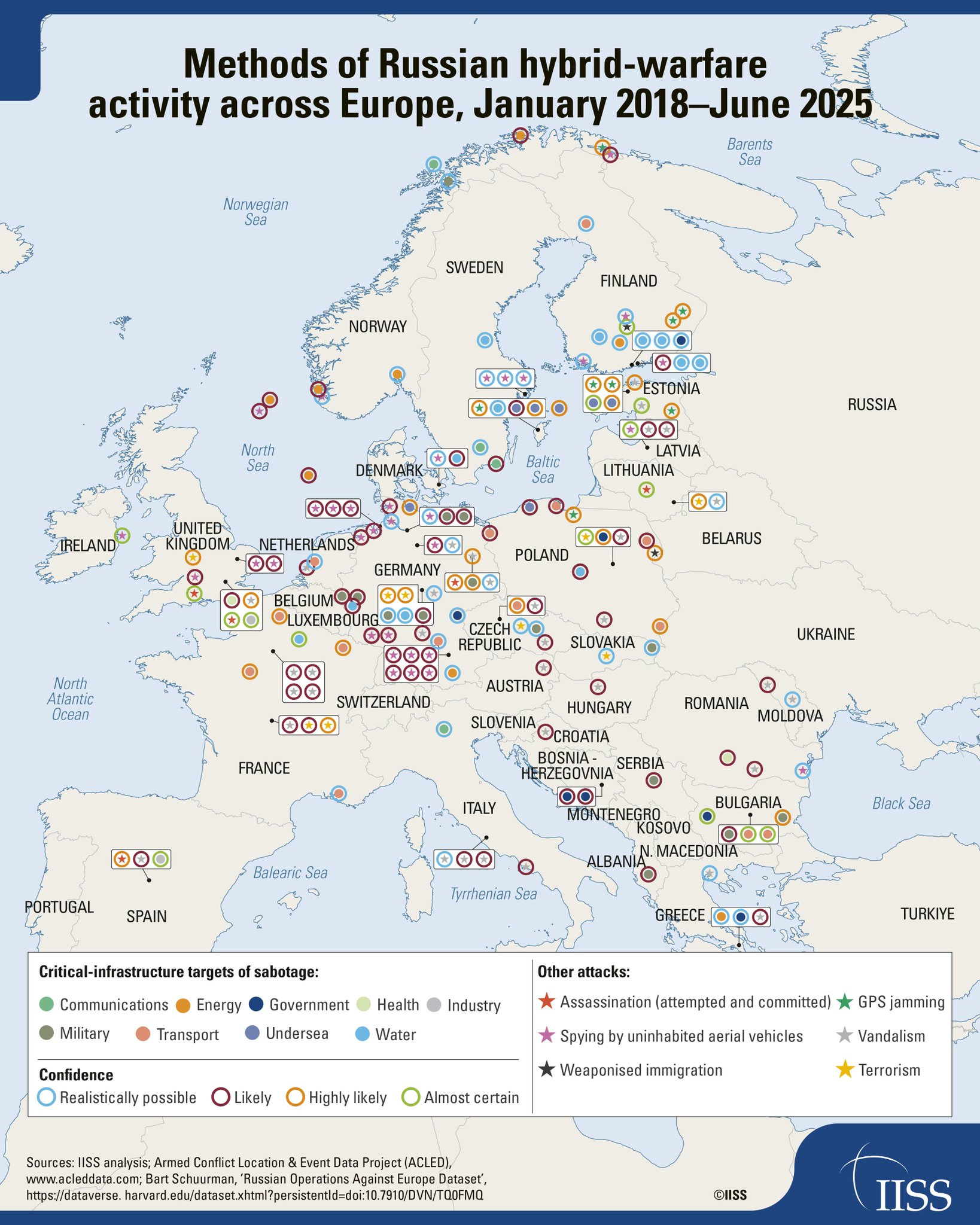
The IISS has produced the most comprehensive open-source database currently available on Russian sabotage operations across Europe and its periphery. It captures the full spectrum of activity with physical effects: from sabotage on undersea cables to GPS blocking across multiple domains and geographies. See below….
A massive cyberattack has crippled Mikord, the key developer behind Russia’s Unified Military Registry, wiping out over 40TB of infrastructure, including source code and backups. Investigative journalists have dubbed the system a “Digital GULAG.” It aggregates 300+ data points on 25 million citizens—from health records to travel history. Once an electronic summons is issued, the conscript is instantly banned from leaving the country. Ignoring it leads to a total loss of rights: no driving, no loans, no property deals. At the FSB’s request, developers built a secret “ghost mode” to untraceably delete data on officials, siloviki, and their relatives, exempting them from the draft. The breach was facilitated by sanctions (expired firewall licenses), outdated software, and negligence (staff sharing keys via messengers). This time it wasn’t Ukraine behind the hack, it was Russian hackers protesting against war and mobilization. While building this digital cage, Mikord’s CEO Ramil Gabdrakhmanov reportedly managed the project from Vienna, living in Europe to avoid mobilization himself. This breach has delayed the registry’s full deployment by months, exposing how corruption and technical debt are undermining the Kremlin’s digital war machine.
We wish all of our readers a safe, peaceful, and joyous holiday season.
Thank you for your continued support and for taking the time to read World Briefing.
In the spirit of the season of giving, we invite you to upgrade to a paid subscription to help fund our mission: independent, on-the-ground reporting and analysis at a time when much of the media is cutting back or pulling its punches.
You can also support World Briefing via our Patreon page or through PayPal. Every contribution helps us go further and tell the stories that too often go untold.

The Palestinian economy is undergoing a severe downturn, driven by Israel’s continued assault on Gaza, intensified restrictions on movement and trade in the occupied West Bank, and a sharp decline in both domestic and external financial resources. As the Palestinian government struggles to manage an escalating fiscal crisis, official data and expert assessments warn that the economy is approaching a critical threshold – one that threatens the continuity of state institutions and their ability to meet even basic obligations. A joint report by the Palestinian Central Bureau of Statistics (PCBS) and the Palestine Monetary Authority (PMA), published in the Palestinian Economic Monitor for 2025, found that the economy remained mired in deep recession throughout the year. According to the report, gross domestic product (GDP) in Gaza contracted by 84 percent in 2025 compared with 2023, while GDP in the occupied West Bank declined by 13 percent over the period. Overall GDP levels remain far below their pre-war baseline, underscoring the fragility of any potential recovery and the economy’s inability to regain productive capacity under current conditions. The report documented a near-total collapse of economic activity in Gaza, alongside sharp contractions across most sectors in the West Bank, despite a modest improvement compared with 2024. It also recorded a decline in trade volumes to and from Palestine compared with 2023, while unemployment in Gaza exceeded 77 percent during 2025 - Al Jazeera
As Ukrainian President Volodymyr Zelensky travels to Washington for another high-stakes meeting with U.S. President Donald Trump, hopes are once again being raised around a revised 20-point peace plan aimed at ending Russia’s war on Ukraine. Speaking live with Al Jazeera from Vancouver, I explained why expectations should remain low.
Donald Trump has installed an attorney and part-time beauty salon owner to decide which foreigners are allowed to enter the U.S. The State Department announced that Mora Namdar has been promoted from her post working on U.S foreign policy in the Middle East and North Africa to become assistant secretary for consular affairs, overseeing everything from passport issuance to visa approvals and revocations. Namdar, who is the daughter of Iranian immigrants, previously did the job on an interim basis during Trump’s first term in 2020. Namdar, 46, owns a mini-chain of beauty salons called Bam in her native Texas, with locations in the West Village in her hometown of Dallas, as well as in Fort Worth and Plano. She was also one of the contributors to the notorious Project 2025, which has heavily influenced Trump’s second term, writing a section about the U.S. Agency for Global Media (USAGM), according to the Columbia Journalism Review. In it, Namdar accused USAGM—the federal umbrella for U.S.-funded broadcasters including Voice of America and Radio Free Europe—of serious mismanagement, “espionage-related security risks,” and of using “anti-U.S. talking points to parrot America’s adversaries’ propaganda,” while calling for it to be reformed or closed altogether. Namdar’s Senate confirmation earlier this month now puts a politically connected operator with media experience in charge of a bureau that can effectively decide who gets to enter the United States—and who gets turned away - The Daily Beast
The journals…