🔥 World Briefing Hot Take
The Winter Games were meant to celebrate human endurance. Instead, they have exposed the limits of neutrality in a world at war.
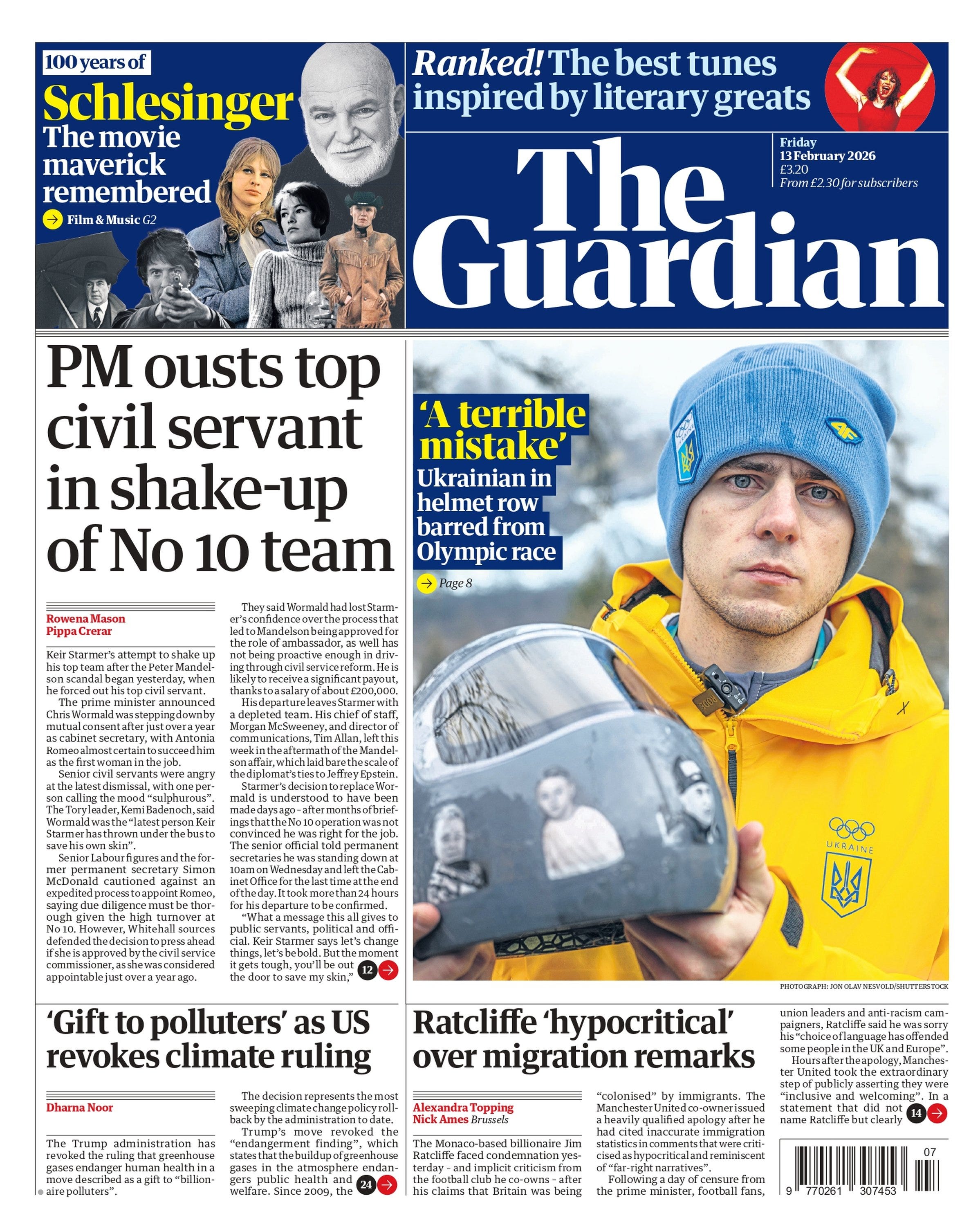
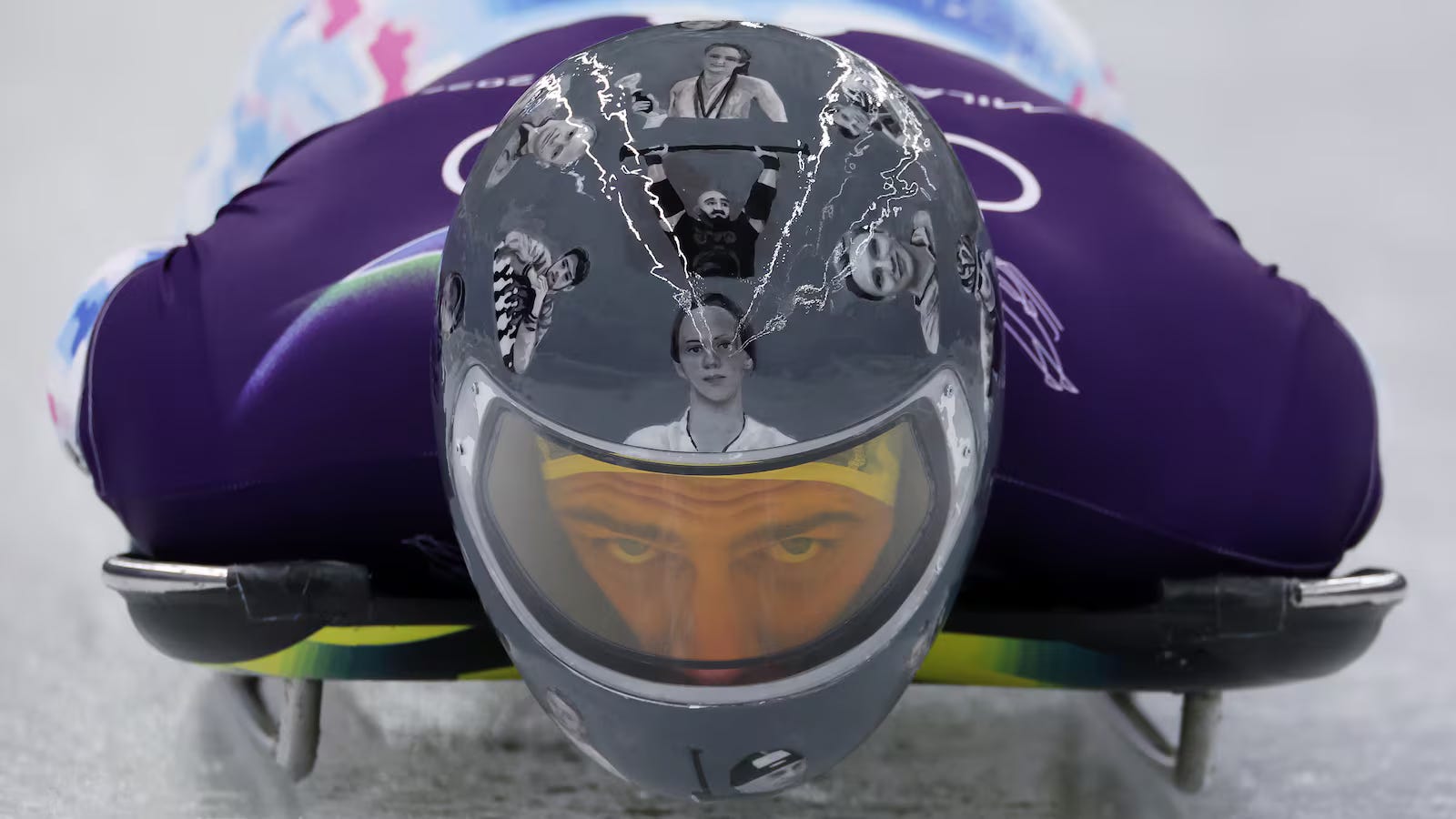
When Volodymyr Zelensky publicly condemned the International Olympic Committee for banning Ukrainian skeleton racer Vladyslav Heraskevych, it was about more than a helmet. It was about memory. Heraskevych had honored Ukrainian athletes killed in Russian attacks. The IOC said the gesture violated political neutrality.
Yet at the same Games, several Russian competitors were cleared as “Individual Neutral Athletes,” despite reported links to pro-war activity. Their vetting was conducted by a three-person IOC panel — including Japanese IOC member, Morinari Watanabe, who, according to BBC Sport, was filmed embracing a Russian gymnast sanctioned for his role in Moscow’s war effort during a visit to Moscow in March.
As one Guardian columnist put it, the IOC is caught between principle and reality: athletes do not arrive at the arena gate stripped of history, war or identity.
Or as I put it: neutrality, it seems, is being enforced unevenly.
News Briefs
Ukrainian President Volodymyr Zelensky slammed the International Olympic Committee for disqualifying fellow countryman Vladyslav Heraskevych from competing in the games. The skeleton racer was kicked from the 2026 Winter Olympics for wearing a helmet honoring Ukrainian athletes who had died from Russian attacks during the competition. Zelensky tore into the Committee on social media, saying, “Sport shouldn’t mean amnesia, and the Olympic movement should help stop wars, not play into the hands of aggressors.” The IOC does not allow any form of political demonstration, according to its founding charter. IOC President Kirsty Coventry told reporters that “The IOC was very keen for Mr Heraskevych to compete” and offered other options to the athlete, including wearing a black armband or donning the helmet immediately after the race concluded. However, Heraskevych balked at any attempts that required him to skip wearing the helmet during the race. “These athletes sacrificed their lives, and because of this sacrifice, I am able to be here, so I will not betray them.” On Thursday, the day of the race, the IOC revoked his accreditation to compete. Heraskevych said the decision left him gutted. “It’s hard to say or put into words. It’s emptiness,” he told reporters.
Booting Heraskevych from the Winter Olympics raises difficult questions about neutrality and the limits of political expression in sport. He was informed only 21 minutes before racing by the IOC president, Kirsty Coventry, who spoke to the media in tears after she could not persuade him to change his mind. For Heraskevych, the helmet was not a political statement but an act of remembrance. “Some of them were my friends,” he said of the 24 people emblazoned across the helmet, including the teenage weightlifter Alina Perehudova, the boxer Pavlo Ishchenko, the ice hockey player Oleksiy Loginov, the actor and athlete Ivan Kononenko, the diver and coach Mykyta Kozubenko, the shooter Oleksiy Khabarov and the dancer Daria Kurdel. The artwork was created by the Ukrainian artist Iryna Prots. The figures, she said, represent possibility cut short: “Each pair of eyes could be seeing this world right now, could be fighting for their own medals, could be standing on their own pedestals.” Within hours of Heraskevych’s disqualification, support surged across Ukraine. Even Ukraine’s private sector joined in: a co-founder of Monobank announced a 1 million hryvnia (£17,000) prize in recognition of the racer’s stance. The controversy has not been limited to one athlete. The Ukrainian short-track speed skater Oleh Handei revealed on Thursday that he too had been ordered to alter his helmet – this time to tape over a line from the Ukrainian poet Lina Kostenko reading: “Where there is heroism, there can be no final defeat.” Olympic officials judged the quotation to be linked to the war and therefore in violation of neutrality rules. “They saw my sentence and they said to me, ‘Sorry, but it’s war propaganda,’” Handei said, adding that he would comply so he could still compete. The IOC have been caught between principle and reality - The Guardian
Several Russian athletes approved to compete as neutrals at the Winter Olympics have links to activity supporting the war in Ukraine, according to evidence seen by BBC Sport. The International Olympic Committee has cleared 13 competitors, external from Russia to participate as Individual Neutral Athletes (AINs) in Milan-Cortina. Their eligibility was assessed by a three-person IOC panel, with athletes deemed ineligible if they were found to have actively supported the war, including through social media activity or participation in pro-war events. However, material shared with the BBC by the Molfar Intelligence Institute, external and investigative journalist Artem Khudolieiev raises questions over whether some of those approved meet the IOC’s broadly-framed criteria. Meanwhile, one member of the panel - Morinari Watanabe - was filmed embracing a Russian gymnast sanctioned for his involvement with Russia’s war effort during a visit to Moscow in March, prompting further questions about the vetting process. Heraskevych, who was also Ukraine’s flag-bearer for the opening ceremony believes the IOC should review its neutral eligibility framework. “Getting ready for competition in occupied territories, or supporting the war on social media, it is definitely not right to call them neutral because they’re not.” The IOC said it could not comment on individual cases but that the panel had “reviewed the athletes in accordance with the executive board decision and the principles it had established”.
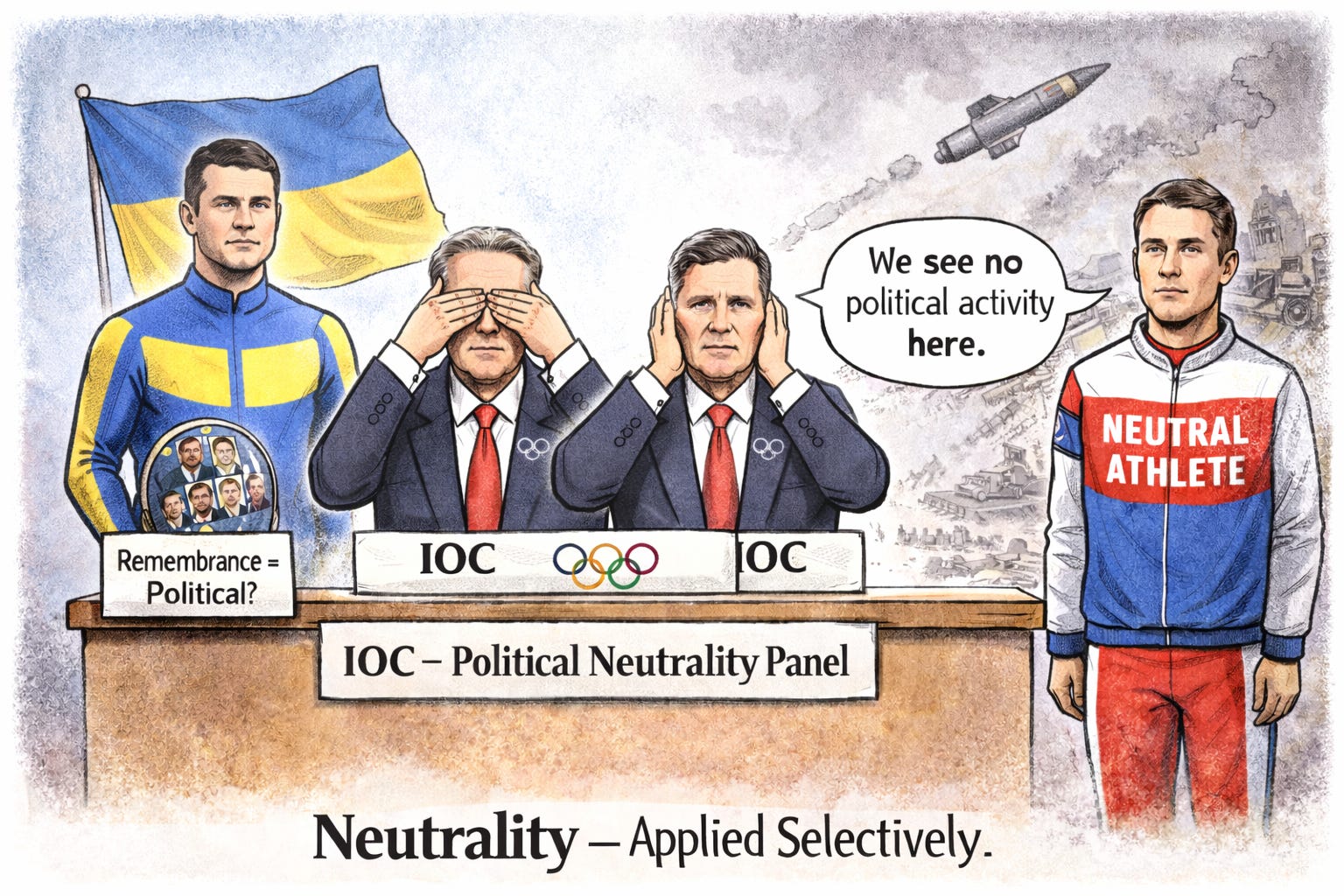
“The IOC have been caught between principle and reality. The Olympic charter demands political neutrality, yet athletes – who explicitly arrive representing countries – carry the weight of nations, wars, revolutions and memories that cannot be set aside at the arena gate” - Yara El-Shaboury, The Guardian
The Bangladesh Nationalist Party (BNP) has won a landslide a majority after the country’s landmark election. This is a huge change of fortunes for the BNP’s leader Tarique Rahman who has been in self-imposed exile in London. People were voting for a new government and also taking part in a referendum to change the constitution. This is the first election held in the country since student-led protests in 2024 ended the 15-year rule of its increasingly autocratic leader, Sheikh Hasina. As many as 1,400 protesters were killed during the uprising - with Hasina accused of having directly ordered the crackdown, an allegation she denies. Hasina’s party, the Awami League, was banned from contesting this election. Delhi, which has seen relations with Bangladesh plummet after Hasina fled there, will be watching this election anxiously - BBC
In its 2026 manifesto, the Bangladesh Nationalist Party (BNP) said it wants to turn Bangladesh into a $1tn economy by 2034. The party said it will try to grow the economy through more investment and reforms. Its plans included attracting more foreign investors, supporting small and medium-sized businesses, as well as startups. BNP leaders have also talked about upskilling workers, selling more products abroad besides garments, and improving roads, ports and transport to make it easier to move goods. The manifesto proposes “Farmer Cards” to help guarantee fair crop prices and provide subsidies, easier loans, insurance and marketing support in the agriculture sector. For poorer families, it proposes “Family Cards”, which would give cash or basic goods to help with daily living costs. The party also says government needs major reform, promising to fight corruption, strengthen the courts, and change how the civil service and police function, BBC

Defense Secretary Pete Hegseth was notably absent from the meeting at NATO headquarters, with Colby, the Pentagon’s No. 3 official, sent to represent the U.S. This marks only the second time in recent history that a Pentagon chief didn’t attend a NATO defense ministers’ meeting. In February 2024, then-Defense Secretary Lloyd Austin had to cancel his trip after being admitted to the hospital but took meetings virtually. Hegseth’s nonattendance follows Secretary of State Marco Rubio’s absence at a December gathering of NATO’s foreign ministers. The lack of top Trump administration officials at the alliance’s past two meetings, coupled with tensions between President Trump and European leaders — most recently over Trump’s demands that the U.S. control Greenland — have sparked concerns over Washington’s commitment to NATO. The United States is the backbone of NATO’s military power and accounts for more than 60 percent of the alliance’s total $1.59 trillion defense spending - The Hill
US Secretary of State Marco Rubio has arrived in Germany to attend the Munich Security Conference (MSC), saying the world is at a “defining moment.” He added: “The world is changing very fast right in front of us. The old world is gone – frankly, the world that I grew up in – and we live in a new era in geopolitics, and it’s going to require all of us to sort of reexamine what that looks like and what our role is going to be.” Rubio said he would likely meet Ukrainian President Volodymyr Zelenskyy on February 14, when Zelenskyy arrives here, although he was not “100 percent” certain the meeting would happen. Asked about ongoing Russian attacks on Ukrainian energy infrastructure, which have plunged hundreds of thousands into cold and darkness in winter, Rubio said this was why Washington was continuing its peace efforts. “People are suffering. It’s the coldest time of year. It’s unimaginable suffering,” he added - RFE/RL
Western countries increasingly believe the world is heading toward a global war, according to results from The POLITICO Poll that detail mounting public alarm about the risk and cost of a new era of conflict. Across all five countries polled — the U.S., Canada, the U.K., France and Germany — the vast majority of respondents think the world is becoming more dangerous. The outbreak of World War 3 is seen as more likely than not within the next five years by American, Canadian, French and British respondents. The share of voters predicting a new global conflict has risen sharply since independent pollsters Public First asked the question in March 2025. “The changed attitudes of the Western public in under a year reflect a dramatic move to a more insecure world, where war is seen as likely and alliances are unstable,” said Seb Wride, head of polling at Public First. But The POLITICO Poll also revealed limited willingness among the Western public to make sacrifices to pay for more military spending. While there is widespread support for increasing defense budgets in principle across the U.K., France, Germany and Canada, that support fell sharply when people learned it might mean taking on more government debt, cutting other services or raising taxes.
The Trump administration has paused several tech curbs aimed at Beijing ahead of President Donald Trump’s visit to China, Reuters reported. The shelved measures include restrictions on sales of Chinese hardware for US data centers. The move reflects Trump’s broader efforts at rapprochement with Beijing ahead of his April summit with Chinese leader Xi Jinping, where the two are reportedly poised to extend the temporary trade truce between their countries. A former Trump official told Reuters the latest actions pose a national security threat, arguing US data centers could become “remotely controlled islands of Chinese digital sovereignty.” Democratic lawmakers this week also accused the White House of sidelining national security officials focused on China’s tech threat “to avoid confronting Beijing.” - Semafor
The journals……