We talk endlessly about connectivity - connecting markets, connecting people, connecting the unconnected.
But at what cost?
At a Canada-Asia gathering today, cybersecurity specialist Jonathan Jackson of BlackBerry described a digital underworld so vast and entrenched that it has become a multi-trillion-dollar industry - spanning dating scams, money laundering networks, child exploitation rings, ransomware cartels and state-linked cybercrime.
“It’s so bad,” he told the room, “that sometimes it makes me not want to get out of bed in the morning.”
That’s not hyperbole. That’s exhaustion from someone who has spent more than two decades helping organizations across APEC and EMEA defend against evolving threats.
Just ask Ukraine: in just the first full year after Russia’s full-scale invasion in February 2022, it’s estimated that 1,100 cyberattacks and operations were linked as part of Moscow’s strategy. “It is difficult to understand the true scale of the human impact of cyber operations…(they) lend another layer of uncertainty as the impact on victims can materialize only after a time delay or may be indirect and cause harm,” said the CyberPeace Institute.
The most dangerous strain? Ransomware.
“It could bring down the infrastructure of an entire company,” Jackson warned. “It can literally bring a country to its knees.”
The chilling part: five years ago, criminals had to hack their way in.
Now?
“They don’t hack anymore,” Jackson said. “They just log in.”
Why? Because, as he put it, “we leave all of our digital junk all over the world.”
Our data trails - hotel bookings, conference check-ins, flight manifests, social posts - are digital breadcrumbs that bad actors feed on. “If they wanted to target me,” he said, “they know where I am today and where I’m going to be tomorrow.”
Governments are trying to respond. The U.S.-led International Counter Ransomware Initiative is one such effort. But coordination lags behind innovation - and cybercriminal networks move faster than bureaucracies.
In a world already destabilized by war, tariffs and geopolitical fracture, the digital battlefield may prove even more corrosive - because it is borderless, scalable and deeply personal.
Connectivity has lifted billions.
But it has also armed predators.
And the bill is coming due.
Nine people were killed and at least 25 more were injured after a mass shooting in the community of Tumbler Ridge, B.C. Canada on Tuesday. Six victims were found dead inside Tumbler Ridge Secondary School and another died on the way to the hospital. Two more people were found dead in a home, which police believed to be connected to the school shooting. The only suspect was found dead inside the school from “a self-inflicted injury.” A Grade 12 student at the school said he and his classmates were locked down for more than two hours behind barricaded doors: “It felt like I was somewhere that I had only seen across a TV.” Officers believe they have identified the shooter, but said they will “struggle” to ever determine a motive for what has become one of the deadliest school shootings in Canadian history - CBC
The fatal shootings in Tumbler Ridge came as Canada’s federal government faces hurdles in a national gun buyback program that has proved politically unpopular and a logistical quagmire. The country’s deadliest mass shooting, in Nova Scotia, precipitated the creation of the program after 23 people, including the attacker, died in April 2020. Days after that attack, Justin Trudeau, the prime minister at the time, announced a ban on 1,500 types of assault-style weapons. In the subsequent years, the federal government has gradually widened its gun reform project, announcing a freeze on handgun sales and expanding the list of firearms covered under the initial ban. By far the most contentious part of Canada’s firearms reform has been a multimillion-dollar gun buyback program targeting owners of “military-style assault rifles,” which include a wide range of long guns and rifles, like those used to hunt animals. The gun buyback has been a politically divisive issue in Canada, where firearm ownership is already strictly regulated. Handguns are the most common type of firearm used in crimes, according to federal data. In cities with higher rates of gun violence, the vast majority of firearms linked to crimes are traced back to the United States. Gun owners and lobby groups have criticized the buyback for putting an undue emphasis on rifles, which are an essential part of life in many rural areas. Some of the critics come from within Prime Minister Mark Carney’s Liberal government. Gary Anandasangaree, Canada’s public safety minister, was heard in September last year criticizing the program in a leaked audio recording, in which he said the police do not have enough resources to enforce the buyback - NYT
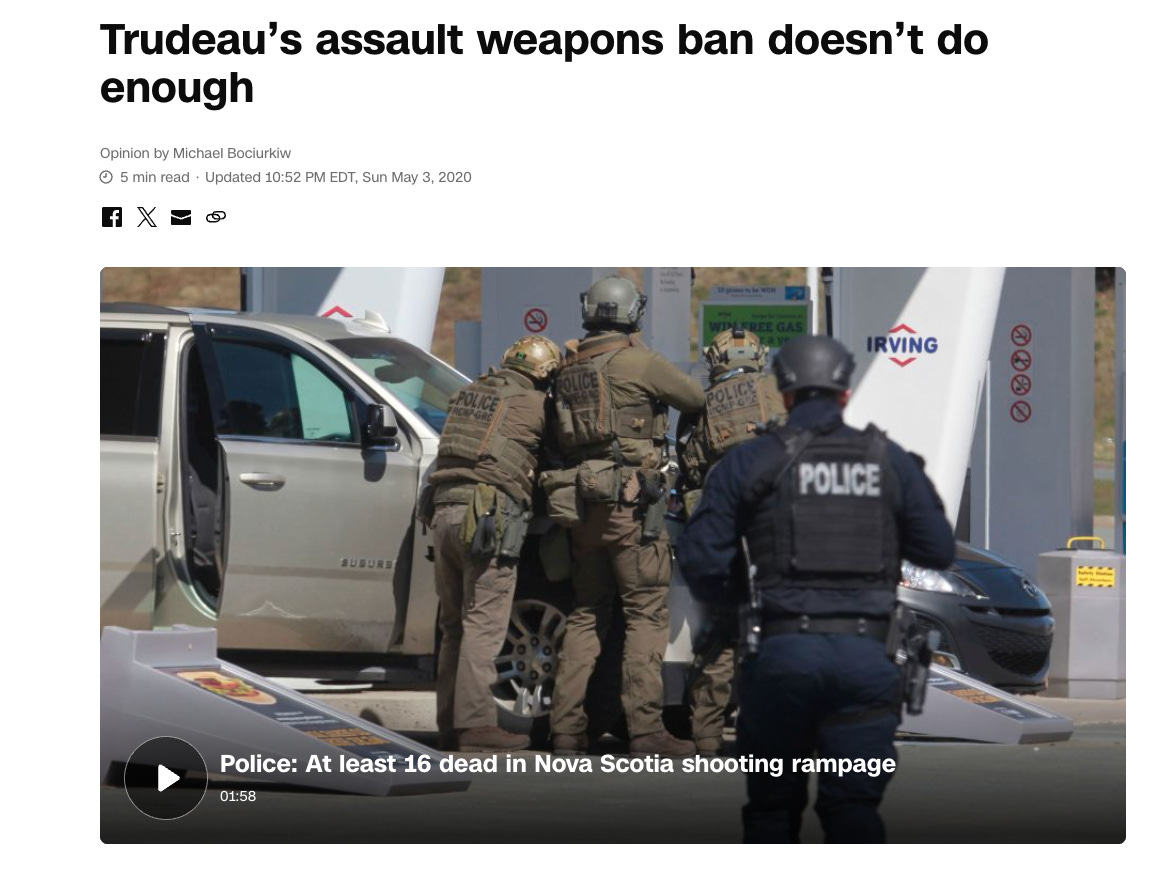
Read my CNN Opinion piece, published in May 2020: “Trudeau’s assault weapons ban doesn’t do enough.” Click here
“What is certain is that with horrific images of mass killings becoming a more familiar fixture on Canadian television screens, now is the time for bold action – especially at our shared border – to make Canadians feel safer” - from my CNN Opinion piece, May 3, 2020, published just days after the mass shooting in rural Nova Scotia that killed 22 people.
Kenya’s Foreign Minister Musalia Mudavadi said Tuesday he planned to travel to Moscow in a bid to prevent the further recruitment of Kenyans to fight for Russia in the full-scale invasion of Ukraine. “We have seen loss of lives, and I am planning to make a visit to Moscow so that we can emphasize that is something that needs to be arrested,” Mudavadi said in a statement to the media. He did not specify when the visit would take place and Moscow has not yet commented on the plans. Nairobi estimates that around 200 Kenyans have been recruited to fight for Russia, all of whom traveled from the East African country through unofficial channels. The real number is believed to be higher. Ukrainian intelligence estimates that Russia has recruited more than 1,400 people from 36 African countries into its military. Moscow has denied recruiting foreign fighters for its full-scale invasion of Ukraine - Moscow Times
Thousands of Palestinians lost loved ones who have simply “evaporated” - allegedly due to the use weapons that generate extremely high temperatures - during Israel’s war on Gaza, which has killed more than 72,000 people. According to the Al Jazeera Arabic investigation, Civil Defence teams in Gaza have documented 2,842 Palestinians who have “evaporated” since the war began in October 2023, leaving behind no remains other than blood spray or small fragments of flesh. Experts and witnesses attributed this phenomenon to Israel’s systematic use of internationally prohibited thermal and thermobaric weapons, often referred to as vacuum or aerosol bombs, capable of generating temperatures exceeding 3,500 degrees Celsius [6,332 degrees Fahrenheit]. The figure of 2,842 is not an estimate, but the result of grim forensic accounting by Gaza’s Civil Defence. Spokesperson Mahmoud Basal explained to Al Jazeera that teams use a “method of elimination” at strike sites. “We enter a targeted home and cross-reference the known number of occupants with the bodies recovered,” Basal said. “If a family tells us there were five people inside, and we only recover three intact bodies, we treat the remaining two as ‘evaporated’ only after an exhaustive search yields nothing but biological traces—blood spray on walls or small fragments like scalps,” he added. Vasily Fatigarov, a Russian military expert, explained that thermobaric weapons do not just kill; they obliterate matter. Unlike conventional explosives, these weapons disperse a cloud of fuel that ignites to create an enormous fireball and a vacuum effect. “To prolong the burning time, powders of aluminium, magnesium and titanium are added to the chemical mixture,” Fatigarov said. “This raises the temperature of the explosion to between 2,500 and 3,000 degrees Celsius [4,532F to 5,432F].” - Al Jazeera

China’s AI industry is gearing up for what may be its most pivotal week of the year, marked by flashy promotions and consumer giveaways. The country’s tech giants, including Alibaba, Baidu, and ByteDance, plan to release the newest versions of their flagship AI models around the Lunar New Year holiday, and are spending big to attract users, offering milk tea vouchers, cash handouts, and even robots. While the three have long competed to dominate the internet space, from e-commerce to short videos, the fight over AI market dominance is more like the “‘Battle of Midway’ — a turning point in the bigger war,” a Chinese tech analyst wrote: “Once lost, they might lose the entire future.” - Semafor
CBS Evening News is reeling from a staff exodus just weeks after editor-in-chief Bari Weiss installed Tony Dokoupil as anchor. At least six of CBS Evening News’ roughly 20 producers have taken voluntary buyouts ahead of looming company-wide layoffs, the New York Post reported on Tuesday. Altogether, 11 opted for the buyouts, according to the Post, which cited sources with knowledge of the matter. The offer was reportedly extended to over 40 Evening News non-union staffers. “It’s a lot of people,” a CBS insider told the outlet. Another source said, “Seems like people are jumping ship.” Dokoupil’s show suffered a ratings bloodbath after he took over on Jan. 5—and the viewership decline shows no sign of stabilizing. The buyout offer came after Weiss, 41, dared the newsroom to quit if they couldn’t get behind her vision at an all-hands meeting. Weiss has set out to give the network a MAGA-friendly makeover since CBS’s new nepobaby owner, David Ellison, the son of Trump megadonor Larry Ellison, put her in charge in October - The Daily Beast
The journals….