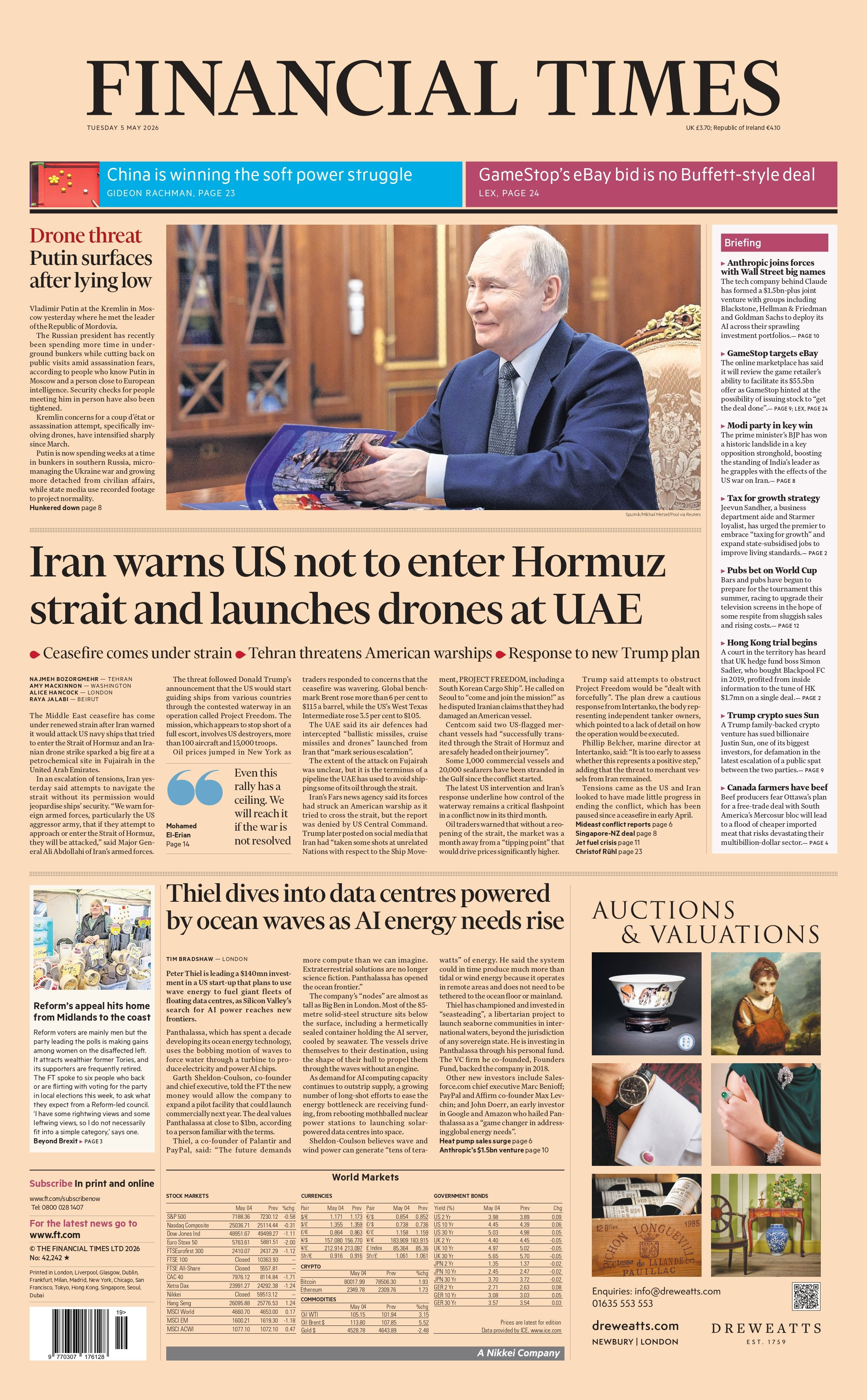
The United States and Iran made competing claims over which side controlled the Strait of Hormuz on Tuesday, adding pressure to their shaky cease-fire after the U.S. Navy launched an effort to protect vessels through the vital oil shipping route. The strait itself remains effectively closed: Only two ships were known to have passed through the waterway on Monday, and none had made the trip on Tuesday. Defense Secretary Pete Hegseth said the U.S. effort to free trapped vessels is ongoing, adding “We’re ensuring that we have control of that strait, which we do.” Iran’s state broadcaster dismissed the U.S. effort as a failure and said Iranian control over the strait had “intensified.” For the second day in a row, the United Arab Emirates said Tuesday that it had come under attack by Iranian missiles and drones, which it had not experienced since the cease-fire took effect in early April. The Emirates said its air defense systems were intercepting the weapons, but it was not clear if any had gotten through. Iran did not confirm or deny that it was behind the attacks. President Trump suggested to reporters in the Oval Office that Iran knew what actions would violate the cease-fire; U.S. officials say the country has fired on U.S. ships several times. Mr. Trump declined to specify what he would deem a violation: “Well, you’ll find out, because I’ll let you know.” On Monday, U.S. Central Command said American forces shot down cruise missiles and drones it said were aimed U.S. vessels, and destroyed six Iranian speedboats. Mr. Hegseth cast the new U.S. naval effort that began on Monday as defensive and temporary. “We’re not looking for a fight,” he told reporters at the Pentagon. Mr. Hegseth said two commercial vessels had crossed the strait under U.S. military protection on Monday. But overall ship traffic remains a trickle compared to before the war, when around 130 vessels a day made the passage - NYT
Energy shortfalls sparked by the Iran war drove intensifying inflation worries worldwide. Australia’s central bank raised interest rates and prices in the Philippines increased far faster than expected, while public companies’ warnings of having to pass on costs to consumers rose to their highest level since Russia’s 2022 invasion of Ukraine. HSBC, meanwhile, warned in a note to clients that food costs in particular were likely to rise thanks to the energy shock sparked by the conflict and the expected onset of the El Niño climate phenomenon. European and US central banks have held off on rate hikes to avoid hurting growth and labor markets, but rapidly rising inflation could force them to follow Australia’s lead - Semafor
Jet fuel is being used up rapidly, to the point that Goldman estimates that European commercial jet fuel inventories could fall below the International Energy Agency’s 23-day threshold as soon as June. If coverage drops under this level, physical shortages may result.
The Strait of Hormuz remains closed. Oil prices have jumped back above $100 a barrel. At times like these, it’s important to remember that things can still get much, much worse - FT Opinion
Austria has expelled three Russian embassy staff on suspicion of spying after determining that a “forest of antennae” on the diplomatic mission in Vienna, Europe’s espionage capital since the cold war, was being be used for illicit data collection. “It is unacceptable that diplomatic immunity be used to commit espionage,” Austria’s foreign minister, Beate Meinl-Reisinger, said on Monday. She added that the three embassy staff – whose expulsions bring the number of Russian diplomats sent home by Vienna to 14 since 2020 – had already left the country. “We have communicated this to the Russian side in no uncertain terms, including as regards the forest of antennae at the Russian mission,” Meinl-Reisinger said. Spying was a problem for Austria, she continued, but the government had embarked on a “change of course” and was “taking consistent action”. The Russian embassy in Vienna described the decision as “outrageous”, “unjustified”, “politically motivated” and “categorically unacceptable”. It promised “harsh” retaliation in return. According to a report by the Austrian public broadcaster ORF, data from international and national organisations using satellite internet was being systematically siphoned off by equipment installed on the roofs of the embassy and diplomatic compound. The Austrian government has promised to take steps to tackle its longstanding espionage problem by closing a loophole in Austria’s criminal code that in effect allows spies to operate freely in the country as long as their activities are not directly targeting Austria’s interests - The Guardian
People in Moscow and St. Petersburg reported widespread mobile internet outages on Tuesday morning, as authorities confirmed temporary restrictions had been introduced due to “security concerns” ahead of Saturday’s Victory Day celebrations. The outages follow warnings from major network providers this week that customers in Moscow should expect significant disruptions to internet and text message services over the next several days. A man in St. Petersburg, asking to remain anonymous, told The Moscow Times that he lost mobile internet access around 9:30 a.m. local time. “Only ‘whitelist’ websites worked for me, even with a VPN,” he said, adding that mobile services in the city appeared to have been restored. Three people in Moscow confirmed that mobile internet was not working for them, but they could still access the internet through Wi-Fi. The ride-hailing app Yandex Go told its users in Moscow that they could face difficulties ordering taxis. Sberbank also reported that customers may struggle to log into their accounts or receive SMS confirmation codes. By midday Tuesday, Russia’s Digital Ministry said that initial mobile internet restrictions in Moscow had ended and network operators were restoring access. However, it warned that further restrictions could be imposed. The disruptions come as Moscow prepares for a significantly scaled-back Victory Day parade this weekend. For the first time in nearly 20 years, the Red Square parade will not feature a display of military hardware, a decision the Kremlin says was made due to an increased risk of Ukrainian drone attacks on the Russian capital. On Monday, Ukraine launched a rare drone assault on Moscow, during which an unmanned aircraft slammed into a high-rise apartment complex not far from the Kremlin - Moscow Times
Russia on Monday declared a unilateral ceasefire with Ukraine between May 8-9, when Moscow holds its annual World War II Victory Day commemorations, and threatened a “massive missile strike” on Kyiv if Ukraine violated it. Ukraine responded by declaring a truce of its own between May 5-6, saying it was “not serious” to expect it to observe a ceasefire during a Russian military holiday. “In accordance with a decision of the Supreme Commander-in-Chief of the Russian Armed Forces, Vladimir Putin, a ceasefire has been declared from May 8–9, 2026... We hope that the Ukrainian side will follow suit,” the Russian Defense Ministry said in a Telegram post. “If the Kyiv regime attempts to implement its criminal plans to disrupt the celebration of the 81st anniversary of Victory in the Great Patriotic War [World War II], the Russian Armed Forces will launch a retaliatory, massive missile strike on the center of Kyiv,” it added. “We warn the civilian population of Kyiv and employees of foreign diplomatic missions of the need to leave the city promptly.” The competing ceasefires between the two sides come amid a lull in U.S.-led diplomatic efforts to end the war, as Washington shifts its focus to the conflict in the Middle East. Ukraine’s President Volodymyr Zelensky said Monday that having a ceasefire so Moscow could mark the celebration was “not serious,” and that Russia was afraid Ukrainian drones would “buzz over Red Square….As of today, there has been no official appeal to Ukraine regarding the modality of a cessation of hostilities that is being claimed on Russian social media,” Zelensky said in a post on X. “In this regard, we are announcing a ceasefire regime starting at 00:00 on the night of May 5-6. In the time left until that moment, it is realistic to ensure that silence takes effect,” he added - MT
Russian first-person view (FPV) drones are reaching deeper into Ukraine’s Donbas fortress belt of highly fortified cities. Photos published on X on May 5 by Iryna Rybakova , a press officer for the 93rd Separate Mechanized Brigade of the Ukrainian military, show the aftermath of a drone strike on a car in a residential area of Kramatorsk, the temporary capital of Ukrainian-held Donetsk Oblast. Rybakova specifically identified the strike as the work of a first-person view FPVs connected by a fiber-optic cable, a dangerous weapon that has not been a major threat in Kramatorsk until now. Fiber-optic drones are famously resistant to many of the vulnerabilities of drones that operate by radio frequency, including jamming, spoofing or loss of connection beyond the line of sight. In urban environments, buildings typically break up that connectivity, but fiber-optic FPVs in a densely populated civilian area can wreak havoc, with Russia’s attacks on civilians in Kherson being one of the clearest examples within Ukraine today. Russia gets most of its fiber-optic spools direct from China, while Ukrainian drone makers rely on a series of intermediaries that result in less reliable and shorter-range optical fiber - Kyiv Independent
Ukraine’s Mriya: Still No Answers, More Than Four Years On
And as the debate rages, Ukraine’s airports remain grounded by politics as much as war
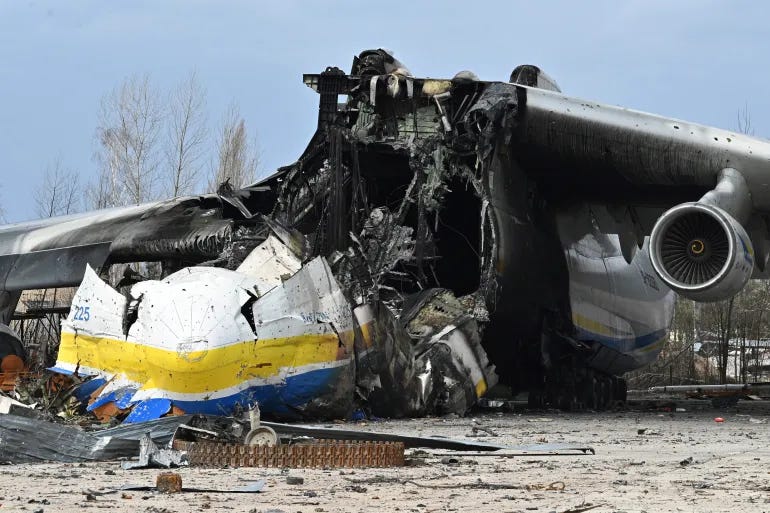
We are now well into the fifth year of Russia’s full-scale invasion of Ukraine - and one of the most painful unanswered questions remains: why was the Mriya left to die?
The An-225, the largest aircraft ever built and the pride of Ukrainian aviation, was destroyed at Hostomel Airport on the very first day of the invasion, February 24, 2022. The debate over whether it could - and should - have been saved is as alive today as ever.
The facts, as established by chief pilot Dmytro Antonov and reported by the Kyiv Independent in April 2022, are striking. As far back as January 26, NATO and its Support and Procurement Organization formally suggested Antonov Airlines redeploy its entire fleet - including the Mriya - to Leipzig, Germany, where Antonov already operates an affiliate providing strategic transport for the Alliance. Poland’s Rzeszow was floated as an alternative. Management did not respond. On the night of February 23, the Mriya’s sixth engine - temporarily removed for use on another aircraft - was reinstalled. By 10 p.m. that night, nearly seven hours before Russia’s attack, the plane was fully operational and ready to go. A sister aircraft, an An-124 Ruslan, took off from the same airfield at midnight on a routine commercial flight to Malaysia. No order was ever given to the Mriya.
Antonov went public in March 2022, stating plainly: “Negligence is the least strong possible explanation behind what happened.” He was fired within days. Antonov Airlines’ management responded with an open letter signed by 130 staff members, claiming the plane had been prepared to leave the following morning but that Russia’s attack and an emergency civilian flight ban made takeoff impossible - and accusing Antonov of grandstanding while others were being shot at. Antonov counters that many signatories told him privately they signed only to avoid conflict with management, and that issuing a departure order was never within his authority to begin with. An investigation is ongoing.
It is worth remembering the broader context. Many governments, intelligence services and journalists warned loudly for months that Russia was poised to invade. And yet President Zelensky was among the few voices urging calm, apparently wary of triggering panic. Whether that same climate shaped the decisions - or indecision - around the Mriya, we still do not know. “Draw your own conclusions,” Antonov said. Many Ukrainians have.
Meanwhile, Ukraine’s skies remain closed - and politics may be why.
All Ukrainian airports have been shut since February 24, 2022. The practical case for cautiously reopening airports in the far west - Lviv or Uzhhorod - is increasingly hard to dismiss. Flights departing from there enter NATO and EU airspace within minutes, a level of protection no airport closer to the front can offer. Look at how Beirut and Tel Aviv have continued operating under dangerous conditions. Ukraine’s western airports deserve the same serious conversation.
And yet sources close to the matter suggest political leaders are pushing to reopen Boryspil - Kyiv’s main international airport - first. The reasoning being offered, I am told, is that opening Lviv ahead of Kyiv might give the impression that Lviv is Ukraine’s capital. It was, briefly, decades ago. Using that as justification to delay reopening the safest and most strategically sound airports in the country is, at best, a flimsy excuse - and at worst, a costly one.
Ukraine needs connectivity. As I argued in my New York Times OpEd, it needs to signal resilience to the world. Opening the right airports, in the right order, for the right reasons, would do exactly that.
The Mriya debate and the airport stalemate share an uncomfortable common thread: decisions that appear driven by politics over pragmatism, come at an enormous cost.
Secretary of State Marco Rubio has yet another job, with the busy 54-year-old becoming President Donald Trump’s go-to-guy for just about anything. He is set to step behind the White House briefing room podium on Tuesday to fill in -- at least temporarily -- for Press Secretary Karoline Leavitt while she is on maternity leave. The arrangement will place the nation’s top diplomat in the role of chief spokesman for the administration, marking a departure from the typical practice of having a communications official handle news briefings. The news comes after Rubio made headlines during the weekend, with video of him behind a DJ booth at a family member’s wedding circulating on social media. White House Deputy Chief of Staff Dan Scavino posted the footage on Saturday night. Rubio will be trading turntables for tough questions for the afternoon because Leavitt is stepping away from her duties as she prepares for the birth of her second child. In December, Leavitt announced she is pregnant with a baby girl and is due in May - The Daily Beast/Fox
The journals…..