

Want a real-time barometer of how the war is landing on ordinary Russians? Skip the Kremlin’s rosy GDP claims and look at where - and whether - they’re going on summer holiday.
New reporting from The Moscow Times paints a picture of a travel map that has collapsed inward. A trip to Rome or Paris - once a single direct flight from Moscow - now demands multiple connections, workarounds for a banking system severed from the West, and a gauntlet of visa restrictions. Tour operators say seasoned independent travellers who once booked everything themselves on Airbnb and Booking.com (both long gone from the Russian market) are crawling back to package-tour agencies. Call it the end of DIY tourism, courtesy of the full-scale invasion.
The Crimea collapse. The most telling data point is on the occupied peninsula. Hotel bookings in Crimea fell roughly 30 percent year-on-year in May and June, with travel companies reporting some 1.5 billion rubles (about US$18.8 million) in losses from cancelled trips in June alone. Ukrainian strikes on supply routes and refineries have produced acute fuel shortages, airports are shut, rail service to Russia is cut roughly in half - and social media video shows near-empty beaches at what should be peak season. Moscow has been forced to dip into its reserve fund to the tune of US$56 million to prop up the region’s tourism sector. When the occupier has to subsidize sunbathing, the “new normal” narrative is in trouble.
Even Sochi, the flagship resort of the affluent, is down as much as 25 percent - with would-be visitors citing drones, sirens and eye-watering prices. One surreal detail: guests at a luxury Sberbank-owned Crimean resort filmed themselves partying in the hotel bunker during a drone alert. Champagne under air raid conditions - a metaphor if ever there was one.
Connecting the dots. Where Russians can still travel tracks almost perfectly with the Kremlin’s geopolitical pivot. Beijing has extended visa-free entry for Russian tourists through 2027, and operators expect Chinese bookings to jump 50 percent. Vietnam, Hong Kong and Tanzania are rising fast. The tourist map, in other words, is redrawing itself along the same Moscow–Beijing–Global South axis as Russian trade, energy and diplomacy. Sanctions and isolation don’t just reroute oil tankers - they reroute honeymoons.
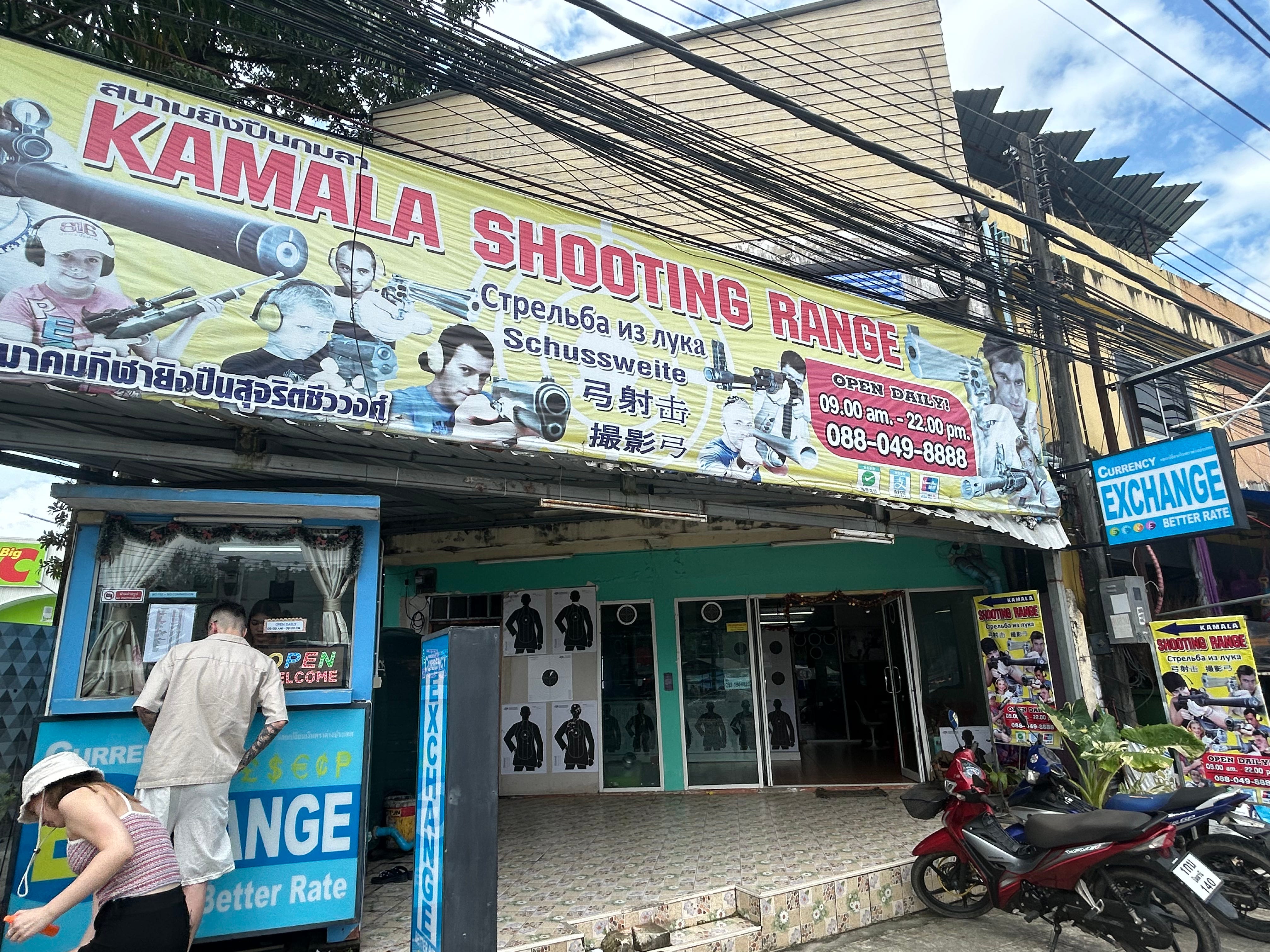
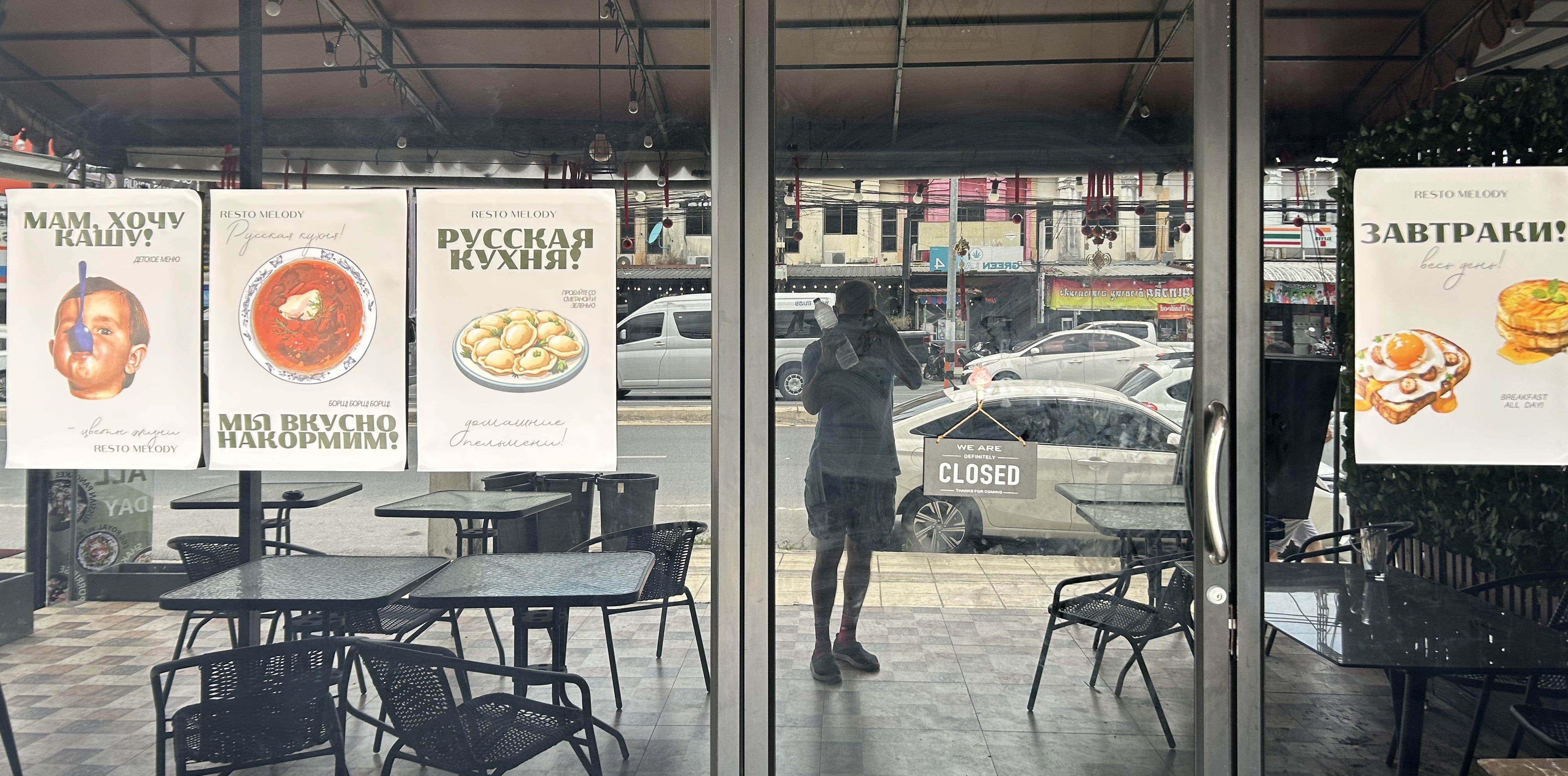
What we’re seeing on the ground. This tracks with what World Briefing has observed firsthand. Georgian friends tell us the Black Sea resort of Batumi has become thick with Russians - a coastal boomtown of exiles, remote workers and vacationers just across a border that requires no visa. And on several trips to Phuket over the past two to three years, we’ve watched the Thai island fill with throngs of Russian travellers. At times, Phuket’s airport resembles an offshore Russian hub - the departure board crowded with direct flights not just to Moscow, but to remote regions deep in the Russian interior. Russian operators have taken over entire blocks of flats for rent on Airbnb, according to our on-the-ground reporting. Savour the irony: the same platform that pulled out of Russia after the invasion is now the storefront for Russian rental empires on a Thai island.
The numbers back up the eyeball test. Thailand ranks among the top five destinations for outbound Russians, and in 2025 the kingdom welcomed nearly 1.9 million Russian visitors - an all-time record, finally surpassing the 2013 peak. The pace hasn’t slowed: more than 979,000 Russians arrived in just the first five and a half months of 2026, making Russia Thailand’s fourth-largest source market and its biggest from Europe by a wide margin. And Phuket is ground zero - Russia was the island’s single largest source of visitors in 2025 at roughly 833,000, nearly double the numbers from India or China. The isolation from the West, in other words, is real; the appetite to get out hasn’t gone anywhere. It has simply been rerouted.
The elite exception. And then there’s the Kremlin’s inner circle, which apparently didn’t get the memo about decadent, hostile Europe. As World Briefing reported earlier this week, Tatiana Navka - Olympic ice dance champion, wife of Putin’s spokesman Dmitry Peskov, and, in a delicious twist, born in Soviet Ukraine - has just gone to the EU’s General Court to overturn the travel ban and asset freeze slapped on her in June 2022; she also demanding more than €2 million in damages for harm to her finances and reputation. She’s not alone: Yekaterina Ignatova, wife of Rostec boss Sergei Chemezov, has filed a parallel challenge. So while state television tells ordinary Russians that Europe is degenerate and dangerous, the spouses of the men running the war are lawyering up for the right to summer there. Nothing says confidence in the Motherland’s resorts quite like suing Brussels for your Riviera privileges back.
The bottom line. For millions outside the big cities, the question isn’t where to go but whether travel is possible at all. A public-sector salary of 40,000 rubles a month (about US$500) doesn’t come close to covering a basic Turkish package tour starting at triple that for two people. Domestic hotel bookings slid 12 percent in late June while cancellations climbed; visits to Lake Baikal are down by a third on price alone. As one village teacher put it, summer in rural Russia isn’t vacation season - it’s haymaking season.
The Kremlin insists the war economy is humming. The empty beaches of Crimea — and the bunker parties above them - tell a different story.
Source: The Moscow Times, July 30, 2026; Bangkok Post; The Nation; World Briefing files
News Briefs
The US-Iran war will likely drag on for months, analysts predicted, as new strikes disrupted a tenuous pause and the conflict widened. Hostilities “could easily continue into 2027,” security expert Richard Fontaine wrote, oscillating between “hot and cold war indefinitely.” The US needs to contain its spread, he warned, as more countries are ensnared: After Saudi Arabia joined US strikes Wednesday, a drone hit a US-owned gas facility in Egypt, while the Houthis threatened to charge tolls in the Red Sea. Meanwhile, Washington sanctioned Chinese companies for transporting Iranian oil, as Tehran reportedly leans on Chinese tech and Russian tactics to attack US bases. Even if a deal is reached, “low level” fighting could continue, officials told Bloomberg - Semafor
A barrage of Russian missile and drone strikes pummeled Ukraine overnight, killing at least 14 people and injuring dozens of others as President Volodymyr Zelenskyy returned from the United States. He later said President Donald Trump had agreed to provide Ukraine with licenses for Patriot missiles. Zelenskyy had warned about a Russian “massive attack” just hours before it began while highlighting to Ukraine’s western partners the need for Patriot missiles to defend the country from attacks like the one that Moscow ended up carrying out. The deadliest hit occurred in the Dnipro region near Zelenskyy’s home town of Kriviy Rih, where a Russian Iskander-M ballistic missile killed six people, including three children, and injured at least 10 others according to local authorities. In the capital, Kyiv, at least one person was killed in what Mayor Vitali Klitschko described as a ballistic missile attack, urging residents to stay in shelters as the threat of further strikes remained. In the western city of Lviv, near the border with Poland, Russian missiles damaged dozens of apartment buildings and injured at least 30 people, officials said. According to Lviv Mayor Andriy Sadoviy, the missile strike on the city damaged 21 residential buildings, two kindergartens, and a school, while two people remained missing as search and rescue operations continued. Odesa was mostly quiet overnight but drone attacks were heard over most of Thursday. Late Thursday, Russian forces struck an apartment building in the eastern frontline city of Kramatorsk, injuring at least two.
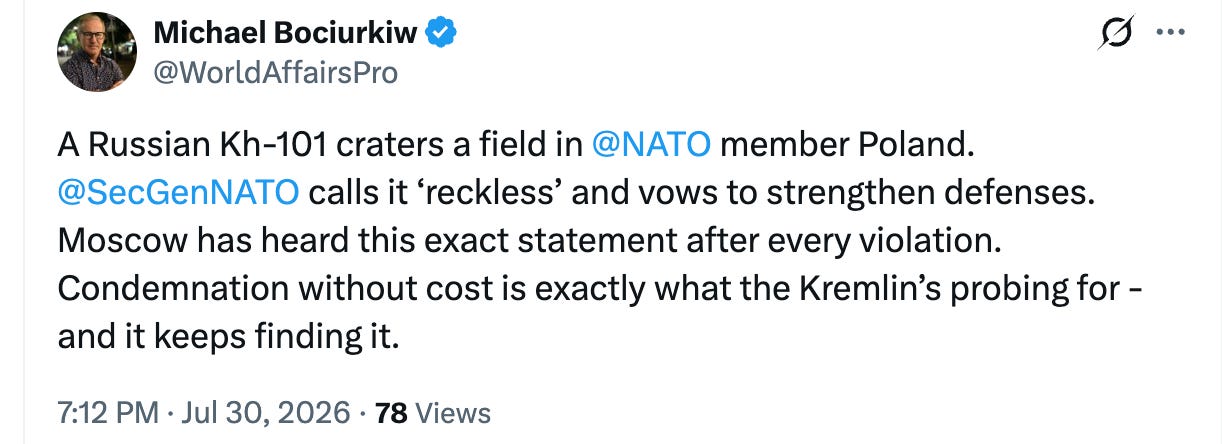
Poland, a member of the European Union and NATO, scrambled fighter jets to protect its airspace amid Russian air strikes, its armed forces said on X. Polish Prime Minister Donald Tusk said a Russian missile attack on western Ukraine resulted in a violation of Polish airspace, prompting him to convene a coordination team with the defense minister and relevant services. Later, Tusk added that the object which violated Polish airspace was likely a Russian Kh-101 cruise missile. He said that he had contacted European leaders about the incident.
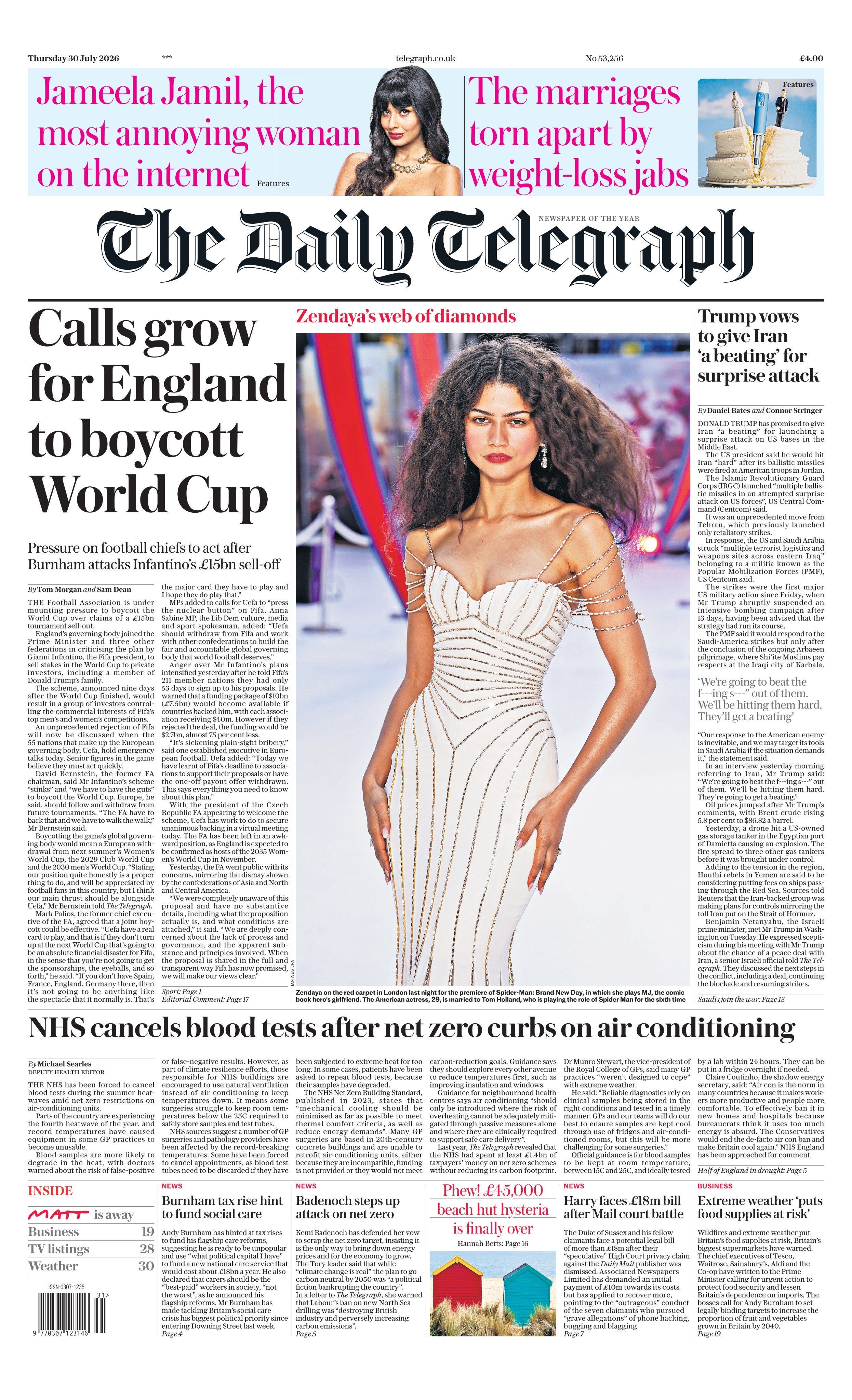
The Union of European Football Associations (UEFA) announced on Thursday that it would boycott future men's and women's World Cups in response to FIFA President Gianni Infantino's plan to allow private investment in its competitions. In a statement issued after an emergency meeting of its 55 member associations, UEFA “unanimously and unequivocally” rejected FIFA’s proposal to launch a new World Cup spin-off. The plan involves selling stakes of up to 20% to external investors, including Joshua Kushner, whose brother Jared is US President Donald Trump’s son-in-law. The World Cup “cannot be treated as an investment product,” the statement said. Without Europe’s participation, Infantino’s venture would become far less attractive, both competitively and commercially as Europeans dominate the competition. Three of the four teams to reach the semi-finals were European: France, England and winner Spain. The next men's World Cup will be hosted by Spain, Portugal and Morocco in 2030, while the next women's World Cup will take place in Brazil in 2027 - Euronews
The EU on Thursday fired the starting gun on plans to fund seven multi-billion-euro computing hubs to train artificial intelligence models in Europe. The launch of an official process for seven industry consortia willing to build AI “gigafactories” fulfills a promise made by European Commission President Ursula von der Leyen at an AI summit last year to help Europe catch up in the race on AI. AI companies need massive amounts of compute power to train advanced models, which is fueling the effort to build out specialized data centers. The EU’s goal is to support four smaller data centers, each underpinned by 25,000 to 75,000 specialized AI chips, and three larger ones, each powered by 40,000 to 100,000 chips. The Commission will select the winning bids by early next year, after which companies will have 18 months to build them. The projects may have to contend with local opposition, amid concerns about the rising power and water demands of data centers accompanying the global AI boom - Politico
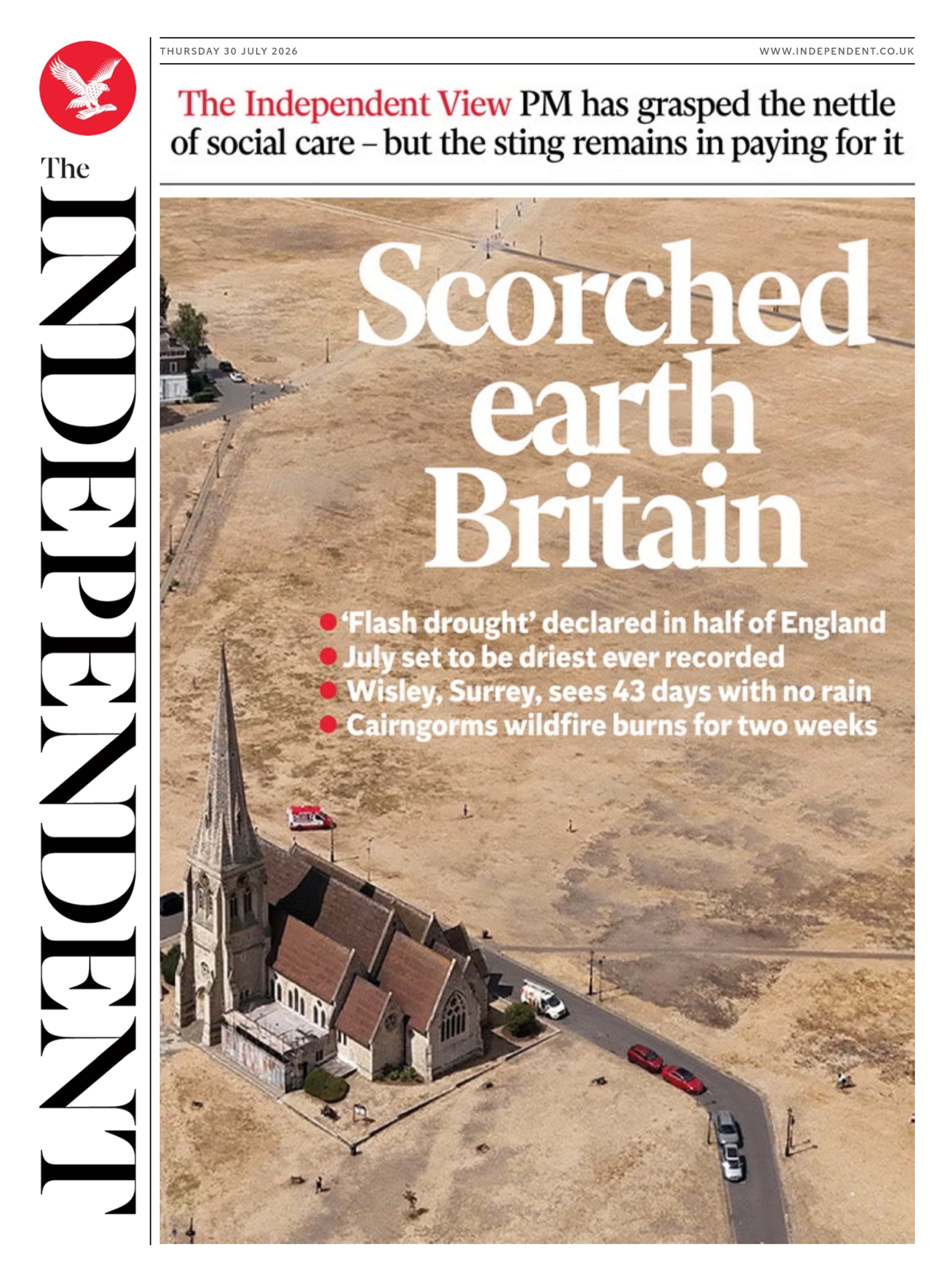
Dozens of people were evacuated from homes and vacation parks in eastern England on Thursday as fire crews tackled a wildfire around four miles from a nuclear power plant. According to the New York Times, the blaze began on Wednesday afternoon and engulfed almost 250 acres of land at Dunwich Heath in Suffolk, a scenic area of protected heathland on England’s eastern coast. Emergency responders declared it a major incident, which in Britain means an event with serious consequences that require extraordinary measures by one or more agencies. The local fire service said that there was “no current risk” to the nearby nuclear plant, known as Sizewell B, because of the fire’s distance from it “and the direction it is traveling.” It added, “However, this is a live and dynamic situation.” Meanwhile, keepers at Prague Zoo used tons of ice on Thursday to give its animals some much-needed relief as yet another heat wave hit Europe, the AP reported.
Singapore has opened an investigation after British trip-hop band Massive Attack expressed support for the Palestinians at their concert in the city-state on Wednesday. The band shouted “Free Palestine” during their performance at The Star Performing Arts Centre, prompting many audience members to join in the chant, a concertgoer who asked not to be identified told CNA. on stage while the crowd cheered. Singapore does not allow the public display of foreign national emblems without a permit or exemption. Offenders may be fined up to S$500 (US$387), face up to six months’ jail, or both. Massive Attack started as a four-member band in 1988 in Bristol. It currently has two core members. The award-winning band behind hits such as Teardrop has previously criticised Israel’s actions in Gaza, calling it a “genocide”. In 2025, they formed a syndicate for artists speaking out about Israel’s military actions in the enclave, alleging that those who did so faced intimidation within the music industry - CNA
The journals…
great briefing - really love the vacationing russians - not just the info - but your tone