

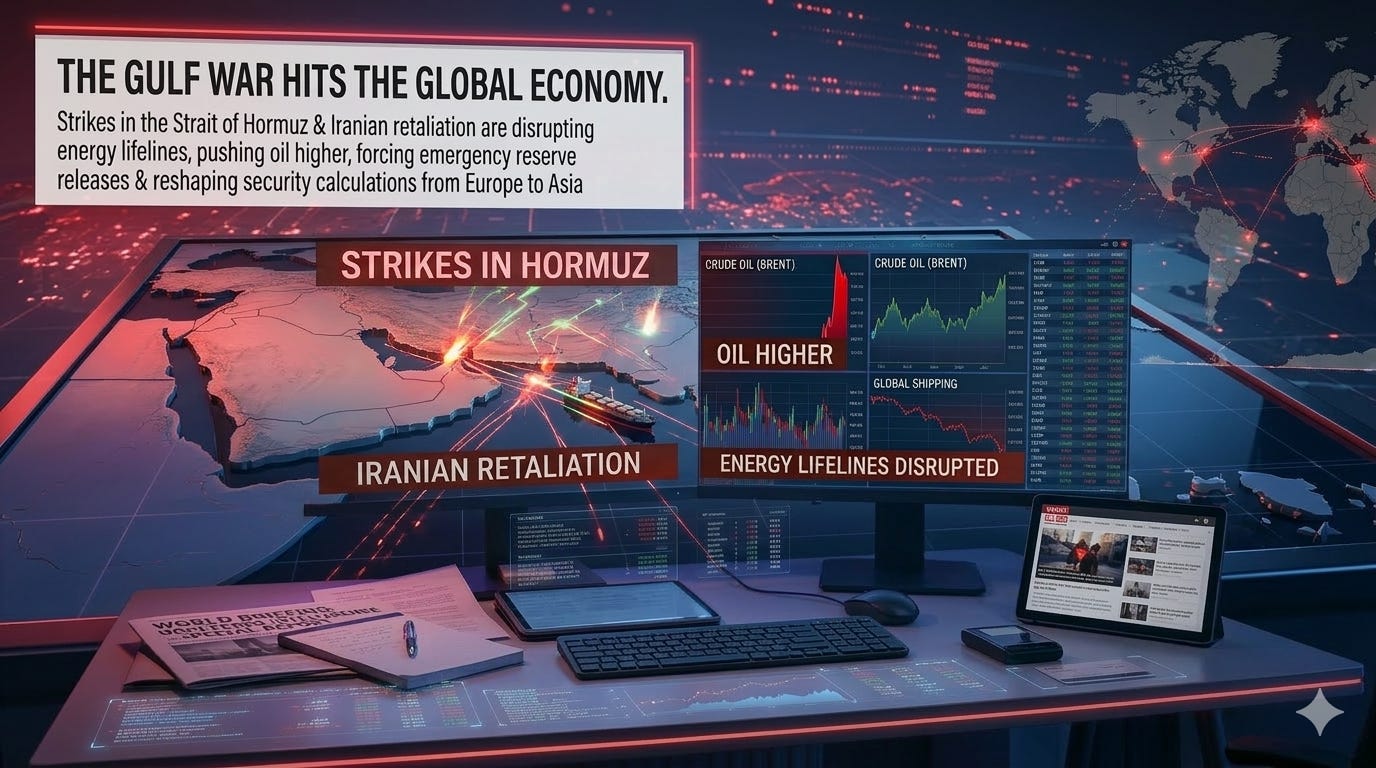
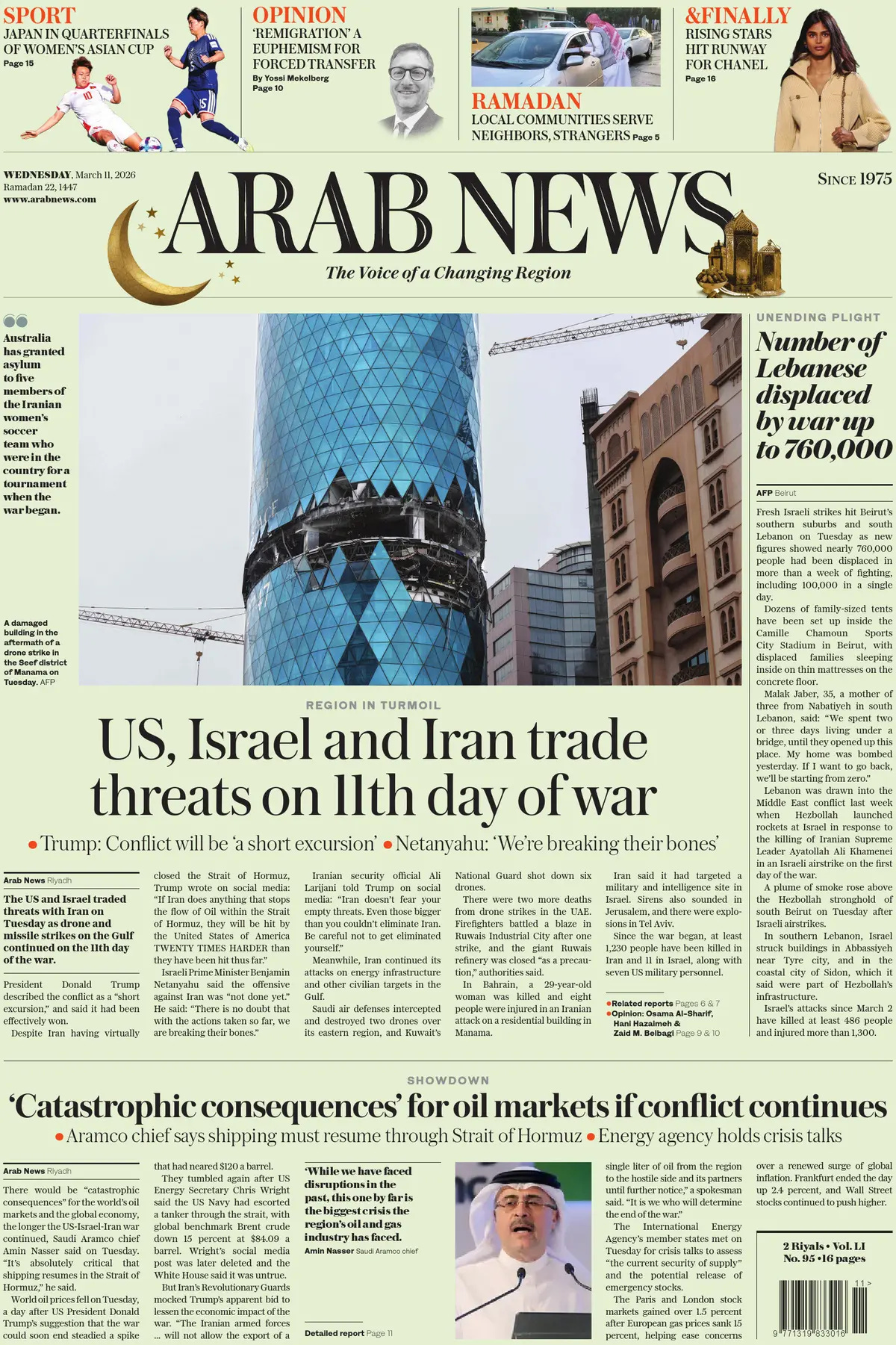
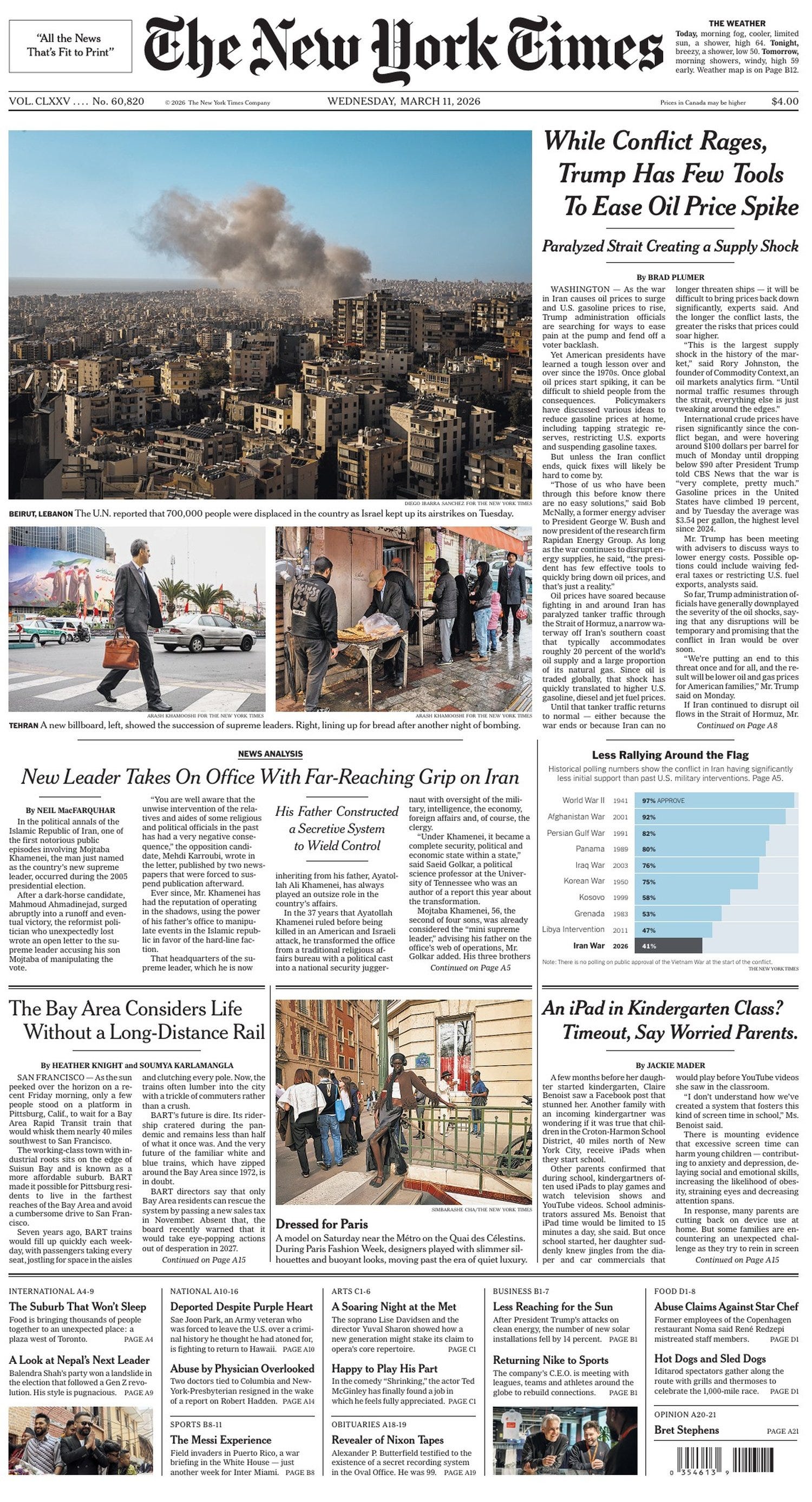
Three ships in the Persian Gulf and Strait of Hormuz were struck in separate incidents on Wednesday, according to a British monitoring agency, as the Middle East war chokes off one of the key conduits for the global oil trade. Hours before the strikes, the U.S. military said that it had attacked 16 Iranian mine-laying vessels near the Strait of Hormuz, through which a fifth of the world’s oil transits. The expanding war in the Middle East has killed more than 1,800 people, mostly in Iran, and disrupted global energy markets. Tanker traffic through the Strait of Hormuz is largely paused because of concerns that drones or missiles could hit merchant vessels. Soaring oil prices have driven up prices for global consumers, with gas prices in the United States rising for the 11th straight day on Wednesday, to a national average of $3.58 a gallon, according to the AAA motor club. Two cargo ships reported being hit by unknown projectiles in the region on Wednesday, according to United Kingdom Maritime Trade Operations, a British monitoring agency. A fire broke out on one of the ships, which was hit in the Strait of Hormuz, and its crew was evacuating. A third ship was hit about 50 miles northwest of Dubai, in the United Arab Emirates, the agency said. The source of the projectiles was not known, although Iran has fired wide-ranging strikes in retaliation for the U.S.-Israeli assault that killed its supreme leader on Feb. 28. Iran’s ability to potentially block the Strait of Hormuz with mines has long been a concern for the United States. President Trump has said the destruction of Iran’s navy is among the core objectives of the U.S. military campaign. The United States believes that Iran was preparing to mine the strait but had not begun the operation, according to an American official who wasn’t authorized to speak publicly. U.S. forces were also targeting mine storage facilities, Gen. Dan Caine, the chairman of the Joint Chiefs of Staff, said on Tuesday. Iran launched fresh retaliatory strikes across the region on Wednesday, with several Persian Gulf countries reporting missiles and drones heading toward their airspace. The defense ministry in the United Arab Emirates said that its air defenses were responding to incoming missiles and drones from Iran. Saudi Arabia, Kuwait and Qatar said their forces had intercepted drones and missiles on Wednesday, without saying where they came from. Israel said in the early hours of the morning that it had launched a wave of strikes on Tehran, targeting what it said was the Iranian regime’s infrastructure. The Israeli military also issued alerts after detecting what it said were missiles fired at Israel from Iran - NYT
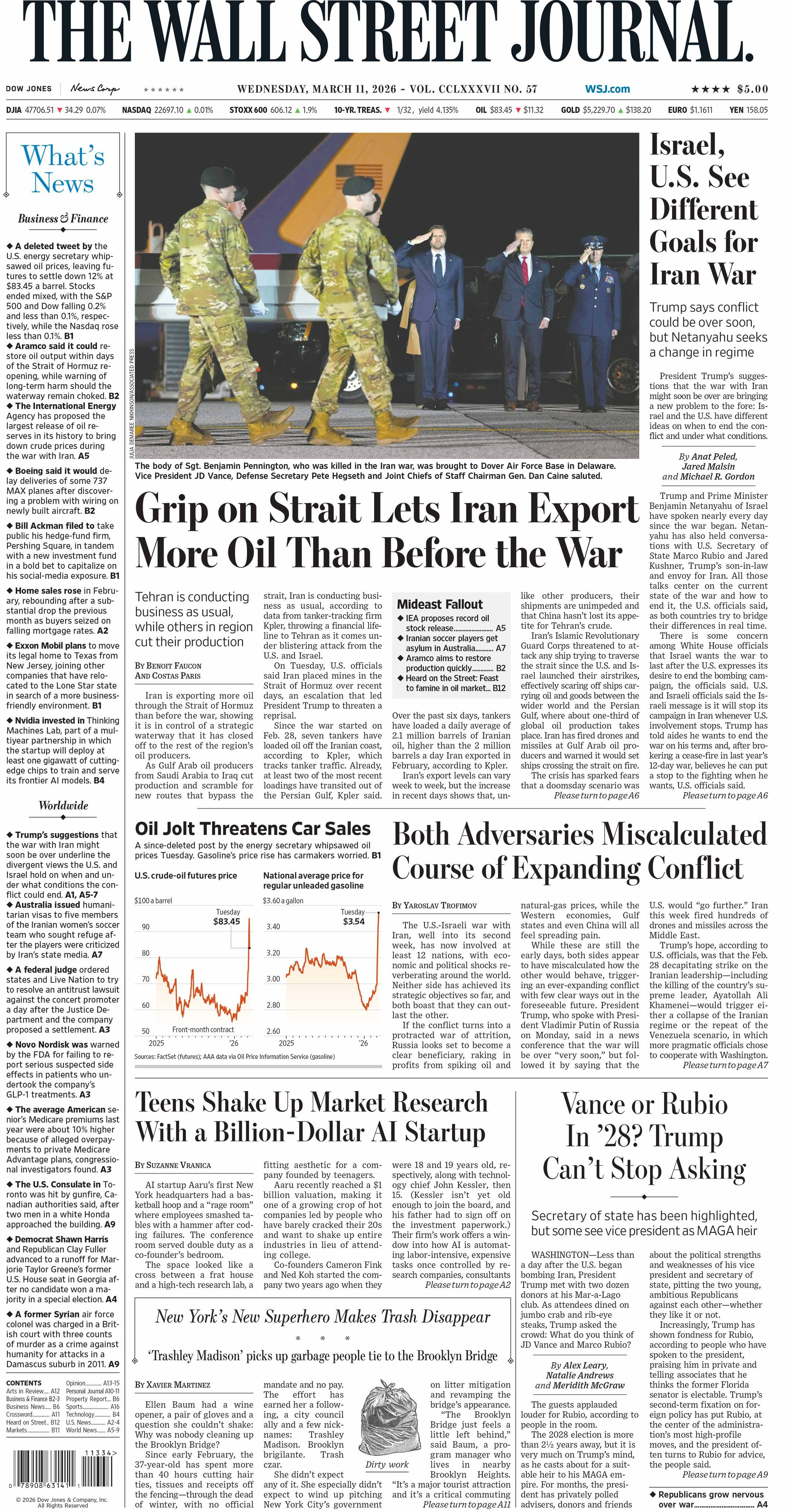
Iran is exporting more oil through the Strait of Hormuz than before the war, showing it is in control of a strategic waterway that it has closed off the rest of the region’s oil exporters. As Gulf Arab oil producers from Saudi Arabia to Iraq cut production and scramble for new routes that bypass the straight, Iran is conducting business as usual according to data from the tanker-tracking firm Kpler, throwing a financial lifeline to Tehran as it comes under blistering attack from the U.S. and Israel. Since the start of the war on Feb. 28, seven tankers have loaded oil off the Iranian coast, according to Kpler. Already, at least two of the most recent loadings have transited out of the Persian Gulf, it said. Over the past six days, tankers have loaded a daily average of 2.1 million barrels of Iranian oil, higher than the 2 million barrels a day Iran exported in February, according to Kpler. Iran’s export levels can vary from week to week, but the increase in recent days shows that, unlike other producers, their shipments are unimpeded and that China hasn’t lost its appetite for Iranian crude - WSJ

Asian countries are boosting defense spending amid concerns over China and the United States, Semafor reported. Indonesia said it would buy an Indian missile defense system, part of a broader push by Asian nations to upgrade their military arsenals amid tensions with China and eroding trust with the US. The Asia-Pacific region was second only to Europe in arms imports between 2021 and 2025, according to new research. Japan and Taiwan recorded the highest increases in East Asia, driven by “fears over China’s intentions” and Beijing’s growing military capabilities. That, coupled with doubts over Washington’s status as a reliable partner — South Korea’s president voiced his opposition to the US moving air defense systems from there to the Middle East — is shifting regional attitudes towards defense; critics worry that Japan could weaken its pacifist principles.
China’s government said its efforts in the Iran war have been focused on “diplomatic mediation,” hoping to help ease tensions, and that it is in communication with all parties, “including parties to the conflict.” Foreign Ministry spokesperson Guo Jiakun said on Wednesday that Foreign Minister Wang Yi has been holding phone conversations with different counterparts and that the special envoy to the region, Zhai Jun, is currently traveling across several countries. “As a permanent member of the United Nations Security Council and a sincere friend of Middle Eastern countries, China will not stop its efforts for peace, nor will it cease its voice in upholding fairness and justice,” he added - Euronews
European countries are gearing up to approve the release of 400 million barrels of oil to offset soaring energy costs and supply fears as war rages in Iran. France, Italy, Germany and the U.K. have all signaled support for the measure, which would be the largest coordinated release of reserves in the International Energy Agency’s history. It would be more than twice the 182 million barrels of oil IEA countries released following Russia’s invasion of Ukraine in 2022. Asian members — hit hardest thanks to their heavy exposure to the Persian Gulf — and the U.S. are also strongly supportive of tapping the reserves, according to two European officials familiar with the matter. The IEA — a key venue for wealthy countries to coordinate oil and gas supplies set up after the 1973 oil embargo — first proposed the measure late Tuesday during an extraordinary all-members meeting that followed a gathering of the G7, according to another person familiar with the matter - Politico
Two drones fell in the vicinity of Dubai International Airport, a hub of international travel in the United Arab Emirates, leaving four people with minor to moderate injuries, the Dubai government said on social media. Air traffic continued as normal, the government added. Civilian infrastructure, tourism landmarks, military installations and the U.S. Consulate have come under attack in the UAE from Iranian missiles and drones. Four people were injured in a previous attack on the airport - WSJ

From the Gulf to Ukraine, the geopolitical dots are multiplying by the day.
Upgrade to World Briefing Plus and stay ahead of the headlines — or support independent global reporting through Patreon or PayPal.
A Saudi Arabian arms company has signed a deal to buy Ukrainian-made interceptor missiles, with one source within Ukraine’s defense industry saying that Riyadh and Kyiv are negotiating a separate “huge deal” for arms that could be finalized this week. Iran’s recent air attacks across neighboring Gulf States amid the U.S. and Israel-led war against Tehran have kicked off a scramble for military equipment to combat ballistic missiles and Shahed attack drones. While cost-effective against expensive missiles, air defense interceptors like the U.S.-made Patriot cost millions of dollars — making them an unsustainable way to shoot down cheap drones built en masse for tens of thousands of dollars a piece. Two sources within Ukraine’s defense industry said that major contracts were up for discussion between the governments of Ukraine and Saudi Arabia. One of the sources told the Kyiv Independent to expect a “huge deal” between Saudi Arabia and Ukraine as soon as March 11. The other said that a contract for Ukrainian-made air defense missiles had just been signed, with a Saudi arms maker acting as a local intermediary - Kyiv Independent
At least nine people were killed and 44 others injured in Russian attacks across Ukraine over the past 24 hours, according to local authorities cited by the Kyiv Independent. Ukraine’s Air Force said Russia launched 99 attack drones overnight, including 70 Iranian-designed Shahed drones. Ukrainian air defenses shot down or jammed 90 of them. Despite the high interception rate, glide bomb strikes near the front line proved deadly. In Sumy Oblast, two people were killed and three injured, while a strike in neighboring Kharkiv Oblast killed two and wounded seven after hitting what officials described as a civilian business. Meanwhile in Zaporizhzhia Oblast, authorities reported more than 700 Russian strikes in the past day, though only one civilian injury was confirmed.
The Kremlin has approved a covert online campaign to help Hungarian Prime Minister Viktor Orbán ahead of next month’s general elections. The report by The Financial Times comes as Orbán, who has long maintained close political and economic ties with Moscow, continues to clash with neighboring Ukraine over oil supplies and European Union funding. Hungary has repeatedly blocked major EU aid packages for Kyiv, deepening a long-running dispute between the two countries. Citing people familiar with the plan, the FT reported that a Russian consultancy known as the Social Design Agency—already under Western sanction—prepared a plan to boost support for Orbán’s ruling Fidesz party. The strategy calls for Russia‑designed messages to be posted by Hungarian social‑media influencers. The move was intended to blend the content with local posts and portray Orbán as the only leader able to defend Hungary’s sovereignty and international standing. The plan also proposes “information attacks” on opposition leader Péter Magyar, who has become Orbán’s most serious challenger in the April 12 vote. Magyar’s Tisza party is currently leading some opinion polls. The FT said the campaign aims to present Magyar as controlled by Brussels and unable to get any meaningful foreign support. During his campaign trail, Magyar has claimed Moscow’s spies are trying to influence next month’s parliamentary elections - TVP World
Pope Leo XIV has accepted the resignation of a disgraced California bishop accused of visiting Mexican brothels and stealing hundreds of thousands of dollars from his church. Bishop Emanuel Shaleta, 69, was arrested last week as he attempted to board a flight to Germany with a bag containing more than $9,000. He was then charged with eight counts of embezzlement, eight counts of money laundering and one count of aggravated white collar crime enhancement. He has pleaded not guilty. His resignation came as he was released from prison on bail. Last month, The Pillar reported that Bishop Shaleta allegedly misused church funds, diverting rental payments for personal use and covering it up with charity money. Investigators say at least $427,000 went missing, with total losses possibly reaching $1 million. The bishop was also reportedly a frequent visitor to the Hong Kong Gentlemen’s Club, a brothel in Tijuana’s red-light district, using a private shuttle reserved for patrons, according to a private investigator. An Iraqi native, Shaleta was ordained by Pope John Paul II in 1984 and served in Detroit and Canada - The Daily Beast
The journals….

So any information on Russian support for Iranian targeting US and Gulf Arab sites and if so why is Trump mum on this ? Is China involved too ?