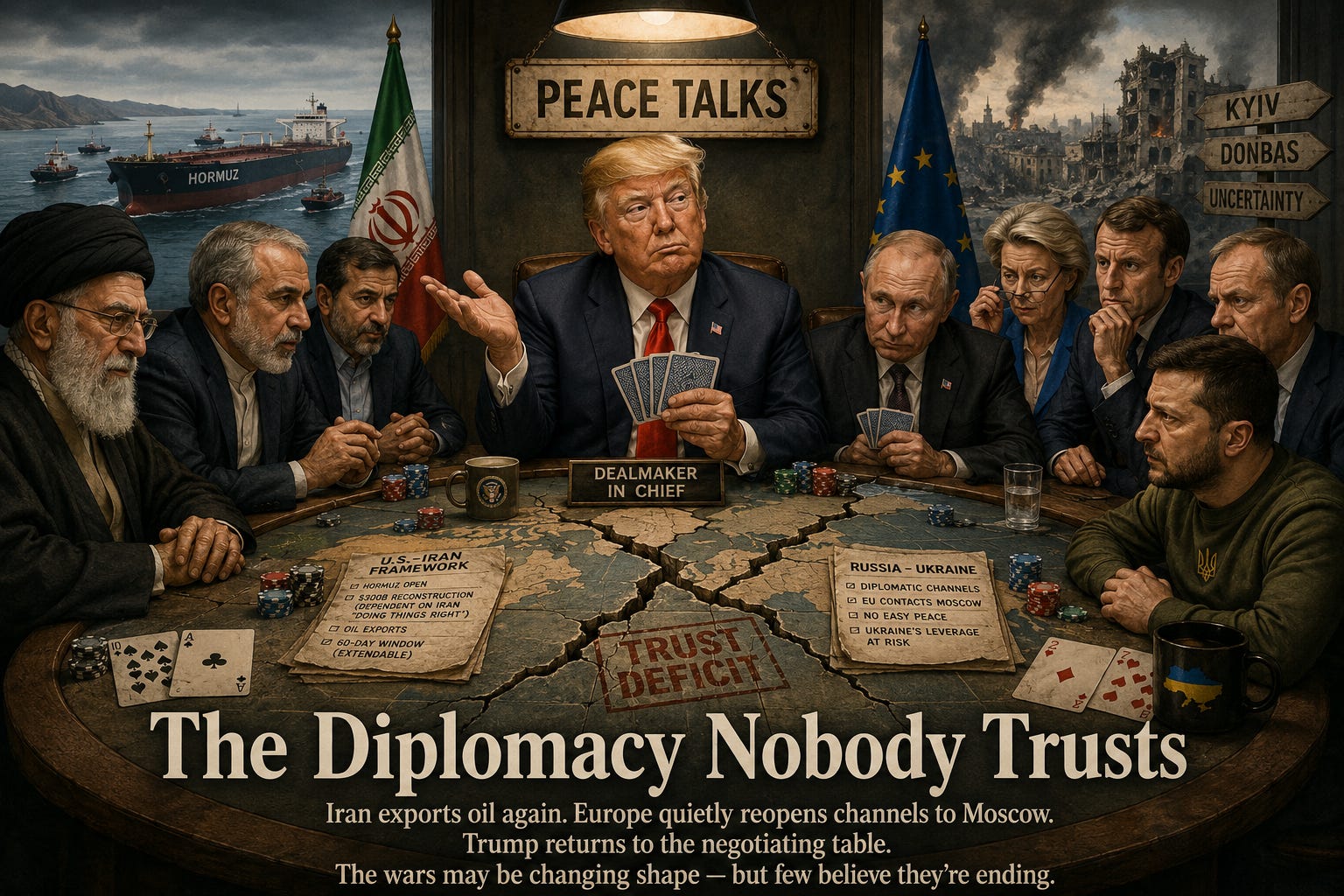
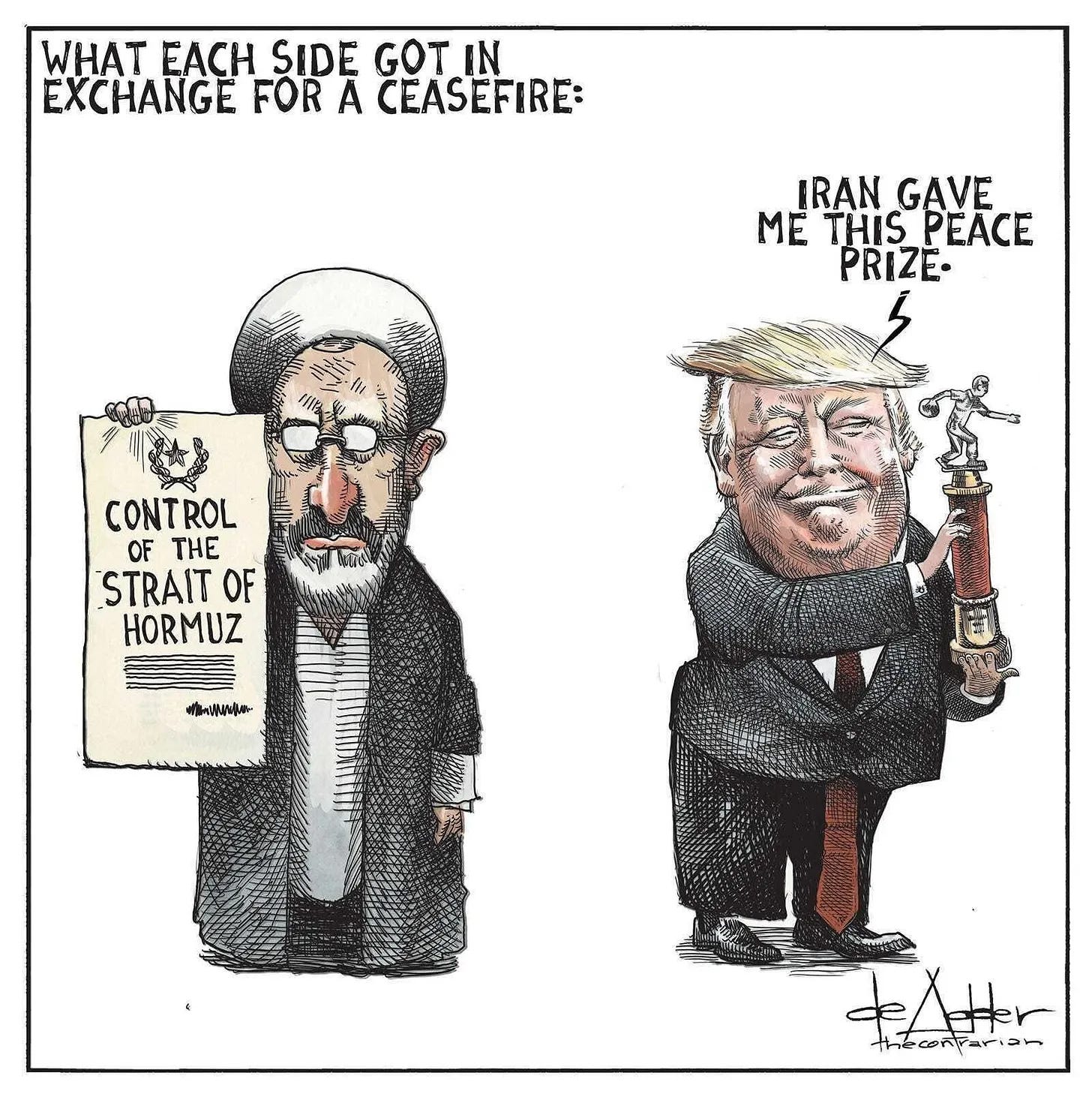
Donald Trump emerged from the G7 in Évian-les-Bains with a preliminary U.S.-Iran framework that’s heavy on headline numbers and light on enforcement mechanics, the New York Times reported. The terms, laid out by a senior U.S. official: reopening the Strait of Hormuz, a $300 billion reconstruction package for Iran, and relief from oil export restrictions - all while the actual nuclear question gets kicked into a 60-day negotiating window that can be extended by mutual consent. Iran’s foreign ministry says its president signed the memorandum digitally; the White House confirmed Trump signed it too, from Versailles, alongside Macron. A planned signing ceremony in Switzerland is now off. Trump kept his leverage rhetoric intact, warning he’d resume strikes if Iran doesn’t comply, though he later softened that to reporters, saying the 60 days isn’t really a hard deadline. The deal also folds in a Lebanon component - an end to Israel’s campaign against Hezbollah, though Israel insists it isn’t bound by the agreement - and tasks Oman and Iran with negotiating Hormuz’s administration going forward. On money: Washington isn’t cutting Iran a check. The $300 billion hinges on Iran “doing things right,” with oil sales and outside investment as the mechanism, not direct U.S. funding. Sanctions relief, including UN-level sanctions, is contingent on a still-unwritten “final deal.” A separate Gulf-states track is meant to tackle Iran’s missile program, with Trump framing it as unrealistic to deny Iran missiles while Saudi Arabia and others have them. Notable aside: Trump publicly criticized Netanyahu’s strikes on Beirut as disproportionate, and cited fear of becoming “the late great Herbert Hoover” — economic-crash optics he’s clearly trying to avoid. The G7’s joint statement praised Trump’s role in brokering the framework, but the leaders’ own language - calling for a “robust and comprehensive diplomatic follow-on agreement” - is itself an admission that this is a memorandum, not a settled deal.
The first shipments of Iranian crude oil in two months have departed the Strait of Hormuz, according to ship-monitoring firm TankerTrackers.com. Using satellite imagery and shipping data, TankerTrackers said it had verified Iran's first crude oil exports since a US naval blockade was imposed two months ago - RFE/RL
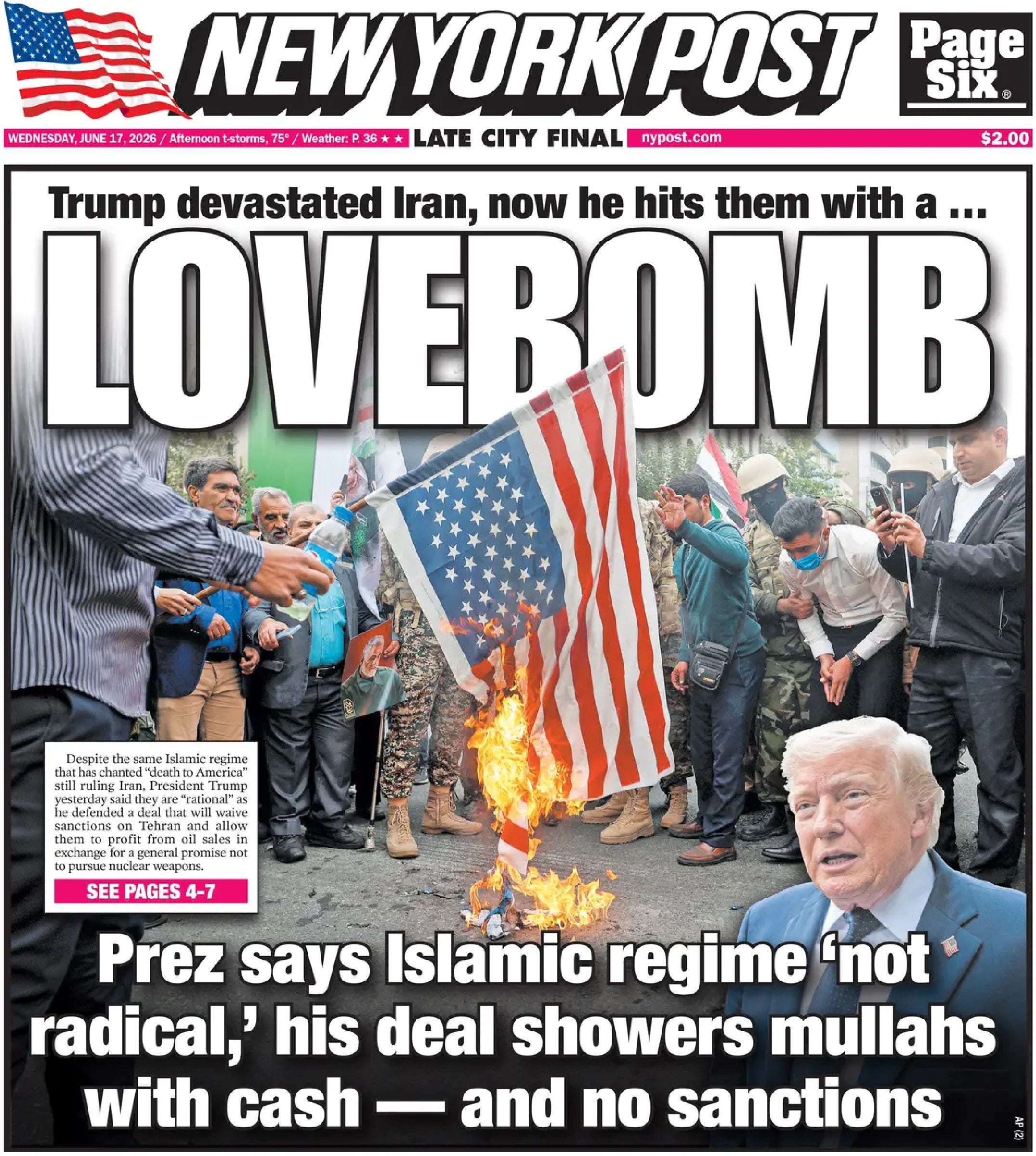
The verdict on Trump’s Iran ceasefire framework arrived before the text did - and it’s brutal. From Fox News primetime to the New York Post’s front page (”Lovebomb” - see below), the conservative coalition that backed Trump’s war on Iran is now revolting against his peace. The complaint is structural, not stylistic: reported terms let Iran restart oil exports free of sanctions immediately, with Gulf states bankrolling a $300 billion reconstruction fund, while Tehran’s surrender of enriched uranium gets kicked into future talks. Hawks see a regime “on its back,” as Fox’s Marc Thiessen put it, being handed a lifeline instead of a surrender.
The defection list cuts across Trump’s usual factions. Mike Pence likened it to Obama-era appeasement. Nikki Haley warned “Iran wins” if sanctions relief lands on day one. Steve Bannon told Trump to keep the sanctions and “just walk away” with Iran’s frozen assets. With midterms approaching, GOP strategists are already telling candidates to avoid the topic entirely. When your own base calls your war’s ending a defeat, you haven’t won the room - you’ve just changed what it’s angry about.
At the G7, Mr. Trump switched between apparent interest and indifference regarding the war in Ukraine, which is now in its fifth year. He said he’d had “very good talks” with President Volodymyr Zelensky and Russia’s president, Vladimir Putin, a day after suggesting that the U.S. had “nothing to do” with the war.
The verdict from this year’s G7: transatlantic alignment on Iran and Ukraine held - barely. CFR’s Liana Fix argues the unity on display is more fragile than it looks, and the real question isn’t whether cracks appear but how soon. On Iran, the framework agreement between Washington and Tehran gave Europeans a moment of relief, but their enthusiasm is tempered. Given the speed of the negotiation and the compressed timeline ahead, European officials worry the deal could end up thinner than the original nuclear accord and leave the question of Iran’s regional proxy network unresolved. Still, the framework’s biggest political benefit may be timing: it helped paper over a brewing transatlantic rift over Europe’s limited military contribution to the Iran conflict. Ukraine is the bigger worry. Trump’s signal that he’s returning to Ukraine negotiations has put Europeans on edge, fearing a repeat of past leniency toward Moscow that could squander what they view as Kyiv’s current window of leverage. Fix’s bottom line for Brussels and beyond: alignment with Washington is worth chasing but can’t be relied on. The more Europe and Ukraine build their own strength, the less Trump’s next move actually matters.
The office of EU chief António Costa has had “brief” diplomatic contacts with the Kremlin to open channels of communication, Brussels said Wednesday, as Europe debates whether to talk to Russia about ending the Ukraine war. “In the past few weeks, brief contacts at diplomatic level were made to open communication channels but nothing was discussed on substance,” an EU official said on condition of anonymity. Discussions on Europe re-engaging with Moscow have become louder amid deadlocked U.S. efforts to halt the war in Ukraine while President Donald Trump’s attention has been consumed by Iran. Ukraine’s President Volodymyr Zelensky — who is due to join EU leaders at a summit in Brussels Thursday — has pushed for Europe to play a more active role. “In any future scenario, the EU has specific interests that will need to be defended, therefore it is important to have established diplomatic channels with Russia,” the EU official said. “The EU is not a mediator. It supports Ukraine in its efforts to achieve a just and lasting peace.” - AFP
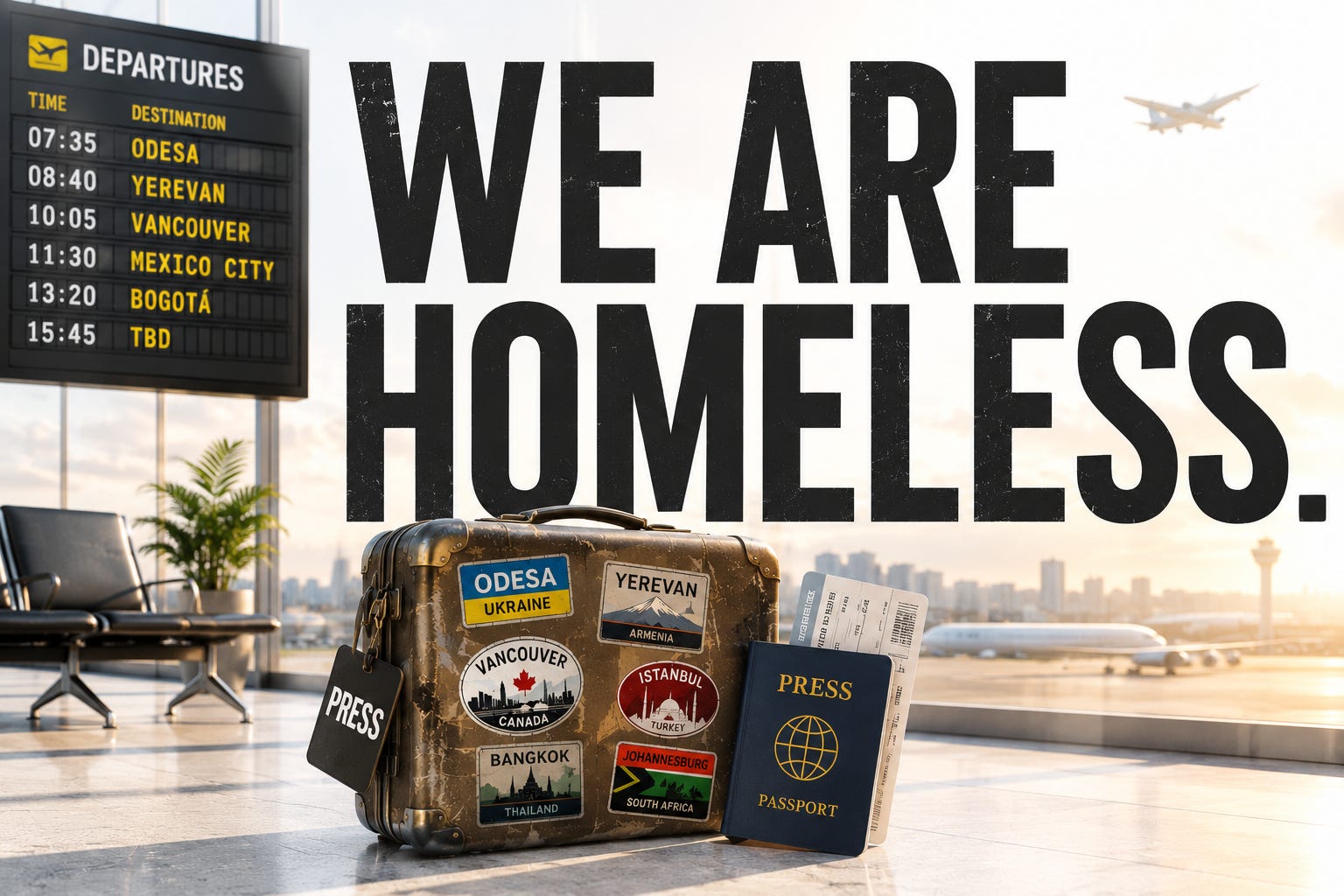
WE ARE HOMELESS.
At least as a newsroom.
World Briefing doesn’t have a headquarters, and that’s intentional.
Over the past year I’ve reported from Odesa under Russian missile attacks, from Armenia ahead of a pivotal election while tracking Russian influence operations and FSB activity, and from Vancouver investigating what the World Cup is really costing taxpayers versus what officials and FIFA claim.
Next stop may be Mexico. Or Colombia. Stay tuned.
Many media organizations cover the world from a handful of studios and newsrooms. World Briefing works differently. We go where the story is happening.
Sometimes that means reporting from a war zone. Sometimes from a border crossing. Sometimes from a taxi, a refugee shelter, an election rally, or outside a stadium.
If you value analysis from people who are actually there - not commentators watching events unfold from thousands of miles away - please consider upgrading your subscription.
Your support keeps us moving.
A startling photo circulating on social media appears to show a man eating a rabbit while walking through a residential Milwaukee neighborhood - and now city officials are reviewing the matter, TMZ has learned. The image, shared in a local Facebook group, appears to show a man holding what looks like a partially skinned rabbit carcass to his mouth while walking down a sidewalk on the city’s East Side. According to the post, the incident occurred within the last several days. The graphic photo quickly spread online, prompting questions about whether any health or wildlife regulations may have been violated. Milwaukee Police Captain Robert Thiel tells TMZ ... the photo was forwarded to the department, and the Wisconsin Department of Natural Resources has been notified as investigators work to verify the image. Thiel says there have been no official reports made to police, and the information remains preliminary.
The journals….