A free press does not usually disappear overnight. It erodes - quietly, incrementally, and often behind closed newsroom doors. That is what appears to be happening in the United States, where political pressure, legal intimidation, and corporate caution are converging to produce a chilling effect on journalism unprecedented in recent decades.
The most striking example came this week when CBS News abruptly pulled a 60 Minutes investigation into alleged torture and brutal conditions at El Salvador’s notorious CECOT mega-prison — just hours before it was due to air (disclosure: I am a frequent guest on CBS’s live streaming channel). The segment had been cleared by lawyers and standards editors, promoted publicly, and scheduled for broadcast. Its sudden withdrawal, amid pressure on the network’s new leadership and fears of White House retaliation, has triggered accusations of political interference and sparked internal revolt among journalists who warn that refusing to grant airtime to uncooperative officials effectively hands governments a “kill switch” over inconvenient reporting.
Let us not forget that it was just a few months ago - 0n July 17, that CBS announced that it would be ending The Late Show with Stephen Colbert and would be retiring The Late Show franchise altogether in May 2026 after 33 years. The show's network, CBS, said it was “purely a financial decision” but media analysts and politicians speculate that Colbert's criticism of President Donald Trump may have more to do with the decision than money.
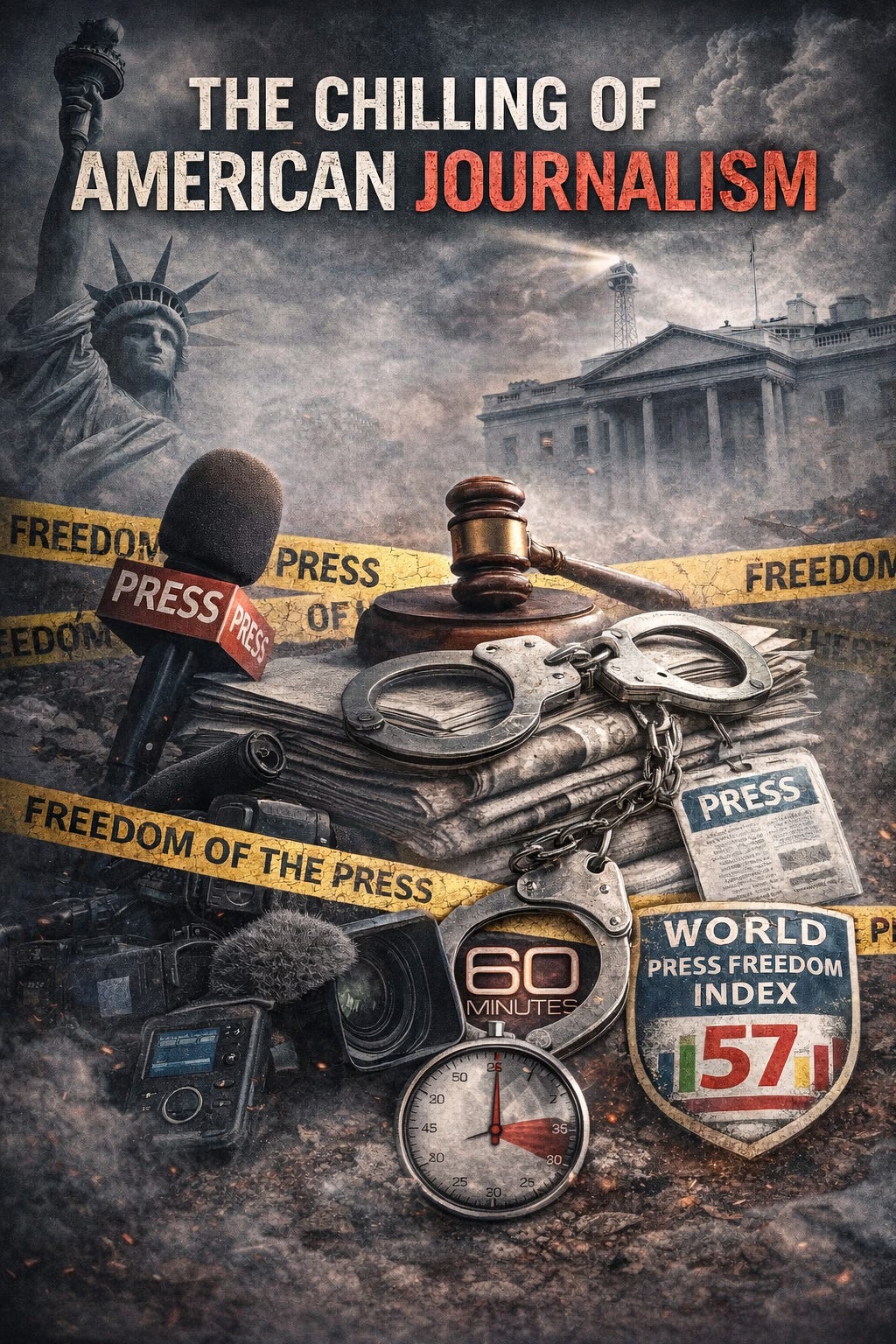
This episode does not stand alone. Across the U.S. media landscape, threats of lawsuits from the Trump White House are exerting a chilling influence on editorial decision-making, while billionaire owners and politically aligned tech figures - the so-called ‘Tech Bros’ - are reshaping legacy news institutions from the inside. At the same time, journalists are facing growing physical and legal risks simply for doing their jobs. The United States has now fallen to 57th place out of 180 countries in Reporters Without Borders’ World Press Freedom Index - a staggering decline for a country that once saw itself as the gold standard of press freedom. Arrests of journalists have surged, particularly during protest coverage, and even deportations have been used as a warning shot to foreign-language and international reporters. “After a century of gradual expansion of press rights in the United States, the country is experiencing its first significant and prolonged decline in press freedom in modern history, and Donald Trump’s return to the presidency is greatly exacerbating the situation,” RSF said.
Taken together, these developments raise an uncomfortable question: is American journalism being censored - or is it censoring itself, out of fear?
CBS News pulled a “60 Minutes” report on El Salvador’s CECOT prison just hours before its scheduled Sunday broadcast, saying it would air at a future time. “The broadcast lineup for tonight’s edition of 60 Minutes has been updated,” the program posted on social media. “Our report ‘Inside CECOT’ will air in a future broadcast,” the program posted on X and other social media platforms three hours before it was slated to air. A CBS News spokesperson said in an email that the segment “needed additional reporting.” CBS removed a link to the “Inside CECOT” segment page on Sunday. The page, which previously featured a trailer, now displays “The page cannot be found” message. However, a description on its Paramount Plus website earlier said the segment was scheduled to air at 7:30 p.m. ET Sunday, with correspondent Sharyn Alfonsi speaking to recently released deportees about the “brutal and torturous” conditions they had endured in the prison. The decision comes even as the network goes through changes under Editor-in-Chief Bari Weiss, who was picked to lead CBS News in October after CBS parent company Paramount Skydance acquired the online publication she founded, The Free Press. CECOT is a mega-prison in El Salvador where the U.S. has sent hundreds of mostly Venezuelan migrants without trial. It has been condemned by human rights groups for its harsh conditions. The Trump administration has faced controversy for deporting hundreds of Venezuelan gang members to CECOT earlier this year. In March, U.S. District Judge James Boasberg issued an emergency order blocking President Donald Trump from deporting certain migrants to El Salvador. Despite the order, hundreds of migrants remained in CECOT for months. Alfonsi said in a private note to her CBS colleagues on Sunday that the episode “was screened five times and cleared by both CBS attorneys and Standards and Practices. It is factually correct. In my view, pulling it now, after every rigorous internal check has been met, is not an editorial decision, it is a political one.” Elsewhere in the note, Alfonsi said her team had requested comment from the White House, the state department, and the Department of Homeland Security. “If the administration’s refusal to participate becomes a valid reason to spike a story, we have effectively handed them a ‘kill switch’ for any reporting they find inconvenient,” she said. “We have been promoting this story on social media for days. Our viewers are expecting it. When it fails to air without a credible explanation, the public will correctly identify this as corporate censorship. We are trading 50 years of ‘gold standard’ reputation for a single week of political quiet….I care too much about this broadcast to watch it be dismantled without a fight,” she wrote. The cancellation of the Cecot investigation segment drew swift criticism and accusations of censorship on social media. “This is really bad. For the Country. For the legacy of CBS News and 60 Minutes,” said crime writer Don Winslow in a post on X. Political commentator Krystal Ball wrote: “Bari’s CBS pulled their Cecot report which included interviews with immigrants who were tortured in this concentration camp. The Trump regime does not want you to know what was done to these people.” Reporter Brian Stelter posted on X that “people” internally at 60 Minutes were “threatening to quit over this”. - The Guardian/Reuters
On Monday morning’s CBS editorial call, Weiss seemed frustrated about the leaks but confident in her decision. “The only newsroom I’m interested in running is one in which we are able to have contentious disagreements about the thorniest editorial matters with respect, and, crucially, where we assume the best intent of our colleagues. Anything else is absolutely unacceptable,” she said, according to CBS. “I held a 60 Minutes story because it was not ready,” she continued. “While the story presented powerful testimony of torture at CECOT, it did not advance the ball — the Times and other outlets have previously done similar work. The public knows that Venezuelans have been subjected to horrific treatment at this prison. To run a story on this subject two months later, we need to do more. And this is ‘60 Minutes.’ We need to be able to get the principals on the record and on camera.” Reading between the lines, Weiss confirmed her insistence on adding Stephen Miller or another Trump official voice to the story. But Alfonsi’s team did ask for comment, and “their refusal to be interviewed” was “a tactical maneuver designed to kill the story,” Alfonsi wrote in the memo. Weiss said on the Monday morning call, “Our viewers come first. Not the listing schedule or anything else. That’s my north star and I hope it’s yours, too.” CNN’s chief media analyst Brian Stelter wrote: But this begs the question: Why were the listings sent out, then? Why did the story get promoted on social media? Some CBS staffers are now asking whether Weiss was pressured by Paramount or by the Trump administration to hold the story once it was publicized.- CNN

Trump insiders and politically connected contractors are maneuvering to control Gaza’s reconstruction and humanitarian logistics, pitching profit-driven plans behind closed doors. One contender, the Guardian has learned, is Gothams LLC, a politically connected contractor that won a $33m contract to help run the notorious south Florida detention center nicknamed “Alligator Alcatraz”, where immigrants are housed in tents and trailers. Documents and three people familiar with the plans say that the contractor had an “inside track” to secure what might be the most lucrative contract it’s ever had. But in an interview on Friday, after questions from the Guardian, the company’s founder, Matt Michelsen, said he had reconsidered his company’s participation and was pulling out, citing security concerns. Sources told the Guardian that contractors have been flying to the region in order to meet with influential US officials and potential business partners before the holidays. “Everybody and their brother is trying to get a piece of this,” one long-time contractor familiar with the process . “People are treating this like another Iraq or Afghanistan. And they’re trying to get, you know, rich off of it.” While Trump and Kushner both have envisioned wealthy resort concepts, most of the international community wishes to see Gaza rebuilt as a livable home for its 2.1 million Palestinian residents. Meanwhile, Israel continues to control half of the Gaza Strip, and has said it will forbid reconstruction on the half overseen by Hamas until the group disarms.
U.S. President Donald Trump appointed Louisiana’s governor as Washington’s special envoy to Greenland, reigniting a fight over the fate of the Arctic island. Trump, who has long expressed his desire to make self-ruling Danish territory Greenland a part of the U.S., said on his social media platform Truth Social late Sunday that he had appointed Louisiana Governor Jeff Landry “as the United States Special Envoy to Greenland.” “Jeff understands how essential Greenland is to our National Security, and will strongly advance our Country’s Interests for the Safety, Security, and Survival of our Allies, and indeed, the World,” Trump wrote. Greenland’s Prime Minister Jens-Frederik Nielsen posted a statement about the appointment on social media, saying “it may seem like a lot” but urging calm and reiterating Greenland’s right to self-determination. “We will shape our own future,” he added. “Greenland is ours, and our borders will be respected.” Copenhagen, which retains some authority on matters of foreign policy and security for Greenland, reacted with fury to Trump’s announcement. Danish Foreign Minister Lars Løkke Rasmussen told local media he was “deeply outraged” and would summon U.S. Ambassador to Denmark Ken Howery. - Politico
A Russian general has been killed in a car bombing in Moscow, officials have said. Russia’s Investigative Committee said Lt Gen Fanil Sarvarov died on Monday morning after an explosive device planted under a car detonated. He is the third military official to have been killed in bomb attacks in the Russian capital over the last year. Sarvarov, 56, was the head of the armed forces’ operational training department, the committee said. It added one theory being investigated was that the bomb was planted with the involvement of Ukrainian intelligence services. Ukraine has not commented. Sarvarov died in hospital as a result of his injuries, the committee said, adding it had opened an investigation into murder and illegal trafficking of explosives. Investigators have been sent to the scene, in a car park near an apartment block in the south of Moscow. Images from the area show a badly damaged white Kia Sorento with the doors blown out, surrounded by other vehicles. According to Russian media, Sarvarov previously took part in combat operations during the Ossetian-Ingush conflict and the Chechen wars in the 1990s and early 2000s, and also led operations in Syria between 2015-2016. Vladimir Putin was informed of Sarvarov’s death immediately, Kremlin spokesman Dmitry Peskov said. Since Russia launched its full-scale invasion of Ukraine in February 2022, a number of military officials and high-profile individuals have been targeted in the Russian capital. - BBC
The Kremlin maintained its hard line on a Ukraine peace deal, rejecting undisclosed changes proposed by Kyiv and its European allies, as separate US-Russia and US-Ukraine talks wrapped up in Florida. All sides continued to characterize the various negotiating sessions as “constructive,” but there were no apparent signs of progress in either the US-Russia or US-Ukraine discussions.
No announcements were made on possible future meetings - BBC
President Donald Trump’s envoy, Steve Witkoff, and Secretary of State Marco Rubio appear to be clashing about peace efforts in Ukraine and other matters, NBC News reported. There is a long-running rift between the two senior figures in the Trump administration with sharply different views about how to end the war in Ukraine and how much the U.S. should trust Russia’s promises. “They seem to be singing off of a different sheet of music,” said Alexander Vershbow, a former career diplomat who was ambassador to NATO. “And if you don’t have a common understanding of the problems and of your adversary in a negotiation, it can’t be good.” Eager to strike a quick deal as ordered by Trump, Witkoff has pushed for proposals that put the onus on Ukraine to make concessions, give up territory and accept risks to its future security. Rubio and some other officials in the administration favor imposing more economic and military pressure on Russia to force Russian President Vladimir Putin to make concessions and allow a secure future for Ukraine, a view shared by America’s European allies.
Russian oil prices have tumbled to their lowest levels since the pandemic after the U.S. sanctioned Rosneft and Lukoil, further squeezing producers already facing sharp profit declines this year. Producers are struggling to cover capital expenditures at several fields at current Urals crude prices, sources at Russian oil companies told Reuters. Last week, Argus reported that Urals was selling abroad for $34-36 per barrel, a record low since the pandemic, while discounts on the crude reached $23-25 per barrel — the largest since the February 2022 invasion of Ukraine. Discounts reportedly reached $35 per barrel for some cargos sold to Chinese refineries. At around $40 per barrel, Urals barely covers extraction and transportation costs, experts say. Remote fields with high production costs may already be unprofitable - Moscow Times
Displaced Ukrainians in Poland are facing an increasingly hostile atmosphere - a dramatic turnaround from the mood in 2022. Then, in the aftermath of Russia’s full-scale invasion, hundreds of thousands of Poles put on a show of support and hospitality for their neighbours, volunteering at the border and offering up their homes to refugees. Now, that outpouring of goodwill is wearing thin, as the war approaches its fourth anniversary, and surveys show an increasingly negative perception of Ukrainians in Poland, stoked by a political debate that has moved further to the right on migration and the resurfacing of historical grievances. There are about a million Ukrainian refugees in Poland, according to UNHCR statistics from September. In one incident in the city of Szczecin in north-west Poland, a man was sentenced to 14 months in prison after assaulting a Ukrainian couple out buying ice cream for their daughter and speaking Ukrainian. “Things feel more tense now,” said Aliona, a 39-year-old entrepreneur who lives in a small town in western Poland. “Nowadays, when we go out, the kids whisper: ‘Mum, let’s speak Polish now.’ It wasn’t like this before. No one used to comment. Even if they heard my accent, they’d just smile,” she said. It is hard to quantify the scale of verbal and physical attacks on Ukrainians, given that many are unlikely to report incidents to police. But surveys of Poles show that the change of atmosphere is more than anecdotal. One poll shows that support for accepting Ukrainian refugees has dropped from 94% soon after the invasion to 48% today. Another survey shows Polish support for Ukraine joining the EU is down to 35%, from 85% in 2022. “There is an attitude in society that we don’t owe anything to the Ukrainians any more,” said Piotr Buras, of the European Council on Foreign Relations in Warsaw. Many things have combined to bring about this change of feeling. Resentment has been stoked by disinformation and viral videos online. Moreover, the election of rightwing populist Karol Nawrocki as president in June 2025 followed an acrimonious campaign which shifted the whole political debate further to the right. Ukrainians are more often portrayed as ungrateful and hungry for benefits, despite economic data showing they are net contributors to the Polish economy - The Guardian
Singer Chris Rea has died at the age of 74, according to a statement released by a family spokesperson. “It is with immense sadness that we announce the death of our beloved Chris,” the family said. “He passed away peacefully in hospital earlier today following a short illness, surrounded by his family.” Rea is known for his festive tune, “Driving Home For Christmas” and several hits, including his 1989 album “Road to Hell.” The British singer recorded 25 solo albums and sold over 30 million albums. Rea suffered from several health issues, according to the Guardian, and was diagnosed with pancreatic cancer at the age of 33. The singer collapsed on stage in 2017 during a concert in Oxford. Chris Cooke, the mayor of Rea’s hometown, Middlesbrough, paid tribute to the late star. “This is really sad news and my thoughts go out to Chris’ loved ones,” Cooke says in a statement. “Millions of people around the world will listen to his music tonight.” - The Daily Beast
The journals….