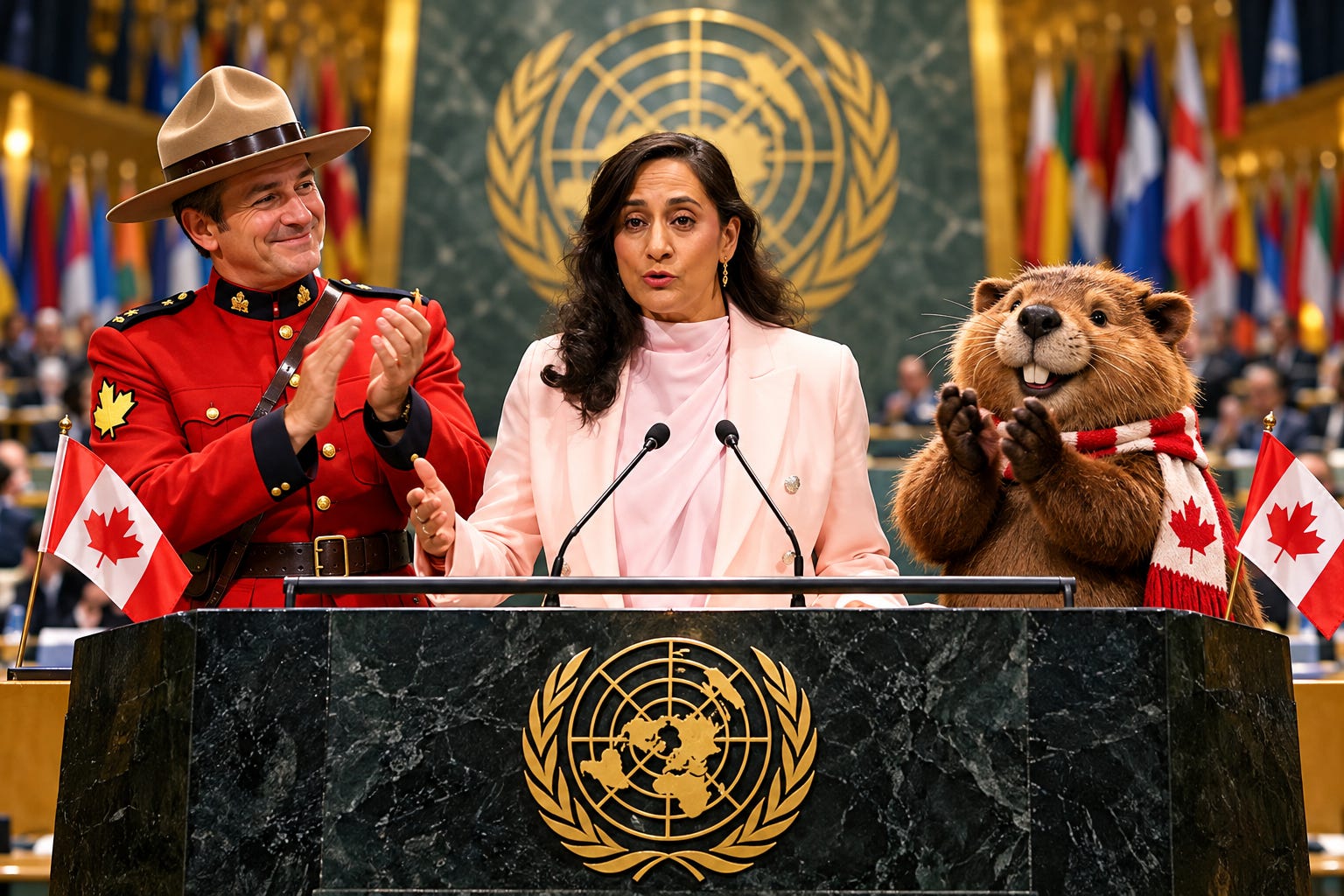
I wrapped up the opening week of the United Nations General Assembly (UNGA) watching Canadian Foreign Affairs Minister Anita Anand’s speech on Saturday. Yes, parts came across as standard middle-power fare: coalitions, UN reform, the two-state solution, the Arctic, kidnapped Ukrainian children.
But, read it twice and it’s something else. It is Canada telling the world, in our trademark, politest-possible terms, that the North American marriage is over.
Anand delivered it from the same lectern where, four days earlier, Donald Trump had defended US military action against Iran and Venezuela. The reply didn't need a name.
The tell comes in the first minute. The foreign minister told the hall that Canada faces “a rupture, not a transition.” Those are Mark Carney’s words from Davos in January, when he told the world’s business elite that great powers had turned economic integration into a weapon. At the time, analysts such as the Lowy Institute’s Sam Roggeveen noted that Carney was warning all great powers, China included. Eight months on, Anand lists China among the large economies Canada is courting (also confirmed by her boss in that long interview with The New York Times). When one of the suspects becomes a partner, you know who the letter is addressed to.
Davos was the diagnosis. The UN was the formal notice. A prime minister speaking to CEOs at an elite gathering at a Swiss ski resort is one thing. A foreign minister putting it on the record at the General Assembly is the Canadian state informing the world.
We can no longer afford to be overly reliant on any one partner. Instead, we are diversifying our ties, and building stronger relationships with new and old partners alike, so that our people can enjoy peace and prosperity - Canadian Foreign Affairs Minister Anita Anand
The messenger mattered too. Anand took the podium in soft pink and opened with her childhood in Nova Scotia as the daughter of immigrants. Her parents came from India, one of the economies Canada now says it wants to get closer to. This wasn't a central banker reading out a balance sheet, and it certainly wasn't a strongman issuing threats. It was an iron message in a silk glove. Canada served its divorce papers with aplomb and a smile. That is exactly what makes them hard to argue with.
The substance is hard to misread. Great powers, Anand said, are walking away from economic cooperation, taking apart economic integration, expecting everyone else to accept whatever terms they’re offered, and treating sovereignty with contempt. She didn’t need to name the country. Every Canadian small business owner who has watched a US order book evaporate this year knew exactly who she meant.
Then came the policy that follows from the diagnosis. The goal is strategic autonomy. Canada can no longer afford to rely too heavily on any one partner. The trading map is being redrawn toward Europe, with an “alliance for the future” with the EU, and toward the Indo-Pacific, the Gulf, Latin America, Africa, and renewed partnerships with India and China.
The closing passage was the real kiss-off. Some countries are building higher walls. Some are turning away from the UN’s principles. Some would rather pretend the rupture isn’t happening. Canada, she said, sees the world as it is.
The US doesn’t appear by name in any of the criticism. It appears only when being thanked: Secretary Rubio for convening the Arctic Seven, Washington for its Haiti contributions, and the new Greenland–Denmark–US security deal. NATO is “ironclad.” That is the shape of the break-up. We’ll still share custody of NORAD and NATO, but we’re moving on.
The UN's own news service summed it up as a call for stronger partnerships and multilateral cooperation. That is exactly how it was designed to be filed.
I spent last week in New York explaining this to anyone who would listen. Canada is swinging from a north–south axis to an east–west one. It’s the most consequential reorientation of our economy in generations, and Ottawa has now said it out loud at the UN.
The bill is already arriving. On the same Monday this went to press, Stelco confirmed it will shut its cold-rolled and coated lines in Hamilton on October 9, putting 350 steelworkers out of work. The company is owned by Ohio-based Cleveland-Cliffs, and it blamed US tariffs along with a flood of cheap imports. Stelco will survive. The machine shops, haulers and parts suppliers that live off Hamilton Works are the ones that can't pivot to Rotterdam or Mumbai in a quarter. For small and medium-sized firms like hockey stick manufacturers, the ones without in-house trade lawyers or sales offices in places like Helsinki, the gap between leaving the old market and reaching the new ones could be long and deep.
And there is no escaping geography. Australia can diversify from a distance. Canada shares a 9,000-kilometre border with the market it’s leaving. Ottawa can redraw the trade map, but it can’t redraw the actual map.
The choice has been made. The next test is whether the government builds a bridge for the companies that have to live through the move. And whether Ottawa has the chutzpah to push back if Donald Trump moves to rewrite arrangements as long-settled as shared cross-border water rights. The 1909 Boundary Waters Treaty, which has kept the peace on our shared rivers for 117 years, can be ended with a year's notice.
News Briefs
Iranian media reported that Foreign Minister Abbas Araqchi was set to meet with Qatari mediators in New York on Monday to discuss the latest proposals and positions concerning the ongoing war with the United States. The mediators were expected to hold separate discussions with US representatives on September 28 or 29, according to an official familiar with the negotiations, as diplomatic efforts continue to find a way to end the war. The talks are expected to focus on a revised version of a seven-day proposal submitted by Tehran last week on the sidelines of the UN General Assembly, an official said, speaking on condition of anonymity, told Reuters. Araqchi remains in New York following the General Assembly meetings. It was not immediately clear who would represent Washington in discussions with the mediators. Iran’s proposed framework calls for a halt to hostilities in Iran and Lebanon, the release of billions of dollars in frozen Iranian assets, the lifting of sanctions on Iranian oil, and an end to the US blockade of Iranian ports. In return, Tehran would allow the Strait of Hormuz to reopen, while negotiations between Iran and the United States on Tehran’s nuclear program would resume. US President Donald Trump said on September 26 that he had rejected Iran’s proposal, arguing that Tehran was seeking a rapid agreement because of mounting economic pressure. However, he told Axios on September 27 that he expected US negotiators to take part in further discussions this week - RFE/RL
Lawyers for The New York Times and other major publishers on Monday asked a federal court to disregard the Justice Department’s efforts to get involved in their lawsuit against OpenAI, saying the Trump administration may simply be biased in the company’s favor. The publishers are suing OpenAI for copyright infringement. The Justice Department earlier this month filed a statement supporting OpenAI’s defense in the case, arguing that copying others’ content without permission in order to train large language models is protected under the “fair use” doctrine. The newspapers on Monday responded that DOJ had discounted the Copyright Office’s contrary conclusion on fair use and AI, and noting that the government is seeking to weigh in at an especially early stage of the case. Requiring AI developers to pay for the use of copyrighted materials also would not be a meaningful setback to the administration’s goals of advancing the technology, the publishers said. The Justice Department and White House did not immediately respond to requests for comment. OpenAI also did not immediately respond to a request for comment - Politico
Ukraine’s POW disclosure angers Seoul, a partner Kyiv is courting for weapons
South Korean President Lee Jae Myung has accused Ukraine of breaking a confidentiality agreement by revealing that it handed two captured North Korean soldiers over to Seoul, Yonhap reported via The Korea Times. The dispute has now damaged relations with a country whose large arsenal Kyiv has been trying to access, the Kyiv Independent reports.
Volodymyr Zelenskyy announced the transfer in his Sept. 23 address to the UN General Assembly. The next day, speaking from Mexico City, Lee wrote on X that the two governments had agreed to keep the handover secret. He said disclosure could cause serious problems for diplomacy, national security and stability on the Korean Peninsula. “I don’t know the reasons (for the disclosure), but I regret it,” he wrote. According to the Kyiv Independent, Seoul’s Foreign Ministry escalated the dispute on Sept. 28 by summoning Ukraine’s envoy to lodge a protest.
Kyiv’s account
Kyiv tells a different story. Zelenskyy adviser Dmytro Lytvyn denied that any nondisclosure agreement existed. He told the Kyiv Independent that Ukraine had shared only the bare fact of the transfer and not the details of how it happened. In his words, it would have been “strange to simply quietly send these people somewhere.” Ukraine’s presidential office gave Yonhap a similar explanation. A South Korean official acknowledged that Seoul had been told of the announcement in advance, though only in vague terms.
Critics could also take aim of Kyiv's January 2025 release of photos and an interrogation video of the two men. It sits uneasily with the Geneva Conventions' protections for prisoners of war, protections Ukraine has repeatedly demanded Russia honour for its own captured troops.
Why it matters
The fallout comes about a month after Zelenskyy asked Seoul for air defence systems. He argued that North Korea’s growing military partnership with Russia threatens the Korean Peninsula as well. South Korea is the world’s ninth-largest arms exporter, according to SIPRI. It fields Patriot batteries and its own Cheongung-II missile defence system, and it has large stocks of K9 howitzers and 155mm shells. Seoul has again refused, citing a law against arming active conflict zones, and limits its help to non-lethal aid. The Kyiv Independent notes that South Korean shells reportedly reached Ukraine indirectly through a 2023 arrangement with the U.S. It says the current breach of trust makes a similar deal less likely.
The paper also places the episode in a series of recent diplomatic missteps by Kyiv. These include Hungary publicly denying it had joined Zelenskyy’s proposed “Carpathian Eight” forum, and a summer dispute with Poland over wartime claims.
At home, Lee faces opposition demands to make the terms of the agreement public. Ukrainian forces captured the two soldiers in Russia’s Kursk region in January 2025. They were among the thousands of troops Pyongyang sent to back Moscow’s war, and both had asked to go to South Korea.
The row lands as South Koreans grow cooler on the North altogether. A Seoul National University poll released Monday found just 39 per cent now consider reunification necessary, and among people in their 20s and 30s only about a quarter do. Researchers have long noted that the roughly 34,000 defectors in the South are often treated as cultural outsiders, and waning interest in reunification risks leaving them further on the margins.
Sources: Yonhap / The Korea Times, Sept. 25, 2026; The Kyiv Independent (Martin Fornusek), Sept. 28, 2026
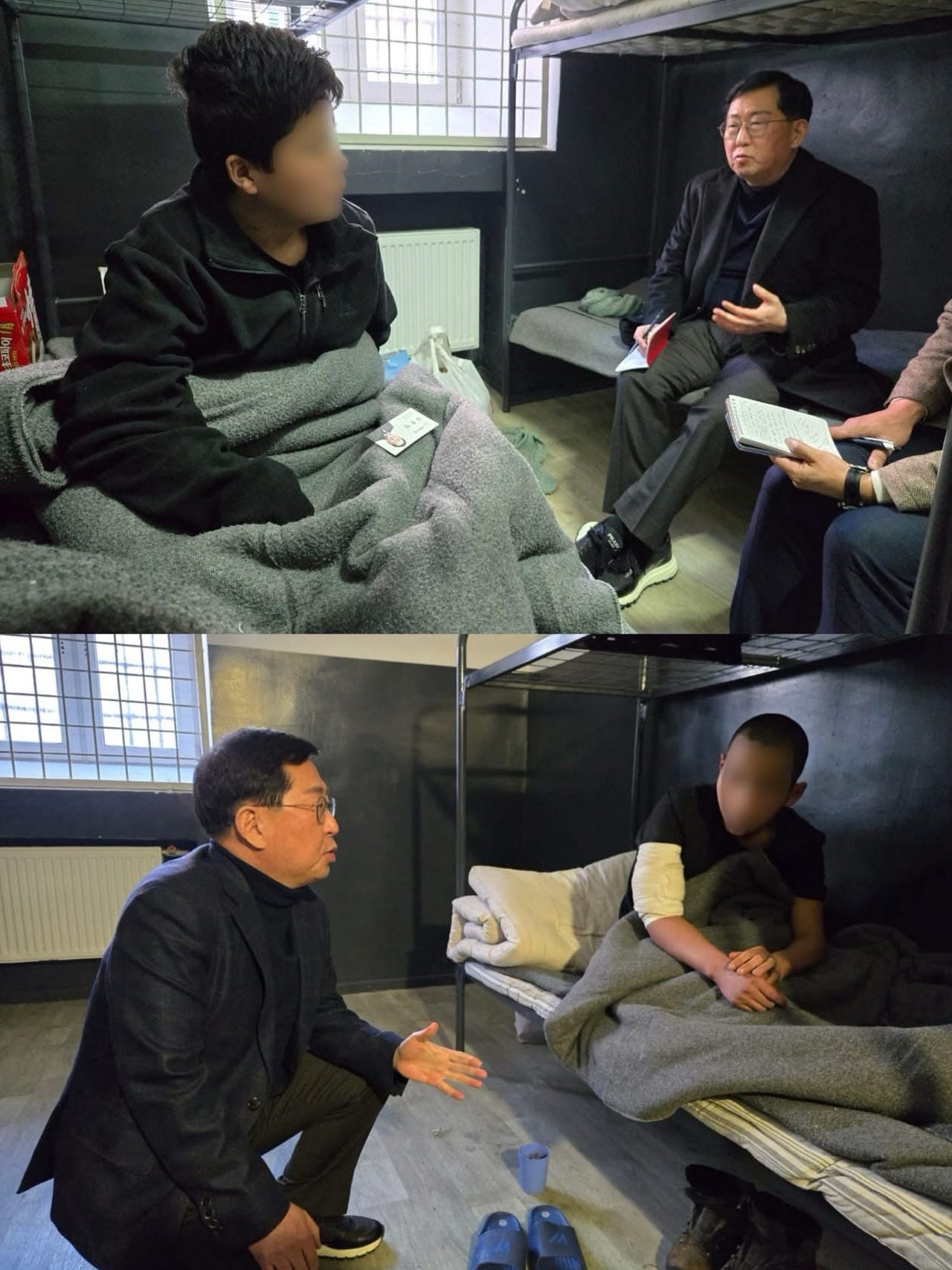
Conservative Supreme Court Justice Samuel Alito will not participate in a major climate case after facing calls to recuse himself for holding oil company stocks. The move to distance himself from the case is a reversal, NBC News reported on Monday, after the justice had previously pushed back. Alito’s move was disclosed in a one-sentence letter from the clerk of the court to attorneys involved on Monday. “I am writing to inform the parties that Justice Alito has determined that he will not continue to participate in this case,” it read - The Daily Beast
The journals…