Trump’s Beijing summit: smiles on the surface, a strategic rout underneath
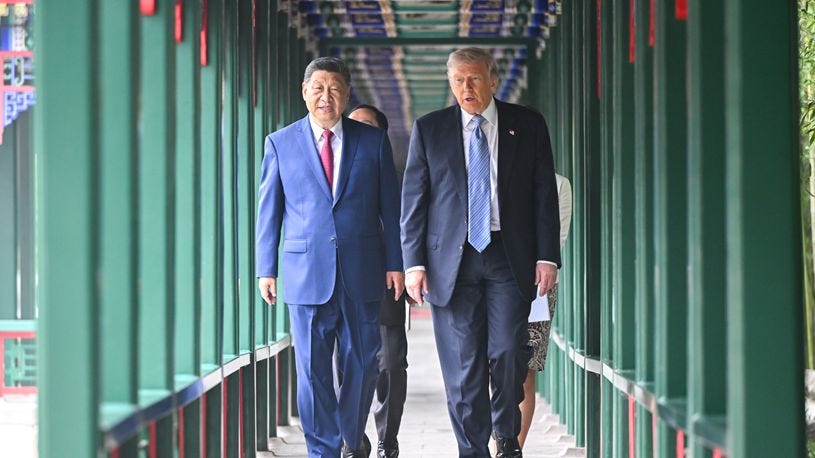
Donald Trump’s three-day visit to Beijing (May 13–15) was declared a success by both governments. Xi Jinping called for the two countries to be “partners, not rivals,” and Trump gushed about “fantastic trade deals” as he departed. He also formally invited Xi to the White House, with August now floated as a possible date.
But beneath the cordial optics, Oxford historian Peter Frankopan argues the summit was an emphatic win for Beijing. Xi opened by invoking the “Thucydides Trap” - the idea that a rising power and an established one are destined for conflict - framing himself as an equal statesman grappling with history. What followed was a masterclass in diplomatic stagecraft: Trump was seated in a smaller, lower chair than his host; he was shown around Zhongnanhai, a privilege Xi noted is extended to “very few” - pausing to mention Putin as one example. Trump’s response - “Good. I like it” - was, in Frankopan’s words, “Chinese gold.”
The symbolism extended further. The White House’s own social media account celebrated “American strength back on the world stage” over footage of Trump being welcomed by Chinese soldiers and children - an image Frankopan describes as an extraordinary own goal. Trump also publicly complained about needing a ballroom to “keep up with China,” and when asked by reporters whether the US would defend Taiwan, replied: “I’m not going to say” - adding that the “last thing we need right now is a war that’s 9,500 miles away.”
Frankopan’s verdict is blunt: poor preparation, gutted State Department expertise, and a transactional approach to foreign policy combined to produce what he calls “a set-piece of how not to do a summit.” China, by contrast, planned every detail. One side, he writes, knows how to think ahead. The other played by ear.
If this was a football match, this would be no draw; rather, an emphatic win for China
US President Donald Trump has warned Iran of consequences if its leadership fails to act quickly, issuing a stark message on Sunday. “For Iran, the Clock is Ticking, and they better get moving, FAST, or there won’t be anything left of them. TIME IS OF THE ESSENCE!” he wrote in a post on Truth Social. Meanwhile, Iran has declared that Trump’s threatening rhetoric and pressure tactics are unacceptable, insisting that the United States engage with them on the basis of mutual respect. Tehran is matching Washington’s escalatory language with equal resolve, signalling the same level of readiness and military preparedness. Iran says it is braced for any form of escalation, whether in the Strait of Hormuz or on its territory, with Foreign Minister Abbas Araghchi stating that their preparedness is effective “right now” at more than 100 percent - Al Jazeera
A fire has broken out at the Barakah nuclear power plant in the United Arab Emirates (UAE), according to the Abu Dhabi Media Authority on May 17. The fire began after a drone attack on the Barakah nuclear power plant in the Al-Dhafra region. No deaths or injuries were reported. The UAE news agency said that the fire broke out in an electrical generator outside the perimeter of the power plant and did not negatively impact the safety of the site. The International Atomic Energy Agency (IAEA) responded to the attack with a statement condemning “military activity that threatens nuclear safety is unacceptable.” The IAEA said that it had been assured by the UAE that radiational levels at Barakah remain normal and that emergency diesel generators are currently providing power to the power plants third unit. “The IAEA is following the situation closely and is in constant contact with the UAE authorities, ready to provide assistance if needed,” the agency said on X - RFE/RL
The World Health Organization (WHO) has declared an Ebola outbreak in the Democratic Republic of Congo a public health emergency of international concern. The agency said the outbreak in DR Congo’s eastern Ituri province, which has seen around 246 suspected cases and 80 deaths reported, does not meet the criteria of a pandemic emergency. But it warned it could potentially be “a much larger outbreak” than what is currently being detected and reported, with significant risk of local and regional spread. The current strain of Ebola is caused by the Bundibugyo virus, the health agency said, for which there are no approved drugs or vaccines. Early symptoms include fever, muscle pain, fatigue, headache and sore throat, and are followed by vomiting, diarrhoea, a rash and bleeding. The WHO said there are now eight laboratory-confirmed cases of the virus, with other suspected cases and deaths across three health zones including Bunia the capital of Ituri province, and the gold-mining towns of Mongwalu and Rwampara. One case of the virus has been confirmed in the capital Kinshasa, believed to be in a patient returning from Ituri. The WHO said that the virus has spread beyond DR Congo, with two confirmed cases reported in neighbouring Uganda. Ugandan officials said a 59-year-old man who died on Thursday had tested positive - BBC
A huge wave of more than 500 Ukrainian drones attacked Russia overnight, killing three people in the Moscow region, authorities said on Sunday. Air defenses shot down 556 drones in more than a dozen regions, including Moscow, Russia’s Defense Ministry said, in one of the largest Ukrainian barrages of the ongoing conflict so far. These interceptions - far above the usually reported few dozen — took place across 14 Russian regions, as well as the annexed Crimean peninsula and the Black and Azov seas, the ministry added, with the region around the capital among the worst-hit. “A woman was killed as a result of a UAV hitting a private house. One more person is trapped under rubble,” the Moscow region’s Governor Andrey Vorobyov said on Telegram, adding that the early morning attack also claimed the lives of two men. One of the victims was an Indian citizen working in Russia, the Indian Embassy in Moscow said in a statement. “Since three o’clock in the morning, air defense forces have been repelling a large-scale UAV attack on the capital region,” he said, adding four people were wounded and infrastructure facilities had been targeted. Ukrainian President Volodymyr Zelensky had vowed to launch more retaliatory strikes on Friday, a day after a Russian attack on Kyiv killed 24 people and injured around 50 more - AFP
Kremlin spokesperson Dmitry Peskov said on May 17 that Moscow could restart dialogue with Europe over Russia’s war in Ukraine, speaking to Russian propagandist Pavel Zarubin after a large-scale Ukrainian drone attack on the Moscow region. The remarks came as European officials continue debating future engagement with Moscow amid growing uncertainty over the United States’ efforts to end Russia’s war against Ukraine. “The active discussion of this topic — the shift toward understanding that at some point they will have to speak with the Russians — is good,” Peskov said. Peskov said the Kremlin is interesting in resuming communication and expressed hope that what he called a “practical approach” would eventually take shape. “The Russian side will be ready for this,” he said. At the same time, Peskov criticized EU foreign policy chief Kaja Kallas, Estonia’s former prime minister, suggesting she would not be suitable for future negotiations with Moscow. “It would not be in Kaja Kallas’s interests to act as a negotiator. It would not be easy for her. If you remember, (Russian President Vladimir) Putin said this could generally be anyone who has not managed to say too many bad things,” Peskov said. - Kyiv Independent
African heads of state are using surging commodity prices and intensifying US-China competition to push back against the continent’s traditional role as a raw material exporter. At the Africa CEO Forum in Kigali, Nigeria’s President Tinubu declared that no metal would leave the country without being processed domestically. Gabon’s President Oligui Nguema - whose country is the world’s second-largest manganese producer - called out opaque mining arrangements and ordered operators to begin local refining by 2029 or forfeit their concessions. Nigeria plans to build at least two Chinese-constructed lithium processing plants. Gabon is also capitalising on elevated oil prices driven by the Iran war, though its mature fields - producing around 227,000 barrels per day - leave limited room to ramp up quickly. Nigeria’s upside is larger, but acute infrastructure gaps persist even as the $20 billion Dangote Refinery still falls short of meeting domestic fuel demand. Rwanda’s President Kagame set the tone for the gathering: “We can’t just be people waiting to be ripped off. We must be able to say no.”
The most-watched news program on CBS is expected to undergo “massive changes” once its season ends on Sunday, a new report claims. An insider tells The Guardian that the network’s MAGA-curious news boss, Bari Weiss, is plotting sweeping changes at 60 Minutes, which is already set to lose two of its top correspondents in Sharyn Alfonsi and Anderson Cooper. “People are afraid, and they’re waiting for something monumental to happen here,” the longtime network insider told the paper. That insider added that viewers can expect massive changes to 60 Minutes for the show’s 59th season, with whispers of a newsroom shake-up that could include layoffs and opening the show to other journalists from across CBS, such as Evening News host Tony Dokoupil. Weiss, a conservative blogger with no prior TV experience before her CBS gig, was named editor-in-chief of CBS News in October after the MAGA billionaire David Ellison acquired her Free Press website. Since taking over, Weiss has axed dozens of journalists and irritated staff with editorial decisions widely viewed as benefiting the Trump administration. That includes her pressing pause on a widely publicized 60 Minutes segment about the administration sending migrants to an El Salvador mega prison without due process. Staffers told The Guardian they are worried their MAGA-curious boss will do permanent damage to the prestige of 60 Minutes, which has aired since 1968, “just like she has done with everything else at CBS News.” - The Daily Beast
The journals….