Sourced to The Korea Times; The Korea Herald (Jung Min-kyung); Chosun Ilbo; the BBC; Reuters; Yonhap; AP.
President Trump’s order to scale back joint exercises with South Korea may be an opening bid to bring Kim Jong-un back to the table, analysts in Seoul told The Korea Times. Trump said Sunday the drills were costly and sent a hostile signal to Pyongyang, invoking his good relationship with Kim and asserting the North had been respectful during his presidency. Too late to cancel Ulchi Freedom Shield outright, he said, so he had told Pete Hegseth — addressed by the department’s new title of Secretary of War — to substantially reduce it. A day earlier he had posted a photograph of his 2019 Panmunjom meeting with Kim.
It appears to be the first such order of his second term, and unlike 2018 it comes before any talks have started. Yu Ji-hoon of the Korea Institute for Defense Analyses said the timing implies intent: an early opening, possibly a second summit, to bank as a foreign policy win before the midterms. He warned separately in the Korea Herald that repeated cuts erode both combined proficiency and the consistency of deterrence signalling. Yang Moo-jin of the University of North Korean Studies called it impulsive in form, calculated in substance — and said Seoul was also an audience. In the same post, Trump complained that South Korea had refused to join his effort to denuclearise Iran.
The exercise began Monday anyway and runs to 27 August. Seoul’s defence ministry said it was proceeding at full scale, with no formal American request to trim it. Per the Herald, Korean planners detected no American move to cut the exercise at any stage. The first Seoul heard of it was on Truth Social.
The soldiers coming home
What “substantially reduce” means is undefined — but the shape of this year’s exercise tells you what is at stake. It was built around drones, GPS interference and cyberattack, and at the same briefing commanders explained why. Asked about North Korean soldiers returning from Russia’s war in Ukraine, US spokesperson Ryan Donald said the training accounts for that threat, the BBC reported.
That is the part easily missed. The North Korean army has at least spent two years learning drone-saturated, signal-jammed warfare in Ukraine — its first combat experience since 1953. Those men are going home, to a border 195 kilometres from Seoul, carrying skills the KPA did not have three years ago. The drills Trump ordered reduced are the drills designed to answer what Pyongyang has just learned.
The programme also included a live-fire test of joint precision targeting, a river crossing under simulated fire, and distribution of pre-positioned American equipment — the logistics-heavy components that prove the alliance can actually fight together, and the first to go when politics intervene. The precedent is not reassuring. Ulchi Freedom Guardian was suspended in 2018 for the first time in 28 years; Key Resolve and Foal Eagle were scrapped in 2019 and replaced with scaled-down command post drills. Large-scale field training returned only in 2022.
The pieces already gone
Nor is this the first asset Seoul has watched leave. In March, Foreign Minister Cho Hyun told parliament that Washington and Seoul were discussing redeploying some US Patriot systems based in South Korea to the war against Iran, after Yonhap reported the batteries had been consolidated at Osan Air Base with C-5 and C-17 transports on the field. USFK declined to comment on the repositioning of specific assets. There was speculation too about the THAAD battery at Seongju and the MQ-9s at Gunsan. It would not have been a first: three of the eight Patriot batteries in Korea reportedly went to the Middle East ahead of last year’s Operation Midnight Hammer, returning in October.
President Lee’s reaction is the most candid statement any allied leader has made about the present arrangement. Seoul opposed the move, he told his Cabinet, but was not in a position to make demands. USFK may dispatch air defence systems abroad according to its own military needs.
The pull is arithmetic. CSIS estimates the US has fired more than 60% of its Patriot and THAAD interceptors during the Iran war, against pre-war holdings of roughly 2,200 and 452 respectively. Rebuilding will take at least three years, with new orders arriving in 2029. Stockpiles were already judged insufficient for a China contingency before the war began. The Pentagon disputes this; spokesman Sean Parnell says the military has everything it needs.
What it costs Seoul
The order lands on more than readiness. Combined exercises are the yardstick for whether South Korea is ready to take wartime operational control of its own forces — a transfer Lee wants completed within his term. The Herald reports the allies are running those very assessments during this exercise, aiming to complete a Full Operational Capability review of the future Combined Forces Command this year, with a target date, Year X, due at the Security Consultative Meeting this autumn. Cut the exercise and you cut the evidence.
Seoul is not opposed in principle. Lee said last December he could consider adjusting the drills if it opened space for Washington–Pyongyang talks. The objection is to method, and it arrived fast. The People Power Party called it a diplomatic disaster of the government’s own making, its leader Jang Dong-hyeok predicting the bill would follow in defence cost-sharing and tariffs. Na Kyung-won reached for a phrase with history in Seoul — Korea passing, the fear of Washington dealing over its ally’s head — and said an alliance forged in blood had been reduced to cost and transactions. Former lawmaker Yoo Seong-min described centrifugal forces now pulling at the alliance from both sides.
The sharpest criticism came from outside the main opposition. Reform Party leader Lee Jun-seok noted that Washington’s assessment of North Korea as non-threatening now contradicts South Korea’s own — and when allies see the same adversary differently, trouble follows. Expanding training with some partners while contracting it with Seoul, he said, means the alliance’s centre of gravity is moving. Real deterrence, he added, is a function of hours spent coordinating, not of declarations. From Washington, Senator Andy Kim, the Korean American Democrat from New Jersey, said decisions about joint exercises need to be made jointly, and not announced unilaterally by social media.
Both Korean analysts expect Pyongyang to wait and watch. The drills began days after North Korea resumed ballistic missile testing, its first launch since late June. Yang said the North could eventually demand a full halt to exercises and push for arms-reduction talks predicated on recognition as a nuclear state. Yu warned that if Washington–Pyongyang ties outpace inter-Korean ones, decisions on exercises, sanctions and denuclearisation could be taken without Seoul.
The Hot Take — on video
Why is a correspondent usually based in Odesa covering the Korean peninsula? Watch below. The short answer is that they stopped being separate stories the day Pyongyang sent soldiers to Russia — and that connection is the kind of thing I unpack every Saturday for World Briefing Plus subscribers.
News Briefs
US President Donald Trump has threatened to launch strikes against Oman if it "gets in the way" of talks between Washington and Tehran over the Strait of Hormuz. “If Oman gets in the way, we’ll bomb the s--- out of them, Trump said in an interview with Fox News on Monday, as June’s US-Iran memorandum of understanding expired. Tehran has been locked in ongoing talks with Oman over establishing a secure passage for commercial shipping through the Strait, a strategic oil and gas transit chokepoint that connects the Persian Gulf with the Gulf of Oman and the Arabian Sea. Earlier this month, Iranian Foreign Minister Abbas Araghchi said negotiations with Oman were in the “final stages” but stressed that any agreement between the two nations did not mean that the Strait of Hormuz would be reopened, as this was dependent on additional “conditions,” per Iranian state media. Iranian Foreign Ministry spokesperson Esmaeil Baghaei said on Monday that talks between the two parties were continuing as they worked towards a joint agreement, Iran’s Fars news agency reported. He reportedly added that an “understanding” had been reached between Iran and Oman on the “navigation route map” in the Strait - which usually carries around a quarter of the world’s seaborne oil trade - Euronews
In a meeting that lasted more than four hours, US envoy Jared Kushner pressed Israeli Prime Minister Benjamin Netanyahu to move forward with the Trump-backed Gaza ceasefire plan and “not create obstacles,” according to an Israeli source familiar with the discussions. Netanyahu, who rejected the 15-point plan earlier this month, said that making progress on the plan was “problematic” because of the upcoming Israeli elections at the end of October, the source told CNN. Courting a right-wing voter base and trailing in repeated polls, Netanyahu has been unwilling to make concessions on Gaza ahead of the elections.
Instead, Netanyahu told Kushner and Board of Peace director Nickolay Mladenov that Hamas needed to take steps first, the source said. The two met with Hamas in Egypt on Sunday. Netanyahu has demanded that Hamas completely disarm before Israel begins to withdraw its forces from Gaza. But Hamas has said it’s only willing to disarm if that occurs alongside a sequenced withdrawal of Israeli forces from the enclave - CNN
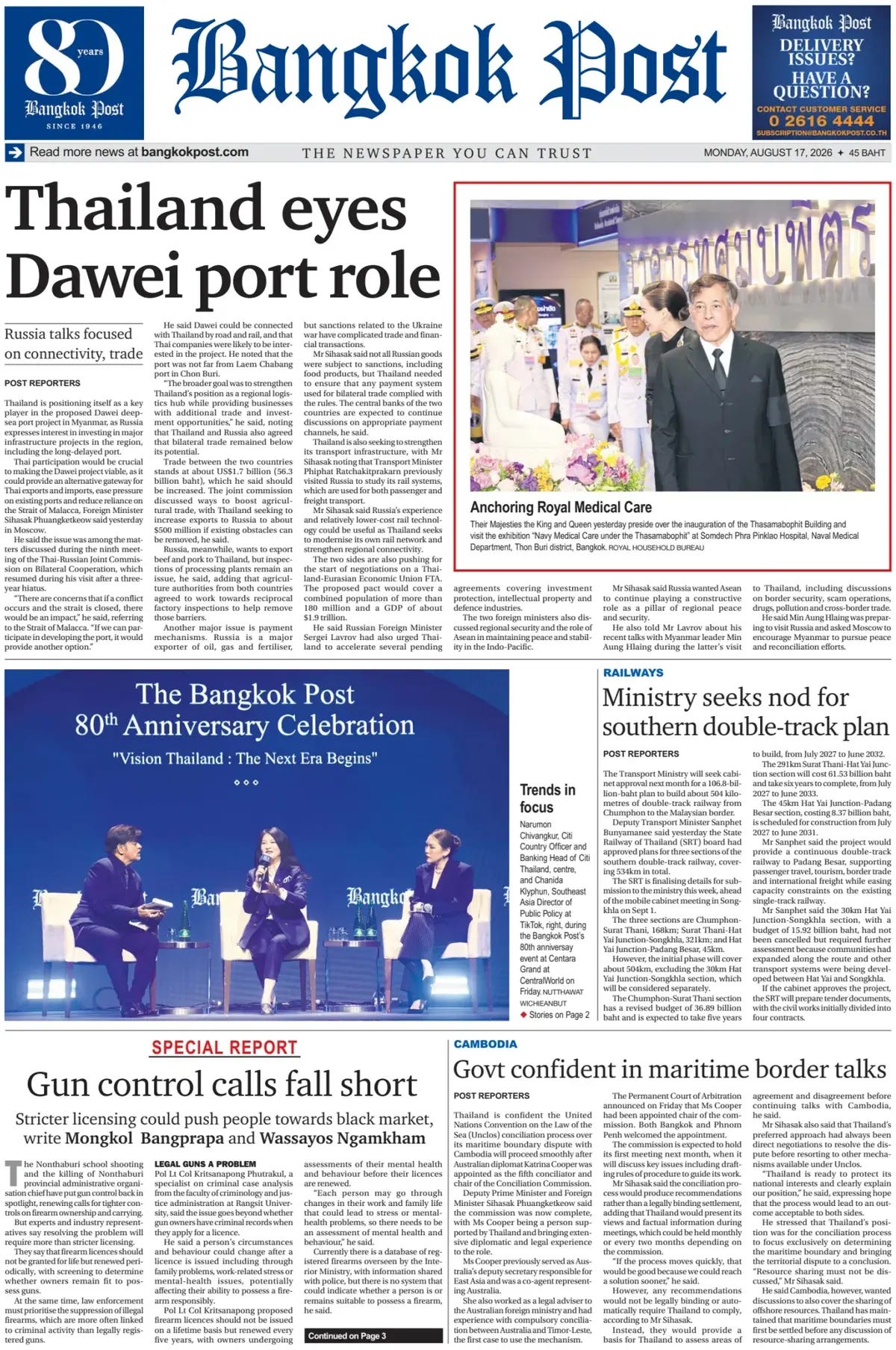
Myanmar’s junta chief-turned-president Min Aung Hlaing left for Russia on Monday for his first official visit to the country since he assumed the presidency in April, state media reported. Russia will be the fifth country Min Aung Hlaing has visited since becoming president, with official trips to India, China, Laos, and earlier this month, Thailand. The former general is the subject of a raft of Western sanctions and has been on a quest for international legitimacy since winning a vote in parliament to become president, which came after an election dominated by an army-backed party in the absence of a viable opposition. Min Aung Hlaing made four visits to Russia as junta chief, the first in June 2021 to attend a security conference, five months after seizing power in a coup. He visited twice in 2022 and again in March 2025 when he held formal talks with Russian President Vladimir Putin in Moscow. Russia is hoping to open up opportunities in Myanmar for its energy companies. The two countries signed an agreement to construct a small-scale nuclear power plant in Myanmar when Min Aung Hlaing met Putin in 2025. Russia and Myanmar signed a memorandum on investment cooperation for the strategically located Dawei Special Economic Zone in February 2025, including the construction of a port and an oil refinery. Min Aung Hlaing’s latest trip includes a Myanmar-Russia business forum. Joining him will be the chief minister of the Tanintharyi region, where Dawei is located, and the head of Myanmar’s aerospace agency, according to state media. Defense ties have grown in recent years with Moscow providing army training and university scholarships to thousands of Myanmar soldiers, as well as selling arms to a military blacklisted by some Western countries. Earlier this year, Russia also said it would help train Myanmar’s first cosmonaut - Reuters
A judge in the Pskov region has sentenced veteran opposition politician Lev Shlosberg to 11 years and one month in prison for “discrediting” and spreading “fake news” about the Russian military, Russian media reported Monday. The sentence partially combines near-maximum penalties under wartime censorship laws with a previous November 2025 conviction in which Shlosberg was sentenced to 420 hours of community service for violating Russia’s “foreign agent” law, the exiled news outlet Mediazona reported. State prosecutors had sought a sentence of 12 years and one month in prison. Shlosberg, a senior member of the liberal political party Yabloko, pleaded not guilty, instead accusing prosecutors of “discrediting” Russian law. “I am an innocent man, against whom criminal charges have been unlawfully brought, who was unlawfully deprived of liberty pending a court verdict, and who is being unlawfully deprived of liberty following a court verdict,” Shlosberg said in his final statement in court - Moscow Times
U.K. Prime Minister Andy Burnham engaged with messages from somebody impersonating one of Donald Trump’s closest advisers, four officials have told POLITICO. The new PM communicated with someone posing as White House chief of staff Susie Wiles before becoming suspicious that the contact was illegitimate, the officials said. “We do not comment on national security matters,” Downing Street said. One person briefed on the communications said a “few messages” were exchanged after the PM entered No. 10 but insisted they were “of no significance.” The British embassy in Washington was so concerned about the incident that it raised it with the White House, two of the officials said. Like others in this article, they were granted anonymity to discuss a matter of national security. Inside the U.K. government, there were fears that Wiles’ phone had been hacked again. Last year, the White House and the FBI launched an investigation after senators, governors and U.S. business executives received texts and phone calls from someone claiming to be Trump’s chief of staff. The Wall Street Journal reported that Wiles told associates her cellphone contacts had been hacked. What was discussed in the exchange with Burnham — and when the messages were sent — is unclear, with the erroneous contact kept a closely-guarded secret. Burnham became PM on July 20, but it was clear he was on course to succeed Keir Starmer from the moment he won the Makerfield by-election on June 18 - POLITICO
The journals…