Europe’s finance ministers won a small symbolic battle in Asheville on Monday and quietly lost the larger one.
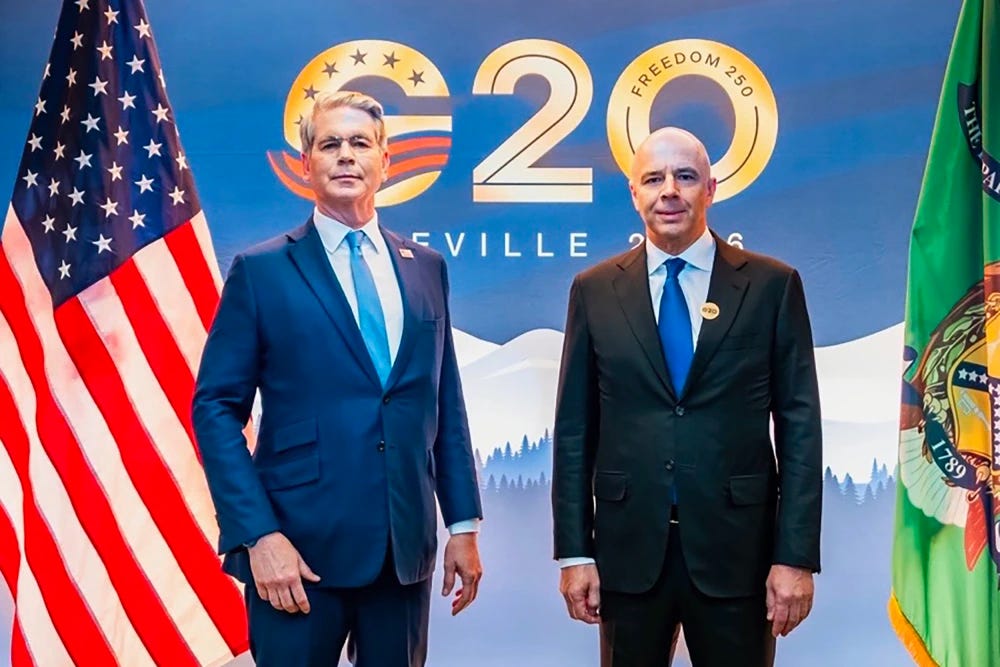
Russian Finance Minister Anton Siluanov walked into the G20 finance ministers’ meeting in North Carolina — his first in-person appearance since Russia’s full-scale invasion — with no advance word to allies. The Trump administration, which holds the G20 presidency this year, simply seated him. Germany’s finance chief, Lars Klingbeil, told his European colleagues he would not stand beside the man; the Europeans held, and the traditional family photo was taken without Siluanov, out of camera range. Then Scott Bessent posed for a picture (above) with him alone.
That is the day in one frame: allies preserving a symbol, Washington cheerfully trading it away for the bilateral it actually wanted.
The pushback inside the room was real. Klingbeil confronted Siluanov in plenary. Poland’s Andrzej Domański said Russia lies constantly. Bessent, by one account, cut Siluanov off when he tried to raise areas of mutual interest: nothing is possible until the war is over. Fine. But the White House line — that this president will never shy away from talking to the people he needs to talk to — is not a strategy, it is a permission slip. Follow it honestly and there is no argument against seating Pyongyang at the next one.
Now hold the seating chart up to the light. South Africa, a founding member, was snubbed through its own presidency — Washington boycotted the Johannesburg summit outright — and has since been barred from the 2026 meetings altogether, the first exclusion of its kind in the group’s history. Domański, whose government is not a member either, was in the room as a guest of the host. And the chair a founding member is not permitted to occupy was warmed on Monday by the finance minister of the state prosecuting the largest war in Europe since 1945. That is not a rules-based forum. It is a guest list.
Consider what that state was doing while its minister sat there. The barrage on Kyiv began at six o’clock the same evening — 218 drones and decoys, a third of them jet-powered, plus ballistic, cruise and anti-radar missiles across nine regions. At least twelve dead, six of them railway workers killed by a ballistic missile on a depot. Ukrainian children went back to school in the morning through it. Sixth consecutive day.
Here is what should worry allied capitals more than a photograph: none of this was improvised. It was a sounding. Put a Russian minister in the room unannounced, see what the traffic will bear, and price the G20 December leaders’ summit version accordingly. The answer came back on Monday: a photograph he was cropped out of, and then everyone sat down again.
Washington has said since April that Russia is invited to every G20 meeting this year, the December leaders’ summit at Trump National Doral included. Moscow accepted. Who it sends is deliberately unresolved — the Kremlin’s formulation is that Putin may go, may not, or someone else may go in his place, and Trump has said he doubts his guest will come while making clear he would be delighted if he did. That ambiguity is not an accident; it is leverage, and it runs until December. Anchorage last August is the precedent, and it should be read as a warning rather than a memory. Trump gave Putin a red carpet, a military honour guard and a motorcade, and came away with nothing — no ceasefire, no prisoner release, not even a communiqué. The Kremlin wrote the staging and Washington paid for it. Doral would be Anchorage with nineteen witnesses and a greens fee.
So the declaration needs to come now, as I said on BBC World Television this evening from Jakarta, before the seating chart is drawn, not in the departure lounge in December. If Putin comes to Miami, we do not. Not a walkout. Not another photo boycott. An absence. Otherwise members will arrive in Florida and discover, as they did in Asheville, that the arrangements were made without them.
The counterweight came, of all places, from Bishkek. With cameras rolling and Putin beside him, India’s Modi called him “my friend,” praised the trade relationship, and then told him that every day the war continues sets humanity back and that the world must move from endless war to an end of war, to a cessation of hostilities. Politico’s correspondent described Putin as visibly uncomfortable, looking at the floor and tapping his feet. It is the sharpest Modi has been since Samarkand in 2022, when he told the same man this was not an era of war — and more pointed, because Samarkand was a lament about war in general and this was a demand about a particular one. Putin’s answer was gratitude and a promise: thank you, prime minister, we are moving forward along this path. Six hours later the missiles hit Kyiv.
Note the symmetry. On the day India publicly told Russia to stop, the United States seated Russia’s finance minister at its own G20 table for the first time since the invasion. New Delhi delivered the message Washington used to deliver. Washington delivered the chair. Talk about mixed messaging.
Now the discount. Modi’s language has moved; India’s barrels have not. Russia supplied more than half of India’s crude in June and July and around 43 per cent through late August, and Russian exports to India ran past $34bn between April and July, up some 60 per cent year on year. He is also speaking with a gun on the table. Washington cut India’s tariff to 18 per cent in February on the understanding that New Delhi would wind down Russian crude — an understanding the Indian side never put in writing — and on 7 August the US Senate voted 86 to 11 to authorise tariffs of up to 100 per cent on the largest buyers of Russian oil (but the Lindsey Graham legacy bill is struggling to get on the House agenda). Twelve days from now, Modi hosts Putin in New Delhi for BRICS.
So: a real shift, and a cheap one. The tone has moved. The alignment has not. The refinery contracts have not moved at all.
And New Delhi is no longer the interesting case. I am writing this from Jakarta, where the government of Prabowo Subianto has agreed to take up to 150 million barrels of Russian crude in stages through the end of the year — at least half of a year’s worth of the country’s crude imports — on preferential terms, under a government-to-government framework built by presidential regulation. The imports are routed through Lemigas, the state oil and gas testing centre, rather than through Pertamina. That is not an administrative quirk. It is a shield: structure the trade so the exposed party is the state itself and no Indonesian company has to weigh the sanctions risk. The first cargo, ESPO crude out of Kozmino, docked at Balikpapan in June.
Jakarta will tell you, correctly, that this is energy security — Hormuz closed, crude above $100, fuel rationing at home, production long past its peak. But note what made it possible. Washington issued its first waiver for Russian barrels in March. Once the United States conceded that Asia could not balance its oil market without Russian crude, the sanctions architecture stopped being a wall and became a queue.
Which is the thread running through all of it. The waiver in March, the seat in Asheville, the open question of who walks into Doral in December. Each was defended on its own terms as pragmatism. Together they are a policy, and everyone outside the room can see it — which is precisely why the middle powers are hedging, and why Modi can say the right thing in Bishkek while buying about two-million barrels a day from the man he is saying it to.
Ukraine’s foreign minister put it more plainly than I can, hours after the strikes: it is time to signal to the Kremlin that imitating diplomacy does not work anymore.
Speaking to BBC World from Kuala Lumpur on Merdeka Day — Bishkek and Asheville convened on identical dates and made opposite offers. Putin worked nine bilaterals; Washington told allies that dollar access means cutting Tehran off. Recorded before we learned Russia's finance minister had turned up in Asheville.
News Briefs
Russia launched a large aerial assault in and around Ukraine’s capital overnight into Tuesday morning, killing at least 12 people and wounding more than a dozen others, including three children, local authorities said. Ukraine’s air force said that Russia began the attack at 6 pm on Monday, using ballistic, cruise and anti-radar missiles, as well as 218 drones and decoys. About a third of the drones were reportedly jet-powered. The main targets were the Kyiv and Odesa regions, the air force said in a statement on Telegram. It was the first day of the school year, with several million children returning to class. The overnight strikes marked the sixth consecutive day of Russian attacks on Kyiv, following an unprecedented stretch of air raid alerts that began last week. The warnings continued at a near-constant pace throughout the rest of the week, forming a sustained, multiday barrage that has increasingly involved the use of fast, jet-powered drones. The relentless attacks have subjected Kyiv and its residents to prolonged danger and disruption, with strikes coming during both nighttime and daytime hours - Euronews
U.S. Treasury Secretary Scott Bessent told Russian Finance Minister Anton Siluanov on Monday that Washington will not grant Russia economic relief or negotiate side agreements until Moscow ends its war against Ukraine, a source told Reuters. The meeting between Bessent and Siluanov took place on the sidelines of a G20 summit of finance ministers and central bank governors in Asheville, North Carolina. The United States currently holds the rotating G20 presidency. Siluanov’s unexpected visit, his first in-person attendance at a G20 event since the 2022 invasion of Ukraine, drew immediate criticism from European officials. “Receiving the Russian finance minister here sends a signal I find troubling,” German Finance Minister Lars Klingbeil told reporters. Klingbeil said he would have preferred a clear U.S. stance denying Siluanov a regular guest platform. Earlier, a U.S. official told Reuters that the focus of the Bessent-Siluanov meeting was President Donald Trump’s peace plan for Ukraine. Russia‘s Finance Ministry said the two officials discussed economic cooperation within the G20 framework. However, when Siluanov tried to discuss areas of mutual interest, the source said Bessent interrupted him, emphasizing that “nothing is possible until the war is over.” Asked about Siluanov’s attendance, White House spokesman Kush Desai told AFP that the Trump administration has been working with Russia to push for a peace deal that “would stop the endless bloodshed that the president has really condemned.” “The president and the administration will never shy away from talking with the folks we need to talk to, to further that,” Desai said. “That’s what we’re working on here at the G20.” - Moscow Times
The UK Maritime Trade Operations center (UKMTO) reported that a tanker was struck by three unknown projectiles while completing an outbound transit of the Strait of Hormuz. According to UKMTO Warning 124-26, the incident occurred approximately 17 nautical miles (31 km) east of Khasab, Oman, on August 31. UKMTO said the tanker reported being struck by three unknown projectiles. The agency reported no casualties or environmental impact and said authorities were investigating. It advised vessels operating in the area to transit with caution and report suspicious activity. Separately, UKMTO said on August 31 that it had received a report of an incident involving a tanker and military forces in the Indian Ocean. The agency provided no further details and said relevant investigations were ongoing. The incidents come amid a renewed escalation between the United States and Iran and heightened security concerns around the Strait of Hormuz. Meanwhile, US President Donald Trump claimed an average of 30 ships a night are passing through the Strait of Hormuz with the assistance of the US Navy - RFE/RL
Solar surpassed coal as China’s top source of power for the first time ever, underscoring the country’s remarkable rollout of green energy as it looks to contain the impact of the Iran war. Solar accounted for almost a third of total installed capacity at the end of July, up from virtually nothing just a decade ago. The world’s largest oil importer has ploughed into renewables at an unprecedented scale, expanding overall power generation and boosting energy-intensive industries like AI. The Iran war has proved that Beijing’s long-term energy strategy was prescient, an expert argued: “China’s dependence on imported oil remains substantial, but the geopolitics of energy are shifting,” a researcher at the Oxford Institute for Energy Studies wrote - Semafor
The journals…