Connecting the dots so you don't have to. This is a special combined edition of World Briefing, covering the breaking news out of the Middle East as well as curated headlines from today and yesterday.
For two decades, aviation security has been designed around one threat: the person on the other side of the cockpit door. The door is reinforced, locked and armoured, and cabin crew are trained to defend it. Since 9/11, all of it has assumed that the danger is in the cabin.
Flydubai flight FZ1073 has blown that assumption apart, for the second time in a decade.
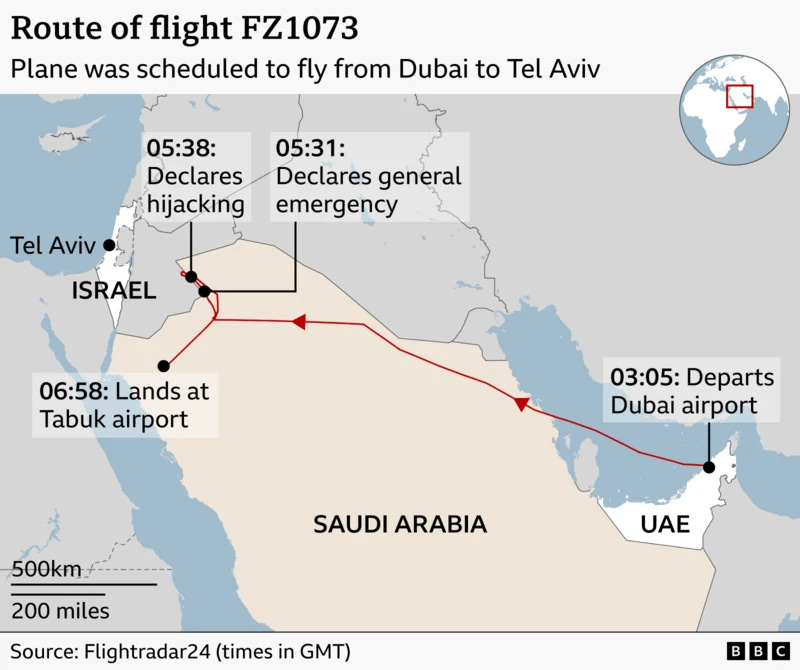
According to Israeli officials, the co-pilot on the Dubai–Tel Aviv service stabbed the captain and then tried to crash the aircraft, which was carrying more than 170 Israelis. Flightradar24 data cited by Reuters shows the jet dropping nearly 14,000 feet in under 30 seconds before the first emergency signal was sent. Passengers, joined by a member of the crew, broke into the cockpit and subdued him. A second pair of pilots, on board to take over for the later part of the flight, landed the aircraft safely at Tabuk in Saudi Arabia.
Fighter jets were scrambled in response to the ‘7700’ and ‘7500’ distress alerts - the first being a general emergency and the latter the more serious hijacking or unlawful interference.
Netanyahu called it “a highly severe security incident.” Two Israeli officials told CNN the co-pilot was an Omani national, which Reuters has also reported. Oman and Israel have no diplomatic relations.
“Like 9/11,” but averted
Ian Bremmer of The Times told Times Radio this morning this could have been a 9/11-scale event. The comparison is apt. On United Flight 93 in 2001, passengers learned what was happening, rushed the cockpit and tried to take the aircraft back from the hijackers. They could not save it, and it crashed into a field near Shanksville, Pennsylvania. Twenty-five years later, passengers again forced their way to the front of a plane that was being turned into a weapon. This time the aircraft survived.
According to Bremmer, luck mattered too. A jet in a steep dive can be recovered fairly easily, he said, provided it hasn’t reached excessive speed or suffered structural damage. FZ1073 was stopped before it reached that point.
The Omani question
How did an Omani pilot end up on a flight into Israel at all? An Israeli official told CNN that this is one of the central questions investigators are examining: why the crew included a pilot from a country with which Israel has no diplomatic relations. It is still unclear how he obtained clearance to fly there.
Bremmer noted that pilot backgrounds are already reviewed closely, particularly in the Middle East.
That makes the lapse, if it was one, harder to explain. Gulf carriers depend heavily on expatriate pilots, and Bremmer said it would be normal for relief pilots to come from countries such as Britain or South Africa. An Omani first officer at a Dubai airline is unremarkable in itself. What is remarkable is that one appears to have been rostered to Tel Aviv.
A caution: the early reporting is messy. Reuters notes that some Israeli outlets identified the pilots as Omani and Emirati, while others said they were Russian and Ukrainian. Some reports described the incident as a suicide attempt. Flydubai says the reasons remain unknown and has warned against premature speculation.
Israel is not waiting. Netanyahu has ordered tighter security for both Israeli and foreign carriers flying into the country. “Every pilot that is going to be flying into Israel, we are going to know the pilots’ identities, know who they are, and do some type of security check,” Doron Spielman, a Netanyahu spokesperson, told Reuters. Israel’s Transport Ministry says it will investigate jointly with the defence establishment.
A state-owned problem
This is not just an airline’s crisis. Flydubai is owned by the government of Dubai. Its Dubai–Tel Aviv route began in late 2020, and Netanyahu met the inaugural flight. It was one of the most visible and commercially successful symbols of the Abraham Accords.
The timing could hardly be worse. Netanyahu met UAE President Sheikh Mohamed bin Zayed in the Emirates only on Sunday. Earlier this year, Israel sent Iron Dome systems and personnel to help the UAE defend against Iranian attacks. Now a state-owned Emirati carrier, on the route that embodies normalisation, has come close to being deliberately crashed with more than 170 Israelis on board. The UAE has yet to comment.
The co-pilot is now in Saudi hands. Netanyahu says Saudi authorities will interrogate him, which puts the investigation in a country that also has no diplomatic ties with Israel. Politics at home will add pressure. Israelis vote within weeks in the first election since October 7, and security minister Itamar Ben-Gvir has already framed the incident as terrorism.
The fallout is already visible. Bremmer pointed to disruptions across the region, including reports that Dubai–Tel Aviv flights have been suspended. He also said there will “probably be some sort of Israeli retaliation.” What that would look like, and against whom, is unclear until the attacker’s motive is established.
There is a commercial cost too. Reporting from Tel Aviv as a Flydubai relief flight arrived, a BBC correspondent said it was not clear whether an air marshal had been on board FZ1073, as there is on every Israeli airline flight. He described the incident as what looks like an attempted hijacking by a member of the cockpit crew. His most telling point was that Israelis may now be wary of flying on foreign carriers that lack that extra layer of security. For Gulf airlines that have built a lucrative business on the Israel routes opened by the Abraham Accords, that is a serious threat.
A threat the system was not built for
As part of World Briefing’s coverage, we spoke exclusively to a recently retired North American airline pilot who flew wide-body aircraft on international routes. He said newer aircraft, such as the Boeing 737 MAX, have several additional security features at the cockpit entrance, including cameras that let pilots see who is at the door before they open it.
The limits of those features are the point, though. Every one of them faces outward, toward the cabin. The cockpit door exists to keep attackers out. It does nothing when the attacker is already inside, and it can become a weapon for him.
On FZ1073, a 737 MAX, the door was nearly decisive. A Netanyahu spokesman told Reuters that the wounded captain, bloodied and lying on the floor, managed to trigger the door release. Only then could passengers get in. In other words, the aircraft's rescue depended on a stabbed man staying conscious long enough to reach a switch. According to our pilot source, it unlocks the door when turned 90 degrees to the left.
Pilots are trained for fires, decompressions, engine failures and unruly passengers. Few, if any, are meaningfully trained for being attacked by the colleague beside them, at altitude, with the controls within reach of both. Flight decks are also not weapon-free zones. A crash axe is standard emergency equipment on most airliners, and investigators will want to know how a knife reached the cockpit.
Exclusive: Lufthansa’s thin line at the cockpit door
Airlines everywhere will now be asked what happens on their own flight decks when one pilot steps out. At Lufthansa, the answer is raising concern inside the company.
Last year Lufthansa introduced its much-promoted Allegris first-class cabin. Under the new staffing model, a single flight attendant looks after the four-seat first-class cabin at the front of the aircraft and handles both the galley and passenger service. The previous standard was two attendants for eight passengers. Cabin crew protested in a letter reported at the time by the German aviation outlet aeroTelegraph, calling the change “a clear decline in service quality.”
The objections so far have been about service. World Briefing has learned from a highly reliable aviation source that there is a safety dimension no one has reported. When one of the pilots leaves the flight deck, for example to use the lavatory, that same lone first-class attendant is expected to guard the cockpit.
Beneath One Mile at a Time's coverage of the crew protest, a commenter identifying as a purser at a US airline described what the forward attendant also handles on long flights: feeding the pilots, entering the flight deck during their breaks and blocking the aisle while they are out. Procedures vary by airline, but the point stands: at the front of the aircraft, service and security fall to the same person.
So, the arrangement could be seen as doing little for the safety of the aircraft. One crew member is running a galley and serving premium passengers while also acting as the last safeguard at the cockpit door. After FZ1073, that also means being the only other person watching the pilot who stays behind.
For Lufthansa, this is a painful place to be. Germanwings flight 9525, deliberately crashed into the French Alps by its co-pilot in 2015 after the captain was locked out, was operated by a Lufthansa subsidiary. That disaster made the few minutes when one pilot is alone on the flight deck the most closely examined gap in commercial aviation. A decade later, the group is reportedly assigning that gap to one stretched flight attendant.
Lufthansa did not respond to a request for comment by publication time
We have been here before
Germanwings 9525, March 2015. On a flight from Barcelona to Düsseldorf, co-pilot Andreas Lubitz waited until the captain left for the lavatory, locked him out of the cockpit and deliberately flew the Airbus A320 into the French Alps. All 150 people on board died. The reinforced door, built to stop hijackers, kept the captain from saving his own aircraft. Europe briefly required two people in the cockpit at all times, then largely dropped the rule.
Malaysia Airlines MH370, March 2014. The Boeing 777 vanished on a flight from Kuala Lumpur to Beijing and is believed to have ended in the southern Indian Ocean, far off Western Australia. The main wreckage has never been found. The official investigation reached no conclusion on the cause, but one of the most persistent theories among investigators and analysts is that someone on the flight deck deliberately diverted the aircraft.
Readers in Southeast Asia will also remember SilkAir 185 (1997) and EgyptAir 990 (1999), both widely attributed to deliberate pilot action. More recently, in 2023, an off-duty Alaska Airlines pilot riding in a cockpit jump seat tried to shut down the engines of a Horizon Air jet in flight.
The pattern is uncomfortable. Pilot-initiated disasters are rare, but they are not freak events. The industry has mostly treated them as mental-health failures to be solved by peer-support programmes and medical checks. FZ1073, if the early reporting holds, adds violence, a weapon and possibly a political motive to that profile.
What comes next
Crew vetting. Israel is already moving to screen every pilot flying into the country. Gulf carriers that rely on multinational crews will face pressure to show how they vet pilots for politically sensitive routes.
Flight-deck protocols. The two-person cockpit rule, abandoned after Germanwings, will be back on the table, along with harder questions about crew screening for weapons and who guards the door when a pilot steps out.
Training. Pilots train endlessly for mechanical failures. Very few train for being attacked by the person beside them.
Passenger confidence. If Israeli travellers shift back to Israeli carriers with armed marshals on board, the Gulf airlines that profited most from normalisation will feel it first.
Motive and fallout. Mental-health crisis, ideologically driven attack, or something else? The answer, now in Saudi hands, will decide whether this remains an aviation-safety story or becomes a regional security crisis.
Credit belongs to the passengers and crew member who broke into a cockpit, to a wounded captain who reached the door release, and to the relief pilots who landed the plane. FZ1073 did not end like Flight 93 or Germanwings because of them. It was not stopped by the security system, and that is what regulators will have to confront.

Your support is what keeps me on the front lines, in the rooms where decisions get made and the backrooms where secrets are shared, and able to report on what others miss. If you value independent, on-the-ground analysis, please consider upgrading today. For a limited time, annual subscriptions are 30% off. It makes a real difference.
News Briefs
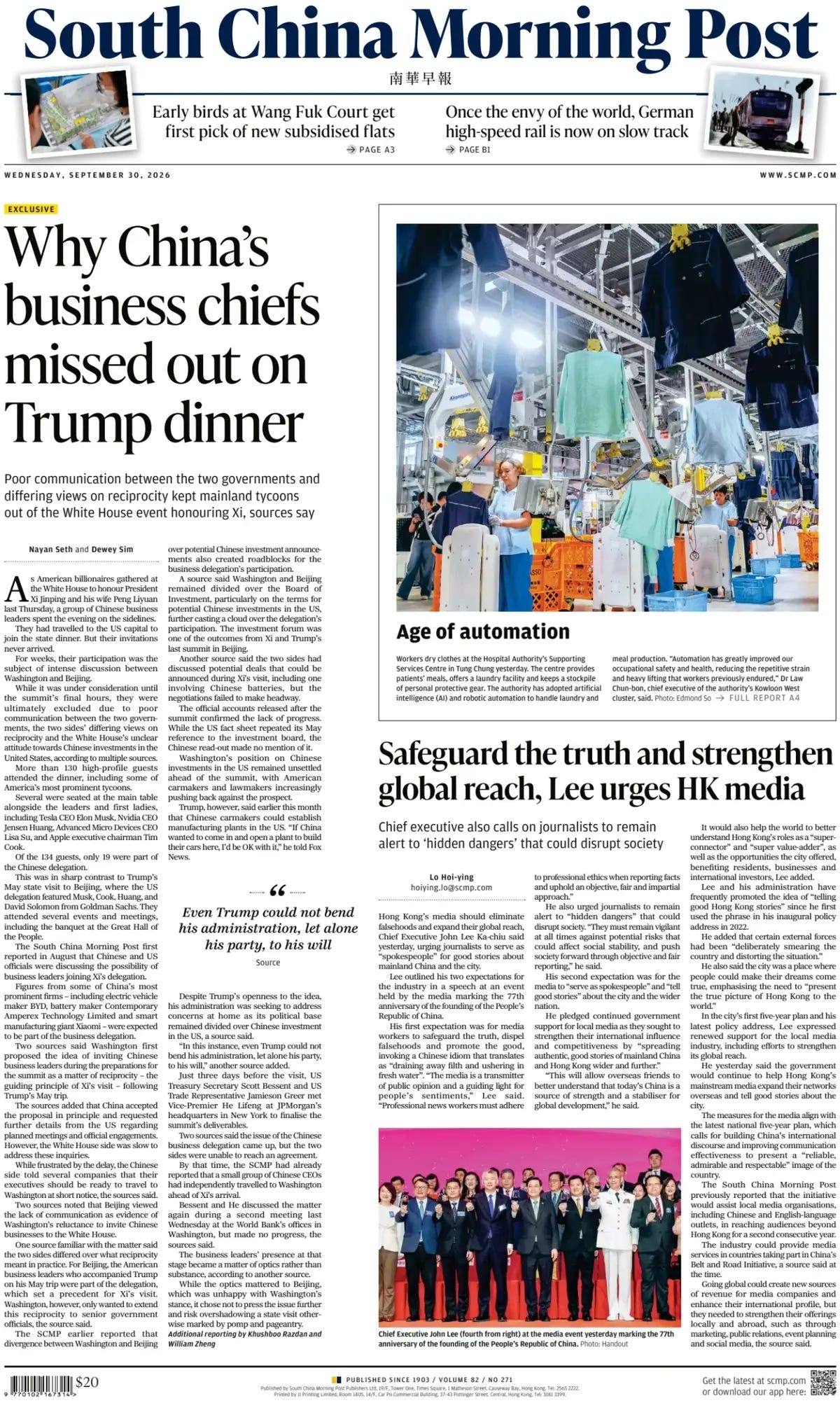
A delegation of China’s top business leaders was left out of last Thursday’s White House state dinner honouring President Xi Jinping. Poor communication between Washington and Beijing and a dispute over reciprocity kept them away, according to an exclusive report in the South China Morning Post citing multiple sources. More than 130 guests attended, including Elon Musk, Jensen Huang, Lisa Su and Tim Cook. Only 19 were part of the Chinese delegation. Executives from firms such as BYD, CATL and Xiaomi had been expected to join Xi’s entourage, but their invitations never arrived. Beijing had asked to include its business leaders as a matter of reciprocity. It pointed to Donald Trump’s May visit to Beijing, when top American CEOs attended the Great Hall of the People banquet and other official events. Washington was willing in principle but slow to respond, and it wanted reciprocity to apply only to senior government officials. Sources said the White House was also wary of domestic political backlash over Chinese investment in the US. The two sides also failed to agree on a joint Board of Investment. Potential deals, including one involving Chinese batteries, were never announced. Official readouts confirmed little progress: the US fact sheet repeated its earlier reference to the investment board, and the Chinese account didn’t mention it. Trump has recently said he would welcome Chinese carmakers building plants in the US. Even so, American automakers and lawmakers continue to resist. Beijing ultimately chose not to press the issue and risk overshadowing the visit. One source said the business leaders’ presence had become a question of optics rather than substance.
Donald Trump on Tuesday said he backed the idea of a ban on diesel exports, which some US politicians are calling for as a way to curb the soaring cost of energy. Diesel prices have rallied in Europe and the US to record highs as wars in Iran and Ukraine sharply cut exports from some of the biggest producers such as Russia, Saudi Arabia and the United Arab Emirates. A gallon of diesel fuel in the US was $6.53 on Tuesday, the highest average on record and more than 75% higher than a year ago. “I’ve said let’s not send out the diesel. We make a lot of diesel … I’ve called for it. I’ve called for it within my people,” Trump told reporters before a meeting with the Ukrainian president, Volodymyr Zelenskyy. The US treasury secretary, Scott Bessent, speaking at the same meeting, said: “We’re examining whether it’s feasible in terms of the overall refining capacity and whether a full or partial ban would work.” On Sunday, Trump urged Zelenskyy to pause strikes on Russian oil refineries over concerns that they could further push up prices, the Financial Times reported. On social media, Trump wrote that Russia “unfortunately lost control of its Diesel Oil Industry”. Some Republican Senate candidates in the most competitive midterm races called for the administration to implement the export ban to try to alleviate high costs for Americans. In a statement, the American Fuel and Petrochemical Manufacturers trade group said that an export ban would “backfire”, noting that domestic refiners would have to reduce production and “producing less diesel also means producing less gasoline”. Trump said he and Zelenskiy would discuss Ukrainian attacks on refining sites in Russia. “It is a serious hit on the Russians. It’s also a serious hit on the price of diesel,” said Trump, who also told reporters the two leaders would discuss working out a solution to end Russia’s war in Ukraine. “I think it’s going to happen,” Trump said, of a potential solution to the war - The Guardian
Donald Trump has held crisis talks with advisers over whether to impose a diesel export ban or take other steps to contain a fuel crisis that threatens to derail his Republican Party’s midterm election campaign - FT
A US diesel export ban could seriously impact the UK. Before the 2022 invasion of Ukraine, Russia supplied roughly a fifth of the UK’s diesel. But the US is now a major supplier, accounting for around a third of Britain’s diesel imports, with imports providing some 55% of its total diesel usage. Back in the early 2000s, Britain’s diesel import reliance was 14%. In the last half century, domestic refining fleet has shrunk dramatically from 18 to four operational major crude refineries, with the UK’s heavy domestic carbon pricing and net zero regulatory costs accelerating that trend in recent years. In the last 18 months alone, Grangemouth in Scotland and the Lindsey refinery in Lincolnshire have closed, with the owners of both plants and trade unions citing “the costs of green regulation” as a major contributing factor. UK diesel costs around £1.98 on garage forecourts, sharply up from £1.40 in mid-2025. Industry analysts warn that Trump’s US export ban will intensify competition for diesel supplies across Continental Europe, which already relies heavily on US diesel exports, as supplies from war-damaged refineries in the Middle East and Russia have plummeted.
As such, the UK may struggle to keep sourcing diesel from European suppliers, including the Netherlands, Sweden and Belgium. That’s why industry analysts warn Trump’s ban could see UK diesel prices surge this autumn, from just under £2 a gallon now to £2.50 or even £3 per litre - The Telegraph
As the US doubles down on its overhaul of global trade, Trade Representative Jamieson Greer is welcoming his G20 counterparts to Milwaukee for two jam-packed days of ministerial sessions and bilateral meetings. The gathering, which sets the stage for the G20 summit in Miami at the end of the year, follows similar engagements on finance and innovation last month. Tensions are highest this week: The US is still trying to force concessions from key trading partners, including through a ban on some Canadian imports that took effect earlier this week. “At some point, will there be a deal [with Canada]? I mean, presumably,” Greer told reporters Tuesday night. “But … it’s not urgent for us.” Attendees are slated to discuss steel overproduction and tour Rockwell Automation before huddling Wednesday afternoon and most of Thursday. All events, except for Greer’s press conference Thursday, will be closed to reporters - Semafor
The Kremlin on Wednesday dismissed press reports that it was discussing the release of political prisoners in exchange for easing U.S. sanctions. Earlier, The Atlantic reported that U.S. President Donald Trump had “signed on” to White House special envoy John Coale’s initiative to pull back sanctions gradually if Moscow would agree to free Russian political prisoners. Coale has spearheaded a similar arrangement with neighboring Belarus, a close Russian ally, where President Alexander Lukashenko has pardoned hundreds of prisoners for sanctions relief. The White House envoy is now reportedly hoping to turn that strategy toward Moscow in order to break the deadlock in U.S.-Russian relations and “help advance the cause of peace.” However, Kremlin spokesman Dmitry Peskov told journalists on Wednesday that U.S. and Russian officials have not discussed the idea. “In this formulation, the issue was not discussed and could not be discussed because we categorically deny the existence of any political prisoners,” Peskov said during a daily briefing - Moscow Times
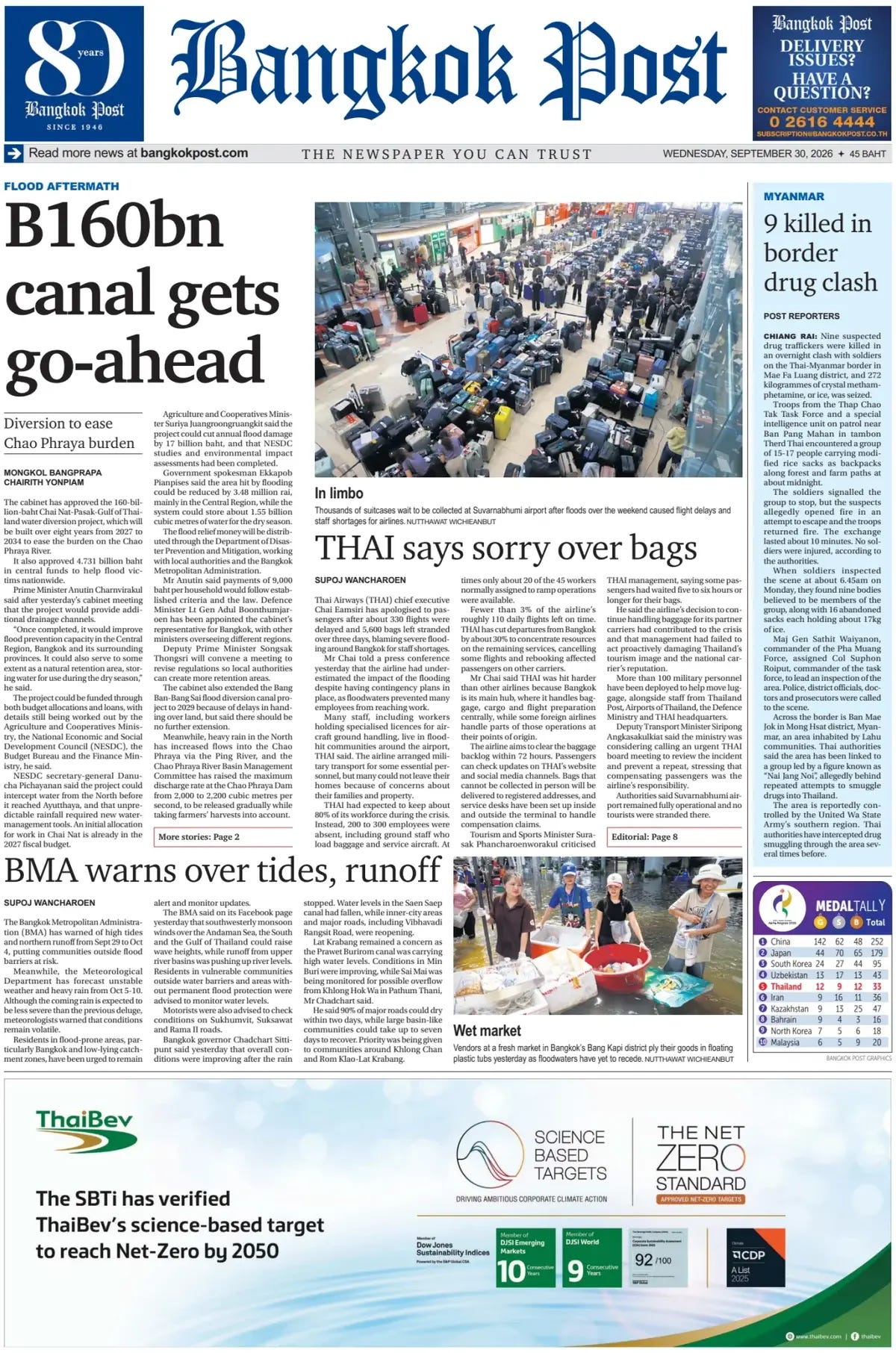
Thai Airways International has cancelled 37 more domestic and international flights scheduled for Tuesday, Wednesday and Thursday. The airline is trying to dig itself out from under a massive baggage backlog at Suvarnabhumi airport caused by massive flooding in the Bangkok region - Bangkok Post
The journals…