🔥 World Briefing Hot Take
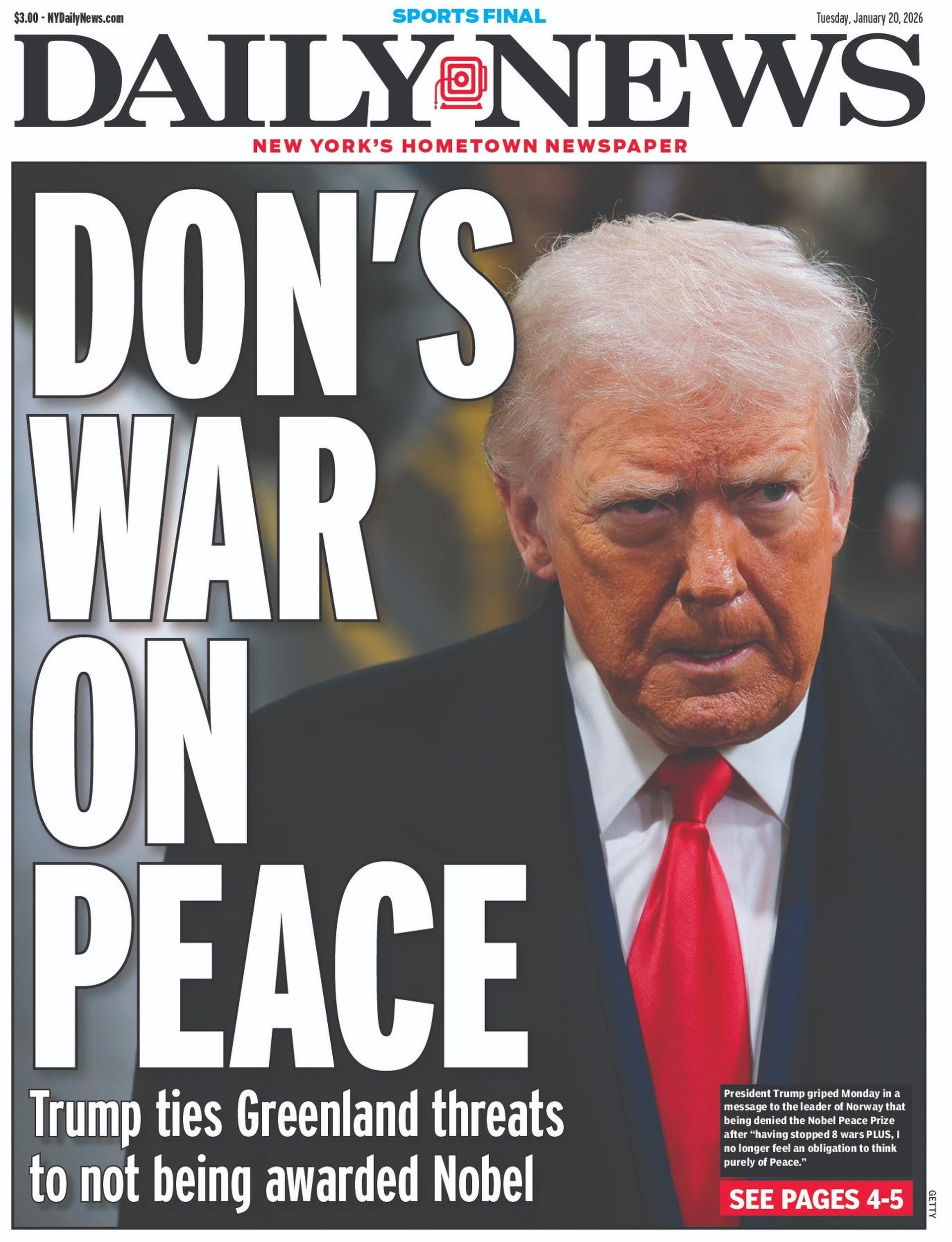
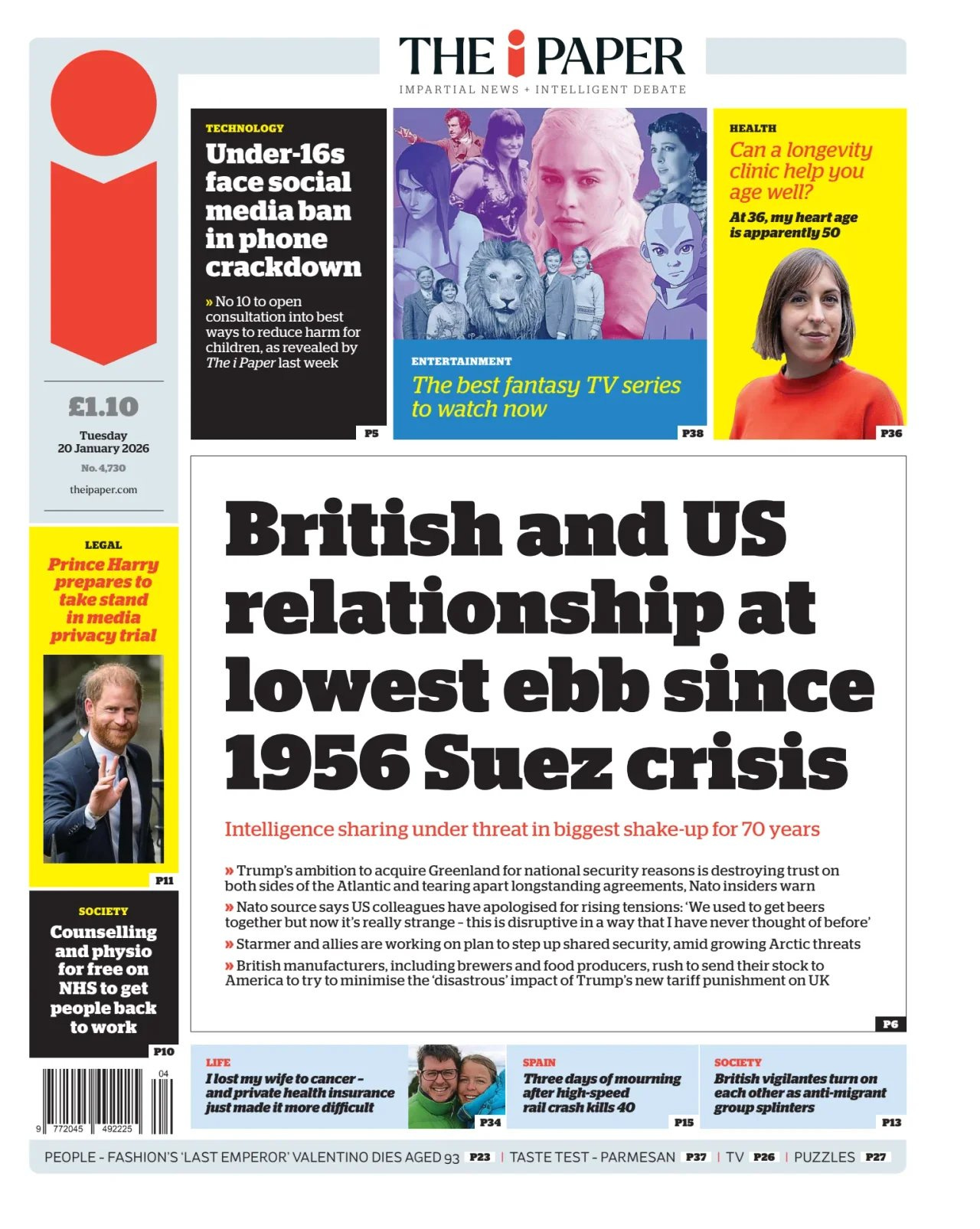
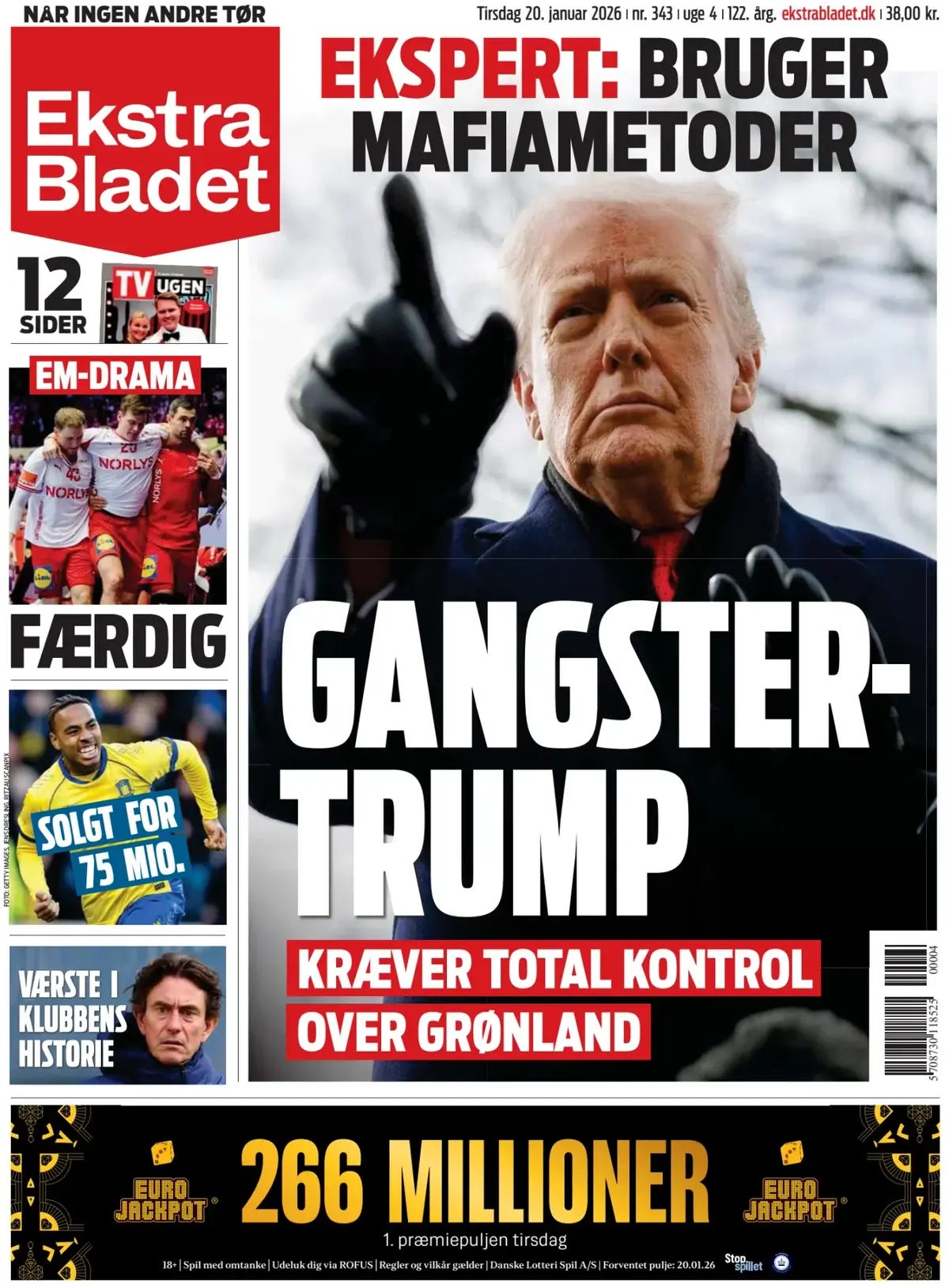
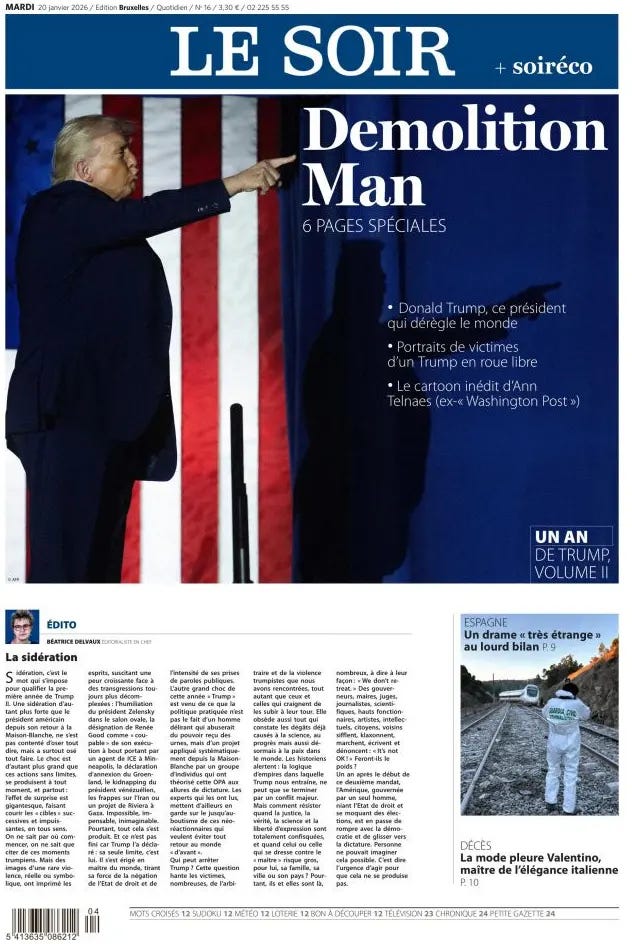
Over the past 48 hours, Donald Trump has swung his tariff baton like a wrecking ball - threatening closest allies not just with economic punishment, but with a loyalty test: comply, flatter, concede… or pay. The revived Greenland fixation isn’t a sideshow; it’s a signal that sovereignty is negotiable and the post-war Western consensus is now treated like a deal to be renegotiated on live television. No wonder parts of the European press have dropped the diplomatic niceties: Belgium’s Le Soir has branded Trump a “demolition man,” while Denmark’s Ekstra Bladet has portrayed him as a “gangster” (see front pages below).
What’s striking now is how quickly European leaders are being forced into a new kind of crisis diplomacy - the kind where managing Trump’s ego becomes part of the job description. In an astonishing text message Trump shared early Tuesday - which the Elysée Palace says is authentic - Emmanuel Macron tells him he doesn’t understand America’s strategy on Greenland, warns it’s tearing at transatlantic relations, and then offers something that feels almost like classic flattery-as-firebreak: a proposed G7 meeting in Paris after Davos (with other major players “on the margins,” including the Russians), capped off with an invitation to dinner in Paris on Thursday. The message sounds polite - but the subtext is revealing: this is a world where allies are scrambling to prevent the alliance itself from becoming collateral damage.
Meanwhile, Canada is treating Greenland not as a distant European issue, but as a precedent - and, wisely, as a flashing red warning light. Speaking at the World Economic Forum on Tuesday, Prime Minister Mark Carney said Canada “stands firmly” with Greenland and “strongly opposes tariffs over Greenland,” after Trump floated 10% tariffs on European countries linked to troop deployments there. Carney didn’t name Trump - but he didn’t need to. His diagnosis of the moment was blunt: “We are in the midst of a rupture, not a transition.” He warned that great powers are turning economic integration into weaponry - “tariffs as leverage… financial infrastructure as coercion… supply chains as vulnerabilities to be exploited” - and urged middle powers to stop competing for favour and instead build a “third path” anchored in shared values and diversification.
We won’t pretend to read Mark Carney’s mind - he’s a cautious former central banker, and a leader who rode a very real “Trump bump” into office. But he would be right to assume Canada now sits squarely in the bull’s-eye of Trump’s vision for U.S. dominance in the Western Hemisphere. With its rich natural resources, vast Arctic territory, abundant fresh water - and comparatively weak military - Ottawa can’t ignore the question many Canadians are now quietly asking: if Greenland is on Trump’s map, could Canada be next? Indeed, The Globe and Mail has reported that the Canadian Armed Forces have modelled a hypothetical U.S. invasion scenario and how Canada might respond - including tactics drawn from resistance strategies used against Russia and later U.S.-led forces in Afghanistan against the mujahideen. “It is believed to be the first time in a century that the Canadian Armed Forces have created a model of an American assault on this country,” the newspaper reported.
The World Economic Forum was built for a world where globalization was the glue. But Trump is demonstrating a different model - one where interdependence becomes a choke chain, and tariffs become the enforcement mechanism, a bazooka if you will. Whether Europe chooses “strong elbows” or cautious delay, the message from Washington is already reshaping behaviour. And as Carney hinted, the biggest shift may be psychological: allies are no longer debating how to manage turbulence - they’re preparing for a future where the old order simply doesn’t come back.
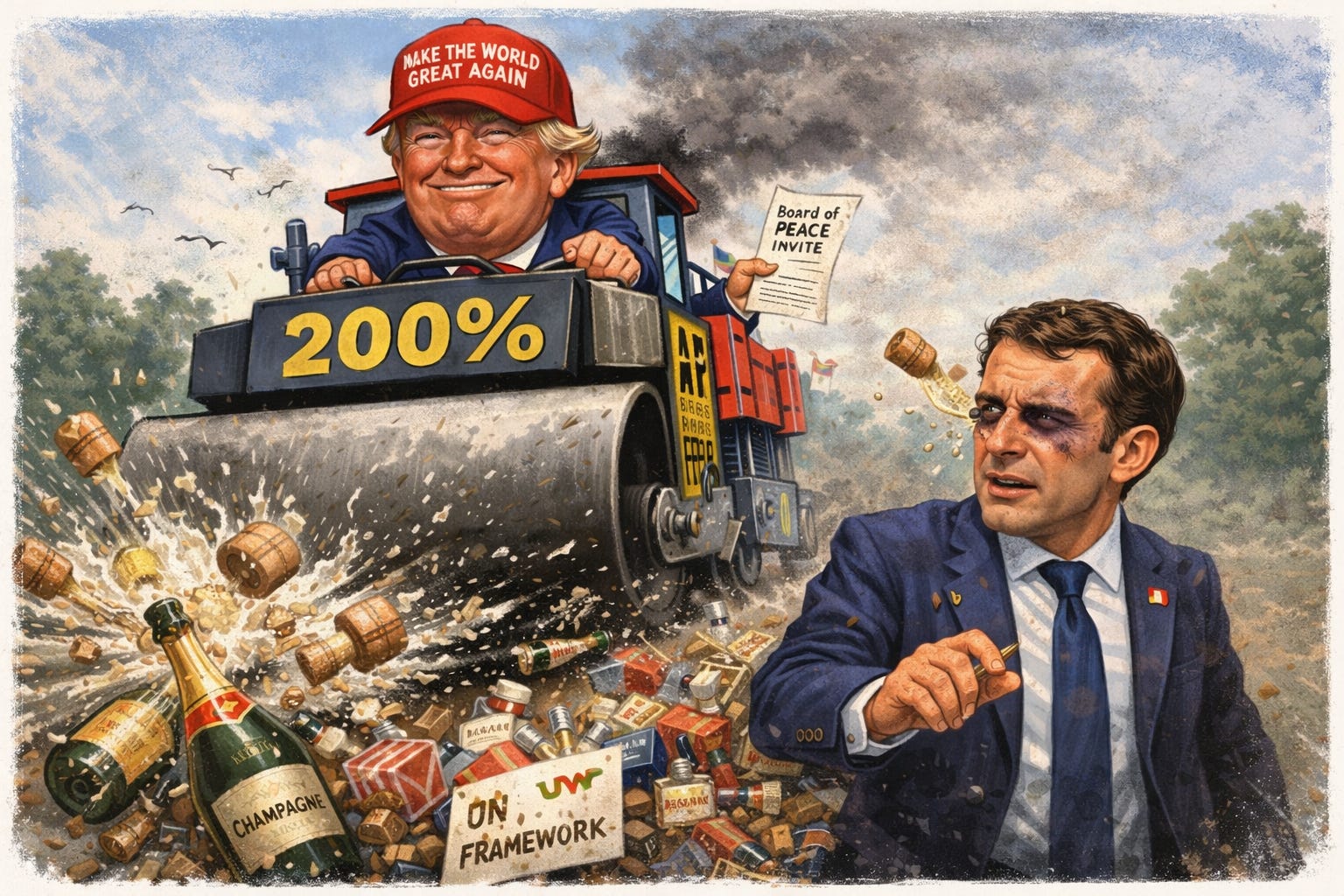
U.S. President Donald Trump threatened to impose 200 percent tariffs on French wine and Champagne late Monday in response to Emmanuel Macron rejecting his offer to join the “Board of Peace” tasked with overseeing the next steps in Gaza. Informed by a reporter that the French president had said he wouldn’t join the board because of concerns about its powers, Trump dismissed Macron as lacking influence and said he would be “out of office in a few months.” “I’ll put a 200 percent tariff on his wines and Champagnes, and he’ll join, but he doesn’t have to join,” Trump said during a huddle with the media. In response, a French official close to Macron who was granted anonymity as they are not authorized to speak on the record, told POLITICO: “We have taken note of Mr. Trump’s statements on wines and Champagnes. As we have always emphasized, tariff threats to influence our foreign policy are unacceptable and ineffective.” Trump announced the establishment of the board — which he touted as “the Greatest and Most Prestigious Board ever assembled at any time, any place” — on Friday as a key part of his 20-point plan to end the war between Israel and Hamas. An assortment of world leaders have been invited to join, including Russian President Vladimir Putin and Belarusian leader Alexander Lukashenko. Bloomberg reported Tuesday that Trump wants the board’s full constitution and remit to be nailed down at the World Economic Forum in Davos on Thursday — but some countries are uneasy about the details of the proposal.
In a text message Donald Trump shared early Tuesday from Emmanuel Macron, which the Elysée Palace says is authentic, the French president says he doesn’t understand the American strategy with respect to Greenland, which Trump is threatening to take over at the expense of transatlantic relations. The French president also offers to set up a G7 meeting in Paris — after Trump leaves Davos, where he is attending this year’s edition of the World Economic Forum — with several other major players on the margins, including the Russians. Macron then invites Trump to dinner in Paris on Thursday. The note seems straightforward enough, but Macron’s appeal to Trump’s ego and ambition speaks to a deeper subtext about the state of the geopolitical order - Politico
Prime Minister Mark Carney asserted that Canada “stands firmly” with Greenland, telling attendees at the World Economic Forum on Tuesday that Canada “strongly opposes tariffs over Greenland.” His comments come just days after U.S. President Donald Trump said he would slap a 10 per cent tariff on several European countries after they sent troops to Greenland, which he has repeatedly insisted he “needs” for national security purposes. While Carney sent a clear message in making reference to economic coercion and tariffs being used as leverage throughout his speech, he did not call out the United States or the American president by name. Also in his speech, Carney charted a new path forward for Canada, one in which the old world order is not coming back. “Let me be direct: We are in the midst of a rupture, not a transition,” Carney said. “More recently, great powers have begun using economic integration as weapons,” he added. “Tariffs as leverage. Financial infrastructure as coercion. Supply chains as vulnerabilities to be exploited.” “In a world of great power rivalry, the countries in between have a choice: to compete with each other for favour, or to combine to create a third path with impact,” Carney said. Carney urged middle powers to work together to uphold or create a new world order based on shared values. Diversification, he argued, is the foundation for honest policy that gives countries strength and a hedge against coercion - CTV
Let me be direct. We are in the midst of a rupture, not a transition ... recently, great powers have begun using economic integration as a weapon - Mark Carney
If you value reporting that isn’t shaped inside conference halls - and analysis that connects the dots others won’t - consider upgrading to a paid subscription. It helps keep World Briefing independent, sharp, and on the ground where it matters most.
Ugandan opposition leader, Bobi Wine, condemned the government’s “crackdown to intimidate, to silence, and to subdue the forces of change”. Speaking with Al Jazeera in an exclusive interview while in hiding, he also alleged he had “evidence” of fraud, videos showing “not the police, not the military, but electoral commission officials” ticking ballot papers in favour of Museveni. President Yoweri Museveni, 81, was declared the winner on Saturday with 72 percent of total votes cast. Wine, a former musician who’s real name is Robert Kyagulanyi, allegedly secured 25 percent. Wine’s National Unity Platform (NUP) party and two other presidential candidates have rejected the results, alleging irregularities including ballot stuffing, intimidation, and the blocking of party agents from polling stations. The United Nations also says Thursday’s vote was marred by “widespread repression and intimidation”.
It should be known that in every dictatorship, especially here in Africa, to run against a dictator means being a terrorist, means being a traitor and everything…
We’ve said it many times that living under a military dictatorship for 40 years is like slavery. Ugandans don’t have a right, they don’t have a voice. Uganda is an extremely young country – the second youngest country in the world [by age], governed by a ruler who is over 80 years old.
Corruption is the order of the day. The country is in a mess. And we, as a current generation – that are the parents of today, that are going to be starting this country – it is our right and duty to ensure that we take charge of our own destiny - Bobi Wine
Russian forces launched a new massive attack on Kyiv and several regions across Ukraine, hitting residential buildings and energy sites amid freezing temperatures. Kyiv Mayor Vitali Klitschko said the strikes caused power, water, and heating outages in the Ukrainian capital, which had already been suffering with massive cuts to utilities. As of early today, 5,635 apartment buildings were without heat, Klitschko said, as temperatures dropped to minus 15 degrees Celsius. Nearly 80 percent of the affected buildings had only recently seen the restoration of heating after a Russian strike last week. As a result of the overnight attack on energy facilities in the capital, more than 335,000 Kyiv residents were left without electricity, DTEK, Ukraine’s largest private utility company, said in a statement - RFE/RL
Ukrainian President Volodymyr Zelensky told reporters today that he will remain in Kyiv to focus on urgent energy issues in Ukraine following Russian strikes instead of going to the World Economic Forum in Davos, where he was scheduled to speak. “But everything can change at any moment,” he said, adding he might still go to the Swiss Alpine resort if the “prosperity plan and security guarantees” -- documents aimed at Ukraine’s economic recovery and future security - are ready to be signed. Zelensky said that, if that happens, he is confident there will be a bilateral meeting with US President Donald Trump, who is due to arrive at Davos today - RFE/RL
A Moscow military court on Tuesday sentenced two men to 24 and 26 years in prison after they were found guilty of trying to assassinate a former Ukrainian intelligence officer in a bomb attack. Vasily Prozorov, a former employee of Ukraine’s SBU security service, was injured in April 2024 after an explosive device placed under his SUV in Moscow went off. Russia’s Prosecutor General’s Office said Vladimir Golovchenko, 42, and Ivan Paskar, 31, were behind the plot to kill Prozorov. Prosecutors accused the two men of forming “an organized group driven by their opposition” to the war in Ukraine. Exiled Russian media previously identified Golovchenko as a dual Russian-Kyrgyz national who moved to Ukraine in 2010 and obtained a residence permit there. Law enforcement authorities in Kyrgyzstan reportedly arrested Golovchenko in April and had him extradited to Russia to stand trial. Paskar was identified as a dual Russian-Moldovan citizen - Moscow Times
Chinese tourism arrivals to Japan plummeted last month even as overall visitor numbers grew, highlighting the growing rift between Asia’s two biggest economies. The Chinese government urged its citizens to refrain from traveling to Japan after Japanese Prime Minister Sanae Takaichi said last year her country could become militarily involved were China to attack Taiwan, which Beijing claims as a renegade province. Though tourism authorities have vowed to get Chinese tourists to “return as soon as possible,” Takaichi’s China stance has boosted her popularity at home, which she has leveraged to call a snap election in a bid to “seize the momentum and strengthen her hand,” an expert told The New York Times - Semafor
South Carolina reported nearly 250 new measles cases this week, official figures showed, bringing the total of confirmed infections to 558 since October as the threat of a wider outbreak increased. State epidemiologist Linda Bell said the risk to unprotected individuals, including those traveling to the outbreak area in the northwestern part of the state, was increasing. At least 531 people are in quarantine after being exposed to the virus, and another 85 people who are symptomatic are in isolation to keep from spreading the disease. In 2025, the United States reported 2,242 confirmed measles cases, the most in three decades, putting the nation's prized status of having eliminated local transmission of the disease at risk. The United States is seeing a resurgence of measles. The Trump administration and Health Secretary Robert Kennedy Jr, an anti-vaccine activist, have made sweeping changes to the U.S. childhood vaccination schedule - moves that many experts say will increase vaccine hesitancy - Reuters
The journals….