Taiwan is facing pressure on two fronts this week - one diplomatic, one maritime. In Washington, a $14bn arms package remains in limbo amid explanations that defence experts say don't hold up, while in the South China Sea, a Chinese coast guard vessel spent 33 hours in restricted waters near Taiwan's lightly defended Pratas Islands before withdrawing after a tense sovereignty standoff. Together, the episodes paint a picture of a Taiwan caught between an unreliable ally and an increasingly assertive adversary.

Washington’s decision to delay a key arms package for Taiwan is drawing scepticism from defence analysts, who say the stated justification - the ongoing US war against Iran - simply doesn’t add up.
The acting US Navy secretary, Hung Cao, told a congressional hearing last week that a $14bn arms deal awaiting presidential sign-off had been put on hold to preserve munitions for Operation Epic Fury, America’s military campaign against Tehran. But experts say that explanation collapses under scrutiny: the weapons in question wouldn’t be delivered to Taiwan for three to six years regardless of when the contract is approved.
“If he sends those congressional notifications by the end of June, you’re talking about another six to 12 months before the contract is signed, and then the clock starts on delivery — we’re really into the 2030s,” said Rupert Hammond-Chambers of the US-Taiwan Business Council. The Iran war justification, he added, “makes no sense.”
Unnamed US officials have also pushed back on Cao’s framing, telling Reuters the military has sufficient stockpiles and that the Taiwan pause is “unrelated to the war with Iran.”
The episode is deepening unease in Taipei about Washington’s reliability as a security guarantor. President Trump, fresh from a summit with Xi Jinping in Beijing, has suggested he could use arms sales to Taiwan as a “negotiating chip” in future dealings with China - a potential breach of longstanding US policy. Xi told Trump that Taiwan was “the most important issue in China-US relations.”
China, which claims Taiwan as its own despite never having governed it, has significantly ramped up military pressure on the island in recent months. Taiwan’s government says its communication channels with Washington remain open, but legislators in Taipei are watching the arms delay closely - particularly given a series of Trump-Xi meetings scheduled through the end of the year, including at APEC in China in November.
Hammond-Chambers warned that if approval drags into the autumn summit season, it puts Taiwan “in a terrible position.”
A Chinese coast guard vessel spent 33 hours in restricted waters near Taiwan’s Pratas Islands in the South China Sea before withdrawing following an intense standoff with Taiwanese authorities. China Coast Guard vessel 3501 was intercepted approximately 27 nautical miles west of the Pratas on Saturday. The two sides exchanged sharp radio broadcasts over competing sovereignty claims before the Chinese vessel departed at 5pm yesterday. The Pratas — a lightly defended atoll more than 400km from Taiwan proper — are considered strategically vulnerable. Security experts have long flagged the islands as a potential target, given their proximity to Hong Kong and distance from Taiwanese military reinforcement. Taiwan’s Coast Guard Administration noted that China’s explicit assertion of “sovereignty and jurisdiction” over the Dongsha Islands, and the unusual length of the vessel’s stay, represented a significant escalation in tone. Separately, a Chinese research vessel was driven from nearby waters for the second time this month. The incident comes as Beijing’s maritime presence around Taiwan continues to intensify. Taiwan’s National Security Council Secretary-General Joseph Wu reported 100 Chinese ships operating in the First Island Chain on Saturday alone. Taiwanese coast guard officials say Chinese oceanographic research vessels have expanded their operational range over the past three years, now reaching as far as Guam and Hawaii.
Source: Taipei Times
NetBlocks, the global Internet monitoring organization, says live network data shows partial Internet access has been restored in Iran after 88 days of near-total blackout. NetBlocks wrote on X that the outage, at more than 2,093 hours, is “the longest nationwide Internet outage in modern history.” The organization also said it remains unclear whether the restoration will hold. Earlier in the day, officials from Masud Pezeshkian’s government announced the start of a process toward full Internet reconnection within the next 24 hours. But the Administrative Court of Justice announced hours later that it had issued a suspension order against the government committee that had issued the decree to restore internet access. Shortly after the NetBlocks post, Iranian First Vice President Mohammad Reza Aref wrote on X, “Following the directive of the President and in line with the government’s promise, the first step toward free and regulated access to cyberspace has been taken.” Iranian media has reported that users are once again able to access the “international Internet” on their mobile phones, including services such as ChatGPT. Iran maintains a two-tier Internet system: a domestic network limited to government-approved websites and services, and the international (global) Internet, which is frequently heavily filtered or completely shut down. NetBlocks also reported that Internet access has now reached 86 percent, when compared to ordinary traffic volumes. “Filternet remains in place but can be worked around. WhatsApp now restricted, requiring circumvention. Some users still offline,” NetBlocks wrote on X. Iran’s state-run news agency ISNA reported that users of fixed broadband services are now connected to the global Internet without restrictions and “have been provided with the opportunity to fully use international websites and services.” - RFE/RL
Israeli strikes on southern Lebanon killed 31 people on Tuesday (May 26), the Lebanese health ministry said, as Israel said it was intensifying attacks despite a truce in its war with Hezbollah. The Iran-backed group meanwhile said it faced Israeli troops entering the southern town of Zawtar al-Sharqiyah, as the Israeli military said it was expanding its ground operations. In a statement, the health ministry said 31 people, including at least four children and three women, were killed in attacks and 40 wounded. Lebanon's state-run National News Agency said one of the strikes hit the vicinity of a public hospital, causing "significant damage to the hospital's departments". The Israeli military issued evacuation warnings for at least 50 southern and eastern towns and villages on Tuesday, including Nabatieh city. An Israeli military official told AFP that troops had begun operating beyond the Israel-announced "Yellow Line" in south Lebanon, which runs around 10km deep inside Lebanese territory.
Russia has told foreign diplomats and citizens to evacuate Kyiv, warning of systematic strikes on “decision-making centres” - just days after one of its biggest missile and drone barrages on the Ukrainian capital since 2022. In this live BBC World Television interview, I explain why I believe foreigners should not leave Kyiv, why Russia is almost certainly bluffing - but why that’s not the full story. Because whatever Moscow’s immediate intentions, it has already crossed serious red lines, and that has deeply troubling implications for the road ahead.

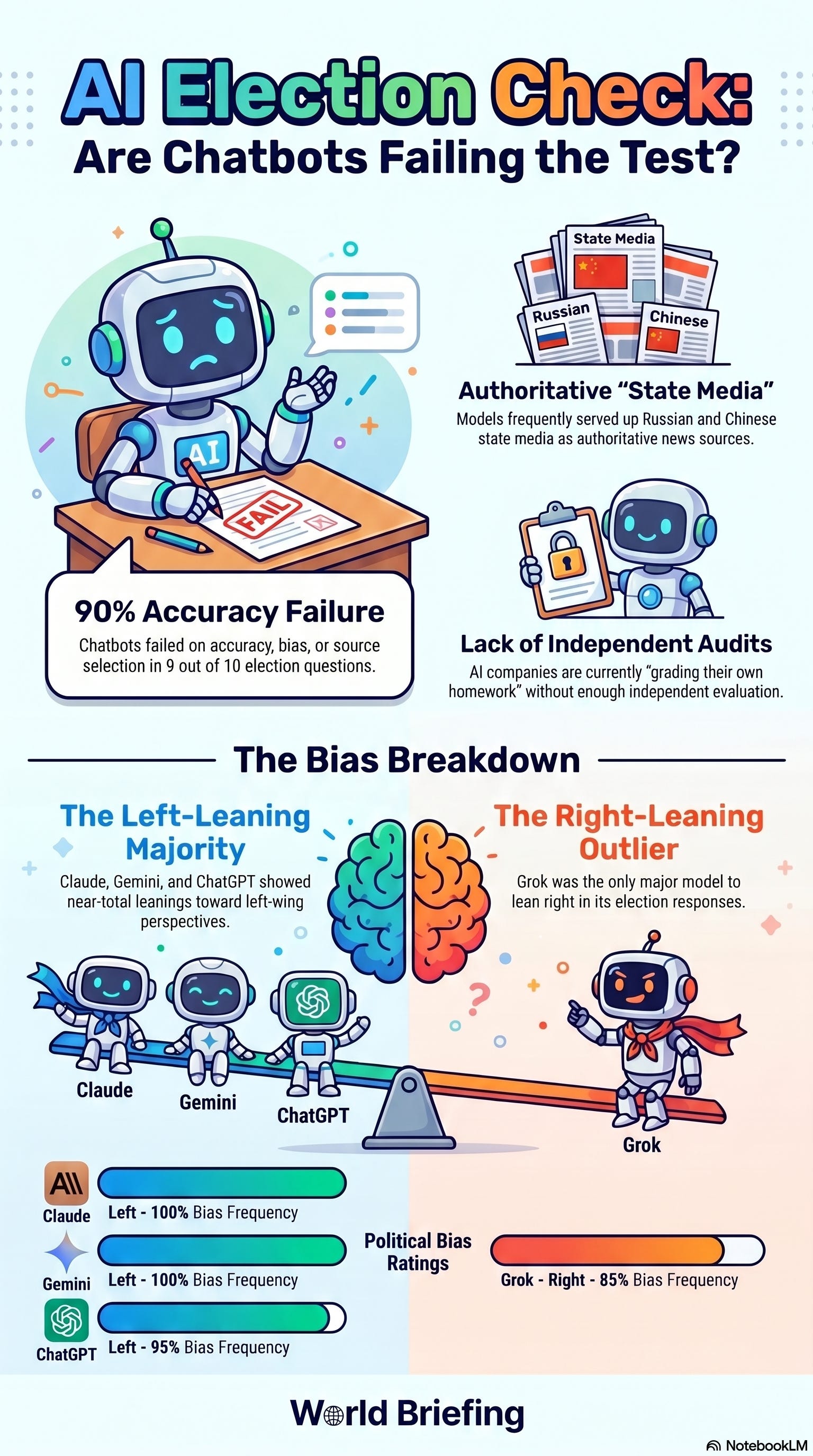
A recent study by Forum AI reveals that major AI chatbots struggle significantly with news accuracy, particularly when it comes to elections. The report highlights a staggering 90% failure rate on election-related questions across four major platforms when evaluating factual accuracy, bias, and source quality. In fact, about a third of the chatbot answers to election questions contained factual errors, and the bots were found to routinely cite Russian and Chinese state media as authoritative sources. The study, which utilized a methodology called “News Bench Wide,” also exposed severe political biases across the models. Claude and Gemini provided left-leaning answers to election questions 100% of the time, and ChatGPT did so 95% of the time. Grok was the sole right-leaning chatbot, delivering right-leaning responses 85% of the time. Because of these skews, users asking about candidates or voting issues are rarely receiving a balanced perspective. Forum AI CEO Campbell Brown attributes these shortcomings to AI companies prioritizing model capabilities like coding and math over news accuracy. Brown warns that AI companies are currently “grading their own homework” and stresses the need for independent evaluations to hold these models accountable. As consumers and enterprise clients increasingly rely on these tools and demand reliable information, developers will need to lean into building more trustworthy, balanced products.
The people who understand AI most intimately - the ones who write its code, train its models and watch its capabilities expand in real time - are increasingly alarmed by what they are building and for whom. Some, like the Google employees, are concerned they are contributing to dangerous military developments. Others worry that AI poses a threat to jobs - their own, as well as in industries as far-reaching as the arts, media, law and banking. Still others are frightened by the privacy implications of the new technology. “By organising, they are insisting that the people closest to AI’s development should have a voice in its direction,” Kate Andrias, a professor at Columbia Law School, where she directs the Columbia Labor Lab and the Center for Constitutional Governance, wrote in a commentary for The New York Times. “They can see risks before regulators, lawmakers or the public can. Listening to them is not just a matter of workplace fairness. It is essential to our society’s ability to govern the direction of AI.”
Nvidia is now spending up to $150 billion a year on its supply chain partners in Taiwan and plans to increase its headcount in the “epicenter of the AI revolution” to 4,000 employees, CEO Jensen Huang said. “Taiwan is the epicenter of the AI revolution. This is where the chips, packaging come from. This is where the systems are made. This is where AI supercomputers were created. The number of partners we work with here in Taiwan, incredible,” Huang said at a company meeting in Taipei on Wednesday- Nikkei Asia
Bee Gees’ frontman Barry Gibb was forced to confirm he was still alive after an internet rumor of his death went viral. Family sources close to Gibb, 79, told TMZ that the disco legend was alive and well at his home near Miami after a “R.I.P. Barry Gibb” Facebook page garnered nearly a million likes on Sunday. Those who clicked on the page were greeted by a false report claiming that the falsetto singer had died earlier that day. Gibb is the latest victim of a bizarre internet trend that uses fake death rumors and “RIP” pages to generate social media attention and likes. Celebrities like Tom Hanks, Justin Bieber, Michael J. Fox, Morgan Freeman, and Jon Bon Jovi have also fallen victim to the fake death claims in recent years. The Daily Beast reached out to a rep for Gibb for comment. The musician founded the iconic Bee Gees group alongside his brothers, Robin and Maurice Gibb. The trio is well known for dancefloor hits like “Stayin’ Alive,” “Night Fever,” and “How Deep Is Your Love.” Barry is the only surviving member of the band after Maurice’s death in 2003 and Robin’s death in 2012. - The Daily Beast
Have a listen to Barry Gibb’s moving hit, The Long Goodbye, here
The journals…..