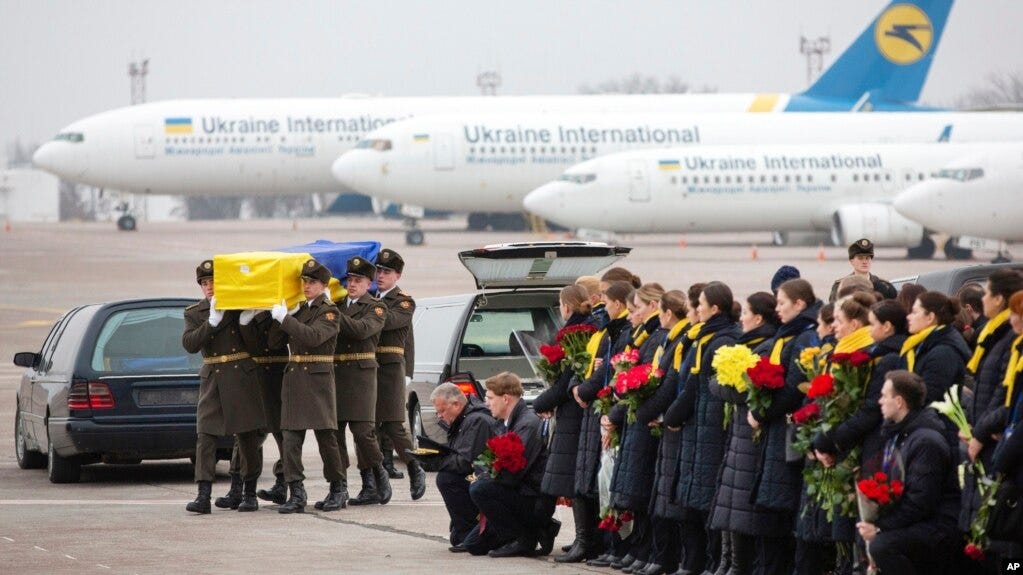
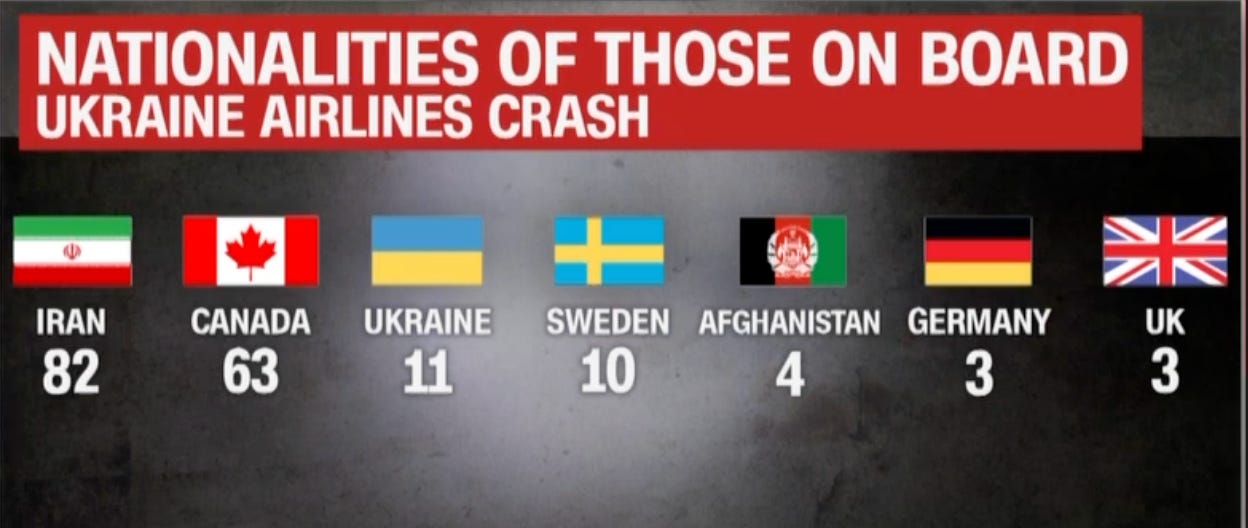
Today marks six years since Ukraine International Airlines Flight PS752 was shot out of the skies over Tehran, killing all 176 passengers and crew onboard. Just minutes after departing the Iranian capital for Kyiv, the Boeing 737-800 was struck by missiles fired by Iran’s Islamic Revolutionary Guard Corps.
As I told my friend and former CNN anchor, Brooke Baldwin, at the time, that aircraft should never have been cleared for takeoff given the circumstances on the ground — and in the air.
“It really saddens me. Haven’t we learned anything from MH17 (the Malaysian airliner which was shot out of the skies by a Russian BUK missile in July 2014, killing all 298 aboard). When there’s a conflict going on, stop civilian aviation. That plane would’ve been here today had they followed that protocol.”
Indeed, in 2024, a Canadian court found that Ukraine International Airlines was negligent for failing to conduct a proper risk assessment for the flight out of Tehran - a ruling that underscored what aviation safety experts had been warning from the outset.
In my assessment, and despite the tragedies of MH17, PS752, and numerous other close calls since, the skies have not become safer. If anything, they are growing more dangerous. Remember the forced landing of Ryanair Flight 4978 in May 2021, when Belarusian authorities compelled a jet flying from Athens to Lithuania to divert to Minsk so an opposition journalist could be dragged off the plane.
Authoritarian leaders and warring belligerents are increasingly encroaching on what were once considered safe corridors for civilian aviation. Conflicts are multiplying and overlapping. Sophisticated weaponry is finding its way into the hands of non-state actors. And too many airline executives appear to be sleepwalking through the risk - prioritizing schedules, margins, and cost savings over hard safety calls.
All of this is unfolding in a vacuum. The bodies tasked with safeguarding global aviation - notably the UN’s International Civil Aviation Organization and the industry group International Air Transport Association - have offered little practical guidance to help airlines navigate increasingly militarized skies.
And don’t expect governments to voluntarily close their airspace. Overflight fees generate lucrative revenue streams, and even active conflict zones are often kept open far longer than they should be.
Ironic, is it not, that just a week ago, during a transit stop in Toronto, I found myself speaking with an Iranian Uber driver about how authorities in Tehran were ultimately backed into a corner by citizen-journalism footage when they tried to deny responsibility for PS752 (as ongoing protests head into a second week all over Tehran, the clerics have resorted to blocking internet access and summoning journalists to control the information space). Once legal proceedings began, the thugs in power deputized other thugs to harass and intimidate grieving families into silence. “After all these years, Iran continues to refuse to take full legal responsibility for the downing, despite admitting its Islamic Revolutionary Guard Corps shot down Flight PS752,” the British Foreign Office said in a statement today.
As both a seasoned flier and someone who has covered multiple aviation disasters, my advice remains blunt and unchanged: check your route before boarding. Know where your aircraft is flying - and why. And always remember one simple rule: if it doesn’t feel right, it probably isn’t safe.
Above: Watch my live CNN interview in NYC with anchor Brooke Baldwin, broadcast on Jan 12, 2020 - shortly after the downing of Ukraine International Airlines Flight PS752
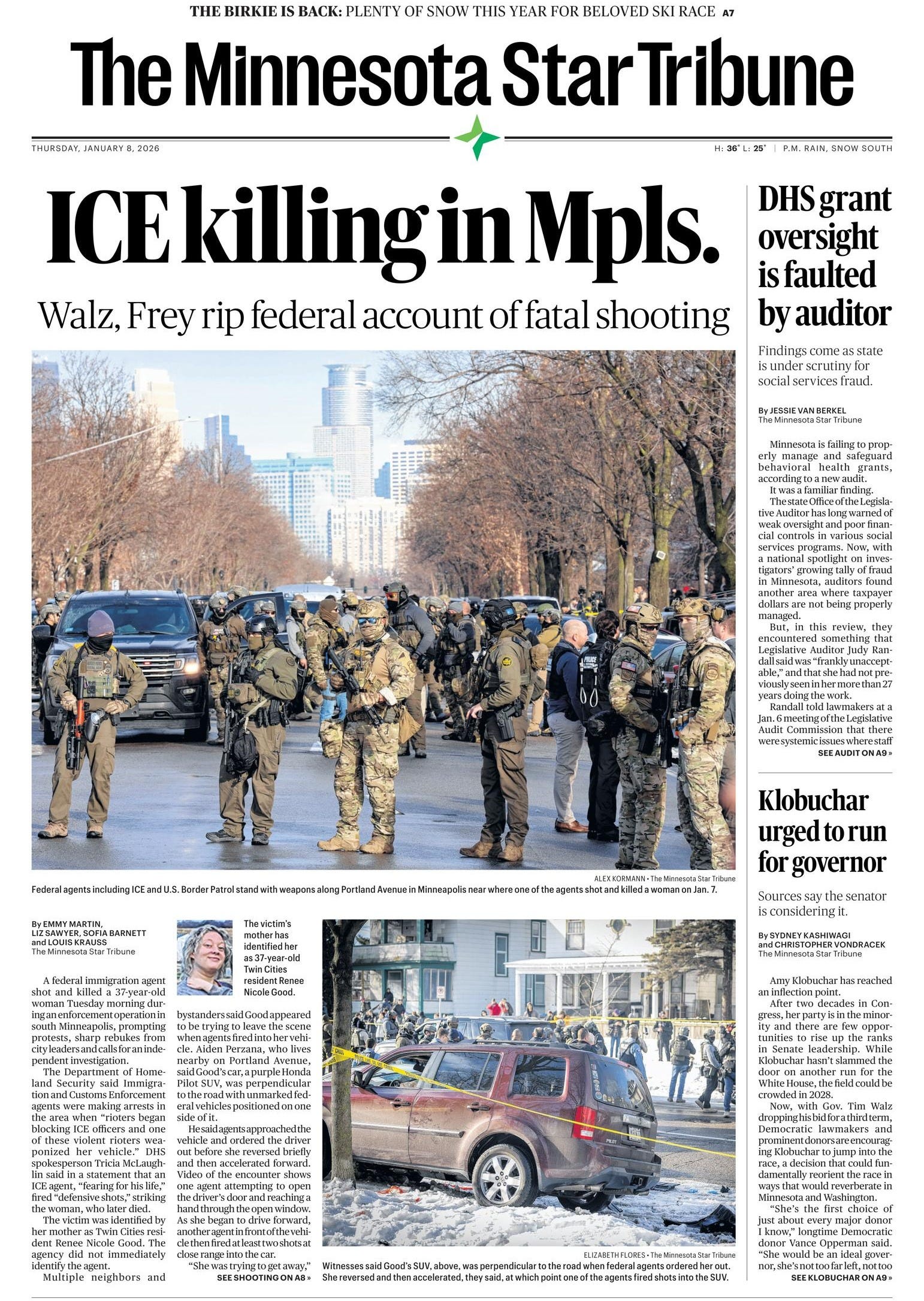
A U.S. Immigration and Customs Enforcement agent shot and killed a woman in south Minneapolis during a morning confrontation between community members and federal officers on Jan. 7. The incident aggravated an already tense standoff between the Trump administration, as it cracks down on immigrants in Minnesota, and state and city leaders who demanded the federal government pull back. The mother of the woman who was killed identified her as Renee Nicole Good, 37, a Minneapolis resident. At a late afternoon news conference, Homeland Security Secretary Kristi Noem characterized the incident as an act of domestic terrorism on the part of the driver, alleging she “weaponized” her vehicle against federal officers. Republican President Donald Trump, in a statement on the incident, said the driver “viciously ran over” the ICE officer, though several videos captured by bystanders do not support that claim. Several residents of the area who witnessed the scene said agents were ordering the woman out of the vehicle. A video showed agents around the vehicle as the driver reversed and then pulled forward. One agent appeared to fire multiple rounds into the car. The agent, who has not been identified, is seen walking away after firing the fatal shots. Noem said he was struck by the vehicle and then later treated and released from a local hospital. In a fiery news conference at City Hall, Mayor Jacob Frey called on ICE to “get the fuck out of Minneapolis.” Frey and Gov. Tim Walz, both Democrats, took issue with the administration’s version of what happened. They put out calls for calm, but also said Minnesotans have the right to peacefully demonstrate over what happened - Minnesota Star Tribune
Good was a mother of three who had just moved to the city. She was a prize-winning poet and a hobby guitarist, and according to Minnesota Senator Tina Smith, a US citizen. Her mother, Donna Ganger, told the Minnesota Star Tribune that her daughter was “probably terrified” during the confrontation with officers that saw her fatally shot and that she was “one of the kindest people I’ve ever known…She was extremely compassionate,” Ganger told the daily. “She’s taken care of people all her life. She was loving, forgiving and affectionate. She was an amazing human being.” Her father, Tim Ganger, told The Washington Post that “she had a good life, but a hard life.” A fundraiser for Good’s family, which was set up with a target of $50,000 (£37,000), raised more than $370,000 in 10 hours. - BBC
U.S. Sen. Amy Klobuchar, who is said to be considering a run for governor, called the shooting “the result of the administration sending federal agents onto our streets against the wishes of local law enforcement.” She said she was concerned "statements made by DHS do not appear to reflect video evidence and on-the-ground accounts."
President Trump withdrew the United States on Wednesday from dozens of international organizations - including the UN climate treaty - intended to foster multinational cooperation, cutting ties with a wide range of prominent forums addressing international security, law, trade, economics and human rights. Secretary of State Marco Rubio listed several reasons for the simultaneous withdrawal from so many international organizations, many of which are part of the United Nations. Pointing to waste, mismanagement and redundancy, Mr. Rubio more broadly suggested in his statement that the international influence gained from sending U.S. representatives to these organizations was ultimately not worth the effort. “It is no longer acceptable to be sending these institutions the blood, sweat and treasure of the American people, with little to nothing to show for it,” Mr. Rubio said, asserting that many of the organizations were “dominated by progressive ideology,” including gender equality and climate change. In trumpeting the withdrawal, Mr. Rubio suggested that it was in line with the Trump administration’s decision to shutter the U.S. Agency for International Development. An executive order, signed by Mr. Trump on Wednesday, follows a broader vision of American foreign policy that shuns the consensus of nations and building coalitions, focusing almost solely on projecting American power and dominance - NYT
The US will also exit the UN Population Fund, which provides sexual and reproductive health services worldwide. Trump cut funding to the agency during his first term over Republican accusations that it participated in coercive abortion practices in China, claims a 2022 State Department review found no evidence to support. Other organisations on the withdrawal list include the Carbon Free Energy Compact, United Nations University, International Cotton Advisory Committee, International Tropical Timber Organisation, Partnership for Atlantic Cooperation and International Lead and Zinc Study Group. Daniel Forti, head of UN affairs at the International Crisis Group, said the approach represents “the crystallisation of the US approach to multilateralism, which is ‘my way or the highway’” - Euronews
According to reports from Iran, as popular protests continued into their 11th night on January 7, users in various cities reported slow and unstable Internet connections. It has been reported that in Tehran, Karaj, Isfahan, Shiraz, Mashhad, and Tabriz, both fixed-line and mobile Internet access have been experiencing severe disruption or brief outages. The technology news website CITNA reported that in various cities across Iran the quality of Internet access has noticeably declined, and that in Tehran and Karaj the use of messaging apps and Internet-based calls has been disrupted. As of 11 p.m. Iran time on January 7, there were no reports of a nationwide Internet shutdown. Meanwhile, reports have emerged of some protesters, civil society activists, and journalists being summoned by anonymous phone calls and text messages with the aim of warning them against taking a stance on the protests and limiting their coverage. Marzieh Mohebbi, a lawyer living outside Iran, wrote on X, “These messages are sent to all those whose mobile phones were found within the area of the demonstrations, and they have no legal value or validity, and do not constitute a source of legal effect.” Addressing those who received the messages, she wrote: “The Islamic Republic’s judiciary lacks legitimacy, is corrupt, and is untrustworthy. No one knows what will happen to you after you appear, so do not even pay attention to the official summons.” - RFE/RL
Russian overnight attacks on Ukrainian energy infrastructure have created a “national emergency,” Dnipro Mayor Borys Filatov said on Jan. 8 during a press briefing. “From a technical standpoint, the situation in Dnipro is one of the most difficult. This is truly a national emergency,” Filatov said. Russian forces struck Ukrainian energy infrastructure, leaving Dnipropetrovsk and Zaporizhzhia oblasts nearly without power in the evening of Jan. 7. The attacks come as Ukraine braces for freezing temperatures, with daytime highs expected to fall below -10 degrees Celsius (14 degrees Fahrenheit) next week. Both regions are operating under extended power outage schedules, and some settlements remain completely without electricity. “This was the first total blackout across the entire region in recent years, but all services were on site from the very first minute,” Zaporizhzhia Oblast Governor Ivan Fedorov said. - Kyiv Independent
In Kryvyi Rih, an industrial city in the Dnipropetrovsk Oblast and the hometown of President Volodymyr Zelensky, Ukrainian Telegram channels were reporting five people, including a child, were injured from a Russian missile attack today. The state-linked Suspilne news service, said that damage was visible on several multi-story buildings and on infrastructure The strikes happen as a severe and dangerous cold snap is approaching Ukraine: The mercury could plunge to as low as -30C in some regions. Today in Odesa, power and water outages affected several areas of the southern port city.
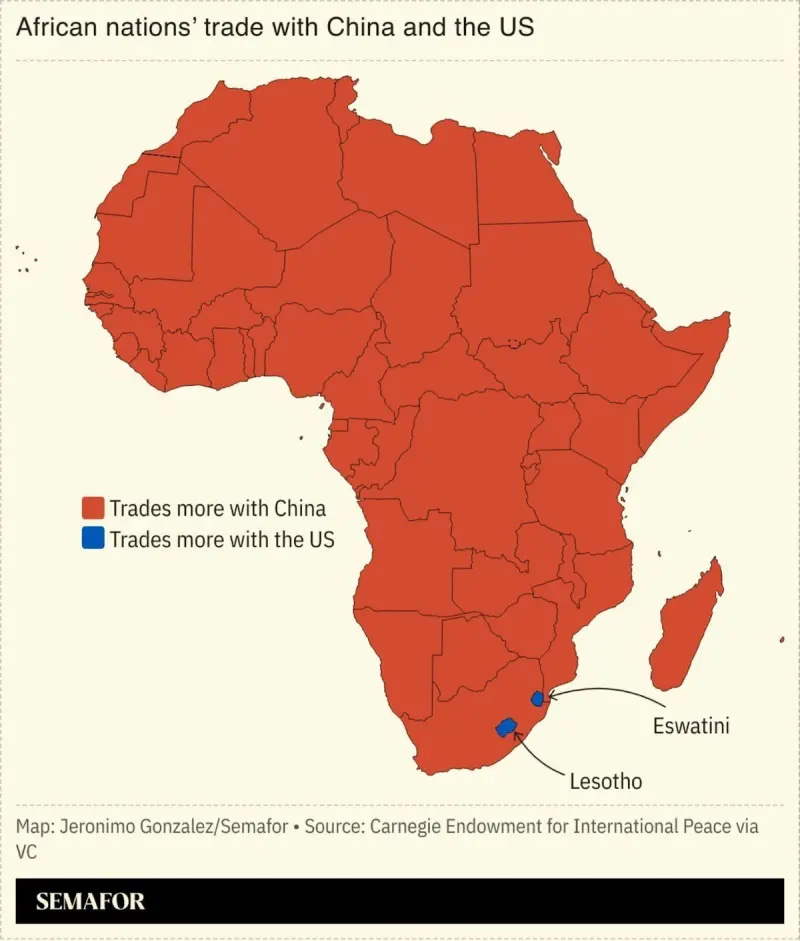
China’s top diplomat Wang Yi courted key East African nations on a tour of the region, part of efforts to capitalize on frustration with the US on the continent. The country’s foreign ministers have traditionally made their first annual overseas trip to Africa, symbolic of Beijing’s push to improve ties. On the itinerary for 2026 are Ethiopia, Lesotho, Somalia, and Tanzania, each of which has seen worsening ties with Washington since the start of US President Donald Trump’s second term. The China-Global South Project noted that Wang will likely frame Beijing as a stable, rule-abiding partner, one which recently announced zero-tariff market access for a raft of African nations — a sharp contrast with its superpower rival.
The journals….