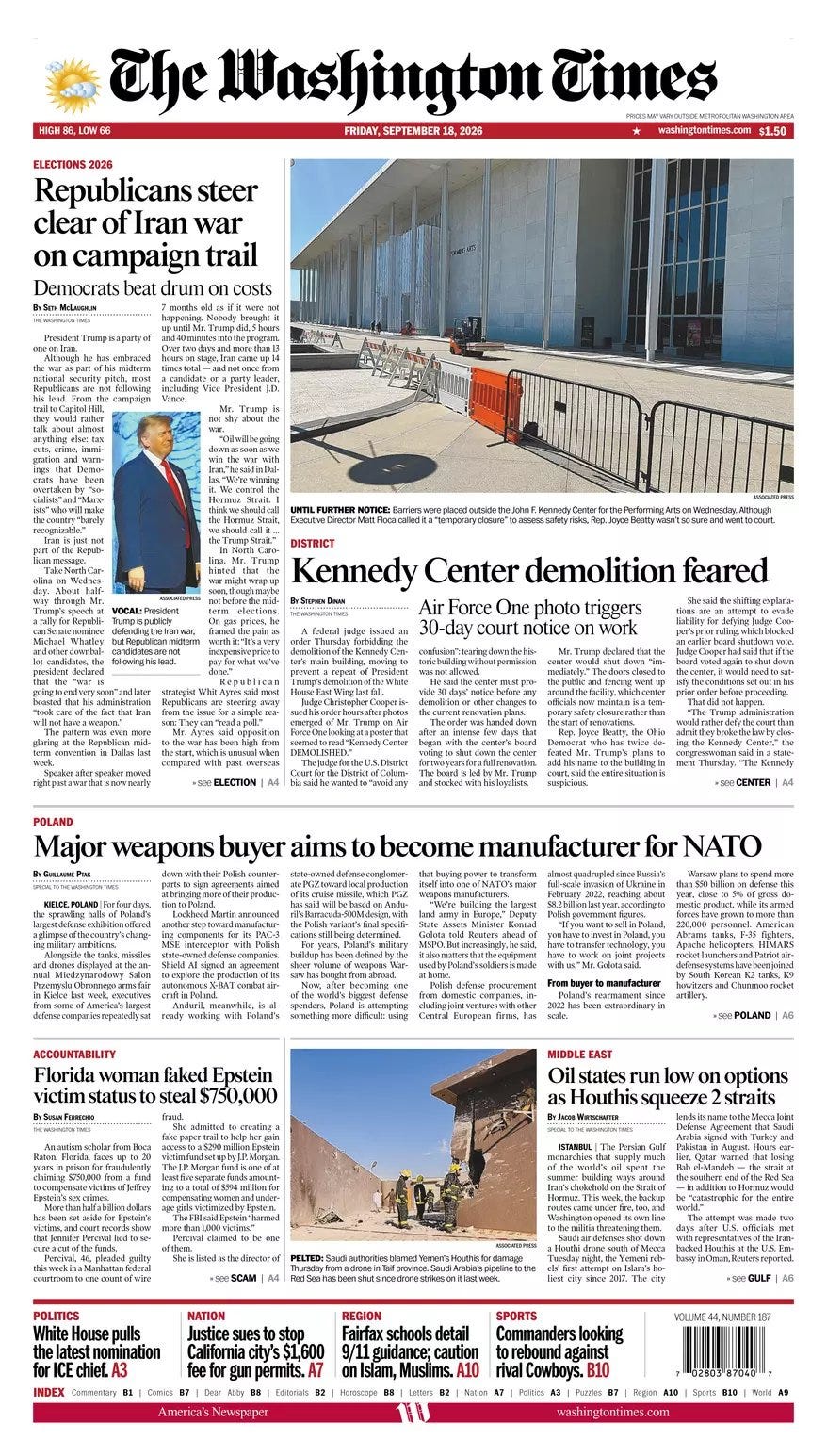
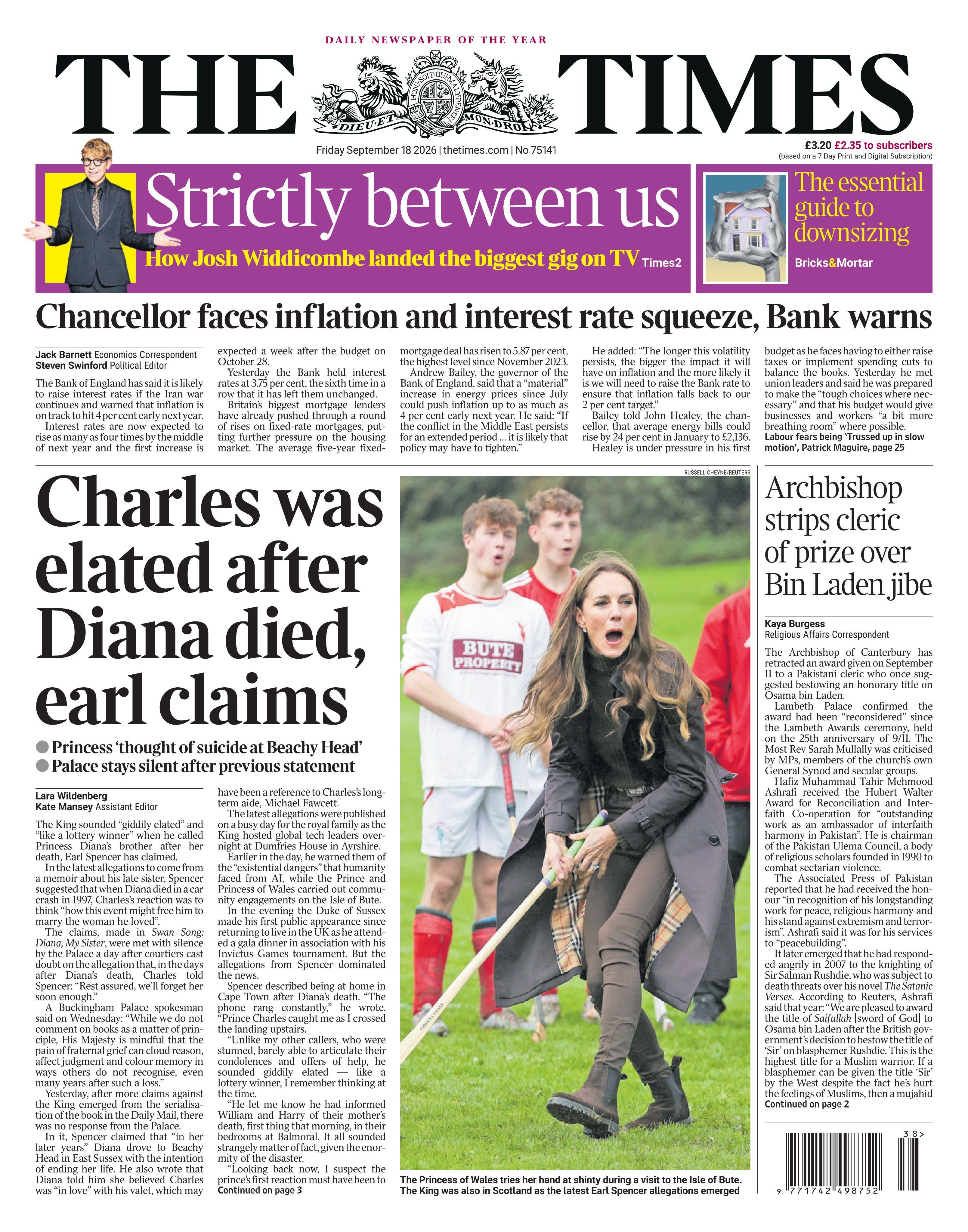
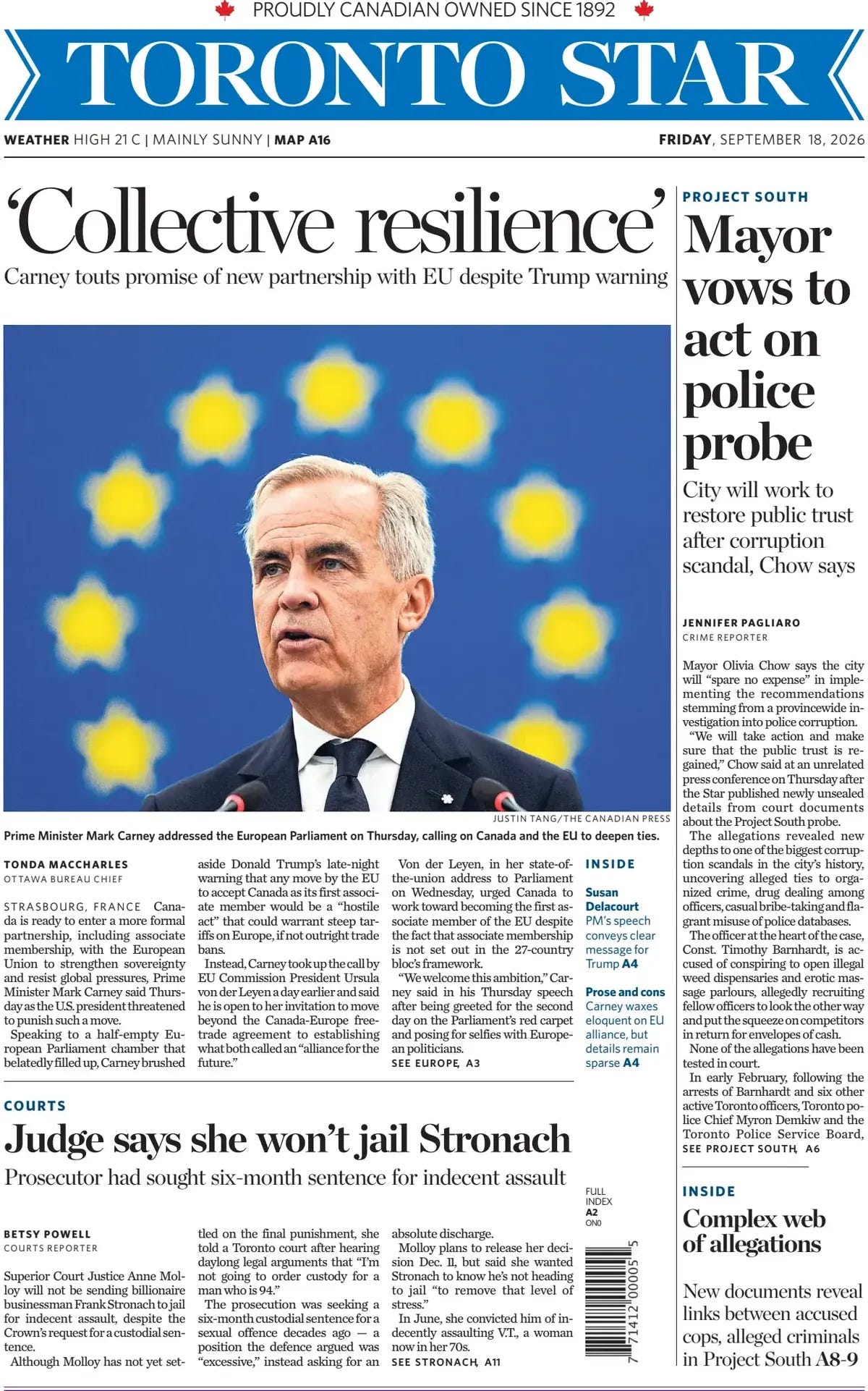
A regime confident in its war doesn't need to bar the only anti-war party from the ballot, seize a coffee maker's factories, or rattle drones at NATO's borders. Each move signals an increasingly paranoid Kremlin struggling to manage pressure: rising casualties, a slowing economy and slipping polls. The danger for Europe is that a Vladimir Putin who is weaker at home may decide he has more to gain from escalation abroad. The pattern rings familiar if we were to swing out lenses across the Atlantic…
News Briefs
Russians cast ballots to choose lawmakers for the State Duma, with the all-out war on Ukraine and a slowing economy looming over the country’s first parliamentary elections since the start of the 2022 invasion. Voters in the Pacific region of Kamchatka, nine time zones ahead of Moscow, kicked off the September 18-20 balloting. Official results on the new composition of the 450-seat lower house of parliament are expected by September 22. United Russia, the Kremlin-linked party that dominates the Duma as well as legislatures and regional governments nationwide, is projected to maintain or increase its majority. Since President Vladimir Putin came to power over a quarter-century ago, the Kremlin has increasingly stifled dissent, marginalized political opponents, and manipulated elections, leaving little room for surprises. Meanwhile, the only prominent political party opposing the war, now in its fifth year, was barred from the ballot weeks ahead of the vote. Amid Kremlin fears of apathy and frustration, Putin, who frequently accuses the West of seeking to weaken or destroy Russia, exhorted Russians to vote, calling the election a barometer of support for the war. More than 1.5 million Russian soldiers have been killed or wounded in the conflict, according to Western estimates. Russian authorities have set up voting precincts in the Russian-occupied portions of five Ukrainian regions that Moscow has claimed as Russian territory. Kyiv has denounced the effort. While no dramatic changes are expected in the composition of the Duma, the Kremlin and the powerful domestic policymaking body known as the Presidential Administration were expected to watch results for hints of the national mood. Though opinion polling is difficult inside Russia due to oppressive policies that have criminalized dissent or opposition to the war, several polls have pointed to slipping popularity for Putin, as well as United Russia - RFE/RL
Top European officials are increasingly alarmed that Russia could stage drone or missile attacks against NATO countries as Moscow steps up its hybrid campaign across the continent. Germany is preparing hospitals for a possible conflict, Lithuania has updated evacuation plans and NATO troops are exercising in the Baltic region, while Belarusian forces have staged large maneuvers near Lithuania. On Thursday, Polish Prime Minister Donald Tusk warned Moscow could send drones or missiles into the territory of NATO countries supporting Ukraine in “the next few months.” The warnings underscore a growing sense of anxiety in Europe amid fast-proliferating incidents of airspace violations and sabotage attempts in recent months. NATO allies have repeatedly said they see the attacks as pressure from the Kremlin to reduce their support for Ukraine but have muted their response over fears of escalation. French President Emmanuel Macron summoned party leaders and 2027 presidential candidates for an emergency meeting on Friday to talk about Ukraine, Iran and the growing energy crisis. He called Tusk’s warnings “sound and well-documented” as he announced a new critical infrastructure protection plan, adding: “In recent weeks … the Russian hybrid threat against Europeans and France has intensified.” On Thursday, Finnish President Alexander Stubb told his country it was “worth mentally preparing for something to happen” including sabotage and Russian drones - POLITICO
The Kremlin said on Friday that hostile actions by “unfriendly” countries played a role in its decision to take control of the Russian assets of Swiss food giant Nestlé and French retailer Auchan. The move, announced in a decree signed by President Vladimir Putin, is the most significant action against Western firms since the seizure of the Russian assets of French dairy company Danone and Danish brewer Carlsberg in 2023. “We are talking about European companies from unfriendly countries,” Kremlin spokesman Dmitry Peskov told reporters, adding that these states were “currently involved in the most active manner in military actions against our country.” Peskov did not name France or Switzerland specifically, but Russia says Western countries that supply weapons to Ukraine, including France, are effectively parties to the conflict. Switzerland does not provide arms to Ukraine but has angered Russia by imposing sanctions against it. The Swiss government expressed concern about the seizure of Nestlé and said it was supporting the company in its efforts to reverse the decision. Russia has steadily tightened its grip on foreign-owned assets since the 2022 invasion of Ukraine. A 2023 decree signed by Putin allows assets from countries Moscow deems “unfriendly” to be placed under temporary administration. Moscow has also used the framework to raise funds through forced sales, exit taxes and discounts, while rewarding Kremlin-linked insiders. According to a 2025 estimate by Moscow law firm NSP, the Russian state has seized more than $50 billion of private property, including assets belonging to foreign companies that exited Russia, since the start of the war. The Russian assets of Nestlé and Auchan were transferred to temporary control by L.E.V. Management, a little-known company with no public profile. Auchan, which runs 230 stores and an online business in Russia, employing about 30,000 people, declined to comment. Nestlé has six factories in Russia producing coffee, pet care and infant formula products. It generated sales of about 2 billion Swiss francs ($2.4 billion) in Russia in 2021, the last year it released figures, and has about 7,000 employees there. That amounted to about 2% of group sales, although analysts estimate the contribution has declined since Nestlé scaled back operations in Russia - Moscow Times
On my way to New York for a high-level UN Week, I stopped in at the Toronto Ukrainian Festival in Bloor West Village, the largest celebration of its kind in North America. I wanted to get a sense of the mood and see how the festival has grown over two decades. It was a pleasure to be back. Some years ago, I had the honour of serving as parade marshal. 🇺🇦
Trump Bans CNN, POLITICO and MS NOW from the White House
President Donald Trump said Friday he is barring CNN, MS NOW and POLITICO from the White House, and warned that “Other Fake News Media Outlets to follow.” In a Truth Social post, Trump said the ban would take effect immediately and accused the outlets of constant “FAKE NEWS,” but did not point to any specific coverage.
The move caps a year and a half of the White House tightening its grip on access. In February 2025 it shut Associated Press journalists out of the Oval Office and Air Force One over the AP’s refusal to adopt the name “Gulf of America,” a case still before the courts. That same month, the White House took control of the presidential press pool away from the White House Correspondents’ Association.
As legacy outlets have been pushed out, friendlier voices have been ushered in. At her first briefing, Press Secretary Karoline Leavitt invited podcasters, influencers and content creators to apply for credentials, and created a front-row “new media” seat. Among the beneficiaries is LindellTV, founded by MyPillow chief and 2020 election denier Mike Lindell. Its correspondent, Cara Castronuova, has been in the briefing room and the press pool since January 2025. When Trump called on her last year by her “red dress,” she used the question to raise the 2020 election. Lindell’s company then promoted the exchange, and its stock jumped nearly 49 per cent that day.
Why it matters: When the Pentagon imposed new rules on the press corps last year, most outlets turned in their credentials together. This time, three outlets have been singled out, and the threat of more bans is aimed at everyone else. Any outlet that walks out in solidarity could be next. And with friendly creators already credentialed, the White House can fill empty seats with its own.
There is precedent for closing ranks. When the White House excluded CNN, POLITICO and others from a 2017 briefing, Fox News, which was allowed in, joined the complaint. Fox’s response now will be the clearest signal of whether the press corps holds together.
Said the National Press Club in a statement issued Friday: “Every American should understand what is at stake. If implemented, this ban would mark an unprecedented assault on press freedom.”
“CNN stands fully behind our White House team and their fair and accurate reporting. We have a right under the U.S. Constitution to do that reporting without hindrance or interference from the government,” the network said in a statement. “Should the ban which President Trump threatened go ahead, it would be an illegal assault on that fundamental and constitutionally-protected right.”
The message today’s action sends is alarming. It tells other news organizations to soften their coverage. It tells reporters to think twice before asking difficult questions, or else lose access. And it leaves the American people knowing less about the government that serves them - National Press Club
The US approved new investments in Africa aimed at challenging China’s preeminence on the continent. Washington’s bets include $414 million in financing for a uranium project in Niger — a country that expelled all US forces two years ago — and hundreds of millions for digital infrastructure providers. China has similarly stepped up its presence: Trade between the two rose more than 17% last year to almost $350 billion, and Beijing remains Africa’s biggest source of international investment. US efforts to sway African countries could be undone by fallout from the Iran war, however, which has dealt a harsh blow to economies across the continent by driving up fuel and fertilizer prices - Semafor
The journals…