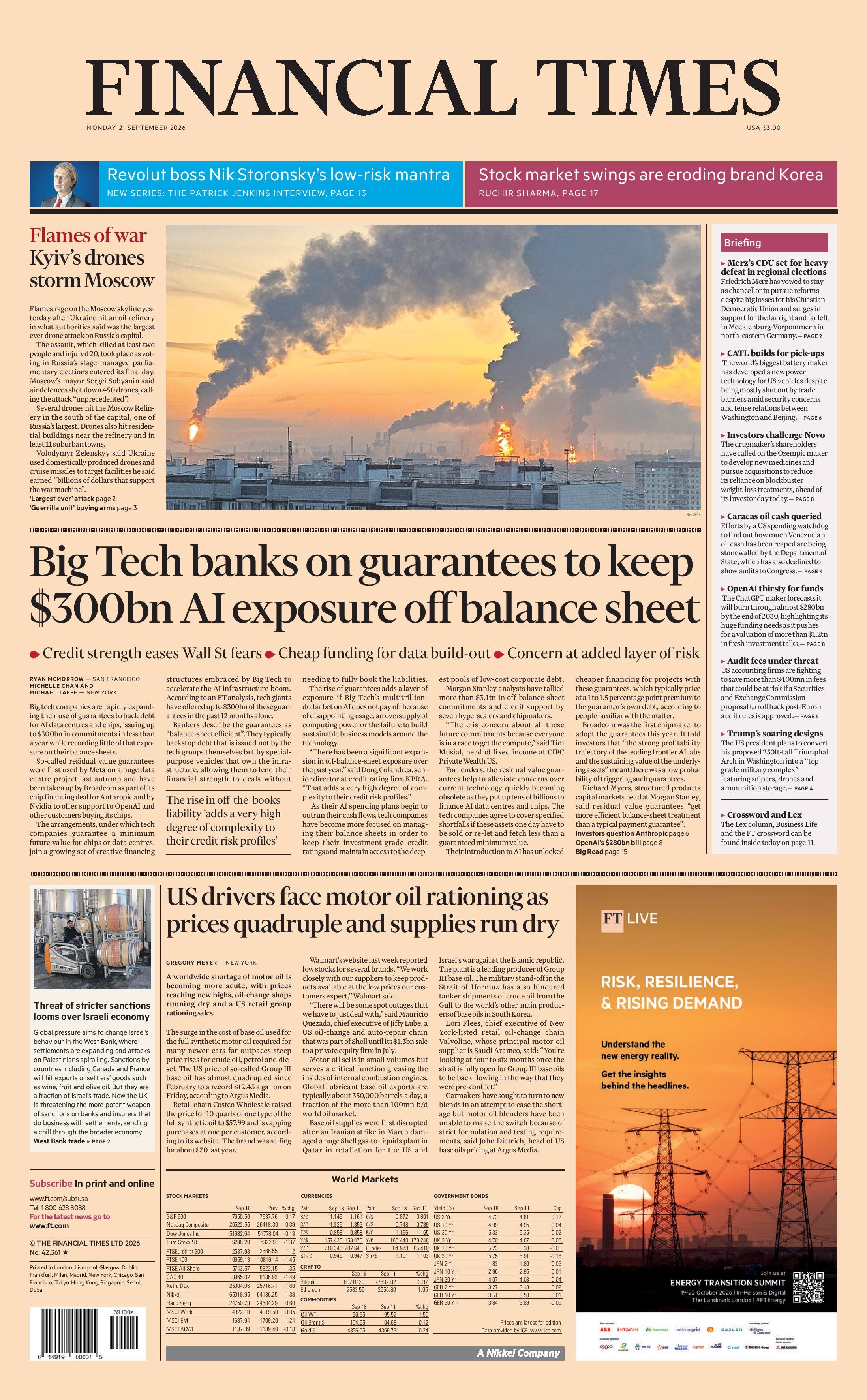
Russia’s first State Duma election since the full-scale invasion closed on Sunday, and the result was never in doubt. Initial Central Election Commission data put United Russia ahead with 57.5 percent, with a final tally not expected before 25 September; an earlier exit poll had the party nearer 49 percent. The number that matters is where the ballots were cast. New constituencies were carved out for the Moscow-controlled portions of Donetsk, Luhansk, Kherson and Zaporizhzhia, meaning occupied Ukraine has now been written into the architecture of the Russian parliament. Elections in Russia stopped being about choosing some time ago. This one was about fixing borders in administrative concrete. Authorities said turnout at the close of polls stood at 56.66 percent.
Ukraine appears to have read it the same way. Moscow Mayor Sergei Sobyanin said Russia downed more than 1,900 drones from Saturday, 450 of them aimed at the capital, and called the timing an attempt to wreck the vote that failed. Several reached an oil refinery; one struck an apartment building. Three people were killed, according to regional governor Andrei Vorobyov. Reuters journalists in Moscow reported blasts and smoke over the refinery. Kyiv has said nothing, as usual.
There is a symmetry here that neither capital will enjoy having pointed out. Sobyanin’s claim is that Ukrainian drones were an attempt to wreck a vote whose outcome was settled before the ballots were printed. Kyiv, for its part, has argued since 2022 that it cannot hold elections precisely because Russian missiles and drones make them impossible. Both governments are now invoking the other’s air campaign as an electoral argument: Moscow to dignify a result, Kyiv to defer one.
The difference is real and worth stating rather than winking at. Ukraine’s case rests on martial law, occupied territory, millions of voters displaced abroad and several hundred thousand under arms. These are constraints any OSCE election observer would recognise. Russia’s rests on the need for a respectable turnout figure. One is a genuine obstacle used as a reason; the other is a genuine attack used as an alibi. But the rhetorical machinery is identical, and Moscow knows it. Expect “they bomb our polling stations while refusing to open their own” to do heavy lifting in Russian messaging through the winter, and in Washington, where the demand that Kyiv hold a wartime vote has never entirely gone away.
The production war, and who is losing it
Strip away the election theatre and three separate stories this week describe a single problem.
First, Ukraine’s refinery campaign is working. The Moscow plant processed 11.6 million tonnes of crude in 2024. Cumulative strikes have taken out a meaningful share of Russian refining capacity, producing fuel shortages, price rises and queues across eleven time zones. This is attrition aimed at the household, not the front line.
Second, Russia is answering by industrialising. Leaked Rosatom documents obtained by POLITICO show an expansion of the Alabuga-Volokno plant in Tatarstan that would add 500 tonnes a year of military-grade carbon fibre by 2029, the material at the heart of the Geran airframe. Weapons analyst David Albright puts that at roughly 28,000 additional Shahed-136-type airframes annually, a 78 percent jump on a base Ukraine already estimates at more than 36,000. Moscow’s stated targets are 130,000 drones by 2030 and 350,000 by 2035. Satellite imagery from May to August shows the ground already cleared. The build-out is also import substitution, cutting dependence on Chinese precursor chemicals. Serhii Kuzan of the Ukrainian Security and Cooperation Centre frames Alabuga as a long-term challenge to the security of all of Europe, not a Ukrainian battlefield problem. Worth noting the documents came via a Kyiv-based centre and were authenticated in part by the Ukrainian government, alongside the US House Select Committee on China.
Third, the defensive side of the ledger does not scale. US Ambassador to NATO Matthew Whitaker told RFE/RL on 18 September that demand for Patriot interceptors is outrunning supply and that allies will have to dig deep to get Ukraine through winter. Zelensky has put the requirement at some 300 PAC-3 interceptors. US stocks have been drawn down defending forces and Gulf partners from Iranian ballistic missiles, and Patriots remain the only real answer to Russian ballistic and hypersonic systems.
Put the three together and the asymmetry is the whole story. Russia is mass-producing cheap, expendable offense on a five-to-ten-year industrial plan. The West is hand-building scarce, expensive defense with no comparable plan. Jet-powered Gerans are already crossing into Polish and Romanian airspace. That makes this NATO arithmetic, not Ukrainian arithmetic, and the honest conclusion is that nobody on the Western side has yet answered the factory with a factory.
Oil under pressure from both ends
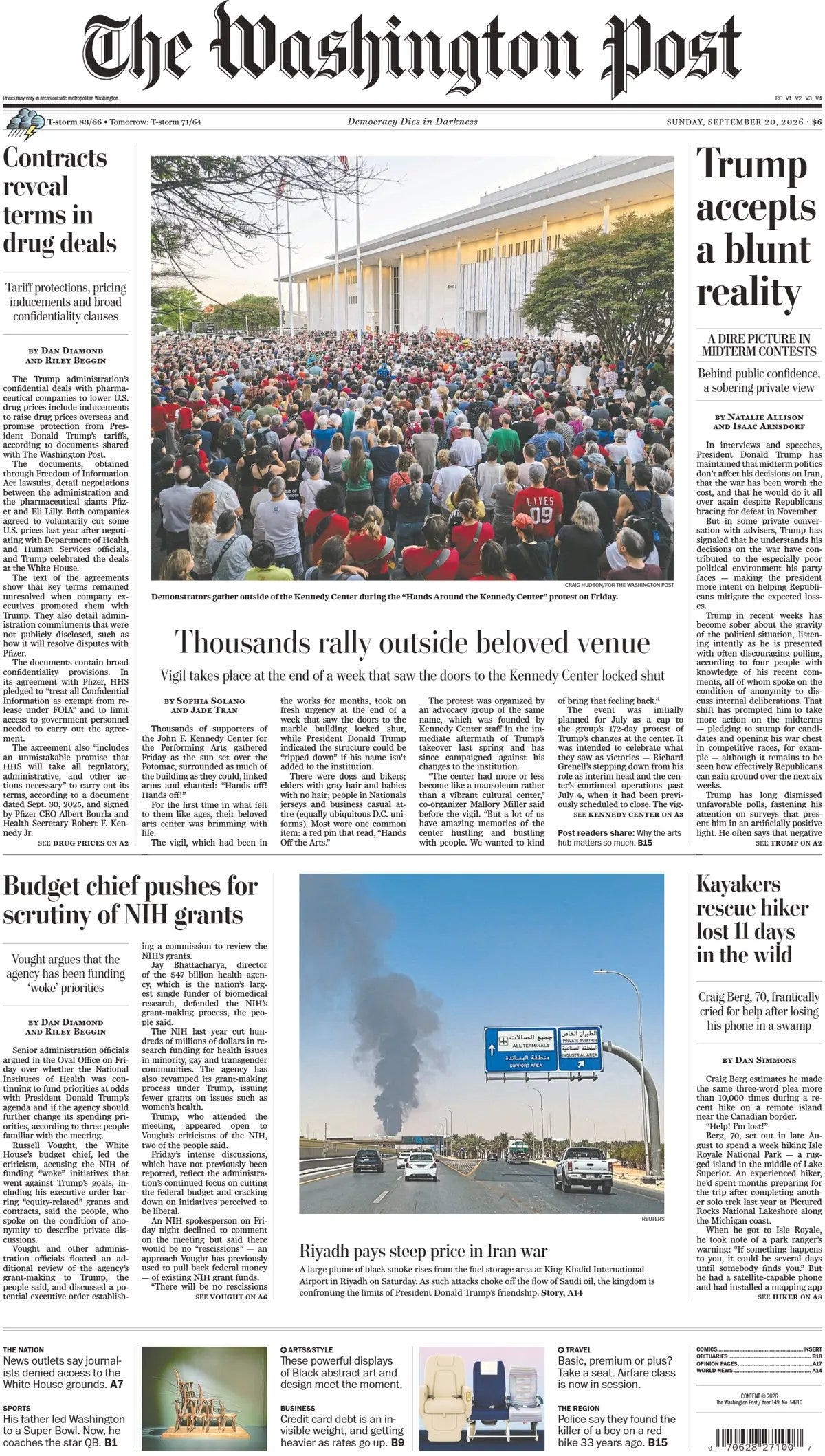
The same week, the other half of the global energy squeeze tightened. Saudi air defences intercepted a Houthi ballistic missile aimed at Riyadh, more than a billion barrels of oil moved through the Strait of Hormuz under a US military blockade, and Israeli strikes hit southern Lebanon despite the US-mediated arrangement. Russian refineries burning in the north, Hormuz and Bab el-Mandeb constricted in the south. Two unrelated wars are now pressing on the same barrel, and the pass-through lands at filling stations from Rostov to Riyadh to Florida.
And finally
Putin’s information machine had a bad Sunday of its own. As the Central Election Commission broadcast the closing hours of voting, an audio fault turned the commissioners’ voices into something unearthly. The adversary, as the mayor might say, failed to achieve this.
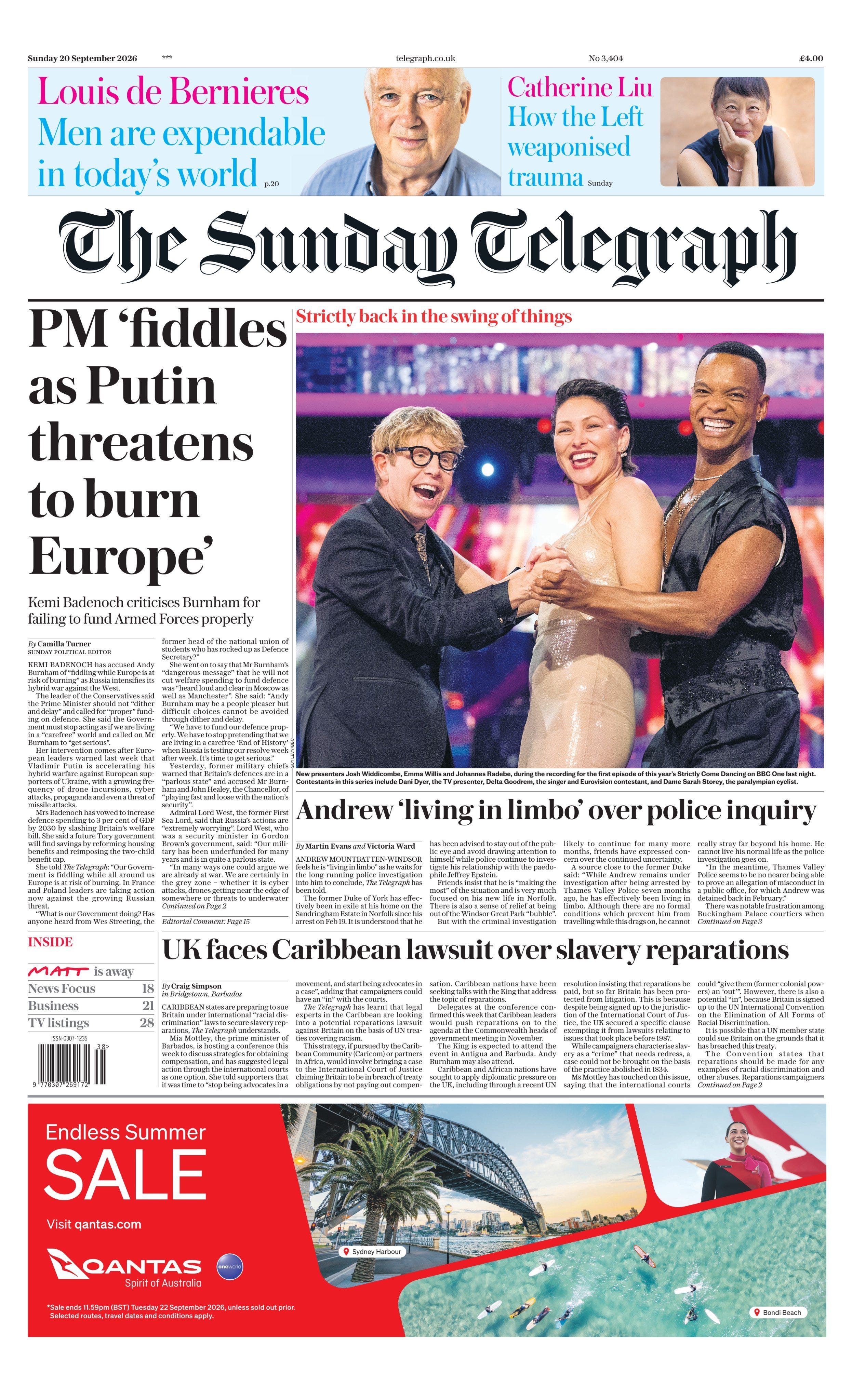
Exit polls showed Chancellor Friedrich Merz’s party suffering heavy losses in two German state elections on Sunday. Merz’s centre-right Christian Democratic Union is projected to fall to 5.5% in Mecklenburg-Western Pomerania, a largely rural state in Germany’s formerly communist east. That would be its worst result there since World War II. In Berlin, the CDU is projected to finish second with 20% of the vote, trailing the Left Party at 24.5%, according to an exit poll by the public broadcaster ARD. The Alternative for Germany (AfD) made significant gains in Sunday’s regional elections. The vote came two weeks after the AfD finished just short of an absolute majority in the small eastern state of Saxony-Anhalt, marking its best chance yet of forming the country’s first far-right regional government since the Second World War. Chancellor Friedrich Merz, 70, assumed leadership of Germany 16 months ago, pledging to revitalise an economy that has stalled for years. However, he has failed to lift a sullen national mood and has seen his personal popularity plunge. The AfD’s strong showing in Saxony-Anhalt has further damaged the chancellor’s standing nationally, sparking calls from within his own party over the past fortnight to replace him. Although no top-level allies have publicly demanded his resignation, many have warned against opening divisive internal personnel debates. Apparently anticipating a challenging post-election period, Merz abandoned a planned trip to New York next week to attend the UN General Assembly - Euronews
US Treasury Secretary Scott Bessent met with Chinese Vice Premier He Lifeng in New York on Sunday before this week’s high-stakes summit between US President Donald Trump and Chinese leader Xi Jinping. Bessent said he was looking forward to “focused, fulsome, and constructive talks” with He that would “set the stage” for Trump and Xi’s meeting on Thursday, which is expected to cover tariffs, rare earth minerals, and AI. With concerns over AI safety mounting, American tech leaders, including OpenAI’s Sam Altman, are expected to attend Xi’s White House dinner. One analyst wrote the meetings will likely produce limited deals, as “neither [side] has much ambition for path-breaking arrangements and compromises” amid “great power competition tempered by interdependence.” - Semafor
Behind the Curtains at the UNGA
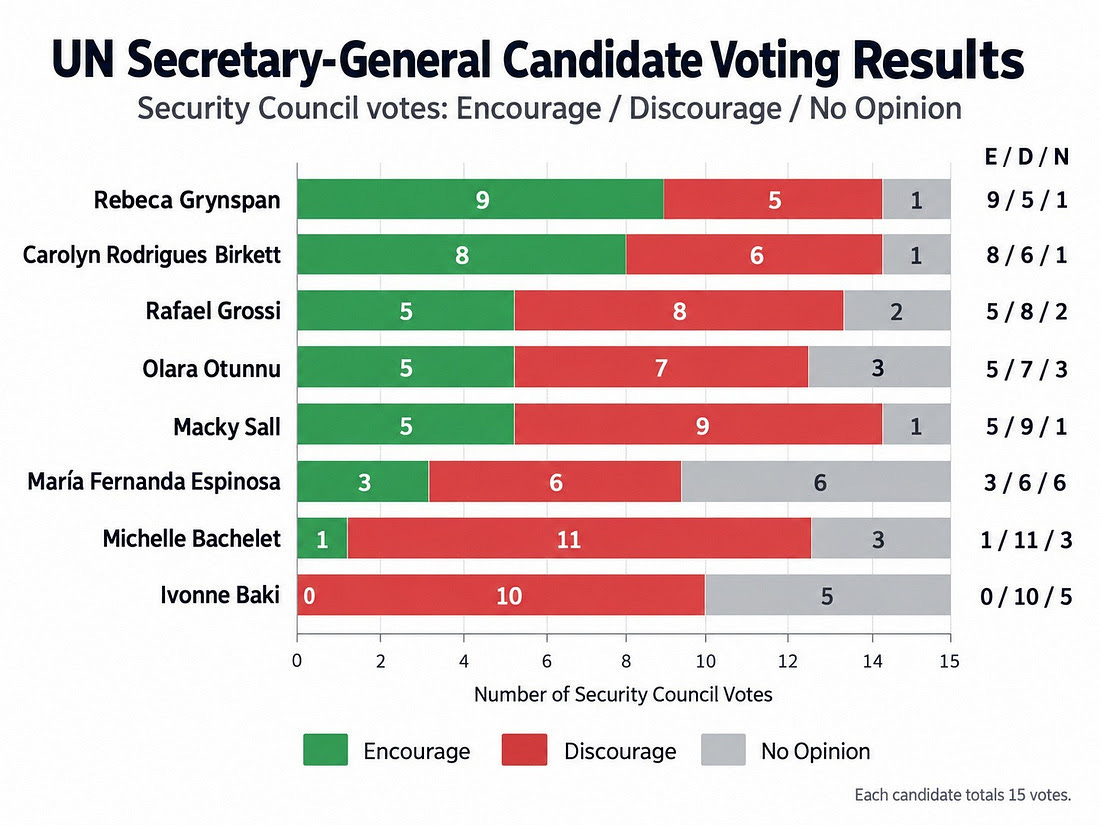
The Security Council held its third straw poll in three months to test the viability of eight candidates for United Nations Secretary-General, with two front-runners emerging. Rebeca Grynspan, a Costa Rican economist, former vice president of Costa Rica and head of the United Nations Conference on Trade and Development, is leading the race. But she is followed very closely by Carolyn Rodrigues Birkett, Guyana’s Ambassador to the United Nations. Mark Leon Goldberg reported on Substack that these two have pulled away from a crowded field. Today’s straw poll asked each of the 15 members of the Security Council to indicate whether they “encourage,” “discourage,” or have “no opinion” on each candidate. In today’s poll, Grynspan received nine “encourage” votes, five “discourage” votes and one “no opinion.” Rodrigues Birkett received eight “encourage” votes, six “discourage” votes and one “no opinion.” In a distant third was Rafael Grossi, head of the International Atomic Energy Agency, with five “encourage” votes, eight “discourage” votes and two “no opinion” votes.
New York City Mayor Zohran Mamdani and President Donald Trump will be crossing the political aisle tomorrow ... and meeting up for their third in-person meeting. The meeting is set to go down in Zohran’s residence, Gracie Mansion, ahead of the U.N. General Assembly ... this according to CNN. Apparently president and mayor's sit-down will "focus on issues affecting New York City and New Yorkers" ... Zohran's spokesperson said. Zohran and Donald made headlines when they seemingly got along pretty well during their first Oval Office meeting in November of last year ... before Trump resumed calling him a "lunatic." While they’ve only met in person two times, with the second meeting being in February of this year ... the last time they were in the same building in the Big Apple, not everything went to plan. Zohran and the prez both attended Game 3 of the NBA Finals back in June ... the only match from the championship series that the Knicks lost. Ahead of the game, the NYC mayor made it clear that they wouldn’t be chatting. Zohran told us at the time ... “If the president went to a game, that’s his decision to make. If I go to the game, I’ll be doing so separately.” The Knicks’ game wasn’t the last event they sparred over ... Mamdani threatened Israeli Prime Minister Benjamin Netanyahu -- saying that Netanyahu also “belongs in The Hague” in an interview with The New York Times. DJT promptly struck him down ... assuring Bibi that he would not be arrested when he stepped foot in the U.S. for the U.N. General Assembly - TMZ
The journals…